NZS 2772.1-1999A1 Maximum exposure levels - 3 kHz
NZS 2772.1-1999A1 Maximum exposure levels - 3 kHz to 300 GHz
NZS 2772.1-1999A1 Maximum exposure levels - 3 kHz to 300 GHz
标准信息
STANDARD INFORMATION- 标准编号
- NZS 2772.1-1999A1 Maximum exposure levels - 3 kHz
- 所属分类
- NZS 新西兰标准
- 文件语言
- 英语
- 文件格式
- 文件页数
- 6 页
- 文件大小
- 117.54 KB
· 更新:
标准简介
OVERVIEW中文简介
标准 NZS 2772.1-1999A1 Maximum exposure levels - 3 kHz to 300 GHz 的预览内容
English summary
Preview of standard NZS 2772.1-1999A1 Maximum exposure levels - 3 kHz to 300 GHz
以上为根据文件整理的内容简介。
标准内容预览
DOCUMENT PREVIEWPREFACE
This Standard was prepared by the Joint Standards Australia/Standards New Zealand Committee TE/7, Human Exposure to Electromagnetic Fields, to supersede AS/NZS 2772.1 (Int):1998.
The finalised text was subsequently balloted by committee members but did not meet the high threshold (80 % of votes cast from each country being positive) necessary for adoption as a joint Standard. Subsequently a number of further changes were discussed, and agreed to, by New Zealand members of the TE/7 Committee. The modified text was balloted by New Zealand members and exceeded the 80 % threshold. A further ballot of Australian members, using the New Zealand text, failed and the document has been published as a New Zealand only (rather than a joint Australian/New Zealand) Standard.
This Standard is based on the ICNIRP Guidelines, April 1998. The objective of this Standard is to specify basic restrictions and reference levels for human exposure to radiofrequency fields in the frequency range 3 kHz to 300 GHz.
The terms "informative" and "normative" have been used in this Standard to define the application of the Appendix to which they apply. An informative Appendix is for information and guidance only whereas a normative Appendix is an integral part of the Standard. Due to the nature of the material contained in this Standard, the Foreword should be considered and read as part of the Standard.
The Standard is consistent with currently accepted world best practice.
Statements expressed in mandatory terms in notes to tables and figures are deemed to be requirements of this Standard.
Permission from the International Commission on Non-Ionizing Radiation Protection and Health Physics for the use and reproduction in this Standard of material from the 1998 ICNIRP Guidelines, is gratefully acknowledged.
6
NZS 2772:Part 1:1999
Pr Gratis
RADIOFREQUENCY FIELDS
Part 1:
Maximum exposure levels – 3 kHz to 300 GHz
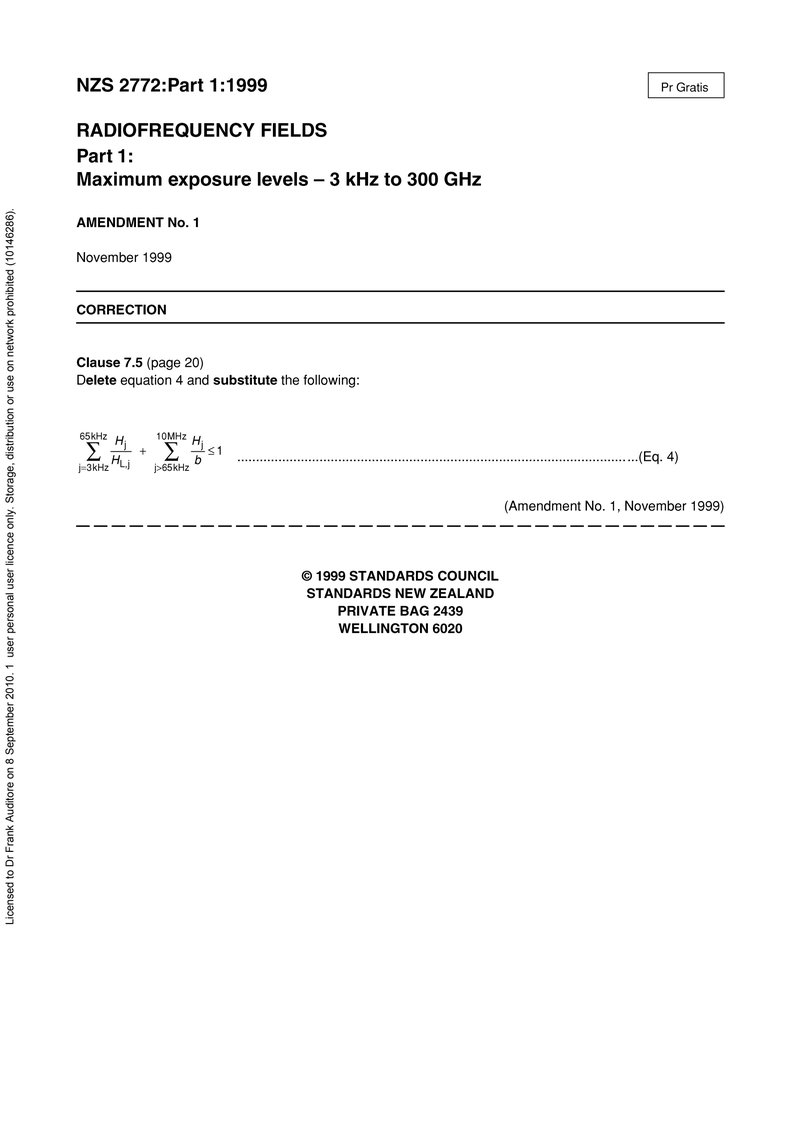
AMENDMENT No. 1
November 1999
CORRECTION
Clause 7.5 (page 20)
Delete equation 4 and substitute the following:
∑j=3kHz65kHz Hj / HL,j + ∑j=65kHz10MHz Hj / b ≤ 1
...(Eq. 4)
(Amendment No. 1, November 1999)
© 1999 STANDARDS COUNCIL
STANDARDS NEW ZEALAND
PRIVATE BAG 2439
WELLINGTON 6020
2
NZS 2772:Part 1:1999
COMMITTEE REPRESENTATION
This Standard was prepared by the Joint Australian/New Zealand Committee TE/7, Human Exposure to Electromagnetic Fields. It was subsequently published as a New Zealand Standard (see Preface).
New Zealand representation on the committee was as follows:
Adopt Radiation Control (NZ)
Broadcast Communications NZ
Local Government, New Zealand
Ministry of Commerce NZ
National Radiation Laboratory New Zealand
New Zealand Association of Radio Transmitters
New Zealand Institute of Occupational & Environmental Medicine
Telecom New Zealand
© COPYRIGHT
The copyright of this document is the property of the Standards Council. No part of it may be reproduced by photocopying or by any other means without the prior written permission of the Chief Executive of Standards New Zealand unless the copying is carried out by or on behalf of a Territorial Authority in the process of preparing its local bylaw, or the circumstances are covered by Part III of the Copyright Act 1994.
Standards New Zealand will vigorously defend the copyright in this Standard. Every person who breaches Standards New Zealand's copyright may be liable to a fine not exceeding $50,000 or to imprisonment for a term not to exceed three months. If there has been a flagrant breach of copyright, Standards New Zealand may also seek additional damages from the infringing party, in addition to obtaining injunctive relief and an account of profits.
Published by Standards New Zealand, the trading arm of the Standards Council, Private Bag 2439, Wellington 6020.
Telephone: (04) 498 5990, Fax: (04) 498 5994.
Website: www.standards.co.nz
| No | Date of issue | Description | Entered by, and date |
|---|---|---|---|
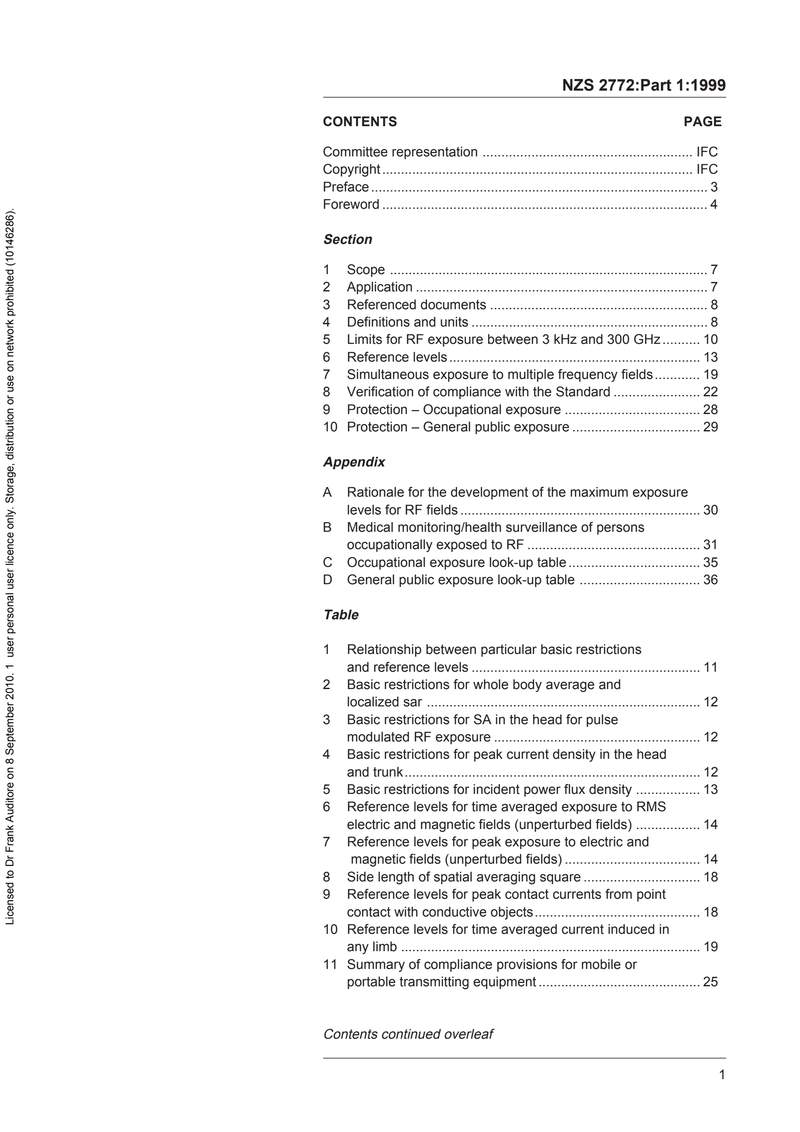
CONTENTS
| CONTENTS | PAGE |
|---|---|
| Committee representation | IFC |
| Copyright | IFC |
| Preface | 3 |
| Foreword | 4 |
| Section | |
| 1 Scope | 7 |
| 2 Application | 7 |
| 3 Referenced documents | 8 |
| 4 Definitions and units | 8 |
| 5 Limits for RF exposure between 3 kHz and 300 GHz | 10 |
| 6 Reference levels | 13 |
| 7 Simultaneous exposure to multiple frequency fields | 19 |
| 8 Verification of compliance with the Standard | 22 |
| 9 Protection – Occupational exposure | 28 |
| 10 Protection – General public exposure | 29 |
| Appendix | |
| A Rationale for the development of the maximum exposure levels for RF fields | 30 |
| B Medical monitoring/health surveillance of persons occupationally exposed to RF | 31 |
| C Occupational exposure look-up table | 35 |
| D General public exposure look-up table | 36 |
| Table | |
| 1 Relationship between particular basic restrictions and reference levels | 11 |
| 2 Basic restrictions for whole body average and localized sar | 12 |
| 3 Basic restrictions for SA in the head for pulse modulated RF exposure | 12 |
| 4 Basic restrictions for peak current density in the head and trunk | 12 |
| 5 Basic restrictions for incident power flux density | 13 |
| 6 Reference levels for time averaged exposure to RMS electric and magnetic fields (unperturbed fields) | 14 |
| 7 Reference levels for peak exposure to electric and magnetic fields (unperturbed fields) | 14 |
| 8 Side length of spatial averaging square | 18 |
| 9 Reference levels for peak contact currents from point contact with conductive objects | 18 |
| 10 Reference levels for time averaged current induced in any limb | 19 |
| 11 Summary of compliance provisions for mobile or portable transmitting equipment | 25 |
Contents continued overleaf
4
| 12 | Maximum output power levels | 27 |
| C1 | Look-up table of reference levels for occupational exposure to electric and magnetic fields as specified in tables 6 and 7 | 35 |
| D1 | Look-up table of reference levels for general public exposure to electric and magnetic fields as specified in tables 6 and 7 | 36 |
Figure
| 1 | Reference levels for peak and time average exposure to electric fields | 16 |
| 2 | Reference levels for peak and time averaged exposure to magnetic fields | 16 |
| B1 | Eye examination record proforma | 33 |
5
PREFACE
This Standard was prepared by the Joint Standards Australia/Standards New Zealand Committee TE/7, Human Exposure to Electromagnetic Fields, to supersede AS/NZS 2772.1 (Int):1998.
The finalised text was subsequently balloted by committee members but did not meet the high threshold (80 % of votes cast from each country being positive) necessary for adoption as a joint Standard. Subsequently a number of further changes were discussed, and agreed to, by New Zealand members of the TE/7 Committee. The modified text was balloted by New Zealand members and exceeded the 80 % threshold. A further ballot of Australian members, using the New Zealand text, failed and the document has been published as a New Zealand only (rather than a joint Australian/New Zealand) Standard.
This Standard is based on the ICNIRP Guidelines, April 1998. The objective of this Standard is to specify basic restrictions and reference levels for human exposure to radiofrequency fields in the frequency range 3 kHz to 300 GHz.
The terms "informative" and "normative" have been used in this Standard to define the application of the Appendix to which they apply. An informative Appendix is for information and guidance only whereas a normative Appendix is an integral part of the Standard. Due to the nature of the material contained in this Standard, the Foreword should be considered and read as part of the Standard.
The Standard is consistent with currently accepted world best practice.
Statements expressed in mandatory terms in notes to tables and figures are deemed to be requirements of this Standard.
Permission from the International Commission on Non-Ionizing Radiation Protection and Health Physics for the use and reproduction in this Standard of material from the 1998 ICNIRP Guidelines, is gratefully acknowledged.
6
预览内容由文件识别整理,表格、公式及文字请以原始文件为准。
原文图片预览
PAGE IMAGES
下载标准文件
NZS 2772.1-1999A1 Maximum exposure levels - 3 kHz
英语 · PDF · 6 页 · 117.54 KB