标准信息
STANDARD INFORMATION- 标准编号
- DIN 272
- 所属分类
- DIN 德国标准
- 发布机构
- DIN
- 版本年份
- 1981
- 文件语言
- 英语
- 文件格式
- 文件页数
- 6 页
- 文件大小
- 3.31 MB
中文名称为参考译名,文件语言以原文为准。
· 更新:
标准简介
OVERVIEW中文简介
该标准规定了氯氧镁自流平砂浆干密度、表面硬度、稠度、长度变化及配合比的测试方法。它适用于评估符合DIN 18560系列标准的氯氧镁自流平材料的质量特性,包括取样、试件制备及化学分析程序。
English summary
This standard specifies methods for testing the dry density, surface hardness, consistency, change in length, and mix ratio of magnesium oxychloride screeds. It applies to the evaluation of quality characteristics of magnesium oxychloride screed materials in accordance with the DIN 18560 series, covering sampling, specimen preparation, and chemical analysis procedures.
以上为根据文件整理的内容简介。
相关标签
标准内容预览
DOCUMENT PREVIEWTesting of magnesium oxychloride screeds
Prüfung von Magnesiaestrich
This standard, together with DIN 18560 Part 1, August 1981 edition, DIN 18560 Part 3, January 1985 edition and DIN 18560 Part 4, April 1985 edition, supersedes the March 1978 edition.
In keeping with current practice in standards published by the International Organization for Standardization (ISO), a comma has been used throughout as the decimal marker.
Dimensions in mm
For general tolerances, accuracy grade g as specified in DIN 7168 shall apply.
1 Scope and field of application
This standard specifies methods of testing the dry density and surface hardness of magnesium oxychloride screeds and of determining their consistency, change in length and mix ratio.
Note. See DIN 18555 Part 1 and Part 3 for compliance with the general requirements specified for magnesium oxychloride screeds in DIN 18560 Part 1.
2 Testing of dry density
2.1 General
To establish the density class as specified in DIN 18560 Part 1, the dry density, qtr, shall be determined.
2.2 Specimens
For each of the suitability, quality and hardening tests, 3 specimens, each measuring 40 mm × 40 mm × 160 mm, shall be prepared from the screed compound and stored for 28 days in DIN 50014 – 20/65-2 standard atmosphere. For confirmation testing, 3 test pieces, each of an area of not less than 100 cm², shall be taken from the full depth of a screed which is at least 28 days old, and from each of them a specimen having a readily calculable volume shall be extracted in the dry state.
2.3 Procedure
The specimens shall be dried to constant mass at a temperature of 105 °C. Constant mass shall be deemed to be reached when the mass determined by two weighings made at an interval of 24 h has not changed by more than 0.1 %. The dimensions of the specimens shall then be measured to the nearest 0.1 mm using a vernier caliper, and the volumes, V, calculated. In addition, the masses, m, shall be determined by weighing to the nearest 0.1 g. The dry density shall be calculated using the following formula:
qtr = m / V (1)
and the individual values, together with the arithmetic mean, obtained for the 3 specimens reported to the nearest 0.01 kg/dm³.
3 Testing of surface hardness
3.1 Specimens
3 specimens conforming to subclause 2.2 shall be used, each of which shall be tested at 3 points. Confirmation testing may also be carried out on the screed in situ, without the extraction of test pieces, using a portable surface hardness testing apparatus [1].
3.2 Procedure
3.2.1 Testing carried out on specimens
A polished steel ball of 10 mm diameter, d, shall be placed on the upper surface, which has been rendered smooth during its preparation, of the specimen, with an initial force, Fv, of (10 ± 0.1) N (preload) applied, and the initial reading taken. Following this initial force, the main force, F, of 500 N shall be applied for a period of 3 minutes, followed by unloading down to the preload level. The penetration depth, t, of the steel ball shall be measured after 1 minute to the nearest 0.01 mm. The surface hardness, H, shall be calculated, in N/mm², using the following formula:
H = F / (d · π · t) (2)
and reported to the nearest 0.1 N/mm² as the arithmetic mean of 3 measurements on each specimen, and also as the arithmetic mean for all 3 specimens.
3.2.2 Testing the screed in situ
Testing shall be carried out at 10 points on the screed, using a portable surface hardness testing apparatus [1]. The surface hardness shall be reported to the nearest 0.1 N/mm² as the arithmetic mean of the 10 individual values.
The test procedure shall conform to the conditions described in subclause 3.2.1. The ambient temperature and relative humidity shall be determined and recorded in the test report.
Continued on pages 2 to 8
1
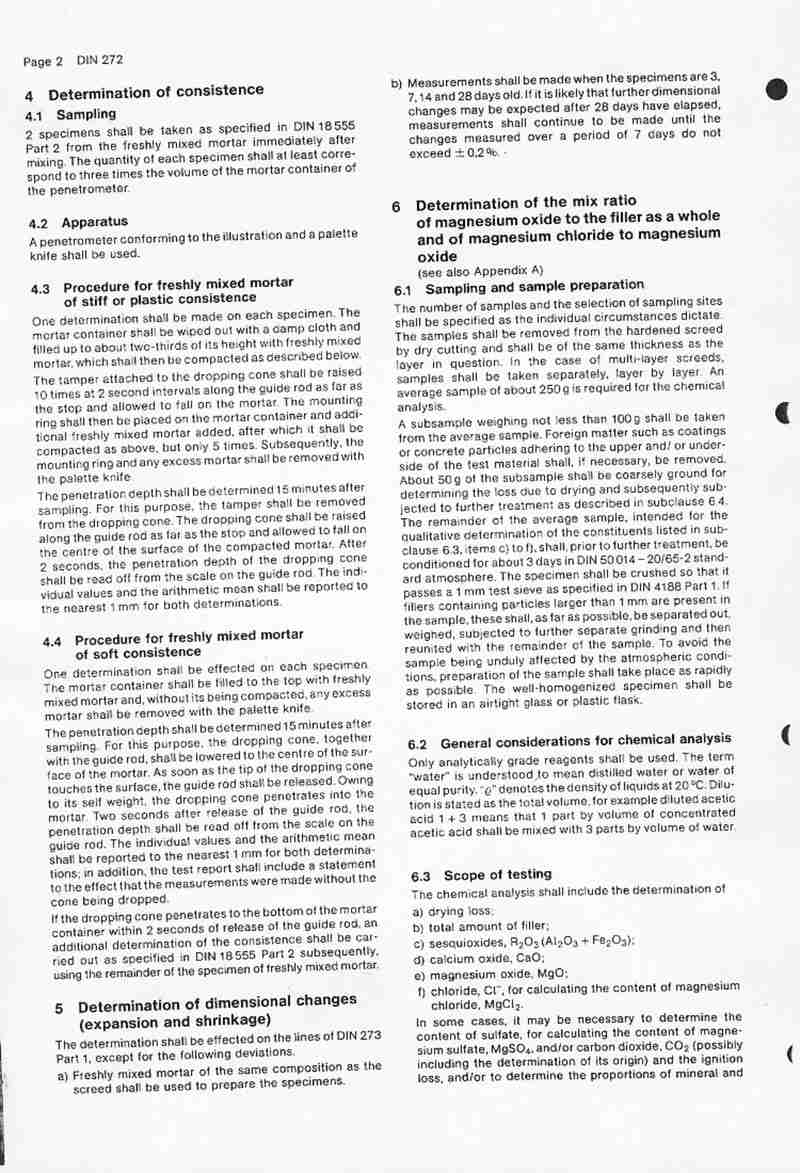
4 Determination of consistency
4.1 Sampling
2 specimens shall be taken as specified in DIN 18 555 Part 2 from the freshly mixed mortar immediately after mixing. The quantity of each specimen shall at least correspond to three times the volume of the mortar container of the penetrometer.
4.2 Apparatus
A penetrometer conforming to the illustration and a palette knife shall be used.
4.3 Procedure for freshly mixed mortar of stiff or plastic consistency
One determination shall be made on each specimen. The mortar container shall be wiped out with a damp cloth and filled up to about two-thirds of its height with freshly mixed mortar, which shall then be compacted as described below. The tamper attached to the dropping cone shall be raised 10 times at 2 second intervals along the guide rod as far as the stop and allowed to fall on the mortar. The mounting ring shall then be placed on the mortar container and additional freshly mixed mortar added, after which it shall be compacted as above, but only 5 times. Subsequently, the mounting ring and any excess mortar shall be removed with the palette knife.
The penetration depth shall be determined 15 minutes after sampling. For this purpose, the tamper shall be removed from the dropping cone. The dropping cone shall be raised along the guide rod as far as the stop and allowed to fall on the centre of the surface of the compacted mortar. After 2 seconds, the penetration depth of the dropping cone shall be read off from the scale on the guide rod. The individual values and the arithmetic mean shall be reported to the nearest 1 mm for both determinations.
4.4 Procedure for freshly mixed mortar of soft consistency
One determination shall be effected on each specimen. The mortar container shall be filled to the top with freshly mixed mortar and, without its being compacted, any excess mortar shall be removed with the palette knife.
The penetration depth shall be determined 15 minutes after sampling. For this purpose, the dropping cone, together with the guide rod, shall be lowered to the centre of the surface of the mortar. As soon as the tip of the dropping cone touches the surface, the guide rod shall be released. Owing to its self weight, the dropping cone penetrates into the mortar. Two seconds after release of the guide rod, the penetration depth shall be read off from the scale on the guide rod. The individual values and the arithmetic mean shall be reported to the nearest 1 mm for both determinations; in addition, the test report shall include a statement to the effect that the measurements were made without the cone being dropped.
If the dropping cone penetrates to the bottom of the mortar container within 2 seconds of release of the guide rod, an additional determination of the consistency shall be carried out as specified in DIN 18 555 Part 2 subsequently, using the remainder of the specimen of freshly mixed mortar.
5 Determination of dimensional changes (expansion and shrinkage)
The determination shall be effected on the lines of DIN 273 Part 1, except for the following deviations.
a) Freshly mixed mortar of the same composition as the screed shall be used to prepare the specimens.
b) Measurements shall be made when the specimens are 3, 7, 14 and 28 days old. If it is likely that further dimensional changes may be expected after 28 days have elapsed, measurements shall continue to be made until the changes measured over a period of 7 days do not exceed ± 0.2%.
6 Determination of the mix ratio of magnesium oxide to the filler as a whole and of magnesium chloride to magnesium oxide
(see also Appendix A)
6.1 Sampling and sample preparation
The number of samples and the selection of sampling sites shall be specified as the individual circumstances dictate. The samples shall be removed from the hardened screed by dry cutting and shall be of the same thickness as the layer in question. In the case of multi-layer screeds, samples shall be taken separately, layer by layer. An average sample of about 250 g is required for the chemical analysis.
A subsample weighing not less than 100 g shall be taken from the average sample. Foreign matter such as coatings or concrete particles adhering to the upper and/or underside of the test material shall, if necessary, be removed. About 50 g of the subsample shall be coarsely ground for determining the loss due to drying and subsequently subjected to further treatment as described in subclause 6.4. The remainder of the average sample, intended for the qualitative determination of the constituents listed in subclause 6.3, items c) to f), shall, prior to further treatment, be conditioned for about 3 days in DIN 50 014 – 20/65-2 standard atmosphere. The specimen shall be crushed so that it passes a 1 mm test sieve as specified in DIN 4188 Part 1. If fillers containing particles larger than 1 mm are present in the sample, these shall, as far as possible, be separated out, weighed, subjected to further separate grinding and then reunited with the remainder of the sample. To avoid the sample being unduly affected by the atmospheric conditions, preparation of the sample shall take place as rapidly as possible. The well-homogenized specimen shall be stored in an airtight glass or plastic flask.
6.2 General considerations for chemical analysis
Only analytically grade reagents shall be used. The term "water" is understood to mean distilled water or water of equal purity. "d" denotes the density of liquids at 20 °C. Dilution is stated as the total volume, for example diluted acetic acid 1 + 3 means that 1 part by volume of concentrated acetic acid shall be mixed with 3 parts by volume of water.
6.3 Scope of testing
The chemical analysis shall include the determination of
a) drying loss;
b) total amount of filler;
c) sesquioxides, R2O3 (Al2O3 + Fe2O3);
d) calcium oxide, CaO;
e) magnesium oxide, MgO;
f) chloride, Cl−, for calculating the content of magnesium chloride, MgCl2.
In some cases, it may be necessary to determine the content of sulfate, for calculating the content of magnesium sulfate, MgSO4, and/or carbon dioxide, CO2 (possibly including the determination of its origin) and the ignition loss, and/or to determine the proportions of mineral and
2
DIN 272
organic substances in the filler material as a whole. Determination of the carbon dioxide content is, however, useful only if it can be ensured that it does not originate in the filler. The determination can, for example, be effected gravimetrically on the lines of DIN 1164 Part 3, volumetrically on the lines of DIN 1060 Part 2 or by some other suitable method. A breakdown of the mineral and organic fractions of the filler is, however, permitted only if it can be shown, for example by microscopic examination of the residue, that the mineral fillers are of such a nature that they do not suffer any loss of mass as a result of heating.
6.4 Drying loss
6.4.1 Apparatus
Balance with a limit of error, G, of 0,0001 g.
Electric hot cabinet, adjustable to (105 ± 2) °C.
Weighing glass with ground lid.
6.4.2 Procedure and evaluation
About 20 g of the specimen, which has been coarsely ground as described in subclause 6.1, shall be weighed to the nearest 0,0001 g in the previously dried weighing glass. The glass shall be kept closed during weighing. It shall then be dried in the hot cabinet to constant mass at a temperature of (105 ± 2) °C. Constant mass shall be deemed to be reached when the mass has not decreased by more than 0,2 %, in terms of the initial mass, after drying for 24 hours following the previous weighing. The drying loss shall be calculated as the proportion by mass, w(TV), in %, using the following formula:
w(TV) = (mE − mA) · 100 / mE (3)
where
mE is the initial specimen mass, in g;
mA is the final specimen mass, in g.
6.5 Total filler
6.5.1 Apparatus
Porcelain crucible.
Electric laboratory furnace, adjustable to (1000 ± 25) °C.
6.5.2 Reagents
Ammonium nitrate, NH4NO3.
Ammonium nitrate solution: 100 g of ammonium nitrate shall be dissolved in water to make up 1000 ml.
Acetic acid, CH3COOH, concentrated (ρ = 1,06 g/cm3).
Acetic acid, diluted 1 + 3.
Methyl red: 4'-dimethylamino-azobenzene-2-carboxylic acid, sodium salt.
Methyl red indicator solution: 0,2 g of methyl red shall be dissolved in water to make up 100 ml.
Silver nitrate, AgNO3.
Nitric acid, HNO3, concentrated (ρ = 1,40 to 1,42 g/cm3).
Silver nitrate solution: 0,5 g of silver nitrate shall be dissolved in 100 ml of water and a few drops of nitric acid added.
6.5.3 Procedure and evaluation
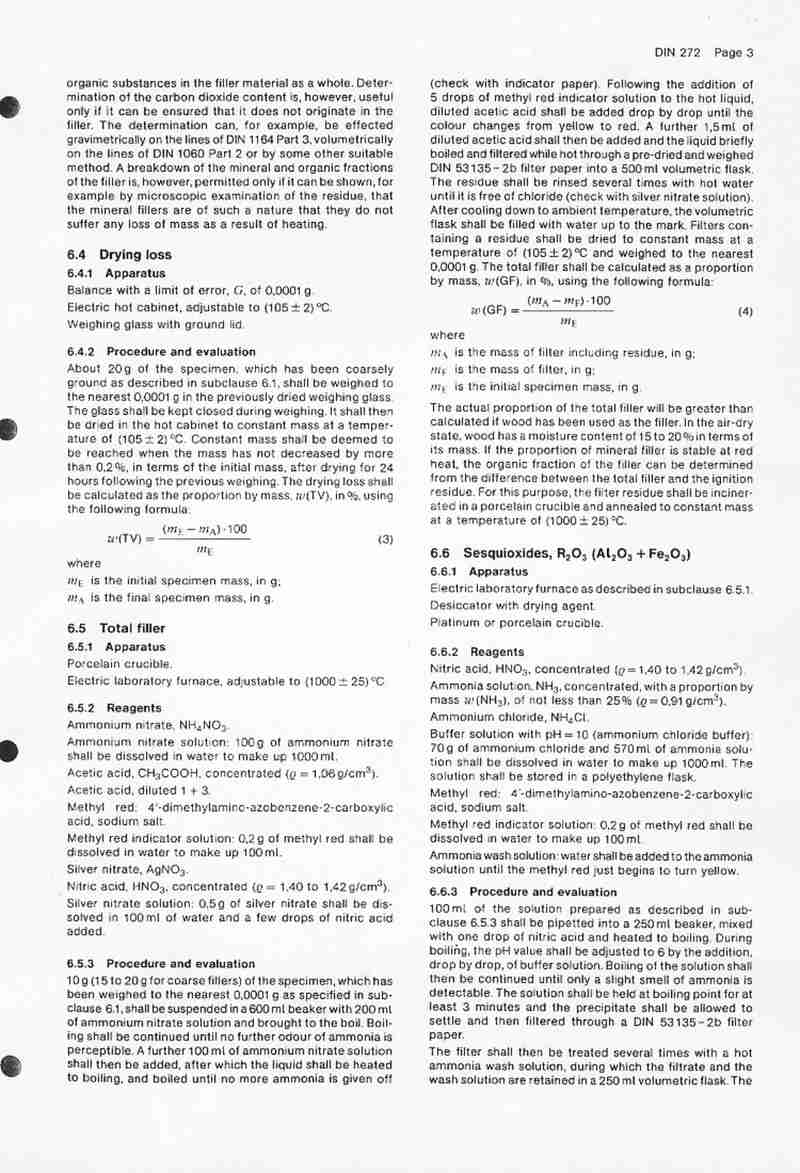
10 g (15 to 20 g for coarse fillers) of the specimen, which has been weighed to the nearest 0,0001 g as specified in subclause 6.1, shall be suspended in a 600 ml beaker with 200 ml of ammonium nitrate solution and brought to the boil. Boiling shall be continued until no further odour of ammonia is perceptible. A further 100 ml of ammonium nitrate solution shall then be added, after which the liquid shall be heated to boiling, and boiled until no more ammonia is given off (check with indicator paper). Following the addition of 5 drops of methyl red indicator solution to the hot liquid, diluted acetic acid shall be added drop by drop until the colour changes from yellow to red. A further 1,5 ml of diluted acetic acid shall then be added and the liquid briefly boiled and filtered while hot through a pre-dried and weighed DIN 53135-2b filter paper into a 500 ml volumetric flask. The residue shall be rinsed several times with hot water until it is free of chloride (check with silver nitrate solution). After cooling down to ambient temperature, the volumetric flask shall be filled with water up to the mark. Filters containing a residue shall be dried to constant mass at a temperature of (105 ± 2) °C and weighed to the nearest 0,0001 g. The total filler shall be calculated as a proportion by mass, w(GF), in %, using the following formula:
w(GF) = (mA − mF) · 100 / mE (4)
where
mA is the mass of filter including residue, in g;
mF is the mass of filter, in g;
mE is the initial specimen mass, in g.
The actual proportion of the total filler will be greater than calculated if wood has been used as the filler. In the air-dry state, wood has a moisture content of 15 to 20 % in terms of its mass. If the proportion of mineral filler is stable at red heat, the organic fraction of the filler can be determined from the difference between the total filler and the ignition residue. For this purpose, the filter residue shall be incinerated in a porcelain crucible and annealed to constant mass at a temperature of (1000 ± 25) °C.
6.6 Sesquioxides, R2O3 (Al2O3 + Fe2O3)
6.6.1 Apparatus
Electric laboratory furnace as described in subclause 6.5.1.
Desiccator with drying agent.
Platinum or porcelain crucible.
6.6.2 Reagents
Nitric acid, HNO3, concentrated (ρ = 1,40 to 1,42 g/cm3).
Ammonia solution, NH3, concentrated, with a proportion by mass w(NH3), of not less than 25 % (ρ = 0,91 g/cm3).
Ammonium chloride, NH4Cl.
Buffer solution with pH = 10 (ammonium chloride buffer): 70 g of ammonium chloride and 570 ml of ammonia solution shall be dissolved in water to make up 1000 ml. The solution shall be stored in a polyethylene flask.
Methyl red: 4'-dimethylamino-azobenzene-2-carboxylic acid, sodium salt.
Methyl red indicator solution: 0,2 g of methyl red shall be dissolved in water to make up 100 ml.
Ammonia wash solution: water shall be added to the ammonia solution until the methyl red just begins to turn yellow.
6.6.3 Procedure and evaluation
100 ml of the solution prepared as described in subclause 6.5.3 shall be pipetted into a 250 ml beaker, mixed with one drop of nitric acid and heated to boiling. During boiling, the pH value shall be adjusted to 6 by the addition, drop by drop, of buffer solution. Boiling of the solution shall then be continued until only a slight smell of ammonia is detectable. The solution shall be held at boiling point for at least 3 minutes and the precipitate shall be allowed to settle and then filtered through a DIN 53135-2b filter paper.
The filter shall then be treated several times with a hot ammonia wash solution, during which the filtrate and the wash solution are retained in a 250 ml volumetric flask. The
3
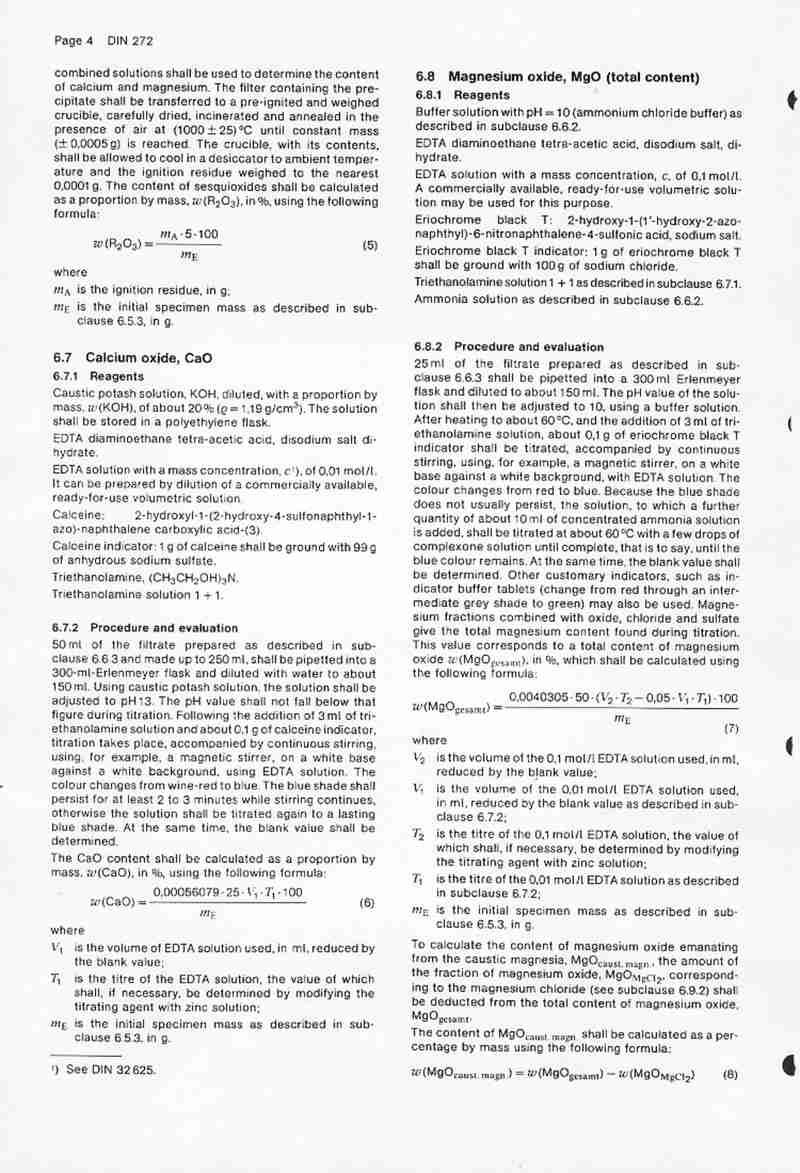
combined solutions shall be used to determine the content of calcium and magnesium. The filter containing the precipitate shall be transferred to a pre-ignited and weighed crucible, carefully dried, incinerated and annealed in the presence of air at (1000 ± 25) °C until constant mass (± 0,0005 g) is reached. The crucible, with its contents, shall be allowed to cool in a desiccator to ambient temperature and the ignition residue weighed to the nearest 0,0001 g. The content of sesquioxides shall be calculated as a proportion by mass, w(R2O3), in %, using the following formula:
w(R2O3) = mA · 5 · 100 / mE (5)
where
mA is the ignition residue, in g;
mE is the initial specimen mass as described in subclause 6.5.3, in g.
6.7 Calcium oxide, CaO
6.7.1 Reagents
Caustic potash solution, KOH, diluted, with a proportion by mass, w(KOH), of about 20 % (ρ = 1,19 g/cm3). The solution shall be stored in a polyethylene flask.
EDTA diaminoethane tetra-acetic acid, disodium salt dihydrate.
EDTA solution with a mass concentration, c1), of 0,01 mol/l. It can be prepared by dilution of a commercially available, ready-for-use volumetric solution.
Calceine: 2-hydroxy-1-(2-hydroxy-4-sulfonaphthyl-1-azo)-naphthalene carboxylic acid-(3).
Calceine indicator: 1 g of calceine shall be ground with 99 g of anhydrous sodium sulfate.
Triethanolamine, (CH3CH2OH)3N.
Triethanolamine solution 1 + 1.
6.7.2 Procedure and evaluation
50 ml of the filtrate prepared as described in subclause 6.6.3 and made up to 250 ml, shall be pipetted into a 300-ml-Erlenmeyer flask and diluted with water to about 150 ml. Using caustic potash solution, the solution shall be adjusted to pH 13. The pH value shall not fall below that figure during titration. Following the addition of 3 ml of triethanolamine solution and about 0,1 g of calceine indicator, titration takes place, accompanied by continuous stirring, using, for example, a magnetic stirrer, on a white base against a white background, using EDTA solution. The colour changes from wine-red to blue. The blue shade shall persist for at least 2 to 3 minutes while stirring continues, otherwise the solution shall be titrated again to a lasting blue shade. At the same time, the blank value shall be determined.
The CaO content shall be calculated as a proportion by mass, w(CaO), in %, using the following formula:
w(CaO) = 0,00056079 · 25 · V1 · T1 · 100 / mE (6)
where
V1 is the volume of EDTA solution used, in ml, reduced by the blank value;
T1 is the titre of the EDTA solution, the value of which shall, if necessary, be determined by modifying the titrating agent with zinc solution;
mE is the initial specimen mass as described in subclause 6.5.3, in g.
1) See DIN 32 625.
6.8 Magnesium oxide, MgO (total content)
6.8.1 Reagents
Buffer solution with pH = 10 (ammonium chloride buffer) as described in subclause 6.6.2.
EDTA diaminoethane tetra-acetic acid, disodium salt, dihydrate.
EDTA solution with a mass concentration, c, of 0,1 mol/l. A commercially available, ready-for-use volumetric solution may be used for this purpose.
Eriochrome black T: 2-hydroxy-1-(1'-hydroxy-2-azonaphthyl)-6-nitronaphthalene-4-sulfonic acid, sodium salt.
Eriochrome black T indicator: 1 g of eriochrome black T shall be ground with 100 g of sodium chloride.
Triethanolamine solution 1 + 1 as described in subclause 6.7.1.
Ammonia solution as described in subclause 6.6.2.
6.8.2 Procedure and evaluation
25 ml of the filtrate prepared as described in subclause 6.6.3 shall be pipetted into a 300 ml Erlenmeyer flask and diluted to about 150 ml. The pH value of the solution shall then be adjusted to 10, using a buffer solution. After heating to about 60 °C, and the addition of 3 ml of triethanolamine solution, about 0,1 g of eriochrome black T indicator shall be titrated, accompanied by continuous stirring, using, for example, a magnetic stirrer, on a white base against a white background, with EDTA solution. The colour changes from red to blue. Because the blue shade does not usually persist, the solution, to which a further quantity of about 10 ml of concentrated ammonia solution is added, shall be titrated at about 60 °C with a few drops of complexone solution until complete, that is to say, until the blue colour remains. At the same time, the blank value shall be determined. Other customary indicators, such as indicator buffer tablets (change from red through an intermediate grey shade to green) may also be used. Magnesium fractions combined with oxide, chloride and sulfate give the total magnesium content found during titration. This value corresponds to a total content of magnesium oxide w(MgOgesamt), in %, which shall be calculated using the following formula:
w(MgOgesamt) = 0,0040305 · 50 · (V2 · T2 − 0,05 · V1 · T1) · 100 / mE (7)
where
V2 is the volume of the 0,1 mol/l EDTA solution used, in ml, reduced by the blank value;
V1 is the volume of the 0,01 mol/l EDTA solution used, in ml, reduced by the blank value as described in subclause 6.7.2;
T2 is the titre of the 0,1 mol/l EDTA solution, the value of which shall, if necessary, be determined by modifying the titrating agent with zinc solution;
T1 is the titre of the 0,01 mol/l EDTA solution as described in subclause 6.7.2;
mE is the initial specimen mass as described in subclause 6.5.3, in g.
To calculate the content of magnesium oxide emanating from the caustic magnesia, MgOcaust. magn., the amount of the fraction of magnesium oxide, MgOMgCl2, corresponding to the magnesium chloride (see subclause 6.9.2) shall be deducted from the total content of magnesium oxide, MgOgesamt.
The content of MgOcaust. magn. shall be calculated as a percentage by mass using the following formula:
w(MgOcaust. magn.) = w(MgOgesamt) − w(MgOMgCl2) (8)
4
DIN 272
If the proportion of sulfate is determined for the purpose of calculating the magnesium sulfate and the corresponding proportion of magnesium oxide, MgOMgSO4, then the latter shall also be deducted from the total content of magnesium oxide, MgOgesamt, in equation (8):
w(MgOcaust. magn.) = w(MgOgesamt) − [w(MgOMgCl2) + w(MgOMgSO4)] (9)
6.9 Chloride (Cl−) for calculating the content of magnesium chloride, MgCl2
6.9.1 Reagents
Nitric acid, HNO3, concentrated (ρ = 1,40 to 1,42 g/cm3).
Nitric acid, diluted 1 + 20.
Silver nitrate, AgNO3.
Silver nitrate solution with a mass concentration, c, of 0,1 mol/l. A commercially available ready-for-use volumetric solution may be used for this purpose.
Ammonium iron (III)-sulfate, NH4Fe(SO4)2·12H2O.
Ammonium iron (III)-sulfate indicator solution: to prepare the aqueous lime-saturated solution, 85 g of ammonium iron (III)-sulfate · 12H2O shall be dissolved in 100 ml of water.
Ammonium thiocyanate, NH4SCN.
Ammonium thiocyanate solution with a mass concentration, c, of 0,1 mol/l. A commercially available, ready-for-use volumetric solution may be used for this purpose. If required, the value of the titre of the solution can be determined by adjusting with silver nitrate solution.
6.9.2 Procedure and evaluation
25 ml of the filtrate prepared as described in subclause 6.5.3 shall be pipetted into a 300-ml-Erlenmeyer flask, slightly deacidulated with nitric acid and diluted with water to about 100 ml. Thereafter, 25 ml in normal cases, and correspondingly more, where appropriate, of silver nitrate solution shall be added, using a pipette. The contents of the flask shall then be gently stirred until the precipitate coagulates and the excess solution appears to be clear. The precipitate shall now be filtered through a DIN 52 135 – 2d filter paper and washed several times with dilute nitric acid (1 + 20), as a result of which the washing liquid is united with the filtrate. Following the addition of 5 ml of aqueous lime-saturated ammonium iron-(III)-sulfate indicator solution, the solution consisting of the filtrate and the washing liquid shall be titrated with ammonium thiocyanate solution, until the pale yellow solution undergoes a change of colour to reddish brown.
The volume of ammonium thiocyanate solution used shall be deducted from the volume of silver nitrate solution added. The calculated residual volume of silver nitrate solution, V, in ml, corresponds to the proportion of chloride combined with the magnesium and the alkalis, w(chloridegesamt). From this, the proportion by mass of magnesium chloride, w(MgCl2), shall be calculated, in %, using the following formula:
w(MgCl2) = (0,0047606 · 20 · V · T · 100) / mE (10)
where
V is the residual volume of silver nitrate solution, in ml;
T is the titre of the silver nitrate solution, the value of which shall, if necessary, be determined by modification with a solution of sodium chloride;
mE is the initial specimen mass as described in subclause 6.5.3, in g.
The proportion by mass of magnesium oxide corresponding to the content of magnesium chloride, w(MgOMgCl2), in %, shall be calculated using the following formula:
w(MgOMgCl2) = 0,4233 · w(mgCl2) (11)
This value shall be substituted into equation (8).
6.10 Sulfate (SO4) for calculating the content of magnesium sulfate, MgSO4
6.10.1 Apparatus
Platinum crucible.
Electric oven, adjustable to (800 ± 25) °C.
Desiccator with drying agent.
6.10.2 Reagents
Hydrochloric acid, HCl, concentrated (ρ = 1,18 to 1,19 g/cm3).
Hydrochloric acid, HCl, diluted 1 + 11.
Barium chloride-2-hydrate, BaCl2·2H2O.
Barium chloride solution: 120 g of barium chloride shall be dissolved in water to make up 1000 ml.
Silver nitrate solution as described in subclause 6.5.2.
6.10.3 Procedure and evaluation
100 ml of the filtrate prepared as described in subclause 6.5.3 shall be pipetted into a 600 ml beaker and, after dilution to about 400 ml, the pH value adjusted with dilute hydrochloric acid to 2,0 to 2,5. A hot solution of barium chloride shall be added drop by drop to the boiling solution, accompanied by continuous stirring. To enable the precipitate to form properly, boiling shall be continued for a further 15 minutes. After standing overnight, the precipitate shall be filtered through a DIN 53 135 – 2d filter paper and washed with boiling water until it is free of chloride (check with silver nitrate solution). The filter and its contents shall be transferred into a previously annealed and weighed platinum crucible and carefully incinerated in a full flow of air. Annealing shall then take place at (800 ± 25) °C until constant mass has been reached (± 0,0005 g). The crucible and its contents shall then be allowed to cool in the desiccator to ambient temperature, after which the ignition residue shall be weighed to the nearest 0,0001 g. From the sulfate content found, the proportion by mass of magnesium sulfate, w(MgSO4), in %, shall be calculated using the following formula:
w(MgSO4) = (0,5157 · 5 · mA · 100) / mE (12)
where
mA is the final mass of barium sulfate, in g;
mE is the initial specimen mass as described in subclause 6.5.3, in g.
The proportion by mass of magnesium oxide corresponding to the content of magnesium sulfate, w(MgOMgSO4), in %, shall be calculated using the following formula:
w(MgOMgSO4) = 0,3349 · w(MgSO4) (13)
This value shall also be deducted from the total content of magnesium oxide, MgO, in equation (8).
5
6.11 Evaluation of results
The results of the analyses described in subclauses 6.4 to 6.10 shall be expressed as percentages by mass, to the nearest 0,1 %.
The mix ratio of anhydrous magnesium chloride to magnesium oxide contained in the caustic magnesia, expressed as percentages by mass, shall be calculated from the ratio of the magnesium chloride content determined in accordance with equation (10) to the magnesium oxide content obtained from equation (8). The mix ratio of magnesium oxide to the total filler, in percentages by mass, shall be calculated from the ratio of the content of magnesium oxide determined in accordance with equation (8) to the total filler obtained from equation (4). However, the calculated mix ratio of magnesium chloride to magnesium oxide and of magnesium oxide to the total filler is valid only if it is certain that the filler contains neither magnesium oxide nor magnesium sulfate.
Figure. Penetrometer
6
预览内容由文件识别整理,表格、公式及文字请以原始文件为准。
原文图片预览
PAGE IMAGES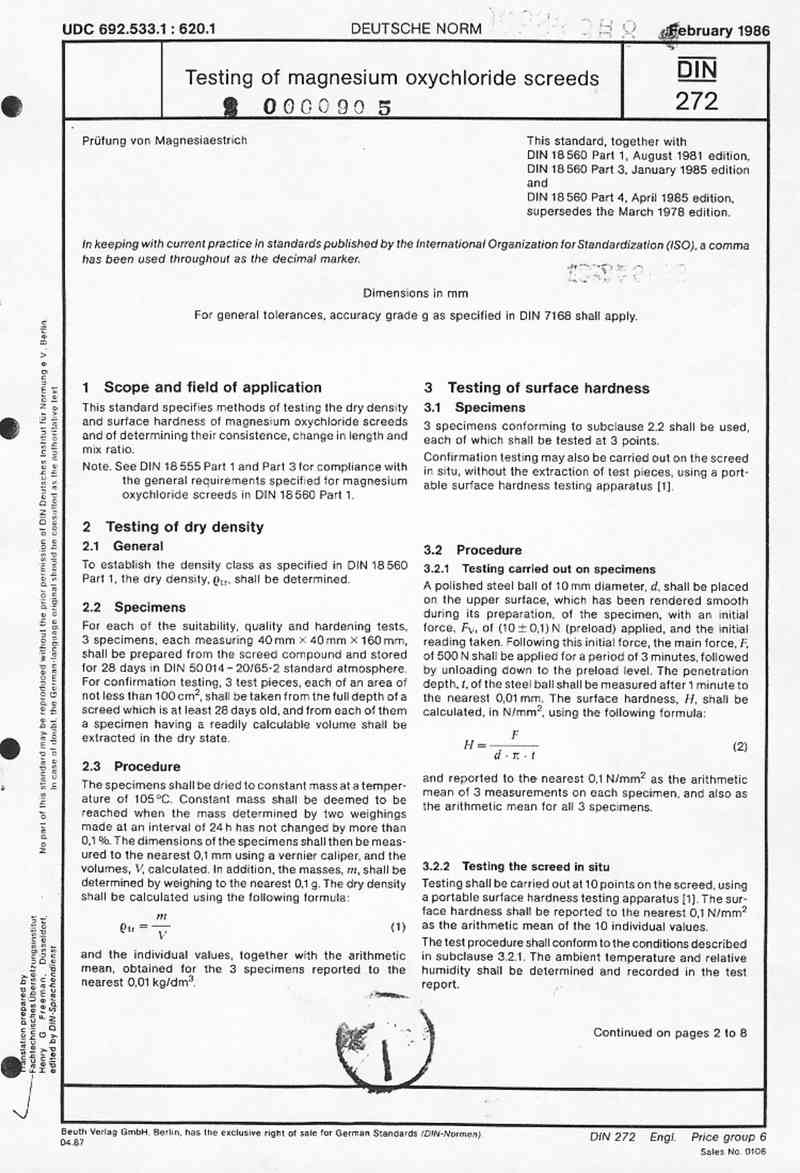
下载标准文件
DIN 272
英语 · PDF · 6 页 · 3.31 MB