DIN EN 196-1
水泥试验方法 第1部分:强度测定
DIN EN 196-1
Methods of testing cement Part 1: Determination of strength
标准信息
STANDARD INFORMATION- 标准编号
- DIN EN 196-1
- 所属分类
- DIN 德国标准
- 发布机构
- CEN
- 版本年份
- 1994
- 文件语言
- 英语
- 文件格式
- 文件页数
- 6 页
- 文件大小
- 797.59 KB
中文名称为参考译名,文件语言以原文为准。
· 更新:
标准简介
OVERVIEW中文简介
该标准规定了测定水泥砂浆抗压强度和抗折强度的参考方法。它详细描述了实验室环境要求、设备规格、砂浆制备流程、试件养护及测试程序,适用于ENV 197-1中定义的水泥类型。
English summary
This standard specifies the reference method for determining the compressive and flexural strengths of cement mortar. It details laboratory conditions, equipment requirements, mortar preparation, specimen conditioning, and testing procedures, applicable to cement types defined in ENV 197-1.
以上为根据文件整理的内容简介。
相关标签
标准内容预览
DOCUMENT PREVIEW4 Laboratory and equipment
4.1 Laboratory
The laboratory where preparation of specimens takes place shall be maintained at a temperature of (20 ± 2) °C and a relative humidity of not less than 50 %.
The moist air room or the large cabinet for storage of the specimens in the mould shall be continuously maintained at a temperature of (20 ± 1) °C and a relative humidity of not less than 90 %.
The temperature of the water in the storage containers shall be maintained at (20 ± 1) °C.
The temperature and relative humidity of the air in the laboratory and the temperature of the storage containers shall be recorded at least once a day during working hours.
The temperature and relative humidity of the moist air room or cabinet shall be recorded at least every 4 h. Where temperature ranges are given, the target temperature at which the controls are set shall be the middle value of the range.
4.2 General requirements for the equipment
The tolerances shown on the drawings (figures 1 to 3) are important for correct operation of the equipment in the testing procedure. When regular control measurements show that the tolerances are not met, the equipment shall be rejected or adjusted or repaired where possible. Records of control measurements shall be kept.
Acceptance measurements on new equipment shall cover mass, volume, and dimensions to the extent that these are indicated in this European Standard paying particular attention to those critical dimensions for which tolerances are specified.
In those cases where the material of the equipment can influence the results, the material is specified and shall be used.
4.3 Test sieves
Wire cloth test sieves conforming to the requirements of ISO 2591-1 and ISO 3310-1 shall be of the sizes from ISO 565 given in table 1 (series R 20).
| Square mesh size |
|---|
| mm |
| 2,00 |
| 1,60 |
| 1,00 |
| 0,50 |
| 0,16 |
| 0,08 |
4.4 Mixer
The mixer shall consist essentially of:
a) a stainless steel bowl with a capacity of about 5 l and of the general shape and size shown in figure 1, and provided with means by which it can be fixed securely to the mixer frame during mixing and by which the height of the bowl in relation to the blade and, to some extent, the gap between blade and bowl can be finely adjusted and fixed;
b) a stainless steel blade of the general shape, size and tolerances shown in figure 1, revolving about its own axis as it is driven in a planetary movement around the axis of the bowl by an electric motor at controlled speeds. The two directions of rotation shall be opposite and the ratio between the two speeds shall not be a whole number.
Where more than one mixer is used, blades and bowls shall form sets which are always used together.
The gap between blade and bowl shown in figure 1 shall be checked every month. The gap of (3 ± 1) mm refers to the situation when the blade in the empty bowl is brought as close as possible to the wall. Simple tolerance gauges ('feeler gauges') are useful where direct measurement is difficult.
The mixer shall operate at the speeds given in table 2.
| Rotation min-1 | Planetary movement min-1 | |
|---|---|---|
| Low speed | 140 ± 5 | 62 ± 5 |
| High speed | 285 ± 10 | 125 ± 10 |
4.5 Moulds
The mould shall consist of three horizontal compartments so that three prismatic specimens 40 mm x 40 mm in cross section and 160 mm in length can be prepared simultaneously.
A typical design is shown in figure 2.
The mould shall be made of steel with walls at least 10 mm thick. The surface Vickers hardness of each internal side face shall be at least HV 200 (see ISO 409-1 and ISO 6507-1).
NOTE 1. A minimum Vickers hardness value of HV 400 is recommended.
The mould shall be constructed in such a manner as to facilitate the removal of moulded specimens without damage. Each mould shall be provided with a machined steel or cast iron baseplate. The mould, when assembled, shall be positively and rigidly held together and fixed to the baseplate.
6
2 Scope
2
EUROPEAN STANDARD
NORME EUROPÉENNE
EUROPÄISCHE NORM
EN 10216-3
May 2002
ICS 23.040.10; 77.140.75
English version
Seamless steel tubes for pressure purposes –
Technical delivery conditions
Part 3: Alloy fine grain steel tubes
Tubes sans soudure en acier pour service sous pression – Conditions techniques de livraison – Partie 3: Tubes en acier allié à grain fin
Nahtlose Stahlrohre für Druckbeanspruchungen – Technische Lieferbedingungen – Teil 3: Rohre aus legierten Feinkornbaustählen
This European Standard was approved by CEN on 2002-04-25.
CEN members are bound to comply with the CEN/CENELEC Internal Regulations which stipulate the conditions for giving this European Standard the status of a national standard without any alteration.
Up-to-date lists and bibliographical references concerning such national standards may be obtained on application to the Management Centre or to any CEN member.
The European Standards exist in three official versions (English, French, German). A version in any other language made by translation under the responsibility of a CEN member into its own language and notified to the Management Centre has the same status as the official versions.
CEN members are the national standards bodies of Austria, Belgium, the Czech Republic, Denmark, Finland, France, Germany, Greece, Iceland, Ireland, Italy, Luxembourg, Malta, the Netherlands, Norway, Portugal, Spain, Sweden, Switzerland, and the United Kingdom.
CEN
European Committee for Standardization
Comité Européen de Normalisation
Europäisches Komitee für Normung
Management Centre: rue de Stassart 36, B-1050 Brussels
© 2002. CEN – All rights of exploitation in any form and by any means reserved worldwide for CEN national members.
Ref. No. EN 10216-3 : 2002 E
Contents
| Section | Page |
|---|---|
| Foreword | 3 |
| Introduction | 4 |
| 1 Scope | 4 |
| 2 Normative references | 5 |
| 3 Definitions | 5 |
| 3.1 DN | 5 |
| 3.2 PN | 5 |
| 4 Designations | 6 |
| 4.1 Range of PN designations | 6 |
| 4.2 Range of DN (nominal sizes) | 6 |
| 4.3 Gasket types | 6 |
| 4.4 Information to be supplied by the purchaser | 6 |
| 5 Gasket designs | 6 |
| 6 Gasket types | 7 |
| 7 Dimensions | 7 |
| 8 Marking | 10 |
| Annex A (informative) Information to be supplied by the purchaser | 10 |
| Annex B (informative) A-deviation | 11 |
:current
Foreword
This document (EN 10216-3:2002) has been prepared by Technical Committee EC/TC 29, "Steel tubes and fittings for steel tubes", the secretariat of which is held by UNI.
This European Standard shall be given the status of a national standard, either by publication of an identical text or by endorsement, at the latest by November 2002, and conflicting national standards shall be withdrawn at the latest by November 2002.
This document has been prepared under a mandate given to CEN by the European Commission and the European Free Trade Association, and supports essential requirements of EU Directive(s).
For relationship with EU Directive(s), see informative annex ZA, which is an integral part of this document.
Other Parts of EN 10216 are:
| Part 1: | Non-alloy steel tubes with specified room temperature properties |
| Part 2: | Non-alloy and alloy steel tubes with specified elevated temperature properties |
| Part 4: | Non-alloy and alloy steel tubes with specified low temperature properties |
| Part 5: | Stainless steel tubes |
Another European Standard series covering tubes for pressure purposes is:
| EN 10217: | Welded steel tubes for pressure purposes |
According to the CEN/CENELEC Internal Regulations, the national standards organizations of the following countries are bound to implement this European Standard: Austria, Belgium, Czech Republic, Denmark, Finland, France, Germany, Greece, Iceland, Ireland, Italy, Luxembourg, Malta, Netherlands, Norway, Portugal, Spain, Sweden, Switzerland and the United Kingdom.
5
1 Scope
This Part of EN 10216 specifies the technical delivery conditions in two test categories for seamless tubes of circular cross section, made of weldable alloyed fine grained steel.
2 Normative references
This European Standard incorporates by date or undated reference, provisions from other publications. These normative references are cited at the appropriate places in the text and the publications are listed hereafter. For date references, subsequent amendments to or revisions of, any of these publications apply to this European Standard only when incorporated in it by amendment or revision. For undated references the latest edition of the publication referred to applies (including amendments).
The requirements of this European Standard rule when they differ from those in the standards and documents referred to below:
EN 10002-1, Metallic materials - Tensile testing - Part 1: Method of test (at ambient temperature).
EN 10002-5, Metallic materials - Tensile testing - Part 5: Method of testing (at elevated temperature).
EN 10020, Definitions and classification of grades of steel.
EN 10021, General technical delivery requirements for steel and iron products.
EN 10045-1, Metallic materials - Charpy impact test - Part 1: Test method.
EN 10052, Vocabulary of heat treatment terms for ferrous products.
EN 10204, Metallic products - Types of inspection documents.
EN 10027-1, Designation systems for steels - Part 1: Steel names, principle symbols.
EN 10027-2, Designation systems for steels Part 2: Numerical systems.
ENV 10220, Seamless and welded steel tubes - Dimensions and masses per unit length
EN 10233, Metallic materials - Tubes - Flattening test.
EN 10234, Metallic materials - Tubes - Drift expanding test.
EN 10236, Metallic materials - Tubes - Ring expanding test.
EN 10237, Metallic materials - Tubes - Ring tensile test.
EN 10246-1, Non-Destructive Testing of steel tubes Part 1: Automatic electromagnetic testing of seamless and welded (except submerged arc welded) ferromagnetic steel tubes for verification of hydraulic leak-tightness.
EN 10246-5, Non-Destructive Testing of steel tubes - Part 5: Automatic full peripheral magnetic transducer/flux leakage testing of seamless and welded (except submerged arc-welded) ferromagnetic steel tubes for the detection of longitudinal imperfections.
EN 10246-6, Non-Destructive Testing of steel tubes - Part 6: Automatic full peripheral ultrasonic testing of seamless steel tubes for the detection of transverse imperfections.
EN 10246-7, Non-Destructive Testing of steel tubes - Part 7: Automatic full peripheral ultrasonic testing of seamless and welded (except submerged arc welded) steel tubes for the detection of longitudinal imperfections.
6
预览内容由文件识别整理,表格、公式及文字请以原始文件为准。
原文图片预览
PAGE IMAGES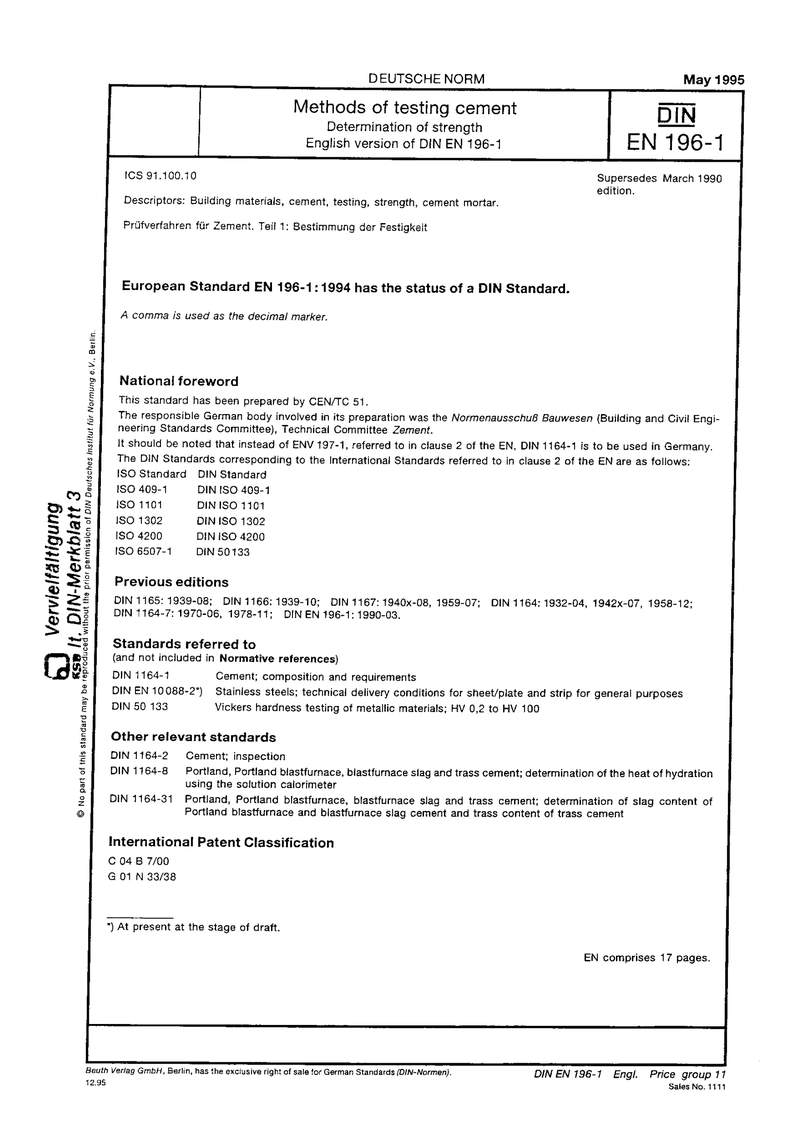


下载标准文件
DIN EN 196-1
英语 · PDF · 6 页 · 797.59 KB