DIN 267-24(1)
紧固件 技术交货条件 螺母的性能等级(硬度等级)
DIN 267-24(1)
Fasteners Technical delivery conditions Property classes for nuts (Hardness classes)
标准信息
STANDARD INFORMATION- 标准编号
- DIN 267-24(1)
- 所属分类
- DIN 德国标准
- 发布机构
- DIN
- 版本年份
- 1981
- 文件语言
- 英语
- 文件格式
- 文件页数
- 6 页
- 文件大小
- 15.64 MB
中文名称为参考译名,文件语言以原文为准。
· 更新:
标准简介
OVERVIEW中文简介
该标准规定了无需承受规定证明载荷的螺母的机械性能,特别是基于最小维氏硬度值的性能等级。它适用于普通螺母,但不适用于需承受规定证明载荷的螺母、自锁螺母或具有特殊要求(如耐腐蚀、耐高温)的螺母。
English summary
This standard specifies the mechanical properties of nuts that do not have to withstand specified proof loads, classifying them by minimum Vickers hardness values. It applies to general nuts but excludes those requiring specified proof loads, prevailing torque nuts, or nuts with special requirements such as corrosion resistance or extreme temperature resistance.
以上为根据文件整理的内容简介。
相关标签
标准内容预览
DOCUMENT PREVIEWFasteners
Technical delivery conditions
Property classes for nuts
(Hardness classes)
DIN 267
Part 24
Mechanische Verbindungselemente; technische Lieferbedingungen;
Festigkeitsklassen für Muttern (Härteklassen)
This Standard, together with DIN ISO 898 Part 2, March 1981 edition, and DIN 267 Part 21, June 1981 edition, supersedes DIN 267 Part 4, October 1971 edition, and DIN 267 Part 8, October 1971 edition withdrawn in 1981.
In keeping with current practice in standards published by the International Organization for Standardization (ISO), a comma has been used throughout as the decimal marker.
DIN 267 Part 4 was converted to the international property classes for nuts in 1967. The previous symbols 4D, 5D, 5S, 6G, 6S and 8G were replaced by code numbers 4, 5, 6, 8, 10, 12 and 14, where the code number indicated 1/100 of the minimum tensile strength of the bolt with which the nut could be mated and loaded up to the minimum tensile strength of the bolt, e. g. bolt 10.9 – nut 10. Appropriate proof load values were allocated to the nuts.
After relevant studies, experiments and calculations, this system of property classes was modified at the international level and laid down in International Standard ISO 898 Part 2 (see DIN ISO 898 Part 2) in an improved version and with greater certainty regarding tightening and the loadability of bolt/nut assemblies. Comprehensive explanatory notes are included in the National foreword and Appendix to DIN ISO 898 Part 2. This also explains that the previously usual hexagon nuts with the nominal 0,8 d nut height (e. g. nuts complying with DIN 934) cannot be fully loaded with sufficient assurance up to the yield point of the appropriate bolt or beyond this, without the nut being stripped. Higher proof load values have been allocated to the revised property classes in DIN ISO 898 Part 2, in order to ensure that fracture generally occurs in the case of overloading, in accordance with the usual principles of design.
It was originally intended to delete the previous specifications for property classes for nuts with coarse threads from DIN 267 Part 4, to replace these by a reference to DIN ISO 898 Part 2, and only to specify in DIN 267 Part 4 the property classes for nuts with fine threads which have not been specified at the international level. It was necessary to abandon this proposal, since not only higher proof load values are assigned to the ISO property classes, but these property classes also require larger nut heights in some cases (see DIN 970, for example). Therefore, in consideration of existing standards which cannot be superseded in the short term (e. g. DIN 934) and of numerous other documents and drawings, DIN 267 Part 4 was retained for an as yet unlimited period specifying the previous proof load values which are lower in comparison with DIN ISO 898 Part 2. However, because DIN ISO 898 Part 2 specifies the international code numbers, it has become necessary to add two vertical bars to the code numbers in DIN 267 Part 4, in order to differentiate products complying with the two standards, e. g. |8| instead of 8, so that there may be no confusion in the future.
By way of supplement to DIN ISO 898 Part 2, DIN 267 Part 23 lists the property classes (ISO classes) for nuts with fine thread, calculated on the basis of this standard. Furthermore, the property classes for nuts without defined proof load values (hardness classes) have been taken from DIN 267 Part 4 and have been specified in DIN 267 Part 24. Thus, at present, there are the following standards dealing with property classes for nuts:
DIN ISO 898 Part 2 Mechanical properties of fasteners; nuts with specified proof load values
DIN 267 Part 4 Fasteners; technical delivery conditions; property classes for nuts (previous classes)
DIN 267 Part 23 Fasteners; technical delivery conditions; property classes for nuts with fine thread (ISO classes)
DIN 267 Part 24 Fasteners; technical delivery conditions; property classes for nuts (hardness classes)
This division provides a clear separation between the previous DIN property classes and the new ISO classes. It permits a correspondingly similar separation in product standards and prevents incorrect allocation (see also the Explanatory notes).
Continued on pages 2 to 4
1
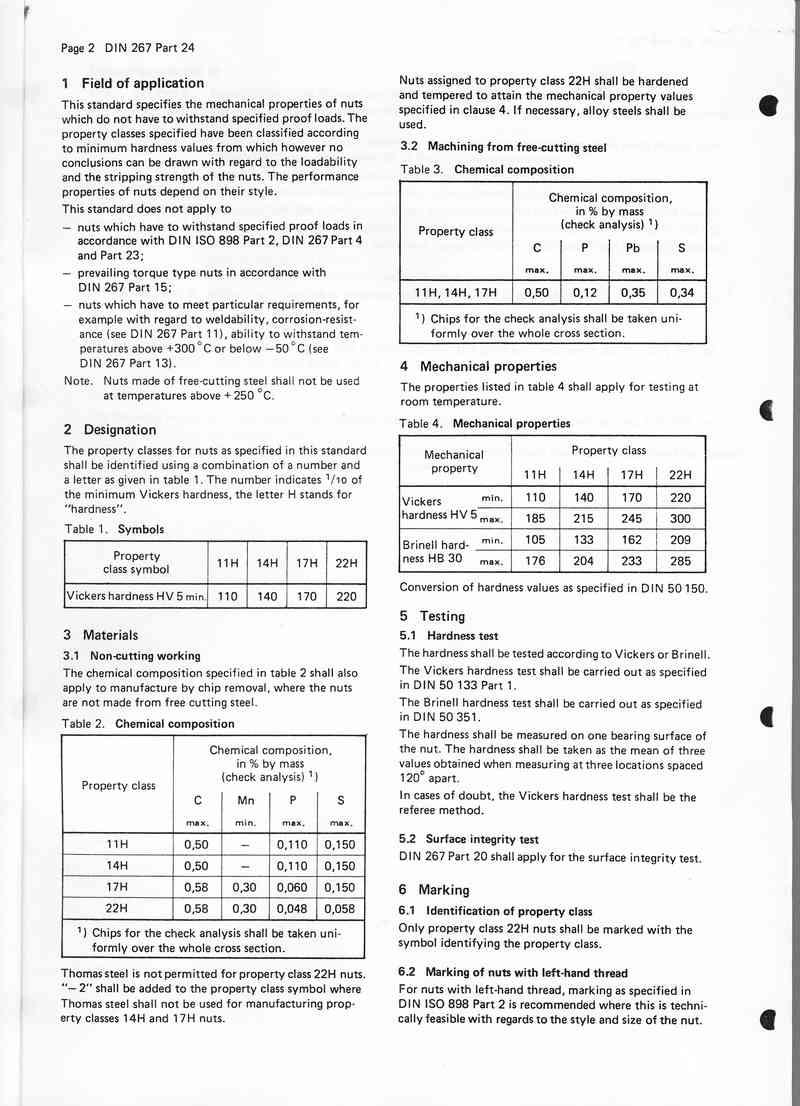
1 Field of application
This standard specifies the mechanical properties of nuts which do not have to withstand specified proof loads. The property classes specified have been classified according to minimum hardness values from which however no conclusions can be drawn with regard to the loadability and the stripping strength of the nuts. The performance properties of nuts depend on their style.
This standard does not apply to
- nuts which have to withstand specified proof loads in accordance with DIN ISO 898 Part 2, DIN 267 Part 4 and Part 23;
- prevailing torque type nuts in accordance with DIN 267 Part 15;
- nuts which have to meet particular requirements, for example with regard to weldability, corrosion-resistance (see DIN 267 Part 11), ability to withstand temperatures above +300 °C or below –50 °C (see DIN 267 Part 13).
Note. Nuts made of free-cutting steel shall not be used at temperatures above +250 °C.
2 Designation
The property classes for nuts as specified in this standard shall be identified using a combination of a number and a letter as given in table 1. The number indicates 1/10 of the minimum Vickers hardness, the letter H stands for “hardness”.
Table 1. Symbols
| Property class symbol | 11H | 14H | 17H | 22H |
|---|---|---|---|---|
| Vickers hardness HV 5 min. | 110 | 140 | 170 | 220 |
3 Materials
3.1 Non-cutting working
The chemical composition specified in table 2 shall also apply to manufacture by chip removal, where the nuts are not made from free cutting steel.
Table 2. Chemical composition
| Property class | Chemical composition, in % by mass (check analysis) 1) | |||
|---|---|---|---|---|
| C max. | Mn min. | P max. | S max. | |
| 11H | 0,50 | — | 0,110 | 0,150 |
| 14H | 0,50 | — | 0,110 | 0,150 |
| 17H | 0,58 | 0,30 | 0,060 | 0,150 |
| 22H | 0,58 | 0,30 | 0,048 | 0,058 |
1) Chips for the check analysis shall be taken uniformly over the whole cross section.
Thomas steel is not permitted for property class 22H nuts. “–2” shall be added to the property class symbol where Thomas steel shall not be used for manufacturing property classes 14H and 17H nuts.
Nuts assigned to property class 22H shall be hardened and tempered to attain the mechanical property values specified in clause 4. If necessary, alloy steels shall be used.
3.2 Machining from free-cutting steel
Table 3. Chemical composition
| Property class | Chemical composition, in % by mass (check analysis) 1) | |||
|---|---|---|---|---|
| C max. | P max. | Pb max. | S max. | |
| 11H, 14H, 17H | 0,50 | 0,12 | 0,35 | 0,34 |
1) Chips for the check analysis shall be taken uniformly over the whole cross section.
4 Mechanical properties
The properties listed in table 4 shall apply for testing at room temperature.
Table 4. Mechanical properties
| Mechanical property | Property class | |||
|---|---|---|---|---|
| 11H | 14H | 17H | 22H | |
| Vickers hardness HV 5 min. | 110 | 140 | 170 | 220 |
| Vickers hardness HV 5 max. | 185 | 215 | 245 | 300 |
| Brinell hardness HB 30 min. | 105 | 133 | 162 | 209 |
| Brinell hardness HB 30 max. | 176 | 204 | 233 | 285 |
Conversion of hardness values as specified in DIN 50 150.
5 Testing
5.1 Hardness test
The hardness shall be tested according to Vickers or Brinell. The Vickers hardness test shall be carried out as specified in DIN 50 133 Part 1.
The Brinell hardness test shall be carried out as specified in DIN 50 351.
The hardness shall be measured on one bearing surface of the nut. The hardness shall be taken as the mean of three values obtained when measuring at three locations spaced 120° apart.
In cases of doubt, the Vickers hardness test shall be the referee method.
5.2 Surface integrity test
DIN 267 Part 20 shall apply for the surface integrity test.
6 Marking
6.1 Identification of property class
Only property class 22H nuts shall be marked with the symbol identifying the property class.
6.2 Marking of nuts with left-hand thread
For nuts with left-hand thread, marking as specified in DIN ISO 898 Part 2 is recommended where this is technically feasible with regards to the style and size of the nut.
2
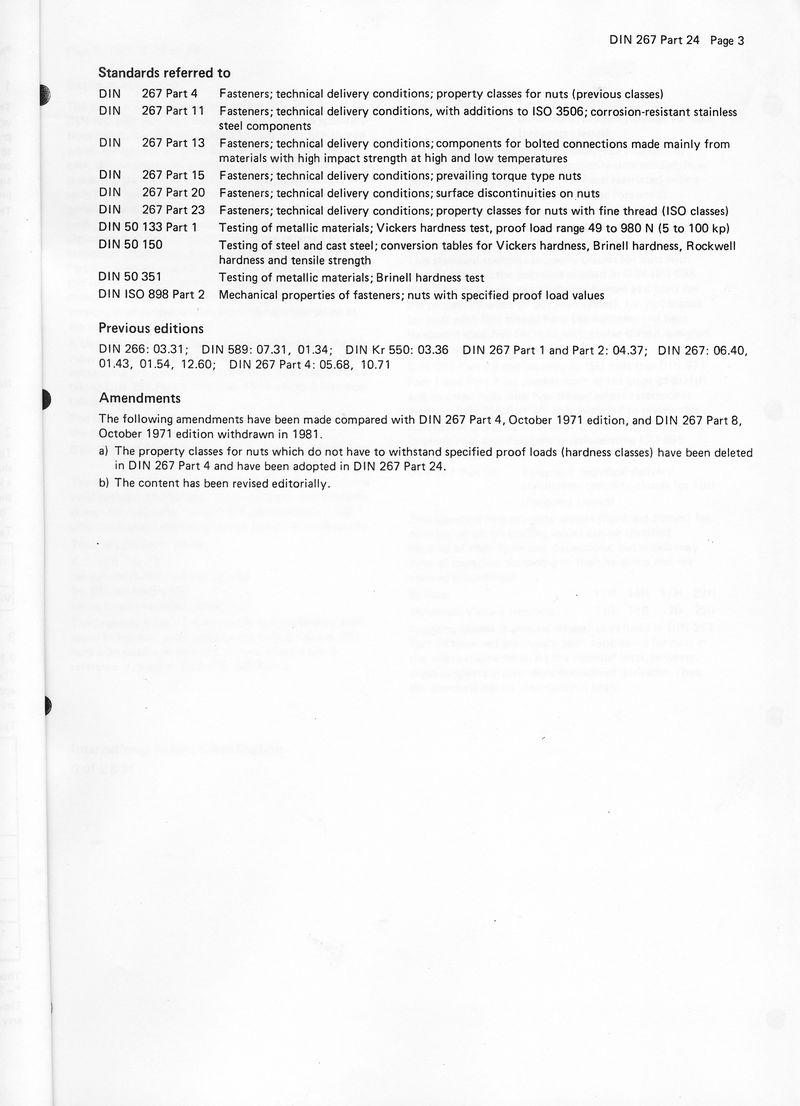
Standards referred to
| DIN 267 Part 4 | Fasteners; technical delivery conditions; property classes for nuts (previous classes) |
| DIN 267 Part 11 | Fasteners; technical delivery conditions, with additions to ISO 3506; corrosion-resistant stainless steel components |
| DIN 267 Part 13 | Fasteners; technical delivery conditions; components for bolted connections made mainly from materials with high impact strength at high and low temperatures |
| DIN 267 Part 15 | Fasteners; technical delivery conditions; prevailing torque type nuts |
| DIN 267 Part 20 | Fasteners; technical delivery conditions; surface discontinuities on nuts |
| DIN 267 Part 23 | Fasteners; technical delivery conditions; property classes for nuts with fine thread (ISO classes) |
| DIN 50 133 Part 1 | Testing of metallic materials; Vickers hardness test, proof load range 49 to 980 N (5 to 100 kp) |
| DIN 50 150 | Testing of steel and cast steel; conversion tables for Vickers hardness, Brinell hardness, Rockwell hardness and tensile strength |
| DIN 50 351 | Testing of metallic materials; Brinell hardness test |
| DIN ISO 898 Part 2 | Mechanical properties of fasteners; nuts with specified proof load values |
Previous editions
DIN 266: 03.31; DIN 589: 07.31, 01.34; DIN Kr 550: 03.36 DIN 267 Part 1 and Part 2: 04.37; DIN 267: 06.40, 01.43, 01.54, 12.60; DIN 267 Part 4: 05.68, 10.71
Amendments
The following amendments have been made compared with DIN 267 Part 4, October 1971 edition, and DIN 267 Part 8, October 1971 edition withdrawn in 1981.
a) The property classes for nuts which do not have to withstand specified proof loads (hardness classes) have been deleted in DIN 267 Part 4 and have been adopted in DIN 267 Part 24.
b) The content has been revised editorially.
3
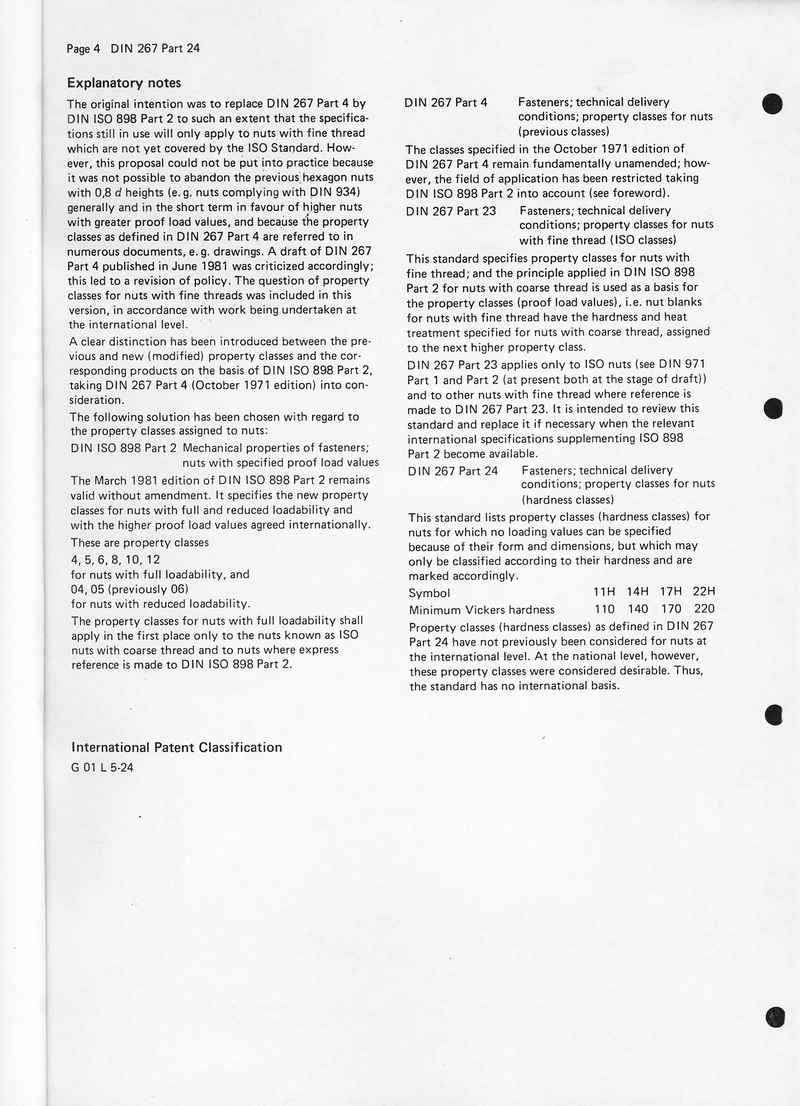
Explanatory notes
|
The original intention was to replace DIN 267 Part 4 by DIN ISO 898 Part 2 to such an extent that the specifications still in use will only apply to nuts with fine thread which are not yet covered by the ISO Standard. However, this proposal could not be put into practice because it was not possible to abandon the previous hexagon nuts with 0,8 d heights (e. g. nuts complying with DIN 934) generally and in the short term in favour of higher nuts with greater proof load values, and because the property classes as defined in DIN 267 Part 4 are referred to in numerous documents, e. g. drawings. A draft of DIN 267 Part 4 published in June 1981 was criticized accordingly; this led to a revision of policy. The question of property classes for nuts with fine threads was included in this version, in accordance with work being undertaken at the international level. A clear distinction has been introduced between the previous and new (modified) property classes and the corresponding products on the basis of DIN ISO 898 Part 2, taking DIN 267 Part 4 (October 1971 edition) into consideration. The following solution has been chosen with regard to the property classes assigned to nuts: DIN ISO 898 Part 2 Mechanical properties of fasteners; nuts with specified proof load values The March 1981 edition of DIN ISO 898 Part 2 remains valid without amendment. It specifies the new property classes for nuts with full and reduced loadability and with the higher proof load values agreed internationally. These are property classes 4, 5, 6, 8, 10, 12 for nuts with full loadability, and 04, 05 (previously 06) for nuts with reduced loadability. The property classes for nuts with full loadability shall apply in the first place only to the nuts known as ISO nuts with coarse thread and to nuts where express reference is made to DIN ISO 898 Part 2. |
DIN 267 Part 4 Fasteners; technical delivery conditions; property classes for nuts (previous classes) The classes specified in the October 1971 edition of DIN 267 Part 4 remain fundamentally unamended; however, the field of application has been restricted taking DIN ISO 898 Part 2 into account (see foreword). DIN 267 Part 23 Fasteners; technical delivery conditions; property classes for nuts with fine thread (ISO classes) This standard specifies property classes for nuts with fine thread; and the principle applied in DIN ISO 898 Part 2 for nuts with coarse thread is used as a basis for the property classes (proof load values), i. e. nut blanks for nuts with fine thread have the hardness and heat treatment specified for nuts with coarse thread, assigned to the next higher property class. DIN 267 Part 23 applies only to ISO nuts (see DIN 971 Part 1 and Part 2 (at present both at the stage of draft)) and to other nuts with fine thread where reference is made to DIN 267 Part 23. It is intended to review this standard and replace it if necessary when the relevant international specifications supplementing ISO 898 Part 2 become available. DIN 267 Part 24 Fasteners; technical delivery conditions; property classes for nuts (hardness classes) This standard lists property classes (hardness classes) for nuts for which no loading values can be specified because of their form and dimensions, but which may only be classified according to their hardness and are marked accordingly.
Property classes (hardness classes) as defined in DIN 267 Part 24 have not previously been considered for nuts at the international level. At the national level, however, these property classes were considered desirable. Thus, the standard has no international basis. |
International Patent Classification
G 01 L 5-24
4
Supplement 1 to DIN 267 Part 2
| Item No. | Illustration | Standard number |
|---|---|---|
| 45 | h14, H14, h14, h14 | DIN 935 Part 1 and Part 2; DIN 937; DIN 979 |
| 46 | ≈ pitch diameter, +IT14, H14 | DIN 962 |
| 47 | ≈ pitch diameter, +IT14, H14, +IT15, 6° | DIN 962 |
| 48 | h13, h13 | DIN 985 |
| 49 | h13, h13, js15, js15 | DIN 986 |
| 50 | +2P, +2P, js16, h14 | DIN 1478 |
| 51 | js14, js15, h14 | DIN 1587 |
| 52 | h13, h12, h13, h13, +1.5P, js15, +1.5P, js16 | DIN 2509 |
| 53 | h13, js14, js15 | DIN 6331 |
| 54 | See dimensional standard for dimensions of full dog point. +IT14, js15 | DIN 6332 |
| 55 | js14, h13, H11, h13, +IT14, js15 | DIN 6912; DIN 7984 |
| 56 | js14, js16, js14 | DIN 7513 type A |
| 57 | h13, h13, js16, js14 | DIN 7513, type B; DIN 7516, type C |
| 58 | +2°, h14, js16, js14 | DIN 7513, type D; DIN 7516, type B |
| 59 | +2°, h14, js16, js14 | DIN 7513, type E; DIN 7516, type C |
5
Page 6 Supplement 1 to DIN 267 Part 2
| Item No. | Illustration | Standard number | Item No. | Illustration | Standard number |
|---|---|---|---|---|---|
| 60 | h14, js14, js17 | DIN 7971 | 65 | h13, js14, js15, +2P | DIN 7985 |
| 61 | +2°, h14, js17 | DIN 7972 DIN 7982 |
66 | +2°, h14, h13, js15, +2P, +1T14 | DIN 7991 |
| 62 | +2°, h14, js17 | DIN 7973 DIN 7983 |
67 | h13, js14, js15, +2P | DIN 22424 |
| 63 | h14, js14, js17 | DIN 7981 | 68 | h13, js14 | DIN 22425 |
| 64 | js14, js17 | DIN 7976 | 69 | h13, js14, js15, +2P | DIN 25197 |
The limits of sizes given below shall apply to the radii of curvature under the heads of bolts and screws with flat seating (with the exception of fit bolts, screw plugs and screw assemblies).
| Nominal thread diameter d | 1 | 1,2 | 1,4 | 1,6 | 1,7 | 2 | 2,3 | 2,5 | 2,6 | 3 | 3,5 | 4 | 5 | 6 | 7 | 8 |
|---|---|---|---|---|---|---|---|---|---|---|---|---|---|---|---|---|
| r min. | 0,1 | 0,2 | 0,25 | 0,4 | ||||||||||||
| da max. | 1,4 | 1,6 | 1,8 | 2 | 2,1 | 2,6 | 2,9 | 3,1 | 3,2 | 3,6 | 4,1 | 4,7 | 5,7 | 6,8 | 7,8 | 9,2 |
| Nominal thread diameter d | 10 | 12 | 14 | 16 | 18 | 20 | 22 | 24 | 27 | 30 | 33 | 36 | 39 | 42 | 45 | 48 |
|---|---|---|---|---|---|---|---|---|---|---|---|---|---|---|---|---|
| r min. | 0,4 | 0,6 | 0,8 | 1 | 1,2 | 1,6 | ||||||||||
| da max. | 11,2 | 13,7 | 15,7 | 17,7 | 20,2 | 22,4 | 24,4 | 26,4 | 30,4 | 33,4 | 36,4 | 39,4 | 42,4 | 45,6 | 48,6 | 52,6 |
| Nominal thread diameter d | 52 | 56 | 60 | 64 | 68 | 72 | 76 | 80 | 90 | 100 | 110 | 120 | 125 | 130 | 140 | 150 |
|---|---|---|---|---|---|---|---|---|---|---|---|---|---|---|---|---|
| r min. | 1,6 | 2 | 2,5 | |||||||||||||
| da max. | 56,6 | 63 | 67 | 71 | 75 | 79 | 83 | 87 | 97 | 108 | 118 | 128 | 133 | 138 | 148 | 159 |
Instead of a maximum dimension for the radius of curvature under head, diameter da has been specified, which limits the radius under the head bearing surface.
6
预览内容由文件识别整理,表格、公式及文字请以原始文件为准。
原文图片预览
PAGE IMAGES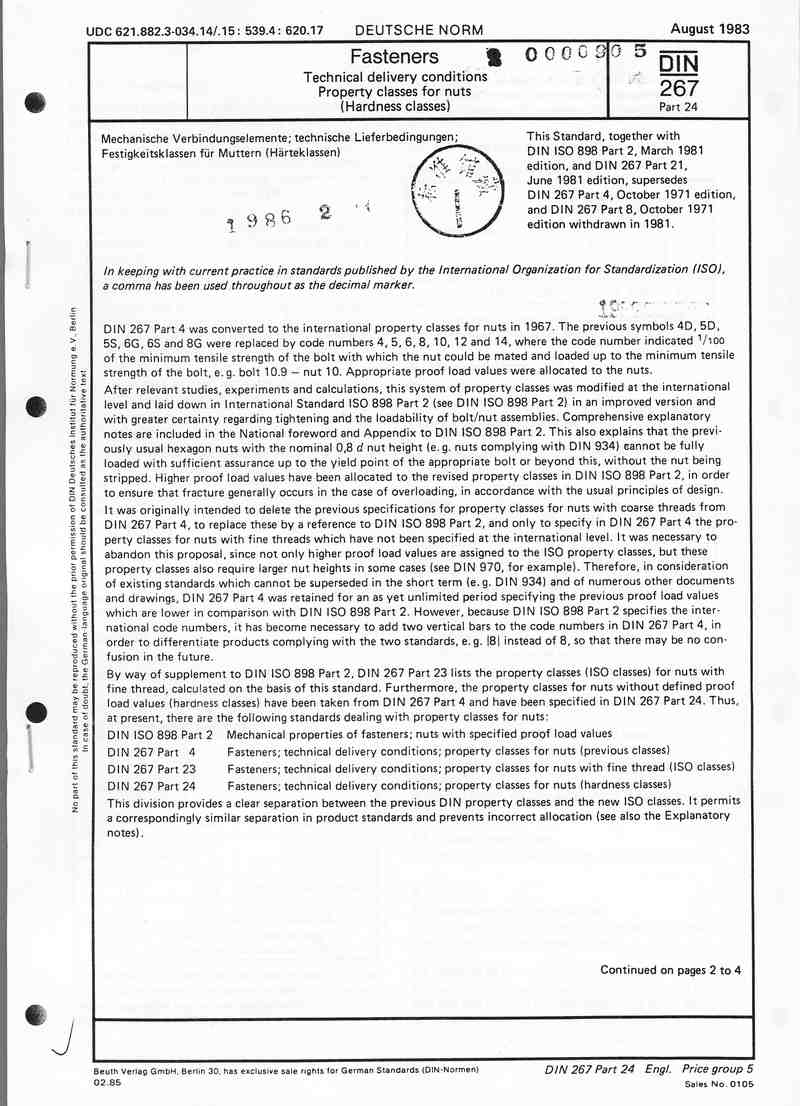
下载标准文件
DIN 267-24(1)
英语 · PDF · 6 页 · 15.64 MB