295_25Jun07_ab_AS2067 Announcement of DR07281 V1 0
295_25Jun07_ab_AS2067 Announcement of DR07281 V1 0
295_25Jun07_ab_AS2067 Announcement of DR07281 V1 0
标准信息
STANDARD INFORMATION- 标准编号
- 295_25Jun07_ab_AS2067 Announcement of DR07281 V1 0
- 所属分类
- 其他国外标准与工程资料
- 文件语言
- 英语
- 文件格式
- 文件页数
- 6 页
- 文件大小
- 104.93 KB
· 更新:
标准简介
OVERVIEW中文简介
标准 295_25Jun07_ab_AS2067 Announcement of DR07281 V1 0 的预览内容
English summary
Preview of standard 295_25Jun07_ab_AS2067 Announcement of DR07281 V1 0
以上为根据文件整理的内容简介。
标准内容预览
DOCUMENT PREVIEWSTANDARDS AUSTRALIA RELEASES
NEW DRAFT STANDARD ON
HIGH VOLTAGE INSTALLATIONS
FOR PUBLIC COMMENT
Standards Australia has recently issued Draft Australian Standards DR 07281 for Public Comment and is seeking comment from interested parties on the proposed replacement of AS 2067:1984.
Alex Baitch, Chairman of Standards Australia Committees EL043 and EL001-08 and Principal of BES (Aust) Pty Ltd said that is important for all groups involved in any aspect of high voltage installations to closely review the draft document and submit comments. Comments may be supportive of the draft standard or may put forward suggestions to modify or improve the draft standard.
The new standard will replace the present long standing Australian Standard AS 2067:1984, Switchgear assemblies and ancillary equipment for attenuating voltages above 1kV. Many parts of AS2067:1984 are now either dated or have been overtaken by other relevant standards.
The objective of the Standard is to provide common rules for the design and the erection of high voltage installations with nominal voltages above 1kV ac. It covers all high voltage installations except overhead and underground lines between separate installations, electric railways (although substations feeding a railway system are covered), installations on ships and off-shore facilities and test sites.
In the preparation of the standard, IEC 61936-1:2002 Power Installations exceeding 1kV ac – Part 1: Common rules was used as the basic reference document. However, in reviewing the IEC standard, the committee found considerable short comings in the IEC Standard and variations from Australia practice. Accordingly, an effort was made to improve the IEC document in order to provide an orderly transition from AS2067:1984. Although the new document is completely different from AS2067:1984, it is proposed to name this document AS 2067:200X Edition 2.
Alex Baitch said that innovative approaches have been adopted in the standard with a view to overcome some of the deficiencies that were foreseen with the IEC standard.
Once the standard is issued the new version of the Wiring Rules, AS/NZS 3000:2007, which is being issued soon, will call up the draft standard in order to define the requirements of High Voltage Installations for Customer owned high voltage installations. The particular requirements of Customer Owned substations are summarised in Section 12 – Special Requirements for Customer Owned High Voltage Installations. As an interim arrangement pending the release of the new Draft Standard, the existing Section 7.8 of AS/NZS 3000:2000 is being included in the new Wiring Rules as an Appendix.
The Draft Standard is to apply to all high voltage installations, be they customer owned or owned and operated by network service providers.
It is a comprehensive document that sets out guidelines for all aspects that need to be considered in the design and erection of high voltage installations. The key chapters for the standard include:
- Fundamental requirements setting out issues such as electrical requirements, mechanical or structural requirements, climatic and environmental conditions and special requirements
- Insulation coordination - selection of insulation level, minimum clearances, minimum clearances under special conditions
- Equipment - issues to be considered in selection and installation of various types of equipment
| BES(Aust) Pty Ltd ABN 11 077 005 273 |
PO BOX 1116, BAULKHAM HILLS NSW 1755 (UNIT 1, “Thornbury”, 9 OWEN AVE, BAULKHAM HILLS NSW AUSTRALIA 2153) EMAIL: baitch@besaust.com.au |
PHONE: (02) 9686 4811 FAX: (02) 9686 4822 INT’L: +(612) 9686 4811 MOBILE: 04 1234 4821 |
AS IS
内部资料
仅供参考
张忠辉惠存
禁止一切非法目的和活动行为,否则后果自负。
NOT FOR PUBLIC RELEASE
(d) Installations - general requirements for installations, outdoor installations of open design, indoor installations of open design, installations of factory-built type-tested enclosed switchgear, requirements for buildings, high voltage / low voltage prefabricated substations and installations on a mast, pole of tower.
(e) Safety measures - including protection against direct or indirect contact, means to protect persons working on electrical installations, protection from arc fault or lightning and protection from fire
(f) Protection, control and auxiliary systems
(g) Earthing systems
(h) Inspection and testing
(i) Special requirements for Customer Owned High Voltage Installations
With respect to minimum values for distances, clearances and dimensions permitted for safe operation certain changes have been made to definitions. The distances adopted in this standard are basically consistent with the values in AS2067:1984 rather than the values included in IEC 61936-1:2002. Accordingly, some of the clearances proposed are greater than prescribed in IEC 61936-1:2002. Comment is being sought on this approach.
In terms of requirements for buildings, it is proposed that buildings shall comply with the Building Code of Australia and the relevant requirements of this Standard. It is noted however that at present the BCA does not specifically cover the requirements of electrical substations and similar installations. The Draft Standard suggests that Class 9b buildings in the Building Code of Australia can be used as a guide for basic general requirements and the Draft Standard defines additional requirements.
Alex Baitch stated that Committee EL-043 is particularly seeking comment in regard to the BCA coverage of electrical substations and similar installations and the proposals as set out in the Draft.
Based on the IEC 61936-1:2002 significant new material is included with respect to the matter of protection against fire. Again reference is made to the application of the BCA and the lack of coverage of electrical substations by the BCA. IEC 61936-1:2002 includes parameters based on IEC, IEEE, CENELEC and Factory Mutual Global documents. In the Draft Standard clearances have been shown consistent with Australian practice. Fire resistance levels have been expressed in terms referred to by the BCA. The Draft Standard covers situations including oil insulated transformers, less combustible liquid insulated transformers with and without enhance protection and dry type transformers. Overall the Draft standard requires that a risk assessment be prepared and to take into account the location of the high voltage installation and the extent to which security of supply must be provided.
In addition, a separate section on typical distribution high voltage installations set outs out arrangements to satisfy fire protection requirements is included. This is a new section which is not included in IEC 61936-1:2002. In some instances the fire resistance levels, although higher than in the IEC document, are lower than some BCA requirements. Accordingly, particular comment is sought on this part of the Draft Standard.
Arguably, perhaps the most significant change in the Draft Standard relates to the requirements of earthing
In the present Standard AS2067-1984 guidance is provided with respect to earthing design. The requirements of AS/NZS 3000:2000, the Wiring Rules are different and require that for combined earthing systems the combined earth resistance is not greater that 1 ohm. For separate earthing systems, the high voltage system earth must not exceed 30 ohm. This has lead to a lot of criticism, particularly the efforts that may be involved in achieving these values.
2
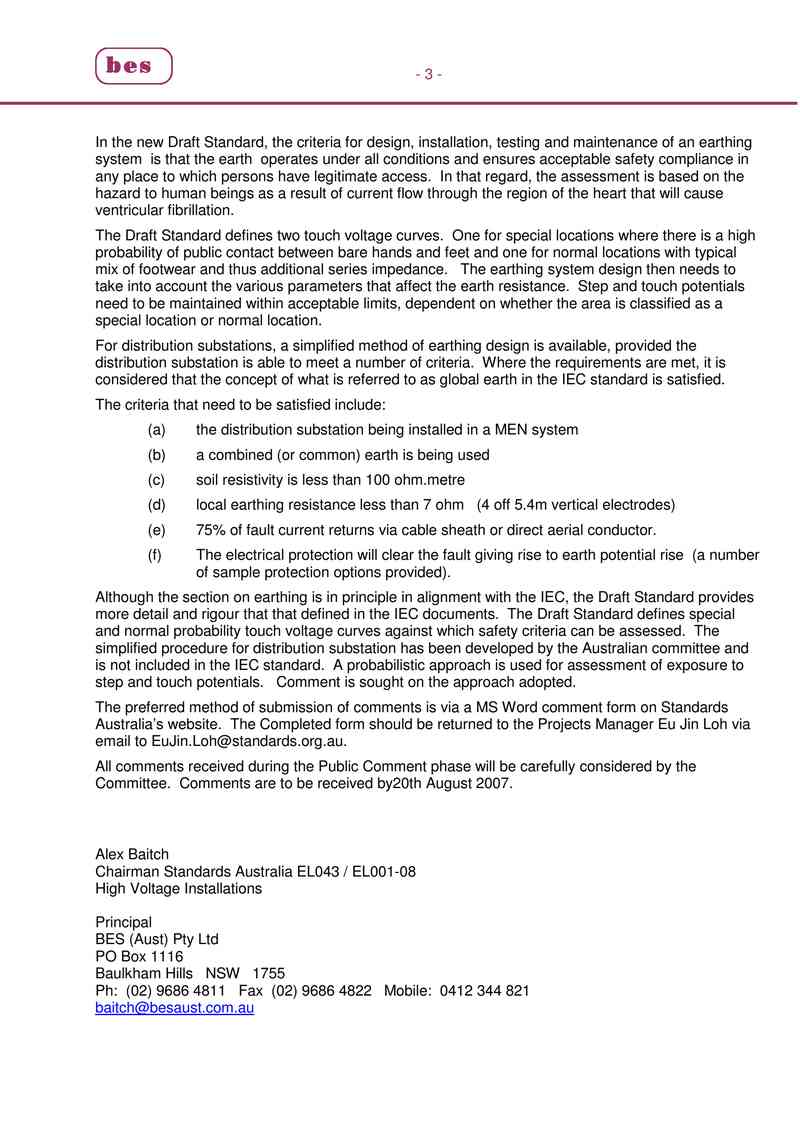
In the new Draft Standard, the criteria for design, installation, testing and maintenance of an earthing system is that the earth operates under all conditions and ensures acceptable safety compliance in any place to which persons have legitimate access. In that regard, the assessment is based on the hazard to human beings as a result of current flow through the region of the heart that will cause ventricular fibrillation.
The Draft Standard defines two touch voltage curves. One for special locations where there is a high probability of public contact between bare hands and feet and one for normal locations with typical mix of footwear and thus additional series impedance. The earthing system design then needs to take into account the various parameters that affect the earth resistance. Step and touch potentials need to be maintained within acceptable limits, dependent on whether the area is classified as a special location or normal location.
For distribution substations, a simplified method of earthing design is available, provided the distribution substation is able to meet a number of criteria. Where the requirements are met, it is considered that the concept of what is referred to as global earth in the IEC standard is satisfied.
The criteria that need to be satisfied include:
- (a) the distribution substation being installed in a MEN system
- (b) a combined (or common) earth is being used
- (c) soil resistivity is less than 100 ohm.metre
- (d) local earthing resistance less than 7 ohm (4 off 5.4m vertical electrodes)
- (e) 75% of fault current returns via cable sheath or direct aerial conductor.
- (f) The electrical protection will clear the fault giving rise to earth potential rise (a number of sample protection options provided).
Although the section on earthing is in principle in alignment with the IEC, the Draft Standard provides more detail and rigour that that defined in the IEC documents. The Draft Standard defines special and normal probability touch voltage curves against which safety criteria can be assessed. The simplified procedure for distribution substation has been developed by the Australian committee and is not included in the IEC standard. A probabilistic approach is used for assessment of exposure to step and touch potentials. Comment is sought on the approach adopted.
The preferred method of submission of comments is via a MS Word comment form on Standards Australia's website. The Completed form should be returned to the Projects Manager Eu Jin Loh via email to EuJin.Loh@standards.org.au.
All comments received during the Public Comment phase will be carefully considered by the Committee. Comments are to be received by20th August 2007.
Alex Baitch
Chairman Standards Australia EL043 / EL001-08
High Voltage Installations
Principal
BES (Aust) Pty Ltd
PO Box 1116
Baulkham Hills NSW 1755
Ph: (02) 9686 4811 Fax (02) 9686 4822 Mobile: 0412 344 821
baitch@besaust.com.au
3
- June 2007
4
Page
SECTION 6 STATIC ANALYSIS
- 6.1 GENERAL ................................................ 38
- 6.2 HORIZONTAL FORCES .................................... 38
- 6.3 VERTICAL DISTRIBUTION OF HORIZONTAL EARTHQUAKE FORCES ........ 39
- 6.4 HORIZONTAL SHEAR DISTRIBUTION ....................... 42
- 6.5 TORSIONAL EFFECTS ..................................... 42
- 6.6 STABILITY EFFECTS ..................................... 44
- 6.7 DRIFT DETERMINATION AND P–DELTA EFFECTS ............... 44
- 6.8 VERTICAL COMPONENT OF GROUND MOTION .................. 45
SECTION 7 DYNAMIC ANALYSIS
- 7.1 GENERAL ................................................ 46
- 7.2 EARTHQUAKE ACTIONS .................................... 46
- 7.3 MATHEMATICAL MODEL .................................... 47
- 7.4 ANALYSIS PROCEDURES ................................. 47
- 7.5 STABILITY EFFECTS ..................................... 48
- 7.6 DRIFT DETERMINATION AND P–DELTA EFFECTS ............... 48
SECTION 8 STRUCTURAL ALTERATIONS
................................................ 49
APPENDICES
- A STRUCTURE CLASSIFICATION .............................. 50
- B STRUCTURAL SYSTEM ..................................... 55
- C DOMESTIC STRUCTURES ................................... 56
- D TYPES OF DYNAMIC ANALYSIS ............................. 58
- E STRUCTURAL ALTERATIONS .............................. 60
预览内容由文件识别整理,表格、公式及文字请以原始文件为准。
原文图片预览
PAGE IMAGES
下载标准文件
295_25Jun07_ab_AS2067 Announcement of DR07281 V1 0
英语 · PDF · 6 页 · 104.93 KB