标准信息
STANDARD INFORMATION- 标准编号
- 美国道路通行能力手册HCM2000
- 所属分类
- 其他国外标准与工程资料
- 发布机构
- Transportation Research Board
- 版本年份
- 2000
- 文件语言
- 英语
- 文件格式
- 文件页数
- 6 页
- 文件大小
- 25.77 MB
中文名称为参考译名,文件语言以原文为准。
· 更新:
标准简介
OVERVIEW中文简介
该手册提供估算交通设施通行能力和确定服务水平的技术方法。它适用于城市道路、交叉口、公路、公交、自行车和行人等地面交通设施的分析与评估。该手册不作为公路设计或施工的法定标准。
English summary
The manual provides state-of-the-art techniques for estimating capacity and determining level of service for transportation facilities. It applies to intersections, roadways, transit, bicycle, and pedestrian facilities. It does not establish a legal standard for highway design or construction.
以上为根据文件整理的内容简介。
相关标签
标准内容预览
DOCUMENT PREVIEWSubcommittee on Arterials (continued)
Dennis Strong, Strong Concepts
Andrzej Tarko, Purdue University
Mark Vandehey, Kittelson & Associates, Inc.
Subcommittee on Concepts and Definitions
Barbara Ostrom, LAW PCS—Chair
Fred L. Hall, McMaster University, Canada
Doug McLeod, Florida Department of Transportation
Stan Teply, University of Alberta, Canada
Subcommittee on Freeways and Multilane Highways
Adolf D. May, University of California at Berkeley—Group Leader, Uninterrupted Flow
Nagui Rouphail, North Carolina State University—Group Leader, Uninterrupted Flow
Lily Elefteriadou, Pennsylvania State University—Leader, Ramp and Weaving Junctions
James Schoen, Catalina Engineering, Inc.—Leader, Basic Freeway Segments and Multilane Highways
Michael Cassidy, University of California at Berkeley
Michael Church, California Department of Transportation
Brian Eads, Crawford, Murphy & Tilly, Inc.
Lily Elefteriadou, Pennsylvania State University
Joseph Fazio, Illinois Institute of Technology
Fred L. Hall, McMaster University, Canada
Abdul-Rahman Hamad, H.W. Lochner, Inc.
Lee Han, University of Tennessee
Joel Leisch, Consultant
John Leonard, Georgia Institute of Technology
Barbara Ostrom, LAW PCS
Thomas Parlante, Arizona Department of Transportation
Ronald Pfefer, Northwestern University
William Prosser, Federal Highway Administration
William Reilly, Catalina Engineering, Inc.
Bruce Robinson, Kittelson & Associates, Inc.
Roger Roess, Polytechnic University
Fred Rooney, California Department of Transportation
Rikke Rysgaard, Danish Road Directorate
James Schoen, Catalina Engineering, Inc.
Ronald Sonntag, Marquette University
Andrzej Tarko, Purdue University
Michelle Thomas, Federal Highway Administration
Jose Ulerio, Polytechnic University
Tom Urbanik, Texas A & M University
Subcommittee on Interchange Ramp Terminals
James Powell, Parsons Transportation Group—Chair
James Bonneson, Texas A & M University
Robert Bryson, City of Milwaukee
Michael Church, California Department of Transportation
Thomas Creasey, Jordan, Jones & Goulding, Inc.
Janice Daniel, New Jersey Institute of Technology
6
CONTENTS
| PREFACE | vii |
| CONTRIBUTORS AND ACKNOWLEDGMENTS | ix |
PART I: OVERVIEW
| 1. INTRODUCTION | 1-1 |
| 2. CAPACITY AND LEVEL-OF-SERVICE CONCEPTS | 2-1 |
| 3. APPLICATIONS | 3-1 |
| 4. DECISION MAKING | 4-1 |
| 5. GLOSSARY | 5-1 |
| 6. SYMBOLS | 6-1 |
PART II: CONCEPTS
| 7. TRAFFIC FLOW PARAMETERS | 7-1 |
| 8. TRAFFIC CHARACTERISTICS | 8-1 |
| 9. ANALYTICAL PROCEDURES OVERVIEW | 9-1 |
| 10. URBAN STREET CONCEPTS | 10-1 |
| 11. PEDESTRIAN AND BICYCLE CONCEPTS | 11-1 |
| 12. HIGHWAY CONCEPTS | 12-1 |
| 13. FREEWAY CONCEPTS | 13-1 |
| 14. TRANSIT CONCEPTS | 14-1 |
PART III: METHODOLOGIES
| 15. URBAN STREETS | 15-1 |
| 16. SIGNALIZED INTERSECTIONS | 16-1 |
| 17. UNSIGNALIZED INTERSECTIONS | 17-1 |
| 18. PEDESTRIANS | 18-1 |
| 19. BICYCLES | 19-1 |
| 20. TWO-LANE HIGHWAYS | 20-1 |
| 21. MULTILANE HIGHWAYS | 21-1 |
| 22. FREEWAY FACILITIES | 22-1 |
| 23. BASIC FREEWAY SEGMENTS | 23-1 |
| 24. FREEWAY WEAVING | 24-1 |
| 25. RAMPS AND RAMP JUNCTIONS | 25-1 |
| 26. INTERCHANGE RAMP TERMINALS | 26-1 |
| 27. TRANSIT | 27-1 |
PART IV: CORRIDOR AND AREAWIDE ANALYSES
| 28. ASSESSMENT OF MULTIPLE FACILITIES | 28-1 |
| 29. CORRIDOR ANALYSIS | 29-1 |
| 30. AREAWIDE ANALYSIS | 30-1 |
PART V: SIMULATION AND OTHER MODELS
| 31. SIMULATION AND OTHER MODELS | 31-1 |
2
PREFACE
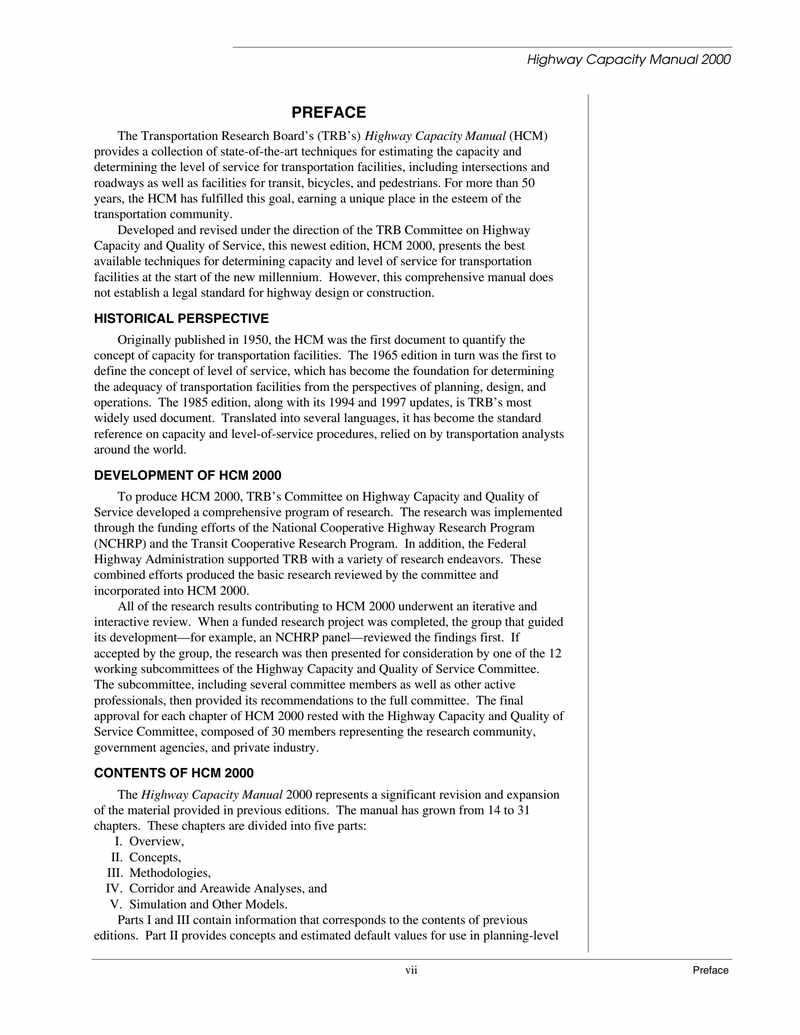
The Transportation Research Board's (TRB's) Highway Capacity Manual (HCM) provides a collection of state-of-the-art techniques for estimating the capacity and determining the level of service for transportation facilities, including intersections and roadways as well as facilities for transit, bicycles, and pedestrians. For more than 50 years, the HCM has fulfilled this goal, earning a unique place in the esteem of the transportation community.
Developed and revised under the direction of the TRB Committee on Highway Capacity and Quality of Service, this newest edition, HCM 2000, presents the best available techniques for determining capacity and level of service for transportation facilities at the start of the new millennium. However, this comprehensive manual does not establish a legal standard for highway design or construction.
HISTORICAL PERSPECTIVE
Originally published in 1950, the HCM was the first document to quantify the concept of capacity for transportation facilities. The 1965 edition in turn was the first to define the concept of level of service, which has become the foundation for determining the adequacy of transportation facilities from the perspectives of planning, design, and operations. The 1985 edition, along with its 1994 and 1997 updates, is TRB's most widely used document. Translated into several languages, it has become the standard reference on capacity and level-of-service procedures, relied on by transportation analysts around the world.
DEVELOPMENT OF HCM 2000
To produce HCM 2000, TRB's Committee on Highway Capacity and Quality of Service developed a comprehensive program of research. The research was implemented through the funding efforts of the National Cooperative Highway Research Program (NCHRP) and the Transit Cooperative Research Program. In addition, the Federal Highway Administration supported TRB with a variety of research endeavors. These combined efforts produced the basic research reviewed by the committee and incorporated into HCM 2000.
All of the research results contributing to HCM 2000 underwent an iterative and interactive review. When a funded research project was completed, the group that guided its development—for example, an NCHRP panel—reviewed the findings first. If accepted by the group, the research was then presented for consideration by one of the 12 working subcommittees of the Highway Capacity and Quality of Service Committee. The subcommittee, including several committee members as well as other active professionals, then provided its recommendations to the full committee. The final approval for each chapter of HCM 2000 rested with the Highway Capacity and Quality of Service Committee, composed of 30 members representing the research community, government agencies, and private industry.
CONTENTS OF HCM 2000
The Highway Capacity Manual 2000 represents a significant revision and expansion of the material provided in previous editions. The manual has grown from 14 to 31 chapters. These chapters are divided into five parts:
I. Overview,
II. Concepts,
III. Methodologies,
IV. Corridor and Areawide Analyses, and
V. Simulation and Other Models.
Parts I and III contain information that corresponds to the contents of previous editions. Part II provides concepts and estimated default values for use in planning-level
analytical work. Part IV presents computational techniques and general analysis guidelines for corridor and areawide analyses. Part V offers background and information on alternative models that may be appropriate for systemwide or more complex analyses.
A companion version of the manual is available in CD-ROM, including tutorials and video clips to enhance the communication of the concepts. In addition, there are links between the text and the glossary to facilitate understanding of the manual by less-experienced users.
SPECIAL ACKNOWLEDGMENTS
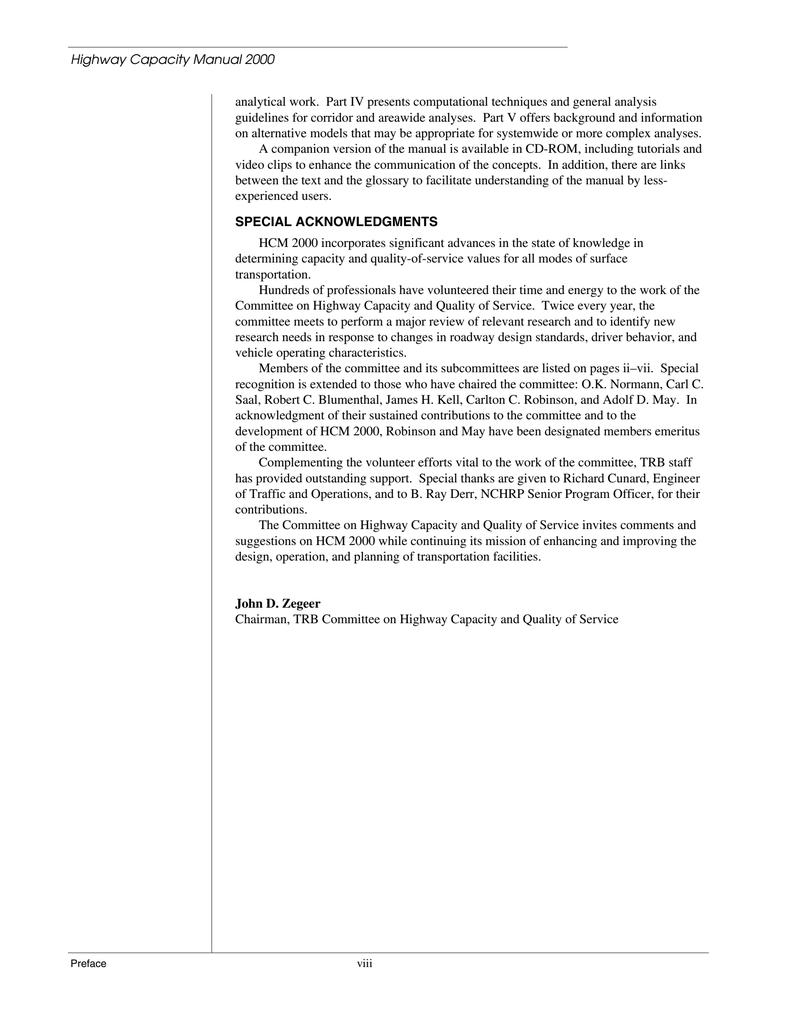
HCM 2000 incorporates significant advances in the state of knowledge in determining capacity and quality-of-service values for all modes of surface transportation.
Hundreds of professionals have volunteered their time and energy to the work of the Committee on Highway Capacity and Quality of Service. Twice every year, the committee meets to perform a major review of relevant research and to identify new research needs in response to changes in roadway design standards, driver behavior, and vehicle operating characteristics.
Members of the committee and its subcommittees are listed on pages ii–vii. Special recognition is extended to those who have chaired the committee: O.K. Normann, Carl C. Saal, Robert C. Blumenthal, James H. Kell, Carlton C. Robinson, and Adolf D. May. In acknowledgment of their sustained contributions to the committee and to the development of HCM 2000, Robinson and May have been designated members emeritus of the committee.
Complementing the volunteer efforts vital to the work of the committee, TRB staff has provided outstanding support. Special thanks are given to Richard Cunard, Engineer of Traffic and Operations, and to B. Ray Derr, NCHRP Senior Program Officer, for their contributions.
The Committee on Highway Capacity and Quality of Service invites comments and suggestions on HCM 2000 while continuing its mission of enhancing and improving the design, operation, and planning of transportation facilities.
John D. Zegeer
Chairman, TRB Committee on Highway Capacity and Quality of Service
4
CONTRIBUTORS AND ACKNOWLEDGMENTS
HCM 2000 is the result of the coordinated efforts of many individuals, groups, research organizations, and government agencies. The TRB Committee on Highway Capacity and Quality of Service is responsible for the content of the Highway Capacity Manual; preparation of the volume was accomplished through the efforts of the following groups and individuals:
TRB COMMITTEE ON HIGHWAY CAPACITY AND QUALITY OF SERVICE
(Members as of January 31, 2000)
John Zeeger, Kittelson & Associates, Inc.—Chairman
Richard Dowling, Dowling Associates, Inc.—Secretary
James Bonneson, Texas A & M University
Werner Brilon, Ruhr University, Bochum, Germany
Robert Bryson, City of Milwaukee
Kenneth Courage, University of Florida
Alan Danaher, Kittelson & Associates, Inc.
Rafael DeArroza, Florida Department of Transportation
Lily Elefteriadou, Pennsylvania State University
Dan Fambro, Texas A & M University (deceased)
Ronald Giguere, Federal Highway Administration
Albert Grover, Albert Grover & Associates
Mariano Gullón Löw, Centro de Estudios de Carreteras (deceased)
Fred L. Hall, McMaster University, Canada
Douglas Harwood, Midwest Research Institute
Chris Hoban, The World Bank
Wayne Kittelson, Kittelson & Associates, Inc.
Michael Kyte, University of Idaho
Adolf D. May, University of California at Berkeley
Douglas McLeod, Florida Department of Transportation
Barbara Ostrom, LAW PCS
James Powell, Parsons Transportation Group
Nagui Rouphail, North Carolina State University
Erik Ruehr, Valley Research and Planning Associates
Rikke Rysgaard, Danish Road Directorate
James Schoen, Catalina Engineering, Inc.
Alex Sorton, Northwestern University
Dennis Strong, Strong Concepts
Stan Teply, University of Alberta, Canada
Rod Troutbeck, Queensland University of Technology, Australia
Richard Cunard, Transportation Research Board Staff Representative
Emeritus Members
(As of February 1, 2000)
Adolf D. May, University of California at Berkeley
Carlton C. Robinson, Consultant
Subcommittee on Arterials
James Bonneson, Texas A & M University—Chair
Janice Daniel, New Jersey Institute of Technology
Ronald Giguere, Federal Highway Administration
Joel Marcuson, Sverdrup Civil, Inc.
Doug McLeod, Florida Department of Transportation
(continued)
5
Subcommittee on Arterials (continued)
Dennis Strong, Strong Concepts
Andrzej Tarko, Purdue University
Mark Vandehey, Kittelson & Associates, Inc.
Subcommittee on Concepts and Definitions
Barbara Ostrom, LAW PCS—Chair
Fred L. Hall, McMaster University, Canada
Doug McLeod, Florida Department of Transportation
Stan Teply, University of Alberta, Canada
Subcommittee on Freeways and Multilane Highways
Adolf D. May, University of California at Berkeley—Group Leader, Uninterrupted Flow
Nagui Rouphail, North Carolina State University—Group Leader, Uninterrupted Flow
Lily Elefteriadou, Pennsylvania State University—Leader, Ramp and Weaving Junctions
James Schoen, Catalina Engineering, Inc.—Leader, Basic Freeway Segments and Multilane Highways
Michael Cassidy, University of California at Berkeley
Michael Church, California Department of Transportation
Brian Eads, Crawford, Murphy & Tilly, Inc.
Lily Elefteriadou, Pennsylvania State University
Joseph Fazio, Illinois Institute of Technology
Fred L. Hall, McMaster University, Canada
Abdul-Rahman Hamad, H.W. Lochner, Inc.
Lee Han, University of Tennessee
Joel Leisch, Consultant
John Leonard, Georgia Institute of Technology
Barbara Ostrom, LAW PCS
Thomas Parlante, Arizona Department of Transportation
Ronald Pfefer, Northwestern University
William Prosser, Federal Highway Administration
William Reilly, Catalina Engineering, Inc.
Bruce Robinson, Kittelson & Associates, Inc.
Roger Roess, Polytechnic University
Fred Rooney, California Department of Transportation
Rikke Rysgaard, Danish Road Directorate
James Schoen, Catalina Engineering, Inc.
Ronald Sonntag, Marquette University
Andrzej Tarko, Purdue University
Michelle Thomas, Federal Highway Administration
Jose Ulerio, Polytechnic University
Tom Urbanik, Texas A & M University
Subcommittee on Interchange Ramp Terminals
James Powell, Parsons Transportation Group—Chair
James Bonneson, Texas A & M University
Robert Bryson, City of Milwaukee
Michael Church, California Department of Transportation
Thomas Creasey, Jordan, Jones & Goulding, Inc.
Janice Daniel, New Jersey Institute of Technology
6
预览内容由文件识别整理,表格、公式及文字请以原始文件为准。
原文图片预览
PAGE IMAGES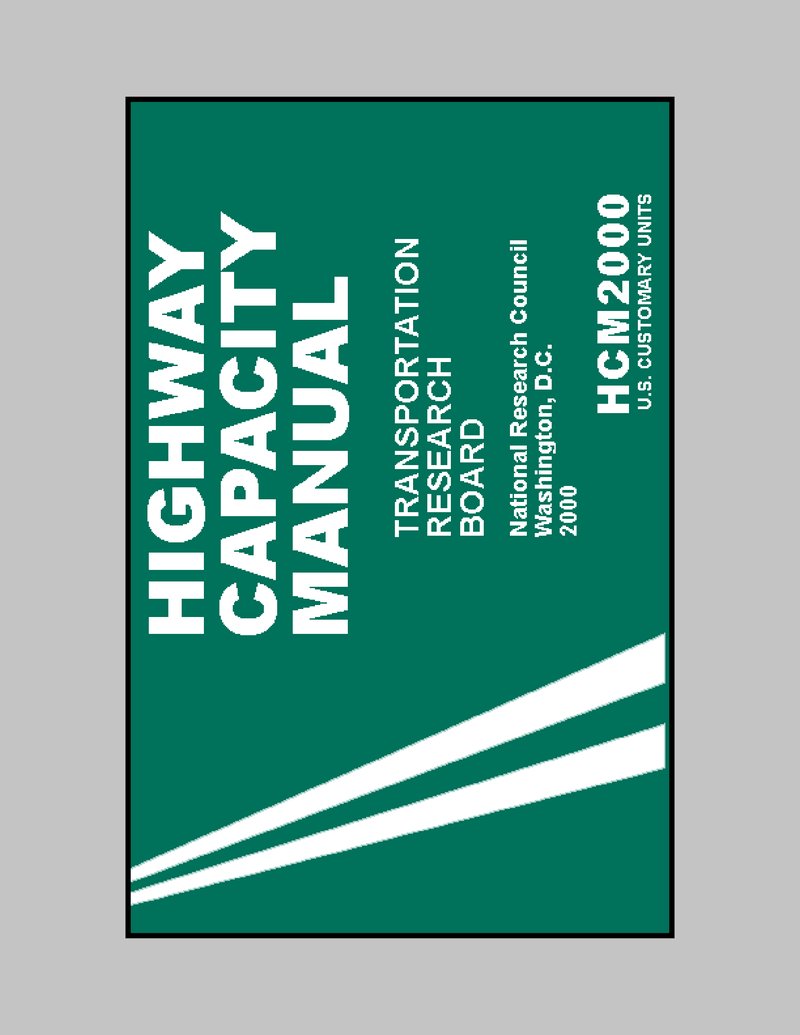

下载标准文件
美国道路通行能力手册HCM2000
英语 · PDF · 6 页 · 25.77 MB