
标准信息
STANDARD INFORMATION- 标准编号
- appendix_C_LCCA
- 所属分类
- 其他国外标准与工程资料
- 文件语言
- 英语
- 文件格式
- 文件页数
- 6 页
- 文件大小
- 1.19 MB
· 更新:
标准简介
OVERVIEW中文简介
标准 appendix_C_LCCA 的预览内容
English summary
Preview of standard appendix_C_LCCA
以上为根据文件整理的内容简介。
标准内容预览
DOCUMENT PREVIEWC.1.4 LCCA and the Design Guide Pavement Design Methodology
The LCCA principles and process outlined in the FHWA Interim Technical Bulletin (2) and promoted under the DP 115 project largely represent the state of the technology at the design level. For this reason, they have been adopted for use with the Design Guide methodology.
A computerized LCCA program that incorporates the FHWA procedures and various functional enhancements has been developed and is provided on the CD-ROM included with the Design Guide. The program, titled “LCCA2002,” is a Microsoft® Excel-based spreadsheet that can perform deterministic and probabilistic analysis of life cycle costs (including certain user costs) for a minimum of two alternative designs. Developed primarily by the FHWA, LCCA2002 is completely separate from the Design Guide software, but uses the same database administrator (Excel) as the Design Guide software outputs (e.g., performance prediction data).
C.1.5 Organization and Use of the LCCA Guide
This appendix presents up-to-date guidelines for performing pavement LCCA at the project level. It is intended for State and local highway agency personnel with responsibility for conducting or reviewing new pavement or pavement rehabilitation design alternatives (1,2).
The guidelines presented embody the principles and practices contained in the 1998 FHWA Interim Technical Bulletin and feature a few supplementary considerations and techniques. The guidelines are detailed and comprehensive, covering all actions necessary for a highway agency to do a full and fair assessment of the economic implications of alternative design strategies.
This appendix consists of four sections, including this introductory section. Section C.2 provides guidance in establishing the LCCA framework, so that projects within an agency are evaluated in a consistent fashion. Section C.3 describes the LCCA process, addressing in detail both the selection of input values and the interpretation of analysis results. Finally, section C.4 provides an overview of the LCCA2002 spreadsheet program, followed by two example applications of the project-level LCCA methodology.
C.2 LCCA FRAMEWORK
As mentioned previously, the LCCA framework represents the governing criteria and principles by which a comparison of costs of alternative design strategies is made. Facets of the LCCA framework include the following:
- Economic analysis technique.
- Real versus nominal dollars.
- Discount rate.
- Analysis period.
- Cost factors.
- Approach to risk and uncertainty in LCCA.
6
ACKNOWLEDGMENT OF SPONSORSHIP
This work was sponsored by the American Association of State Highway and Transportation Officials, in cooperation with the Federal Highway Administration, and was conducted in the National Cooperative Highway Research Program, which is administered by the Transportation Research Board of the National Research Council.
DISCLAIMER
This is the final draft as submitted by the research agency. The opinions and conclusions expressed or implied in the report are those of the research agency. They are not necessarily those of the Transportation Research Board, the National Research Council, the Federal Highway Administration, the American Association of State Highway and Transportation Officials, or the individual states participating in the National Cooperative Highway Research Program.
2
APPENDIX C—LIFE CYCLE COST ANALYSIS GUIDELINES
C.1 INTRODUCTION
The application of principles of engineering economy to highway pavement projects generally occurs at two levels—the network level and the project level. At the network level, the feasibility and programming of many pavement projects must be determined as part of a multi-year capital improvement program. Pavement management data, including inventory, condition, and cost data, are evaluated to prioritize network needs and develop listings of recommended projects and preservation treatments, based on anticipated budgets.
At the project level, the most economical design strategy capable of satisfying the overall project requirements must be determined. Whether the project is to be new construction or rehabilitation, the goal of project-level analysis is to select the most appropriate strategy, given various cost, engineering, and other constraints associated with the project. Ideally, network and project asset management should be accomplished simultaneously, but analytical tools are not available. Thus, they are often performed independently.
An important tool to both the network and project levels is life cycle cost analysis (LCCA). LCCA has been used in transportation engineering for well over a century, but it is only in the last couple decades that its use has become more widespread, largely due to the increased accountability placed on highway agencies. Not only has LCCA helped many agencies make wiser use of limited capital improvement funds, it has strengthened the competitiveness of the road building industry.
C.1.1 Definition and Makeup of LCCA
LCCA allows comparisons of investment alternatives having different cost streams. In the highway arena, it is a formal, systematic approach for considering most of the factors that go into making a pavement investment decision. Such factors include the initial cost of building or renovating a pavement facility, all significant upkeep costs anticipated over the pavement's life, and the value of the pavement at the end of its life. Other factors can include engineering costs, traffic control costs associated with construction work zones, and costs incurred by users of the highway as a result of travel delays and/or increased vehicle operating costs. Accident costs due to lane closures may also be significant.
There are four components of LCCA—the LCCA framework, the input parameters, the analysis process, and the outputs/results. The LCCA framework represents the governing criteria and principles by which a comparison of costs of alternative design strategies is made.
Input parameters include the specified costs and the anticipated timings of the specified costs. Estimated values of each input parameter are needed in order to conduct the LCCA.
The LCCA process is the sequence of steps taken to successfully complete a LCCA. It begins with the formulation of alternative design strategies and concludes with the analysis and
interpretation of the LCCA results. A key part of the LCCA process is the determination of the input parameters, which can give biased or erroneous results if not properly estimated.
The outputs or results of a LCCA represent important decision-making information for the pavement designer/analyst. Combined with engineering and other feasibility information, the projected economic implications of alternative design strategies can be used to identify the preferred pavement strategy.
C.1.2 Basic Concepts and Principles
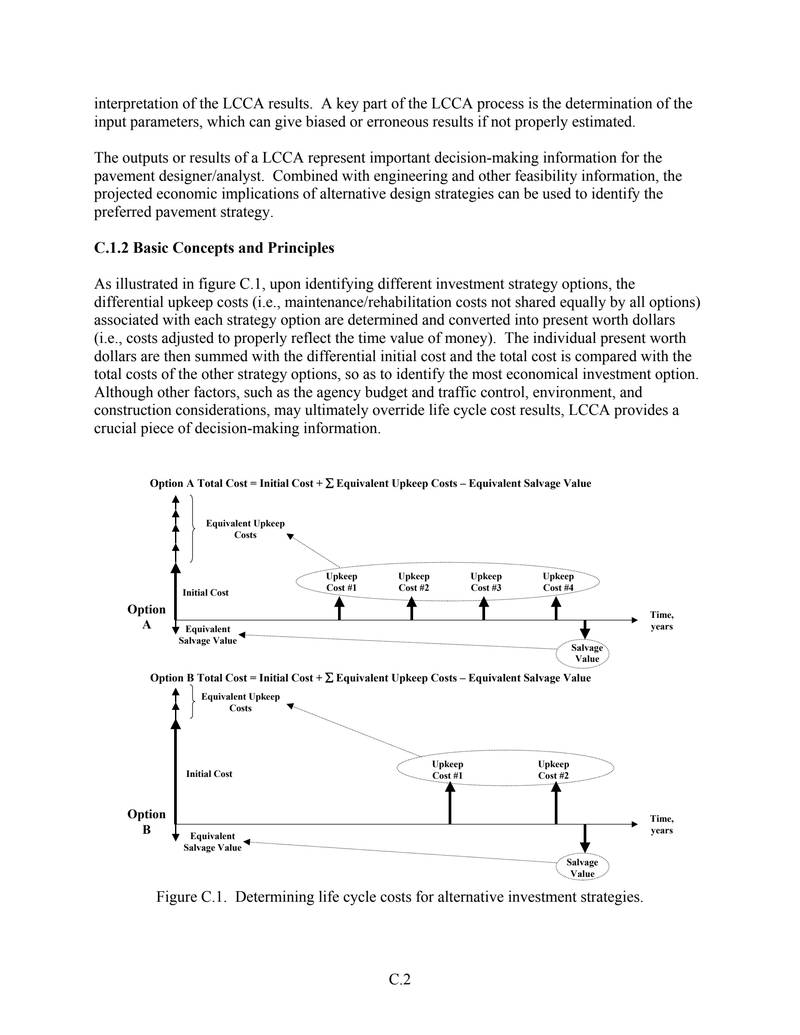
As illustrated in figure C.1, upon identifying different investment strategy options, the differential upkeep costs (i.e., maintenance/rehabilitation costs not shared equally by all options) associated with each strategy option are determined and converted into present worth dollars (i.e., costs adjusted to properly reflect the time value of money). The individual present worth dollars are then summed with the differential initial cost and the total cost is compared with the total costs of the other strategy options, so as to identify the most economical investment option. Although other factors, such as the agency budget and traffic control, environment, and construction considerations, may ultimately override life cycle cost results, LCCA provides a crucial piece of decision-making information.
Figure C.1. Determining life cycle costs for alternative investment strategies.
4
The accuracy of LCCA results depends on the accuracy of each of the inputs, which typically include the following:
- Initial construction (or rehabilitation) cost.
- Expected service life of initial pavement structure.
- Future maintenance and rehabilitation (M&R) costs.
- Expected timings/performance characteristics of future M&R treatments.
- Economic discount rate.
- Expected salvage value.
- User costs, as a result of extra time delay, increased vehicle operating costs, or increased accidents.
- Expected timings of user costs.
C.1.3 Applications of LCCA in Design
Although LCCA is occasionally used at the network level for project programming purposes, its predominant application is for comparing and judging the efficiency of different design alternatives at the project level. This includes both new and rehabilitation designs having different pavement surface types (i.e., AC versus PCC) or other different design features, such as surface mix design and thickness, subsurface and shoulder design, and in the case of PCC surfaces, joint and reinforcement design.
Nearly two-thirds of 52 United States (U.S.) highway agencies (including all 50 States) surveyed by the Federal Highway Administration (FHWA) in 1997 reported using formal LCCA procedures for determining the type of pavement to use in a new construction or reconstruction project (1). Most of the remaining one-third use informal procedures or plan to develop a set of procedures in the near future.
Although the concepts and principles of LCCA are fairly uniform, the application of LCCA in design varies considerably. Differences in agency philosophies, policies, and preferences typically result in different cost factors being included or excluded, different methods being used to determine input values, and different analysis periods being used. The fact that different computer programs are used to compute life cycle costs, and that LCCA results are interpreted in different ways, also adds to the variation.
Despite the current variation in practice, much greater consistency has been achieved in recent years, due in large part to FHWA development and implementation efforts. Since the mid-1990s, the FHWA has worked closely with States and industry alike to better define the LCCA process and to build greater consensus within the pavement community as to how LCCA should be performed at the project level. Specifically, the development of the Interim Technical Bulletin on LCCA in 1998 (2) and the conduct of Demonstration Project (DP) 115 training sessions between 1997 and 2001 have greatly helped advance the application of LCCA in the U.S.
5
C.1.4 LCCA and the Design Guide Pavement Design Methodology
The LCCA principles and process outlined in the FHWA Interim Technical Bulletin (2) and promoted under the DP 115 project largely represent the state of the technology at the design level. For this reason, they have been adopted for use with the Design Guide methodology.
A computerized LCCA program that incorporates the FHWA procedures and various functional enhancements has been developed and is provided on the CD-ROM included with the Design Guide. The program, titled “LCCA2002,” is a Microsoft® Excel-based spreadsheet that can perform deterministic and probabilistic analysis of life cycle costs (including certain user costs) for a minimum of two alternative designs. Developed primarily by the FHWA, LCCA2002 is completely separate from the Design Guide software, but uses the same database administrator (Excel) as the Design Guide software outputs (e.g., performance prediction data).
C.1.5 Organization and Use of the LCCA Guide
This appendix presents up-to-date guidelines for performing pavement LCCA at the project level. It is intended for State and local highway agency personnel with responsibility for conducting or reviewing new pavement or pavement rehabilitation design alternatives (1,2).
The guidelines presented embody the principles and practices contained in the 1998 FHWA Interim Technical Bulletin and feature a few supplementary considerations and techniques. The guidelines are detailed and comprehensive, covering all actions necessary for a highway agency to do a full and fair assessment of the economic implications of alternative design strategies.
This appendix consists of four sections, including this introductory section. Section C.2 provides guidance in establishing the LCCA framework, so that projects within an agency are evaluated in a consistent fashion. Section C.3 describes the LCCA process, addressing in detail both the selection of input values and the interpretation of analysis results. Finally, section C.4 provides an overview of the LCCA2002 spreadsheet program, followed by two example applications of the project-level LCCA methodology.
C.2 LCCA FRAMEWORK
As mentioned previously, the LCCA framework represents the governing criteria and principles by which a comparison of costs of alternative design strategies is made. Facets of the LCCA framework include the following:
- Economic analysis technique.
- Real versus nominal dollars.
- Discount rate.
- Analysis period.
- Cost factors.
- Approach to risk and uncertainty in LCCA.
6
预览内容由文件识别整理,表格、公式及文字请以原始文件为准。
原文图片预览
PAGE IMAGES

下载标准文件
appendix_C_LCCA
英语 · PDF · 6 页 · 1.19 MB