
标准信息
STANDARD INFORMATION- 标准编号
- appendix_B_Strategy
- 所属分类
- 其他国外标准与工程资料
- 文件语言
- 英语
- 文件格式
- 文件页数
- 6 页
- 文件大小
- 255.17 KB
· 更新:
标准简介
OVERVIEW中文简介
标准 appendix_B_Strategy 的预览内容
English summary
Preview of standard appendix_B_Strategy
以上为根据文件整理的内容简介。
标准内容预览
DOCUMENT PREVIEWB.5 CONSTRUCTION CONSIDERATIONS
Stage construction can be mandated politically or because of special traffic handling considerations. For these reasons, stage construction may dictate the pavement strategy selected. Often, stage construction does not work well because the first stage of construction is allowed to deteriorate too much before the next stage is placed. This will result in early failure of the second stage.
Other considerations—such as speed of construction, accommodating traffic during construction, safety to traffic during construction, ease of replacement, anticipated future widening, seasons of the year when construction must be accomplished, and perhaps others—might have a strong influence on the strategy selections in specific cases.
Construction considerations can be especially important when the design of rehabilitation projects is underway. For example, limited overhead clearances may preclude an overlay or limit its thickness such that a type selection issue evolves. Other geometric factors, such as roadway width, guardrail heights and cut-fill slopes often impact the design decision.
B.5.1 Availability of Local Materials or Contractor Capabilities
The availability and adaptability of local material may influence the selection of pavement strategy. Also, the availability of commercially produced mixes and the equipment capabilities of area contractors may influence the selection, particularly on small projects.
B.5.2 Recycling
The opportunity to recycle material from an existing pavement structure or other sources may dictate the use of a particular strategy. Future recycling opportunities may also be considered. Because of advances in recycling technologies it may be possible to recycle one pavement type into another such that type selection becomes driven by economic or construction expediency considerations.
B.5.3 Conservation of Materials and Energy
Selection of a pavement strategy may be influenced by the criticality of materials supply as well as by the energy requirements of materials production. The construction energy requirements associated with various pavement types may be an additional consideration.
B.6 OTHER CONSIDERATIONS
B.6.1 Performance of Similar Pavements in the Area
To a large degree, the experience and judgment of the highway engineer is based on the performance of pavements in the immediate area of their jurisdiction. Past performance is a valuable guide, provided there is good correlation between conditions and service requirements of the reference pavements and the designs under study. As is always the case with projections,
ACKNOWLEDGMENT OF SPONSORSHIP
This work was sponsored by the American Association of State Highway and Transportation Officials, in cooperation with the Federal Highway Administration, and was conducted in the National Cooperative Highway Research Program, which is administered by the Transportation Research Board of the National Research Council.
DISCLAIMER
This is the final draft as submitted by the research agency. The opinions and conclusions expressed or implied in the report are those of the research agency. They are not necessarily those of the Transportation Research Board, the National Research Council, the Federal Highway Administration, the American Association of State Highway and Transportation Officials, or the individual states participating in the National Cooperative Highway Research Program.
2
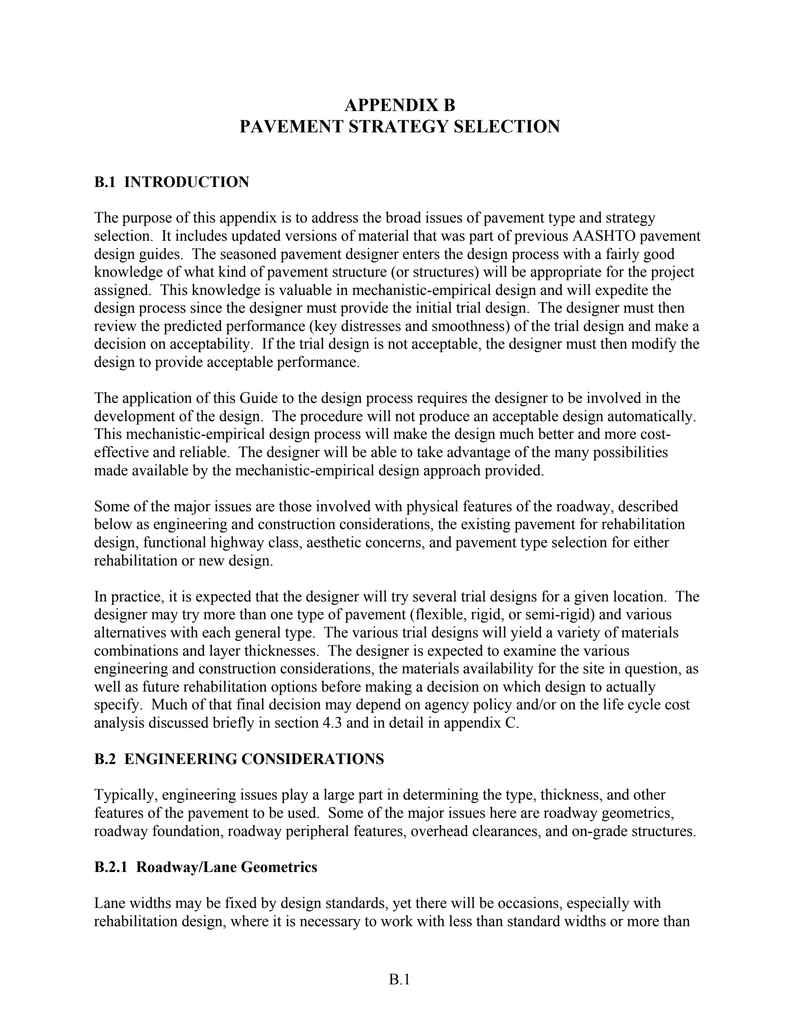
APPENDIX B PAVEMENT STRATEGY SELECTION
B.1 INTRODUCTION
The purpose of this appendix is to address the broad issues of pavement type and strategy selection. It includes updated versions of material that was part of previous AASHTO pavement design guides. The seasoned pavement designer enters the design process with a fairly good knowledge of what kind of pavement structure (or structures) will be appropriate for the project assigned. This knowledge is valuable in mechanistic-empirical design and will expedite the design process since the designer must provide the initial trial design. The designer must then review the predicted performance (key distresses and smoothness) of the trial design and make a decision on acceptability. If the trial design is not acceptable, the designer must then modify the design to provide acceptable performance.
The application of this Guide to the design process requires the designer to be involved in the development of the design. The procedure will not produce an acceptable design automatically. This mechanistic-empirical design process will make the design much better and more cost-effective and reliable. The designer will be able to take advantage of the many possibilities made available by the mechanistic-empirical design approach provided.
Some of the major issues are those involved with physical features of the roadway, described below as engineering and construction considerations, the existing pavement for rehabilitation design, functional highway class, aesthetic concerns, and pavement type selection for either rehabilitation or new design.
In practice, it is expected that the designer will try several trial designs for a given location. The designer may try more than one type of pavement (flexible, rigid, or semi-rigid) and various alternatives with each general type. The various trial designs will yield a variety of materials combinations and layer thicknesses. The designer is expected to examine the various engineering and construction considerations, the materials availability for the site in question, as well as future rehabilitation options before making a decision on which design to actually specify. Much of that final decision may depend on agency policy and/or on the life cycle cost analysis discussed briefly in section 4.3 and in detail in appendix C.
B.2 ENGINEERING CONSIDERATIONS
Typically, engineering issues play a large part in determining the type, thickness, and other features of the pavement to be used. Some of the major issues here are roadway geometrics, roadway foundation, roadway peripheral features, overhead clearances, and on-grade structures.
B.2.1 Roadway/Lane Geometrics
Lane widths may be fixed by design standards, yet there will be occasions, especially with rehabilitation design, where it is necessary to work with less than standard widths or more than
3
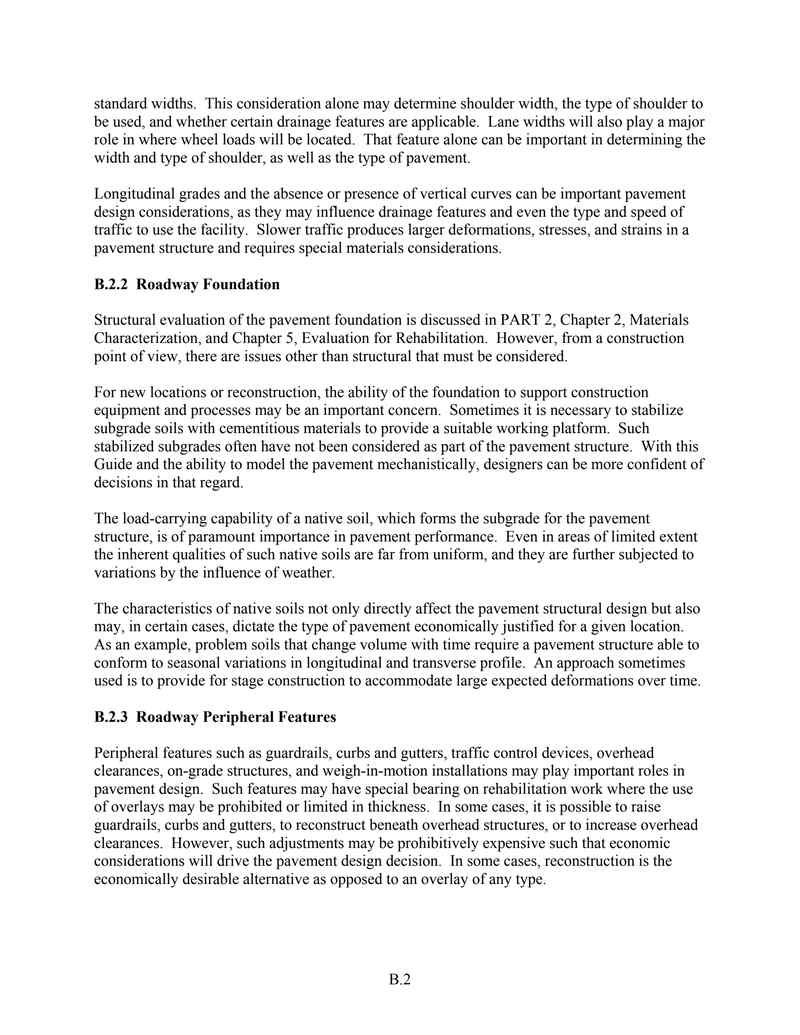
standard widths. This consideration alone may determine shoulder width, the type of shoulder to be used, and whether certain drainage features are applicable. Lane widths will also play a major role in where wheel loads will be located. That feature alone can be important in determining the width and type of shoulder, as well as the type of pavement.
Longitudinal grades and the absence or presence of vertical curves can be important pavement design considerations, as they may influence drainage features and even the type and speed of traffic to use the facility. Slower traffic produces larger deformations, stresses, and strains in a pavement structure and requires special materials considerations.
B.2.2 Roadway Foundation
Structural evaluation of the pavement foundation is discussed in PART 2, Chapter 2, Materials Characterization, and Chapter 5, Evaluation for Rehabilitation. However, from a construction point of view, there are issues other than structural that must be considered.
For new locations or reconstruction, the ability of the foundation to support construction equipment and processes may be an important concern. Sometimes it is necessary to stabilize subgrade soils with cementitious materials to provide a suitable working platform. Such stabilized subgrades often have not been considered as part of the pavement structure. With this Guide and the ability to model the pavement mechanistically, designers can be more confident of decisions in that regard.
The load-carrying capability of a native soil, which forms the subgrade for the pavement structure, is of paramount importance in pavement performance. Even in areas of limited extent the inherent qualities of such native soils are far from uniform, and they are further subjected to variations by the influence of weather.
The characteristics of native soils not only directly affect the pavement structural design but also may, in certain cases, dictate the type of pavement economically justified for a given location. As an example, problem soils that change volume with time require a pavement structure able to conform to seasonal variations in longitudinal and transverse profile. An approach sometimes used is to provide for stage construction to accommodate large expected deformations over time.
B.2.3 Roadway Peripheral Features
Peripheral features such as guardrails, curbs and gutters, traffic control devices, overhead clearances, on-grade structures, and weigh-in-motion installations may play important roles in pavement design. Such features may have special bearing on rehabilitation work where the use of overlays may be prohibited or limited in thickness. In some cases, it is possible to raise guardrails, curbs and gutters, to reconstruct beneath overhead structures, or to increase overhead clearances. However, such adjustments may be prohibitively expensive such that economic considerations will drive the pavement design decision. In some cases, reconstruction is the economically desirable alternative as opposed to an overlay of any type.
4
B.3 TRAFFIC CONSIDERATIONS
While the total volume of traffic affects the geometric requirements of the highway, the percentage of commercial traffic and frequency of heavy load applications have the major effect on the structural design of the pavement.
Traffic forecasts for design purposes have generally projected normal growth in the immediate corridor with an appropriate allowance for changes in land use and potential commercial and industrial development. However, experience over the past several decades has shown that the construction of new major highway facilities diverts large amounts of heavy traffic from other routes in a broad traffic corridor. This, coupled with a decline in the quantity of railroad services, has resulted in a considerable underestimation of traffic growth, particularly commercial traffic. Also, historically there have been increases in legal loads to which pavement structures are subjected during their design life. The result of all factors is that cumulative traffic has been badly underestimated on many pavements.
For these reasons, on pavement designs for major facilities agencies may wish to incorporate an appropriate standard deviation in the various components that make up the traffic estimation (e.g., growth rate of trucks). Agencies may choose to establish minimum structural requirements for all alternate pavement types to ensure adequate performance and service life for minor facilities where traffic is unknown. Alternate strategies comprised of various combinations of initial design, maintenance, and rehabilitation can be developed to provide equivalent service over a given period of time although the initial designs are not equivalent. Life cycle costs play a major role in evaluating the efficacy of such alternate strategies. For heavily trafficked facilities in congested locations, the need to minimize the disruptions and hazards to traffic (i.e., to minimize user costs) may dictate the selection of those strategies having long initial service life with little maintenance or rehabilitation designed at a high level of reliability. For these very heavily trafficked pavements, all possible modes of failure and risks should be considered and minimized to ensure a long-lasting and reliable pavement structure.
B.4 ENVIRONMENTAL CONSIDERATIONS
Weather affects the subgrade as well as the pavement-wearing course. The amount of rainfall, snow and ice, and frost penetration will seasonally influence the bearing capacity of subgrade materials. Moisture, freezing and thawing, and winter clearing operations will affect the performance and maintenance costs of pavement-wearing surfaces. These surfaces, in turn, will have some effect on the ease of winter clearing operations due to differences in thermal absorption or to the ability of the pavement to resist damage from snow and ice control equipment or materials. Each of these factors engenders "tradeoffs" the designer must consider.
Some designers, in the selection of a pavement strategy, will look to the performance of various pavements as experienced by other agencies. In drawing upon the performance of pavements elsewhere, it is most important to take into consideration the conditions pertaining to the particular environment. The climate model incorporated in this Guide will develop useful comparative information.
5
B.5 CONSTRUCTION CONSIDERATIONS
Stage construction can be mandated politically or because of special traffic handling considerations. For these reasons, stage construction may dictate the pavement strategy selected. Often, stage construction does not work well because the first stage of construction is allowed to deteriorate too much before the next stage is placed. This will result in early failure of the second stage.
Other considerations—such as speed of construction, accommodating traffic during construction, safety to traffic during construction, ease of replacement, anticipated future widening, seasons of the year when construction must be accomplished, and perhaps others—might have a strong influence on the strategy selections in specific cases.
Construction considerations can be especially important when the design of rehabilitation projects is underway. For example, limited overhead clearances may preclude an overlay or limit its thickness such that a type selection issue evolves. Other geometric factors, such as roadway width, guardrail heights and cut-fill slopes often impact the design decision.
B.5.1 Availability of Local Materials or Contractor Capabilities
The availability and adaptability of local material may influence the selection of pavement strategy. Also, the availability of commercially produced mixes and the equipment capabilities of area contractors may influence the selection, particularly on small projects.
B.5.2 Recycling
The opportunity to recycle material from an existing pavement structure or other sources may dictate the use of a particular strategy. Future recycling opportunities may also be considered. Because of advances in recycling technologies it may be possible to recycle one pavement type into another such that type selection becomes driven by economic or construction expediency considerations.
B.5.3 Conservation of Materials and Energy
Selection of a pavement strategy may be influenced by the criticality of materials supply as well as by the energy requirements of materials production. The construction energy requirements associated with various pavement types may be an additional consideration.
B.6 OTHER CONSIDERATIONS
B.6.1 Performance of Similar Pavements in the Area
To a large degree, the experience and judgment of the highway engineer is based on the performance of pavements in the immediate area of their jurisdiction. Past performance is a valuable guide, provided there is good correlation between conditions and service requirements of the reference pavements and the designs under study. As is always the case with projections,
预览内容由文件识别整理,表格、公式及文字请以原始文件为准。
原文图片预览
PAGE IMAGES

下载标准文件
appendix_B_Strategy
英语 · PDF · 6 页 · 255.17 KB