
标准信息
STANDARD INFORMATION- 标准编号
- appendix_A_Glossary
- 所属分类
- 其他国外标准与工程资料
- 文件语言
- 英语
- 文件格式
- 文件页数
- 6 页
- 文件大小
- 317.02 KB
· 更新:
标准简介
OVERVIEW中文简介
标准 appendix_A_Glossary 的预览内容
English summary
Preview of standard appendix_A_Glossary
以上为根据文件整理的内容简介。
标准内容预览
DOCUMENT PREVIEWdirection distribution factor
A factor describing the percentage of truck traffic traveling in a given direction on a roadway.
discount rate
The time value of money used as the means of comparing the alternative uses for funds by reducing the future expected costs or benefits to present-day terms. Discount rates are used to reduce various costs or benefits to their present worth or to uniform annual costs so that the economics of the various alternatives can be compared (approximately equals interest minus inflation).
dowel
A load transfer device across a joint (usually transverse joint) in a rigid slab, usually consisting of a plain cylindrical steel bar.
drainable granular subbase
A subbase constructed of compacted and crushed open-graded aggregate.
dynamic modulus (E*)
The relationship between stress and strain under continuous sinusoidal loading used to evaluate the elastic-viscoelastic response parameters of a material. The dynamic modulus of a material is typically defined as the absolute value of the complex modulus E*.
elastic layer theory
A mathematical process wherein the layers of a pavement structure are all assumed to behave elastically.
equivalent single axle load (ESAL)
A numerical factor that expresses the relationship of a given axle load to another axle load in terms of the relative effects of the two loads on the serviceability of a pavement structure. Often expressed in terms of 18,000-pound single axle loads.
expansion joint
A joint located to provide for expansion of a rigid slab, without damage to itself, adjacent slabs, or structures.
fatigue cracking
Cracking of the pavement surface as a result of repetitive loading; may be manifested as longitudinal or alligator cracking in the wheel paths for flexible pavement and transverse cracking (and sometimes longitudinal cracking) for jointed concrete pavement.
faulting
Elevation or depression of a PCC slab in relation to an adjoining slab, usually at transverse joints and cracks.
finite element analysis
The finite element method is one wherein rigorous mathematical solution, often employing complex differential equations, of an engineering problem is approximated algebraically. The geometry of the problem is described by discrete elements of finite dimensions that are analyzed through the application of engineering mechanics principles. Results of the finite element analyses are aggregated to approximate the exact mathematical solution.
flexible pavement
A pavement structure that maintains intimate contact with and distributes loads to the subgrade and depends on aggregate interlock, particle friction, and cohesion for stability.
friction number
The number that is used to report the results of pavement friction tests conducted in accordance with ASTM Standard E-274. Also, skid number.
gear load
loading applied to the pavement by a combination of tire loads
6
ACKNOWLEDGMENT OF SPONSORSHIP
This work was sponsored by the American Association of State Highway and Transportation Officials, in cooperation with the Federal Highway Administration, and was conducted in the National Cooperative Highway Research Program, which is administered by the Transportation Research Board of the National Research Council.
DISCLAIMER
This is the final draft as submitted by the research agency. The opinions and conclusions expressed or implied in the report are those of the research agency. They are not necessarily those of the Transportation Research Board, the National Research Council, the Federal Highway Administration, the American Association of State Highway and Transportation Officials, or the individual states participating in the National Cooperative Highway Research Program.
2
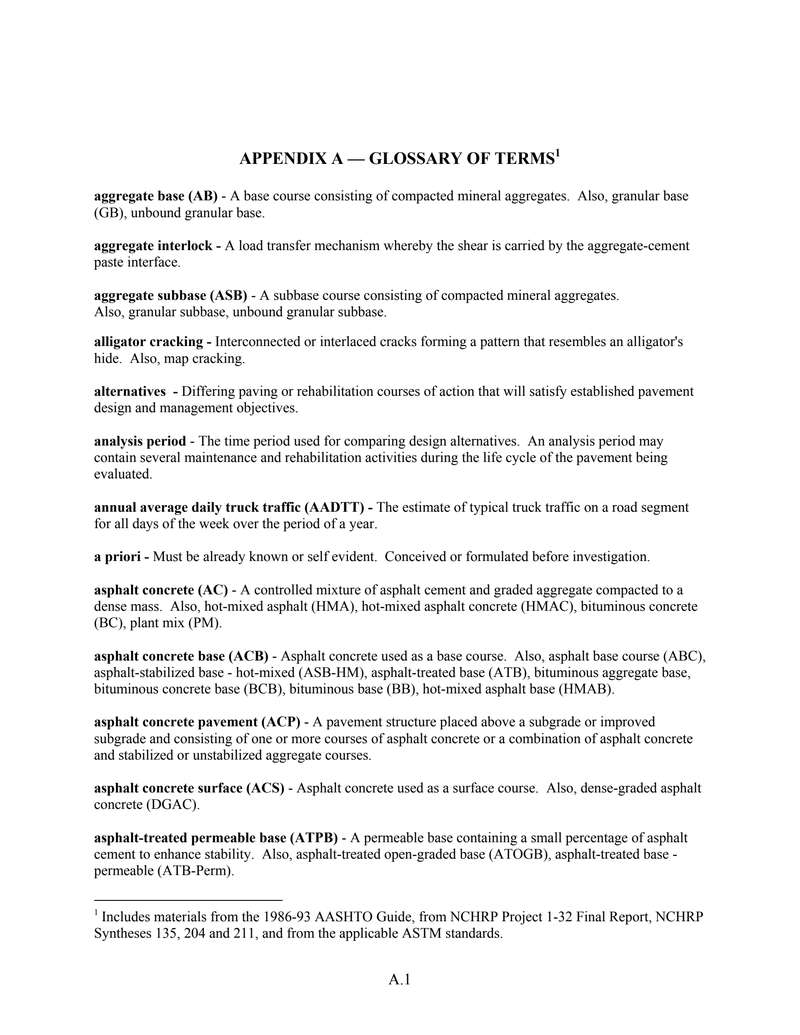
APPENDIX A — GLOSSARY OF TERMS1
aggregate base (AB) - A base course consisting of compacted mineral aggregates. Also, granular base (GB), unbound granular base.
aggregate interlock - A load transfer mechanism whereby the shear is carried by the aggregate-cement paste interface.
aggregate subbase (ASB) - A subbase course consisting of compacted mineral aggregates. Also, granular subbase, unbound granular subbase.
alligator cracking - Interconnected or interlaced cracks forming a pattern that resembles an alligator's hide. Also, map cracking.
alternatives - Differing paving or rehabilitation courses of action that will satisfy established pavement design and management objectives.
analysis period - The time period used for comparing design alternatives. An analysis period may contain several maintenance and rehabilitation activities during the life cycle of the pavement being evaluated.
annual average daily truck traffic (AADTT) - The estimate of typical truck traffic on a road segment for all days of the week over the period of a year.
a priori - Must be already known or self evident. Conceived or formulated before investigation.
asphalt concrete (AC) - A controlled mixture of asphalt cement and graded aggregate compacted to a dense mass. Also, hot-mixed asphalt (HMA), hot-mixed asphalt concrete (HMAC), bituminous concrete (BC), plant mix (PM).
asphalt concrete base (ACB) - Asphalt concrete used as a base course. Also, asphalt base course (ABC), asphalt-stabilized base - hot-mixed (ASB-HM), asphalt-treated base (ATB), bituminous aggregate base, bituminous concrete base (BCB), bituminous base (BB), hot-mixed asphalt base (HMAB).
asphalt concrete pavement (ACP) - A pavement structure placed above a subgrade or improved subgrade and consisting of one or more courses of asphalt concrete or a combination of asphalt concrete and stabilized or unstabilized aggregate courses.
asphalt concrete surface (ACS) - Asphalt concrete used as a surface course. Also, dense-graded asphalt concrete (DGAC).
asphalt-treated permeable base (ATPB) - A permeable base containing a small percentage of asphalt cement to enhance stability. Also, asphalt-treated open-graded base (ATOGB), asphalt-treated base - permeable (ATB-Perm).
1 Includes materials from the 1986-93 AASHTO Guide, from NCHRP Project 1-32 Final Report, NCHRP Syntheses 135, 204 and 211, and from the applicable ASTM standards.
3
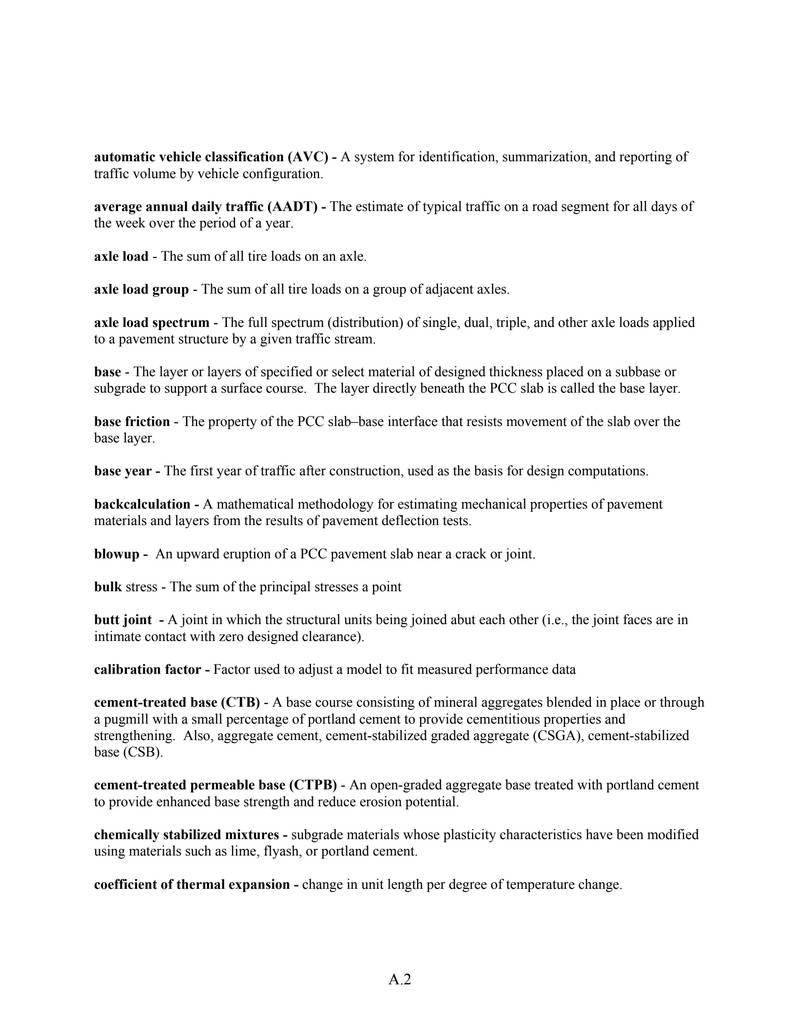
automatic vehicle classification (AVC) - A system for identification, summarization, and reporting of traffic volume by vehicle configuration.
average annual daily traffic (AADT) - The estimate of typical traffic on a road segment for all days of the week over the period of a year.
axle load - The sum of all tire loads on an axle.
axle load group - The sum of all tire loads on a group of adjacent axles.
axle load spectrum - The full spectrum (distribution) of single, dual, triple, and other axle loads applied to a pavement structure by a given traffic stream.
base - The layer or layers of specified or select material of designed thickness placed on a subbase or subgrade to support a surface course. The layer directly beneath the PCC slab is called the base layer.
base friction - The property of the PCC slab–base interface that resists movement of the slab over the base layer.
base year - The first year of traffic after construction, used as the basis for design computations.
backcalculation - A mathematical methodology for estimating mechanical properties of pavement materials and layers from the results of pavement deflection tests.
blowup - An upward eruption of a PCC pavement slab near a crack or joint.
bulk stress - The sum of the principal stresses a point
butt joint - A joint in which the structural units being joined abut each other (i.e., the joint faces are in intimate contact with zero designed clearance).
calibration factor - Factor used to adjust a model to fit measured performance data
cement-treated base (CTB) - A base course consisting of mineral aggregates blended in place or through a pugmill with a small percentage of portland cement to provide cementitious properties and strengthening. Also, aggregate cement, cement-stabilized graded aggregate (CSGA), cement-stabilized base (CSB).
cement-treated permeable base (CTPB) - An open-graded aggregate base treated with portland cement to provide enhanced base strength and reduce erosion potential.
chemically stabilized mixtures - subgrade materials whose plasticity characteristics have been modified using materials such as lime, flyash, or portland cement.
coefficient of thermal expansion - change in unit length per degree of temperature change.
4
Definitions
cold mix asphalt - asphalt concrete mixtures composed of aggregate and asphalt emulsions or cut-back asphalts which do not require heating during mixing.
composite pavement - A pavement structure composed of an asphalt concrete wearing surface and portland cement concrete slab; an asphalt concrete overlay on a PCC slab is also referred to as a composite pavement.
construction joint - For rigid pavements, a joint made necessary by a prolonged interruption in the placing of concrete. For a flexible pavement, a longitudinal joint between adjoining lanes paved separately or a transverse joint separating layers of different ages or paved at different times.
direction distribution factor
A factor describing the percentage of truck traffic traveling in a given direction on a roadway.
discount rate
The time value of money used as the means of comparing the alternative uses for funds by reducing the future expected costs or benefits to present-day terms. Discount rates are used to reduce various costs or benefits to their present worth or to uniform annual costs so that the economics of the various alternatives can be compared (approximately equals interest minus inflation).
dowel
A load transfer device across a joint (usually transverse joint) in a rigid slab, usually consisting of a plain cylindrical steel bar.
drainable granular subbase
A subbase constructed of compacted and crushed open-graded aggregate.
dynamic modulus (E*)
The relationship between stress and strain under continuous sinusoidal loading used to evaluate the elastic-viscoelastic response parameters of a material. The dynamic modulus of a material is typically defined as the absolute value of the complex modulus E*.
elastic layer theory
A mathematical process wherein the layers of a pavement structure are all assumed to behave elastically.
equivalent single axle load (ESAL)
A numerical factor that expresses the relationship of a given axle load to another axle load in terms of the relative effects of the two loads on the serviceability of a pavement structure. Often expressed in terms of 18,000-pound single axle loads.
expansion joint
A joint located to provide for expansion of a rigid slab, without damage to itself, adjacent slabs, or structures.
fatigue cracking
Cracking of the pavement surface as a result of repetitive loading; may be manifested as longitudinal or alligator cracking in the wheel paths for flexible pavement and transverse cracking (and sometimes longitudinal cracking) for jointed concrete pavement.
faulting
Elevation or depression of a PCC slab in relation to an adjoining slab, usually at transverse joints and cracks.
finite element analysis
The finite element method is one wherein rigorous mathematical solution, often employing complex differential equations, of an engineering problem is approximated algebraically. The geometry of the problem is described by discrete elements of finite dimensions that are analyzed through the application of engineering mechanics principles. Results of the finite element analyses are aggregated to approximate the exact mathematical solution.
flexible pavement
A pavement structure that maintains intimate contact with and distributes loads to the subgrade and depends on aggregate interlock, particle friction, and cohesion for stability.
friction number
The number that is used to report the results of pavement friction tests conducted in accordance with ASTM Standard E-274. Also, skid number.
gear load
loading applied to the pavement by a combination of tire loads
6
预览内容由文件识别整理,表格、公式及文字请以原始文件为准。
原文图片预览
PAGE IMAGES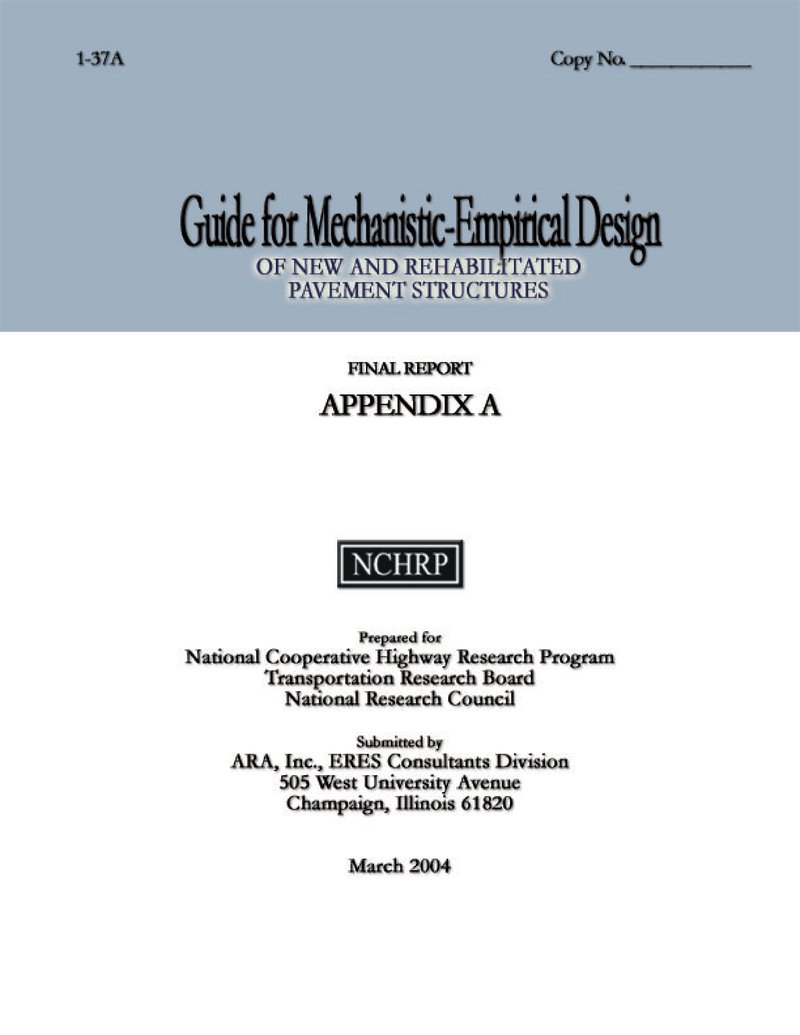

下载标准文件
appendix_A_Glossary
英语 · PDF · 6 页 · 317.02 KB