Part3_Chapter7_PCC Rehab
Part3_Chapter7_PCC Rehab
Part3_Chapter7_PCC Rehab
标准信息
STANDARD INFORMATION- 标准编号
- Part3_Chapter7_PCC Rehab
- 所属分类
- 其他国外标准与工程资料
- 文件语言
- 英语
- 文件格式
- 文件页数
- 6 页
- 文件大小
- 1.72 MB
· 更新:
标准简介
OVERVIEW中文简介
标准 Part3_Chapter7_PCC Rehab 的预览内容
English summary
Preview of standard Part3_Chapter7_PCC Rehab
以上为根据文件整理的内容简介。
标准内容预览
DOCUMENT PREVIEW- Step 5: Rehabilitation strategy selection (PART 3, Chapter 5).
- Step 6: Rehabilitation design (PART 3, Chapter 7).
- Step 7: Perform life cycle cost analysis (as desired).
- Step 8: Determine non-monetary factors that influence rehabilitation (as desired).
- Step 9: Determine preferred rehabilitation strategy (as desired).
Figure 3.7.2 presents a summary of the specific activities that constitute rehabilitation design and that are presented in this chapter. Figures 3.7.1 and 3.7.2 show a general commonality in the design of a rehabilitation strategy. There are, however, some important differences in rehabilitation design for different strategies.
Figure 3.7.2. Overall design process for major PCC rehabilitation strategies.
3.7.2.1 Concrete Pavement Restoration (CPR) of JPCP
Several non-overlay rehabilitation treatments are utilized on existing JPCP to restore both functionality and structural capacity. In this Guide, a total package of rehabilitation treatments, CPR, is considered to restore a deteriorated JPCP to adequate levels of functionality and to restore the pavement's load carrying capacity.
Some of the commonly used treatments are presented in table 3.7.1. The performance of the individual CPR treatments listed is directly related to:
- Adequacy of preliminary assessment of condition and identification of needed treatments to repair and prevent further deterioration.
- Timing of the CPR work (or condition of existing pavement when applied).
- Quality of construction and materials.
6
ACKNOWLEDGMENT OF SPONSORSHIP
This work was sponsored by the American Association of State Highway and Transportation Officials, in cooperation with the Federal Highway Administration, and was conducted in the National Cooperative Highway Research Program, which is administered by the Transportation Research Board of the National Research Council.
DISCLAIMER
This is the final draft as submitted by the research agency. The opinions and conclusions expressed or implied in the report are those of the research agency. They are not necessarily those of the Transportation Research Board, the National Research Council, the Federal Highway Administration, the American Association of State Highway and Transportation Officials, or the individual states participating in the National Cooperative Highway Research Program.
2
PART 3—DESIGN ANALYSIS
CHAPTER 7
PCC REHABILITATION DESIGN OF EXISTING PAVEMENTS
3.7.1 INTRODUCTION
This chapter describes the mechanistic-empirical design procedures for rehabilitation of existing flexible, rigid, and composite pavements with portland cement concrete (PCC). Lane additions and widening of narrow lanes are also considered. Note that many aspects of rehabilitation design are similar to new design, and this chapter often references PART 3, Chapter 4 to avoid duplication. For this reason, the designer should become familiar with PART 3, Chapter 4 prior to using this chapter for design of rehabilitation of existing pavements with PCC.
3.7.1.1 Background
PCC can be used to remedy functional or structural deficiencies of all types of existing pavements. It is important for the designer to consider several aspects, including the type of deterioration present, before determining the appropriate rehabilitation strategy to adopt. Several different rehabilitation strategies using PCC can be applied to existing pavements to extend their useful service life. These range from the combination of repair and preventive treatments such as full-depth repair and diamond grinding of existing jointed plain concrete pavement (JPCP) to the placement of unbonded JPCP or continuously reinforced concrete pavement (CRCP) overlays over existing flexible, composite, or rigid pavements, to the placement of bonded PCC overlays over existing JPCP or CRCP, to the reconstruction (including adding additional lanes) of existing pavements with JPCP or CRCP as described in PART 3, Chapter 5 of this Guide. These strategies are commonly used to remedy functional, structural, or other inadequacies.
3.7.1.2 Scope
This chapter presents detailed design procedures for the following PCC rehabilitation strategies:
- Design of concrete pavement restoration (CPR) for JPCP.
- Design of unbonded JPCP or CRCP overlays over existing rigid and composite pavements.
- Design of bonded PCC overlays over existing JPCP or CRCP.
- Design of conventional JPCP or CRCP overlays over existing flexible pavements.
In addition, general guidelines are provided for design of additional traffic lanes. However, the detailed design is provided in PART 3, Chapter 4. The design of ultra-thin concrete overlays of existing asphalt pavements is not covered in this Guide. The American Concrete Pavement Association (ACPA) Technical Bulletin TB009P, Guidelines for Concrete Overlays over Existing Asphalt Pavements, provides guidance for this design (1). Throughout this chapter, bonded PCC over existing JPCP or CRCP overlays are generally described as bonded JPCP and CRCP overlays. Also, conventional JPCP or CRCP overlays over existing flexible pavements are described as JPCP or CRCP overlays over existing flexible pavements.
3
3.7.1.3 Organization
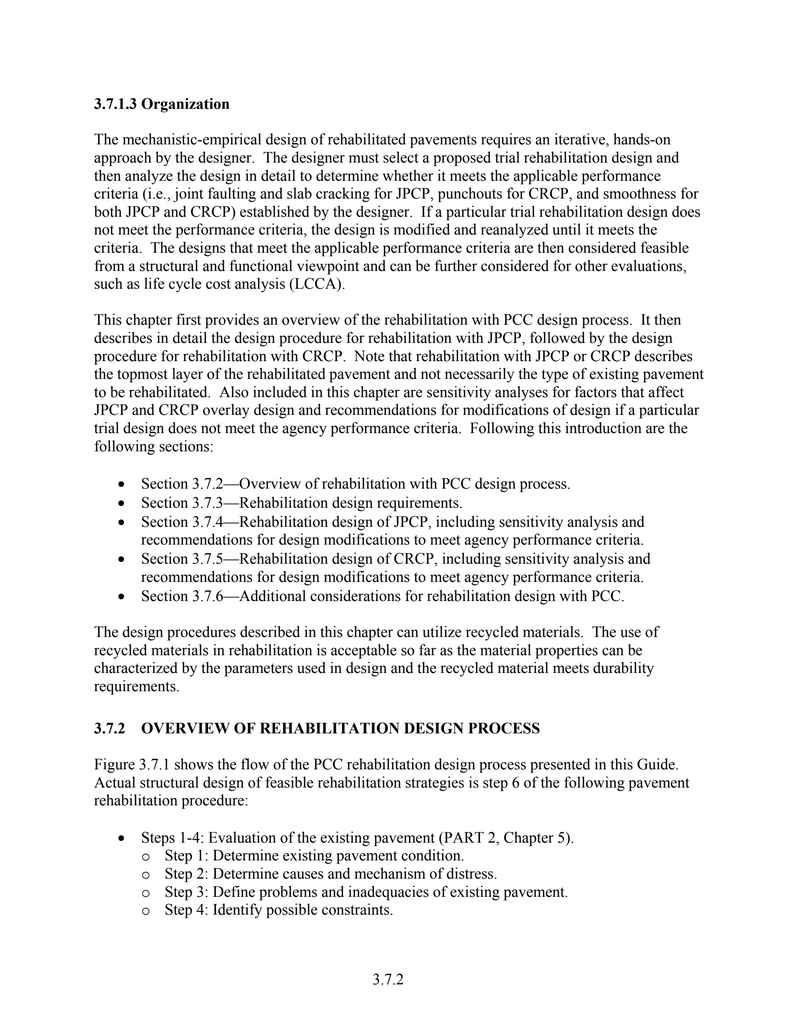
The mechanistic-empirical design of rehabilitated pavements requires an iterative, hands-on approach by the designer. The designer must select a proposed trial rehabilitation design and then analyze the design in detail to determine whether it meets the applicable performance criteria (i.e., joint faulting and slab cracking for JPCP, punchouts for CRCP, and smoothness for both JPCP and CRCP) established by the designer. If a particular trial rehabilitation design does not meet the performance criteria, the design is modified and reanalyzed until it meets the criteria. The designs that meet the applicable performance criteria are then considered feasible from a structural and functional viewpoint and can be further considered for other evaluations, such as life cycle cost analysis (LCCA).
This chapter first provides an overview of the rehabilitation with PCC design process. It then describes in detail the design procedure for rehabilitation with JPCP, followed by the design procedure for rehabilitation with CRCP. Note that rehabilitation with JPCP or CRCP describes the topmost layer of the rehabilitated pavement and not necessarily the type of existing pavement to be rehabilitated. Also included in this chapter are sensitivity analyses for factors that affect JPCP and CRCP overlay design and recommendations for modifications of design if a particular trial design does not meet the agency performance criteria. Following this introduction are the following sections:
- Section 3.7.2—Overview of rehabilitation with PCC design process.
- Section 3.7.3—Rehabilitation design requirements.
- Section 3.7.4—Rehabilitation design of JPCP, including sensitivity analysis and recommendations for design modifications to meet agency performance criteria.
- Section 3.7.5—Rehabilitation design of CRCP, including sensitivity analysis and recommendations for design modifications to meet agency performance criteria.
- Section 3.7.6—Additional considerations for rehabilitation design with PCC.
The design procedures described in this chapter can utilize recycled materials. The use of recycled materials in rehabilitation is acceptable so far as the material properties can be characterized by the parameters used in design and the recycled material meets durability requirements.
3.7.2 OVERVIEW OF REHABILITATION DESIGN PROCESS
Figure 3.7.1 shows the flow of the PCC rehabilitation design process presented in this Guide. Actual structural design of feasible rehabilitation strategies is step 6 of the following pavement rehabilitation procedure:
- Steps 1-4: Evaluation of the existing pavement (PART 2, Chapter 5).
- Step 1: Determine existing pavement condition.
- Step 2: Determine causes and mechanism of distress.
- Step 3: Define problems and inadequacies of existing pavement.
- Step 4: Identify possible constraints.
4
Figure 3.7.1. Overall PCC rehabilitation design process.
5
- Step 5: Rehabilitation strategy selection (PART 3, Chapter 5).
- Step 6: Rehabilitation design (PART 3, Chapter 7).
- Step 7: Perform life cycle cost analysis (as desired).
- Step 8: Determine non-monetary factors that influence rehabilitation (as desired).
- Step 9: Determine preferred rehabilitation strategy (as desired).
Figure 3.7.2 presents a summary of the specific activities that constitute rehabilitation design and that are presented in this chapter. Figures 3.7.1 and 3.7.2 show a general commonality in the design of a rehabilitation strategy. There are, however, some important differences in rehabilitation design for different strategies.
Figure 3.7.2. Overall design process for major PCC rehabilitation strategies.
3.7.2.1 Concrete Pavement Restoration (CPR) of JPCP
Several non-overlay rehabilitation treatments are utilized on existing JPCP to restore both functionality and structural capacity. In this Guide, a total package of rehabilitation treatments, CPR, is considered to restore a deteriorated JPCP to adequate levels of functionality and to restore the pavement's load carrying capacity.
Some of the commonly used treatments are presented in table 3.7.1. The performance of the individual CPR treatments listed is directly related to:
- Adequacy of preliminary assessment of condition and identification of needed treatments to repair and prevent further deterioration.
- Timing of the CPR work (or condition of existing pavement when applied).
- Quality of construction and materials.
6
预览内容由文件识别整理,表格、公式及文字请以原始文件为准。
原文图片预览
PAGE IMAGES

下载标准文件
Part3_Chapter7_PCC Rehab
英语 · PDF · 6 页 · 1.72 MB