Part3_Chapter5_Rehab_Selection
Part3_Chapter5_Rehab_Selection
Part3_Chapter5_Rehab_Selection
标准信息
STANDARD INFORMATION- 标准编号
- Part3_Chapter5_Rehab_Selection
- 所属分类
- 其他国外标准与工程资料
- 文件语言
- 英语
- 文件格式
- 文件页数
- 6 页
- 文件大小
- 561.8 KB
· 更新:
标准简介
OVERVIEW中文简介
标准 Part3_Chapter5_Rehab_Selection 的预览内容
English summary
Preview of standard Part3_Chapter5_Rehab_Selection
以上为根据文件整理的内容简介。
标准内容预览
DOCUMENT PREVIEWStructural overlays fall into four basic categories:
- HMAC overlay over an existing flexible pavement.
- HMAC overlay over an existing rigid pavement.
- HMAC overlay over an existing composite pavement.
- Bonded or unbonded JPCP and CRCP over existing rigid or composite pavement.
- PCC overlay over an existing flexible pavement.
The PCC overlays fall into two subcategories, bonded and unbonded. Brief descriptions of the various structural overlay types are presented in the following sections (1, 3, 4). Note that recycling of one or more pavement layers should be considered for any type of rehabilitation.
HMAC Overlays.
Typically, an HMAC overlay of a flexible pavement (HMAC/HMAC), an AC overlay of a rigid pavement (AC/PCC), or an AC overlay of a composite pavement (HMAC/HMAC /PCC) is placed to improve the ride quality, surface friction, or to substantially increase the structural capacity of the existing pavement. A variety of alternative HMAC mixtures exist as described in PART 2, Chapter 2. The designer must carefully select the most appropriate mixture given the level of traffic and the climate where the project is located.
HMAC over Existing Flexible Pavement
An HMAC overlay of an existing flexible pavement may be placed to improve ride quality and/or surface friction, or may be placed for the purpose of substantially increasing structural capacity. A thin AC overlay is appropriate for existing pavements with functional inadequacies only such as insufficient smoothness, poor surface friction, excessive rutting, and distresses such as bleeding, weathering, raveling, bumps, settlement, and heaves (5).
A thicker HMAC overlay is appropriate for exiting pavements with insufficient structural capacity for anticipated future traffic. HMAC overlays placed to correct structural inadequacies will also correct functional inadequacies. A thin functional overlay should not be placed when a structural deficiency exists.
HMAC over Existing Rigid or Existing Composite Pavement (Intact PCC Slab)
An HMAC overlay of a rigid or composite pavement may improve ride quality and/or surface friction, or may be placed for the purpose of substantially increasing structural capacity. A relatively thin HMAC overlay (e.g., 1 to 3 in) is appropriate for existing pavements with functional inadequacies only, such as excessive loss of smoothness or poor surface friction. A thicker HMAC overlay is appropriate for existing pavements with insufficient structural capacity for anticipated future traffic (e.g., > 3 in). HMAC overlays placed to correct structural inadequacies will also correct functional inadequacies. HMAC overlays of existing rigid or composite pavements must be designed and constructed to withstand the development of reflection cracking because it is the most common form of premature failure for such rehabilitation. Existing rigid or composite pavements with excessive amounts of deteriorated cracks or joints may not be the best candidates for HMAC overlays (5).
HMAC over Fractured Concrete Pavement
The existing PCC pavement can be fractured to address the problem of reflection cracking. Fracturing the slab may be performed to reduce
6
ACKNOWLEDGMENT OF SPONSORSHIP
This work was sponsored by the American Association of State Highway and Transportation Officials, in cooperation with the Federal Highway Administration, and was conducted in the National Cooperative Highway Research Program, which is administered by the Transportation Research Board of the National Research Council.
DISCLAIMER
This is the final draft as submitted by the research agency. The opinions and conclusions expressed or implied in the report are those of the research agency. They are not necessarily those of the Transportation Research Board, the National Research Council, the Federal Highway Administration, the American Association of State Highway and Transportation Officials, or the individual states participating in the National Cooperative Highway Research Program.
2
PART 3—DESIGN ANALYSIS
CHAPTER 5
IDENTIFICATION OF FEASIBLE REHABILITATION STRATEGIES
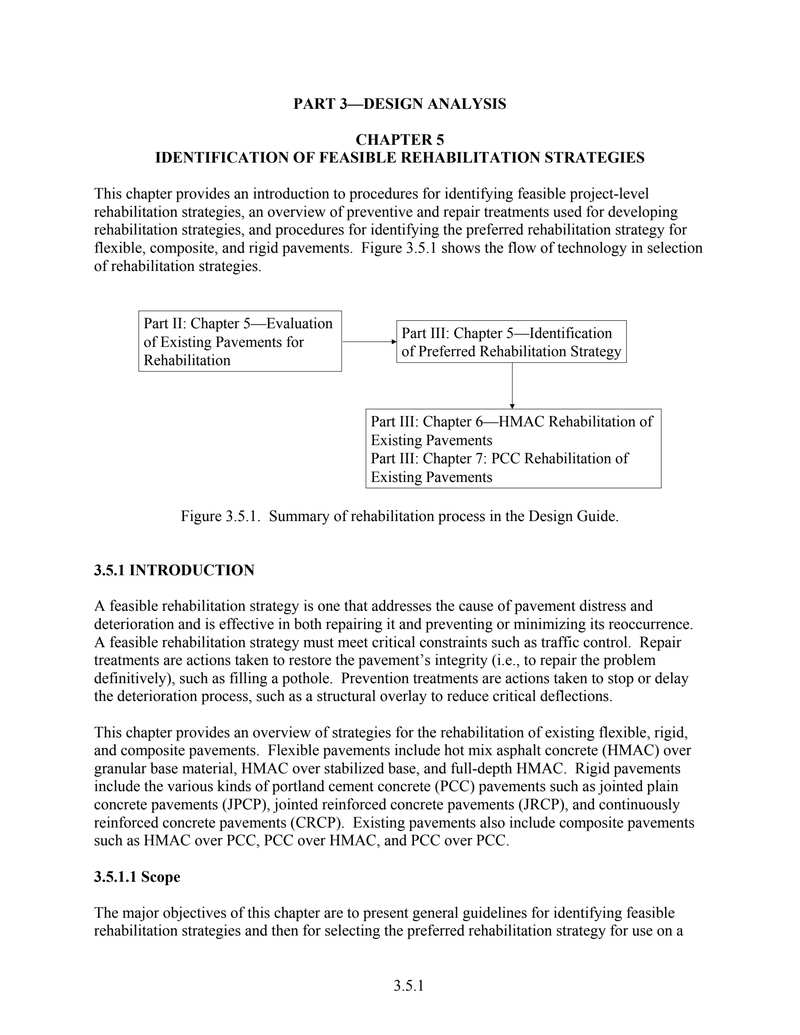
This chapter provides an introduction to procedures for identifying feasible project-level rehabilitation strategies, an overview of preventive and repair treatments used for developing rehabilitation strategies, and procedures for identifying the preferred rehabilitation strategy for flexible, composite, and rigid pavements. Figure 3.5.1 shows the flow of technology in selection of rehabilitation strategies.
Figure 3.5.1. Summary of rehabilitation process in the Design Guide.
3.5.1 INTRODUCTION
A feasible rehabilitation strategy is one that addresses the cause of pavement distress and deterioration and is effective in both repairing it and preventing or minimizing its reoccurrence. A feasible rehabilitation strategy must meet critical constraints such as traffic control. Repair treatments are actions taken to restore the pavement's integrity (i.e., to repair the problem definitively), such as filling a pothole. Prevention treatments are actions taken to stop or delay the deterioration process, such as a structural overlay to reduce critical deflections.
This chapter provides an overview of strategies for the rehabilitation of existing flexible, rigid, and composite pavements. Flexible pavements include hot mix asphalt concrete (HMAC) over granular base material, HMAC over stabilized base, and full-depth HMAC. Rigid pavements include the various kinds of portland cement concrete (PCC) pavements such as jointed plain concrete pavements (JPCP), jointed reinforced concrete pavements (JRCP), and continuously reinforced concrete pavements (CRCP). Existing pavements also include composite pavements such as HMAC over PCC, PCC over HMAC, and PCC over PCC.
3.5.1.1 Scope
The major objectives of this chapter are to present general guidelines for identifying feasible rehabilitation strategies and then for selecting the preferred rehabilitation strategy for use on a
3
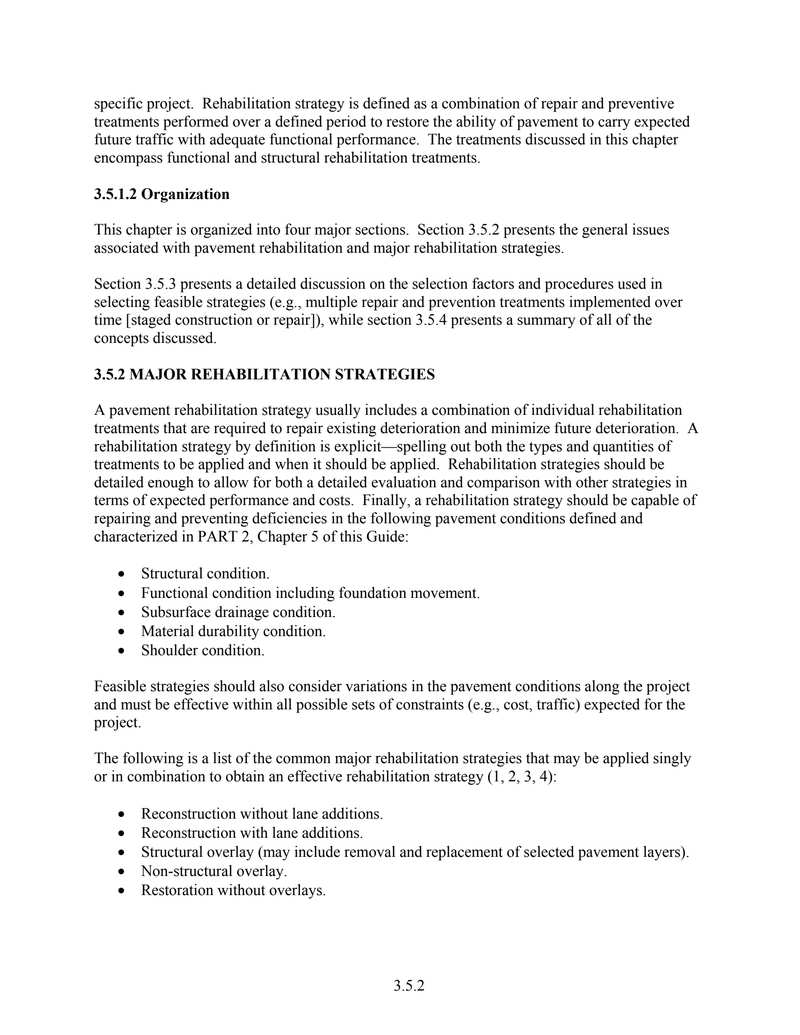
specific project. Rehabilitation strategy is defined as a combination of repair and preventive treatments performed over a defined period to restore the ability of pavement to carry expected future traffic with adequate functional performance. The treatments discussed in this chapter encompass functional and structural rehabilitation treatments.
3.5.1.2 Organization
This chapter is organized into four major sections. Section 3.5.2 presents the general issues associated with pavement rehabilitation and major rehabilitation strategies.
Section 3.5.3 presents a detailed discussion on the selection factors and procedures used in selecting feasible strategies (e.g., multiple repair and prevention treatments implemented over time [staged construction or repair]), while section 3.5.4 presents a summary of all of the concepts discussed.
3.5.2 MAJOR REHABILITATION STRATEGIES
A pavement rehabilitation strategy usually includes a combination of individual rehabilitation treatments that are required to repair existing deterioration and minimize future deterioration. A rehabilitation strategy by definition is explicit—spelling out both the types and quantities of treatments to be applied and when it should be applied. Rehabilitation strategies should be detailed enough to allow for both a detailed evaluation and comparison with other strategies in terms of expected performance and costs. Finally, a rehabilitation strategy should be capable of repairing and preventing deficiencies in the following pavement conditions defined and characterized in PART 2, Chapter 5 of this Guide:
- Structural condition.
- Functional condition including foundation movement.
- Subsurface drainage condition.
- Material durability condition.
- Shoulder condition.
Feasible strategies should also consider variations in the pavement conditions along the project and must be effective within all possible sets of constraints (e.g., cost, traffic) expected for the project.
The following is a list of the common major rehabilitation strategies that may be applied singly or in combination to obtain an effective rehabilitation strategy (1, 2, 3, 4):
- Reconstruction without lane additions.
- Reconstruction with lane additions.
- Structural overlay (may include removal and replacement of selected pavement layers).
- Non-structural overlay.
- Restoration without overlays.
4
3.5.2.1 Reconstruction with/without Lane Additions
Engineers should also take advantage of recent advances in research into the properties of recovered paving materials and industrial byproducts that has made it possible to apply these materials—recycling—in pavement reconstruction and overlay construction.
Overall rehabilitation strategy usually consists of various combinations treatments commonly applied during rehabilitation. Each major strategy is briefly described in the next few sections.
Reconstruction is the most invasive rehabilitation option; however, it may be the most cost-effective if life cycle costs are considered. Reconstruction may be applied to existing flexible, rigid, and composite pavements. It is most suitable for flexible pavements with high-severity load-related distress such as fatigue cracking or rutting or material durability problems such as stripping. For rigid pavements, reconstruction is most appropriate for pavements with a high percentage of cracked slabs, a high percentage of deteriorated joints, inadequate subgrade or foundation support, or material-related distresses such as D-cracking. Reconstruction is also feasible for both flexible and rigid pavements exhibiting major foundation movements and frost heave where the upper subgrade material must be replaced (3, 4).
Reconstruction usually involves the removal and replacement of parts of the pavement, (e.g., removal and replacement of a single lane), the complete removal of the entire pavement (including support layers), removal and replacement of shorter areas, or the addition of extra lanes to an existing pavement with or without reconstruction of the existing pavement. When only one or two lanes are removed from an existing multi-lane pavement for reconstruction, the replacement pavement is called an inlay. Recycled materials from the existing pavement may be used in reconstruction (3, 4, 5).
One other form of rehabilitation is widening of old narrow pavement cross-sections. This is a very challenging design because it requires the matching of an already existing pavement with an entirely new structure with the new structure performing a closely to the existing pavement as possible so that there is uniform performance across the widened traffic lane. Designing is even more difficult when constraints forces the new outer wheel path to fall directly on the widened longitudinal joint. In most situations, failure along the joint is inevitable unless a good structural design is performed.
3.5.2.2 Rehabilitation with Structural Overlay
Structural overlays represent a wide variety of treatments to rehabilitate a pavement. They are used when the pavement has medium to high levels of load-related distress, which would make the use of preventive maintenance/repair treatments too expensive or ineffective. Structural overlays for flexible, rigid, and composite pavements are placed for the purpose of substantially increasing existing pavement structural capacity.
3.5.3
5
Structural overlays fall into four basic categories:
- HMAC overlay over an existing flexible pavement.
- HMAC overlay over an existing rigid pavement.
- HMAC overlay over an existing composite pavement.
- Bonded or unbonded JPCP and CRCP over existing rigid or composite pavement.
- PCC overlay over an existing flexible pavement.
The PCC overlays fall into two subcategories, bonded and unbonded. Brief descriptions of the various structural overlay types are presented in the following sections (1, 3, 4). Note that recycling of one or more pavement layers should be considered for any type of rehabilitation.
HMAC Overlays.
Typically, an HMAC overlay of a flexible pavement (HMAC/HMAC), an AC overlay of a rigid pavement (AC/PCC), or an AC overlay of a composite pavement (HMAC/HMAC /PCC) is placed to improve the ride quality, surface friction, or to substantially increase the structural capacity of the existing pavement. A variety of alternative HMAC mixtures exist as described in PART 2, Chapter 2. The designer must carefully select the most appropriate mixture given the level of traffic and the climate where the project is located.
HMAC over Existing Flexible Pavement
An HMAC overlay of an existing flexible pavement may be placed to improve ride quality and/or surface friction, or may be placed for the purpose of substantially increasing structural capacity. A thin AC overlay is appropriate for existing pavements with functional inadequacies only such as insufficient smoothness, poor surface friction, excessive rutting, and distresses such as bleeding, weathering, raveling, bumps, settlement, and heaves (5).
A thicker HMAC overlay is appropriate for exiting pavements with insufficient structural capacity for anticipated future traffic. HMAC overlays placed to correct structural inadequacies will also correct functional inadequacies. A thin functional overlay should not be placed when a structural deficiency exists.
HMAC over Existing Rigid or Existing Composite Pavement (Intact PCC Slab)
An HMAC overlay of a rigid or composite pavement may improve ride quality and/or surface friction, or may be placed for the purpose of substantially increasing structural capacity. A relatively thin HMAC overlay (e.g., 1 to 3 in) is appropriate for existing pavements with functional inadequacies only, such as excessive loss of smoothness or poor surface friction. A thicker HMAC overlay is appropriate for existing pavements with insufficient structural capacity for anticipated future traffic (e.g., > 3 in). HMAC overlays placed to correct structural inadequacies will also correct functional inadequacies. HMAC overlays of existing rigid or composite pavements must be designed and constructed to withstand the development of reflection cracking because it is the most common form of premature failure for such rehabilitation. Existing rigid or composite pavements with excessive amounts of deteriorated cracks or joints may not be the best candidates for HMAC overlays (5).
HMAC over Fractured Concrete Pavement
The existing PCC pavement can be fractured to address the problem of reflection cracking. Fracturing the slab may be performed to reduce
6
预览内容由文件识别整理,表格、公式及文字请以原始文件为准。
原文图片预览
PAGE IMAGES
下载标准文件
Part3_Chapter5_Rehab_Selection
英语 · PDF · 6 页 · 561.8 KB