Part3_Chapter4_Rigid Design
Part3_Chapter4_Rigid Design
Part3_Chapter4_Rigid Design
标准信息
STANDARD INFORMATION- 标准编号
- Part3_Chapter4_Rigid Design
- 所属分类
- 其他国外标准与工程资料
- 文件语言
- 英语
- 文件格式
- 文件页数
- 6 页
- 文件大小
- 3.27 MB
· 更新:
标准简介
OVERVIEW中文简介
标准 Part3_Chapter4_Rigid Design 的预览内容
English summary
Preview of standard Part3_Chapter4_Rigid Design
以上为根据文件整理的内容简介。
标准内容预览
DOCUMENT PREVIEWFigure 3.4.2. Overall design process for CRCP.
3.4.4
6
ACKNOWLEDGMENT OF SPONSORSHIP
This work was sponsored by the American Association of State Highway and Transportation Officials, in cooperation with the Federal Highway Administration, and was conducted in the National Cooperative Highway Research Program, which is administered by the Transportation Research Board of the National Research Council.
DISCLAIMER
This is the final draft as submitted by the research agency. The opinions and conclusions expressed or implied in the report are those of the research agency. They are not necessarily those of the Transportation Research Board, the National Research Council, the Federal Highway Administration, the American Association of State Highway and Transportation Officials, or the individual states participating in the National Cooperative Highway Research Program.
2
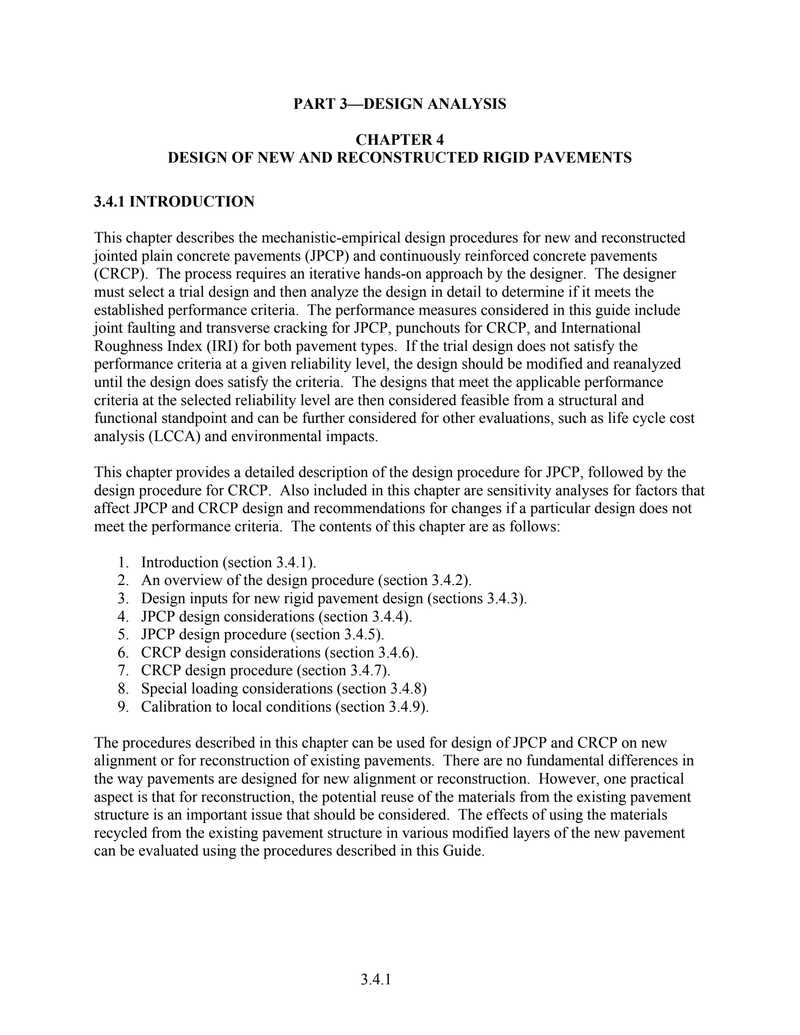
PART 3—DESIGN ANALYSIS
CHAPTER 4
DESIGN OF NEW AND RECONSTRUCTED RIGID PAVEMENTS
3.4.1 INTRODUCTION
This chapter describes the mechanistic-empirical design procedures for new and reconstructed jointed plain concrete pavements (JPCP) and continuously reinforced concrete pavements (CRCP). The process requires an iterative hands-on approach by the designer. The designer must select a trial design and then analyze the design in detail to determine if it meets the established performance criteria. The performance measures considered in this guide include joint faulting and transverse cracking for JPCP, punchouts for CRCP, and International Roughness Index (IRI) for both pavement types. If the trial design does not satisfy the performance criteria at a given reliability level, the design should be modified and reanalyzed until the design does satisfy the criteria. The designs that meet the applicable performance criteria at the selected reliability level are then considered feasible from a structural and functional standpoint and can be further considered for other evaluations, such as life cycle cost analysis (LCCA) and environmental impacts.
This chapter provides a detailed description of the design procedure for JPCP, followed by the design procedure for CRCP. Also included in this chapter are sensitivity analyses for factors that affect JPCP and CRCP design and recommendations for changes if a particular design does not meet the performance criteria. The contents of this chapter are as follows:
- Introduction (section 3.4.1).
- An overview of the design procedure (section 3.4.2).
- Design inputs for new rigid pavement design (sections 3.4.3).
- JPCP design considerations (section 3.4.4).
- JPCP design procedure (section 3.4.5).
- CRCP design considerations (section 3.4.6).
- CRCP design procedure (section 3.4.7).
- Special loading considerations (section 3.4.8)
- Calibration to local conditions (section 3.4.9).
The procedures described in this chapter can be used for design of JPCP and CRCP on new alignment or for reconstruction of existing pavements. There are no fundamental differences in the way pavements are designed for new alignment or reconstruction. However, one practical aspect is that for reconstruction, the potential reuse of the materials from the existing pavement structure is an important issue that should be considered. The effects of using the materials recycled from the existing pavement structure in various modified layers of the new pavement can be evaluated using the procedures described in this Guide.
3
3.4.2 OVERVIEW OF THE DESIGN PROCESS
The overall iterative design processes for JPCP and CRCP are illustrated in figures 3.4.1 and 3.4.2, respectively. The main steps include the following:
- Assemble a trial design for a specific site conditions including traffic, climate, and foundation—define layer arrangement, portland cement concrete (PCC) and other paving material properties, and design and construction features.
- Establish criteria for acceptable pavement performance at the end of the design period (i.e., acceptable levels of faulting and cracking for JPCP, punchouts for CRCP, and IRI for both).
- Select the desired level of reliability for each of the applicable performance indicators (e.g., select design reliability levels for cracking, faulting, and IRI for JPCP).
- Utilize design guide software to accomplish the following:
- a. Process input to obtain monthly values of traffic, material, and climatic inputs needed in the design evaluations for the entire design period.
- b. Compute structural responses (stresses and deflections) using finite element based rapid solution models for each axle type and load and for each damage-calculation increment throughout the design period.
- c. Calculate accumulated damage at each month of the entire design period.
- d. Predict key distresses (joint faulting, slab cracking, CRCP punchouts) month-by-month throughout the design period using the calibrated mechanistic-empirical performance models provided in the Guide.
- e. Predict smoothness (IRI) as a function of initial IRI, distresses that occur over time, and site factors at the end of each time increment.
- Evaluate the expected performance of the trial design at the given reliability level for adequacy.
- Modify the design and repeat the steps 4 through 5 above as necessary until the design does meet the established criteria.
The designs that satisfy the target performance criteria at the specified reliability are considered feasible from a structural and functional viewpoint and can be further considered for other evaluations, such as LCCA.
3.4.2.1 Design Inputs
Trial Design Inputs and Site Conditions
The design procedure offers the capability to consider a wide variety of structural layer arrangements (as illustrated in figure 3.4.3) and design features, including joint spacing, dowels, tied PCC shoulder, widened slabs, base type, and drainage. The design is accomplished iteratively by analyzing trial designs in detail to identify a design that satisfies the performance criteria (i.e., joint faulting, slab cracking, punchouts, IRI) over the analysis period. A trial design includes all details needed to perform design evaluations using the procedures prescribed in this Guide, including pavement layers, joint design, reinforcement design, and materials properties.
4
Figure 3.4.1. Overall design process for JPCP.
3.4.3
5
Figure 3.4.2. Overall design process for CRCP.
3.4.4
6
预览内容由文件识别整理,表格、公式及文字请以原始文件为准。
原文图片预览
PAGE IMAGES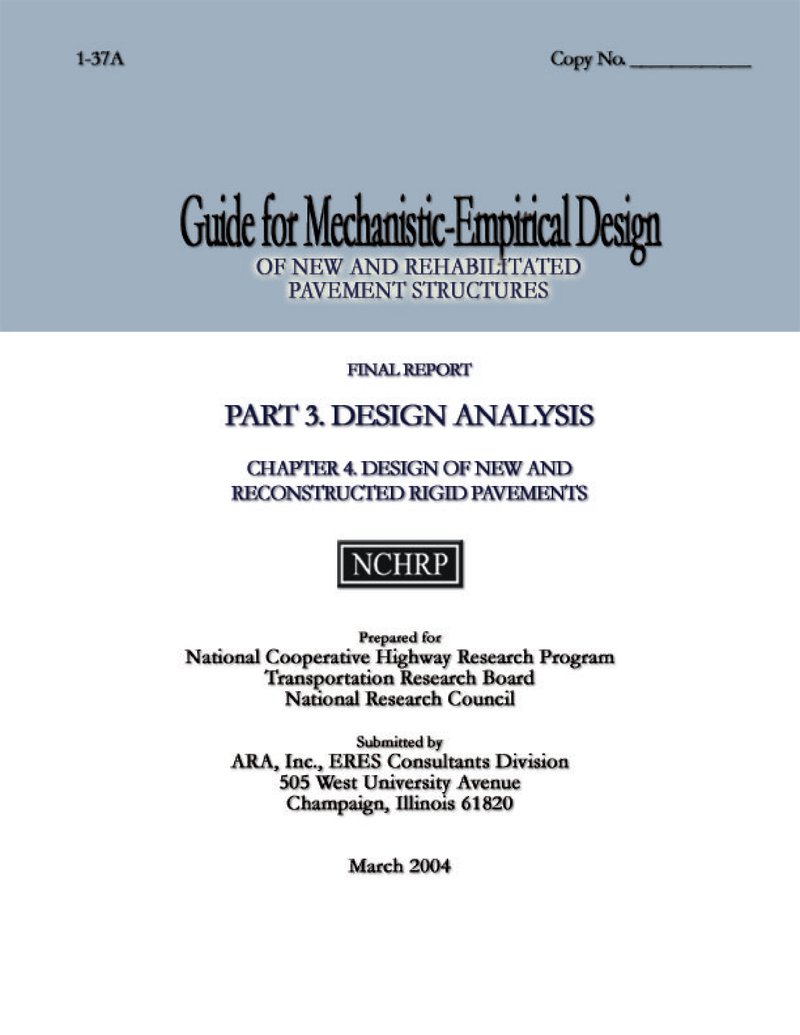


下载标准文件
Part3_Chapter4_Rigid Design
英语 · PDF · 6 页 · 3.27 MB