Part3_Chapter1_Subdrainage
Part3_Chapter1_Subdrainage
Part3_Chapter1_Subdrainage

标准信息
STANDARD INFORMATION- 标准编号
- Part3_Chapter1_Subdrainage
- 所属分类
- 其他国外标准与工程资料
- 文件语言
- 英语
- 文件格式
- 文件页数
- 6 页
- 文件大小
- 807.08 KB
· 更新:
标准简介
OVERVIEW中文简介
标准 Part3_Chapter1_Subdrainage 的预览内容
English summary
Preview of standard Part3_Chapter1_Subdrainage
以上为根据文件整理的内容简介。
标准内容预览
DOCUMENT PREVIEWpavements do not contain joints, they do develop cracks over time that should be sealed properly to prevent moisture intrusion.
3.1.2.2 Provide Moisture-Insensitive (Nonerodible) Materials
Another means of preventing moisture-accelerated damage is to use moisture-insensitive or nonerodible base materials that are less affected by the detrimental effects of moisture. However, although some materials can reduce or delay the detrimental effects of moisture, moisture-insensitive materials by themselves may not fully address moisture-related problems in pavements that are heavily loaded. A discussion on materials that are used often to reduce moisture-related damage is presented in this section.
Lean Concrete Base and Cement-Treated Base
Strong and nonerodible cement-stabilized materials can be effective in minimizing problems with pumping and faulting in PCC pavements. In addition to the conventional strength testing for durability, such materials should also be checked for resistance to moisture erosion. In general, the higher the cement content and compressive strength, the more resistant the material is to moisture damage. Obviously, high-quality crushed aggregates are also needed to ensure long-term durability.
When using cement stabilized base layers under jointed plain concrete pavements (JCPCP), two construction options are available. If bonding between the slab and base is allowed, notches should be cut in the base to match the joints in the JCPCP to prevent reflection cracking. If bonding is not allowed, an asphalt seal coat should be used between the slab and the base to serve as a shear-relief layer. Further, an aggregate subbase is recommended to prevent pumping and loss of fines from beneath the treated base on JCPCP in areas with adverse site conditions (e.g., high design traffic, wet climates, and high amounts of pumpable fines in the subgrade). The use of pavement design features such as widened lanes and dowel bars can sometimes obviate this requirement.
The erodibility class definitions of lean concrete base (LCB) and cement-treated base (CTB) materials for use in design can be found in PART 2, Chapter 2 of the Guide.
Asphalt-Treated Base
Hot-mix asphalt base materials can also be effective in minimizing moisture problems in HMA and PCC pavements. The stripping of asphalt binder, caused by many factors but particularly aggregate characteristics and inadequate film thicknesses, has been the biggest problem with asphalt-treated base (ATB) under PCC pavements. Therefore, just as with CTB, adequate film thickness of asphalt cement around the aggregates and quality aggregates are required in ATBs to ensure long-term durability. The treated asphalt layers should be constructed using high-quality aggregates, and the design should be consistent with that of a dense graded HMA base course layers defined in PART 2, Chapter 2 of the Guide. In general, high asphalt content ensures adequate film thicknesses around the aggregates, thereby increasing resistance to moisture. Laboratory testing should be conducted to ensure that the mix design and testing for stripping is adequate to withstand the effects of moisture.
6
ACKNOWLEDGMENT OF SPONSORSHIP
This work was sponsored by the American Association of State Highway and Transportation Officials, in cooperation with the Federal Highway Administration, and was conducted in the National Cooperative Highway Research Program, which is administered by the Transportation Research Board of the National Research Council.
DISCLAIMER
This is the final draft as submitted by the research agency. The opinions and conclusions expressed or implied in the report are those of the research agency. They are not necessarily those of the Transportation Research Board, the National Research Council, the Federal Highway Administration, the American Association of State Highway and Transportation Officials, or the individual states participating in the National Cooperative Highway Research Program.
2
PART 3—DESIGN ANALYSIS
CHAPTER 1
DRAINAGE
3.1.1 INTRODUCTION
As early as 1820, John McAdam noted that, regardless of the thickness of the structure, many roads in Great Britain deteriorated rapidly when the subgrade was saturated (1). It is widely recognized today that excess moisture in pavement layers, when combined with heavy truck traffic and moisture-susceptible materials, can reduce service life. Temperatures below freezing can also contribute to durability problems of saturated materials.
Moisture in the subgrade and the pavement structure can come from many different sources, as indicated in figure 3.1.1. Water may seep upward from a high groundwater table due to capillary suction or vapor movements, or it may flow laterally from the pavement edges and side ditches. Another source of water in pavements is surface infiltration of rain and meltwater through joints, cracks, shoulder edges, and various other defects, especially in older deteriorated pavements. Some studies have indicated that up to 40 percent of rainfall enters the pavement structure (2, 3, 4).
Figure 3.1.1. Sources of moisture in pavement systems.
Problems caused by prolonged exposure to excess moisture fall into three broad categories:
- Softening of pavement layers and subgrade as they become saturated and remain saturated for lengthy periods of time.
- Degradation of material quality from interaction with moisture.
- Loss of bond between pavement layers from saturation with moisture.
3
Moisture damage in pavements manifests itself in the form of moisture-caused and moisture-accelerated distresses. Moisture-caused distresses are those that are induced primarily by moisture, such as stripping of asphalt in flexible pavements and D-cracking in rigid pavements. Moisture-accelerated distresses are those that are initiated primarily by factors other than moisture (e.g., by wheel loads) but whose rate of deterioration is accelerated in the presence of moisture. Most pavement distresses worsen in the presence of moisture. Therefore, by corollary, if the entry of water into the structure is addressed adequately, it may be possible to extend pavement life by reducing the rate of progression of distress.
In recognition of the impact moisture can have on pavement performance, the AASHTO Design Guide incorporated an empirical drainage coefficient into the 1986 design equations. This coefficient increased awareness and encouraged design of pavements with permeable drainage layers.
In the design process presented in this Guide, the impact of moisture on the stiffness properties of unbound granular and subgrade materials is considered directly through the modeling of the interactions between climatic factors (rainfall and temperatures), groundwater fluctuations, and material characteristics of paving layers. In addition, the effect of moisture on base erodibility is considered for rigid pavement analysis and design (empirically). Further, for both flexible and rigid pavements, the effects of moisture on frost penetration and its subsequent impact on unbound base/subbase and subgrade structural properties are considered. Unlike previous versions of the AASHTO Guide, drainage coefficients such as mi (for flexible pavements) and Cd (for rigid pavements) will not be used. The changes to the layer strength and stiffness in the Guide procedure are predicted directly by the Enhanced Integrated Climatic Model (EICM) (PART 2, Chapter 3) based on the climatic, materials, and foundation inputs (including water table depth) for the design project under consideration. The incremental damage accumulation process described in PART 1, Chapter 1 makes it possible to consider seasonal changes in unbound layer and subgrade properties due to moisture and coupled moisture-temperature effects in predicting pavement distress. Therefore, using this approach, the benefits of incorporating drainage layers should be apparent in terms of the distresses predicted.
A point to note, however, is that the sensitivity of the distress prediction models to drainage considerations is limited to the performance data available for calibrating the distress models included in the Guide procedure. Considering that only a limited amount of performance data was available for sections incorporating permeable layers and edgedrains, additional work is needed to document the effect of positive drainage on pavement life.
3.1.2 GENERAL DESIGN CONSIDERATIONS FOR COMBATING MOISTURE
A major objective in pavement design should be to keep the base, subbase, subgrade, and other susceptible paving materials from becoming saturated or even being exposed to constant high moisture levels over time. Many engineers would also add hot mix asphalt (HMA) and portland cement concrete (PCC) to this list, as saturation and freezing have caused problems in the past with these materials. Four approaches commonly employed to control or reduce moisture problems are listed below:
4
3.1.2.1 Prevent Moisture from Entering the Pavement System
- Prevent moisture from entering the pavement system.
- Use materials that are insensitive to the effects of moisture.
- Incorporate design features to minimize moisture damage.
- Quickly remove moisture that enters the pavement system.
It is important to recognize that no approach can completely negate the effects of moisture on the pavement system under heavy traffic loads over many years. Thus, it is often necessary to employ a combination of approaches, particularly for heavy traffic loading conditions. Salient aspects of each of these approaches are discussed below.
Conceptually, the best approach for reducing the detrimental effects of moisture is to prevent moisture from entering the pavement system; however, moisture enters the pavement system from a variety of sources, and nothing can prevent it completely. Nevertheless, designers can minimize the amount of moisture entering the pavement system.
Pavement Geometry—Surface Drainage
An effective means for minimizing surface infiltration is to provide adequate cross-slopes and longitudinal slopes to drain water from the pavement surface quickly. The selection of appropriate pavement slopes is based on considerations such as user safety, profile economics, level of service, terrain, and vehicle operating characteristics. In general, the less time the water is allowed to stay on the pavement surface, the less moisture can infiltrate through joints and cracks. Minimum cross-slopes and longitudinal grades must be maintained to achieve this objective. The AASHTO geometric design manual, A Policy on Geometric Design of Highways and Streets, is the governing document on highway geometric design (5). A recent study, "Improved Surface Drainage of Pavements," proposed several changes to the current AASHTO geometric design policy to further reduce the risk of hydroplaning on new and rehabilitated pavements (6). According to this study, the risk of hydroplaning in pavements with design speeds exceeding 60 mph can be offset by adopting alternative pavement finishing techniques (grooving, tining, texture depth), using drainage appurtenances (slotted drains), or using alternative pavement materials (porous asphalt) in addition to maximizing the pavement slopes within feasible limits.
Joint and Crack Sealing
Another common approach to limit surface water in the pavement system is to seal all joints, cracks, and other discontinuities. Many agencies seal the joints on rigid pavements during initial construction. However, with time, the seal becomes damaged due to the opening and closing of the joints and other climatic effects. In addition, some cracks in all types of pavements may never be sealed, including the lane/shoulder longitudinal joint or crack. For this approach to be effective, all cracks must be sealed soon after they develop, and joints and cracks must be cleaned and resealed as often as necessary. Special attention must be paid to lane-lane and lane-shoulder longitudinal joints, as these are significant moisture entry points. Although HMA
5
pavements do not contain joints, they do develop cracks over time that should be sealed properly to prevent moisture intrusion.
3.1.2.2 Provide Moisture-Insensitive (Nonerodible) Materials
Another means of preventing moisture-accelerated damage is to use moisture-insensitive or nonerodible base materials that are less affected by the detrimental effects of moisture. However, although some materials can reduce or delay the detrimental effects of moisture, moisture-insensitive materials by themselves may not fully address moisture-related problems in pavements that are heavily loaded. A discussion on materials that are used often to reduce moisture-related damage is presented in this section.
Lean Concrete Base and Cement-Treated Base
Strong and nonerodible cement-stabilized materials can be effective in minimizing problems with pumping and faulting in PCC pavements. In addition to the conventional strength testing for durability, such materials should also be checked for resistance to moisture erosion. In general, the higher the cement content and compressive strength, the more resistant the material is to moisture damage. Obviously, high-quality crushed aggregates are also needed to ensure long-term durability.
When using cement stabilized base layers under jointed plain concrete pavements (JCPCP), two construction options are available. If bonding between the slab and base is allowed, notches should be cut in the base to match the joints in the JCPCP to prevent reflection cracking. If bonding is not allowed, an asphalt seal coat should be used between the slab and the base to serve as a shear-relief layer. Further, an aggregate subbase is recommended to prevent pumping and loss of fines from beneath the treated base on JCPCP in areas with adverse site conditions (e.g., high design traffic, wet climates, and high amounts of pumpable fines in the subgrade). The use of pavement design features such as widened lanes and dowel bars can sometimes obviate this requirement.
The erodibility class definitions of lean concrete base (LCB) and cement-treated base (CTB) materials for use in design can be found in PART 2, Chapter 2 of the Guide.
Asphalt-Treated Base
Hot-mix asphalt base materials can also be effective in minimizing moisture problems in HMA and PCC pavements. The stripping of asphalt binder, caused by many factors but particularly aggregate characteristics and inadequate film thicknesses, has been the biggest problem with asphalt-treated base (ATB) under PCC pavements. Therefore, just as with CTB, adequate film thickness of asphalt cement around the aggregates and quality aggregates are required in ATBs to ensure long-term durability. The treated asphalt layers should be constructed using high-quality aggregates, and the design should be consistent with that of a dense graded HMA base course layers defined in PART 2, Chapter 2 of the Guide. In general, high asphalt content ensures adequate film thicknesses around the aggregates, thereby increasing resistance to moisture. Laboratory testing should be conducted to ensure that the mix design and testing for stripping is adequate to withstand the effects of moisture.
6
预览内容由文件识别整理,表格、公式及文字请以原始文件为准。
原文图片预览
PAGE IMAGES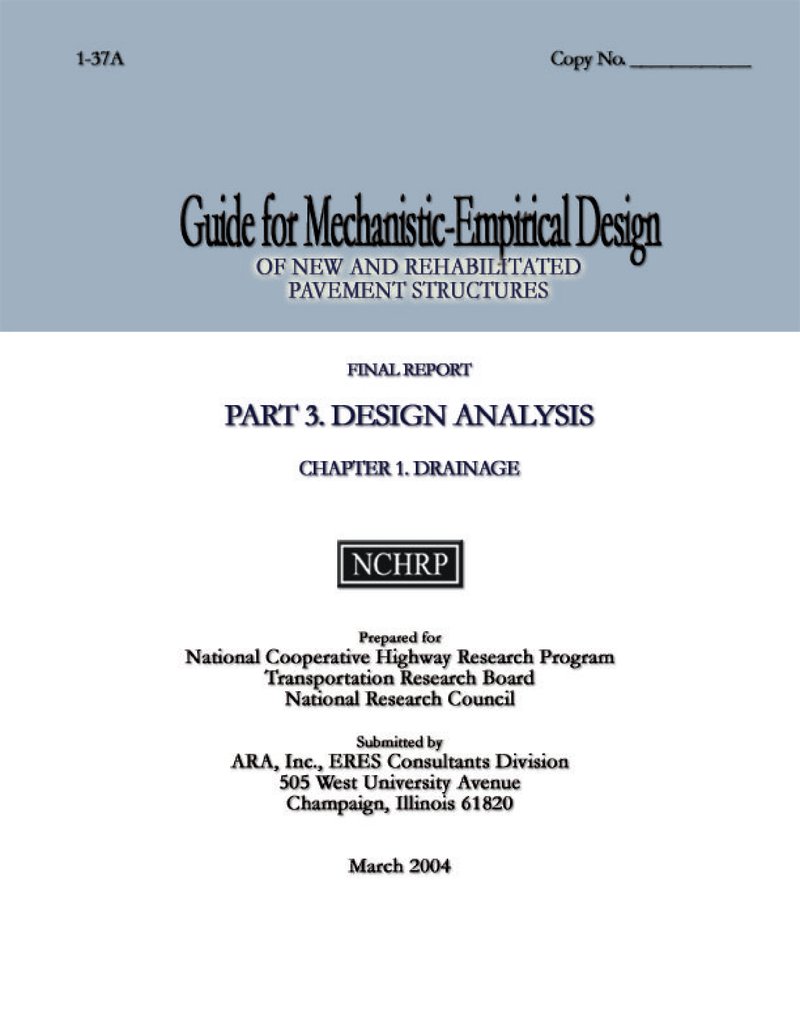


下载标准文件
Part3_Chapter1_Subdrainage
英语 · PDF · 6 页 · 807.08 KB