标准信息
STANDARD INFORMATION- 标准编号
- 2appendices_QQ
- 所属分类
- 其他国外标准与工程资料
- 文件语言
- 英语
- 文件格式
- 文件页数
- 6 页
- 文件大小
- 878.19 KB
· 更新:
标准简介
OVERVIEW中文简介
标准 2appendices_QQ 的预览内容
English summary
Preview of standard 2appendices_QQ
以上为根据文件整理的内容简介。
标准内容预览
DOCUMENT PREVIEWTable 1.2. Operational evaluation criteria and their level of importance.
| Criterion | High Importance | Moderate Importance | Low Importance |
|---|---|---|---|
| Computational efficiency/time | X | ||
| Ability to modify program (e.g., source code availability) | X1 | ||
| Licensing/proprietary restrictions | X | ||
| Documentation | X2 | ||
| User support | X3 | ||
| Verification, validation, and acceptance with the profession | X | ||
| Ability of agencies, contractors, etc. to use the analysis method | X | ||
| Cost (initial acquisition, modification, annual licensing) | X4 | ||
| Platform (e.g., Windows 95/NT PC vs. UNIX workstation) | X | ||
| Pre- and post-processing capabilities | X | ||
| Provides migration path for future technical advances | X |
1It is assumed that any selected analysis program will require some modification.
2Necessary primarily for the project team to be able to use and modify the program effectively. New end user documentation will be provided as part of the 2002 Design Guide.
3End user support will be provided as part of the overall 2002 Design Guide software support and not by the analysis program author/vendor.
4Assumes that any initial acquisition and modification costs will be spread over a large number of copies of the 2002 Design Guide software.
ABAQUS
ABAQUS is a very powerful and reliable general-purpose, production-oriented, finite-3D, dynamic, nonlinear finite element code designed to address structural and heat transfer problems. ABAQUS incorporates implicit (ABAQUS/STANDARD) and explicit (ABAQUS/EXPLICIT) dynamic solvers to allow analysis of a wide range of linear and nonlinear applications. The ABAQUS solvers are well integrated, allowing a single analysis to switch between solvers as needed.
ABAQUS is a modular code consisting of a library of over 300 different element types, a comprehensive material model library, and a library procedure with different procedures (static, heat transfer, dynamic). This makes ABAQUS the most powerful general-purpose code available.
Selecting ABAQUS is further justified by the fact that the majority of 3D finite element rigid pavement models were developed using it. Zaghloul and White (1993) developed a nonlinear, dynamic model of rigid pavements. Mallela and George (1994) developed a three-dimensional finite element model for load-deflection analysis of concrete pavement when subject to a falling weight deflectometer type raid loading. Darter et al. (1995) used ABAQUS to investigate the effect of foundation support and base layers on pavement responses. Hammons (1997) used
6
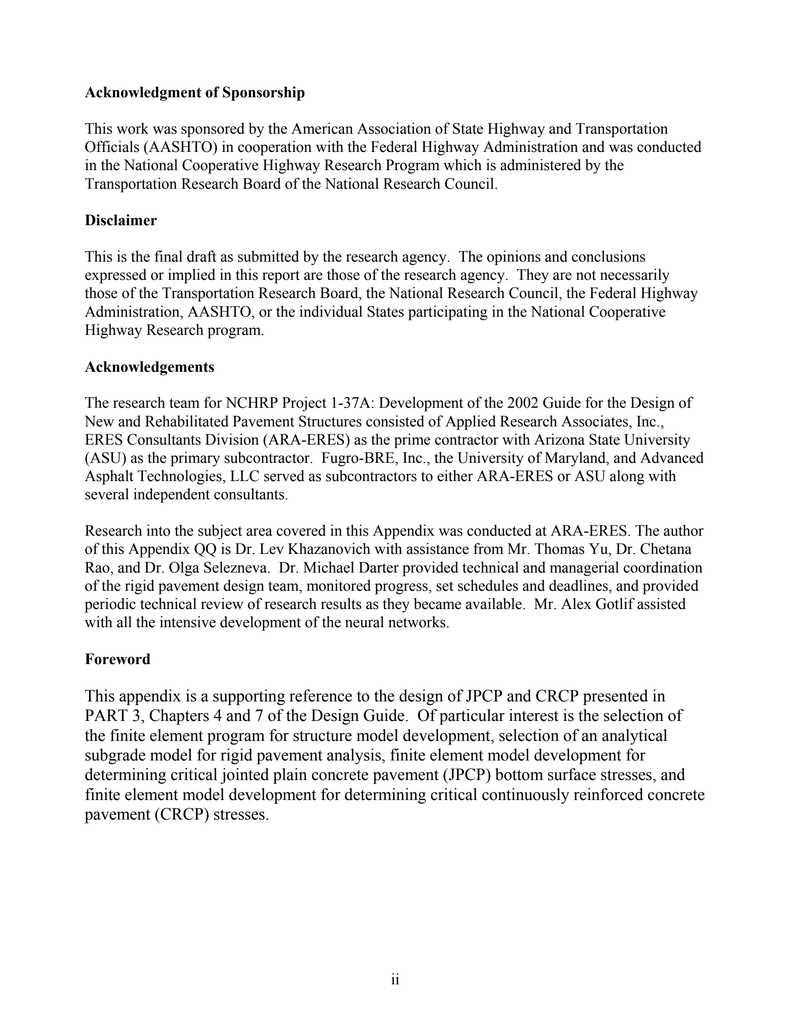
Acknowledgment of Sponsorship
This work was sponsored by the American Association of State Highway and Transportation Officials (AASHTO) in cooperation with the Federal Highway Administration and was conducted in the National Cooperative Highway Research Program which is administered by the Transportation Research Board of the National Research Council.
Disclaimer
This is the final draft as submitted by the research agency. The opinions and conclusions expressed or implied in this report are those of the research agency. They are not necessarily those of the Transportation Research Board, the National Research Council, the Federal Highway Administration, AASHTO, or the individual States participating in the National Cooperative Highway Research program.
Acknowledgements
The research team for NCHRP Project 1-37A: Development of the 2002 Guide for the Design of New and Rehabilitated Pavement Structures consisted of Applied Research Associates, Inc., ERES Consultants Division (ARA-ERES) as the prime contractor with Arizona State University (ASU) as the primary subcontractor. Fugro-BRE, Inc., the University of Maryland, and Advanced Asphalt Technologies, LLC served as subcontractors to either ARA-ERES or ASU along with several independent consultants.
Research into the subject area covered in this Appendix was conducted at ARA-ERES. The author of this Appendix QQ is Dr. Lev Khazanovich with assistance from Mr. Thomas Yu, Dr. Chetana Rao, and Dr. Olga Selezneva. Dr. Michael Darter provided technical and managerial coordination of the rigid pavement design team, monitored progress, set schedules and deadlines, and provided periodic technical review of research results as they became available. Mr. Alex Gotlif assisted with all the intensive development of the neural networks.
Foreword
This appendix is a supporting reference to the design of JPCP and CRCP presented in PART 3, Chapters 4 and 7 of the Design Guide. Of particular interest is the selection of the finite element program for structure model development, selection of an analytical subgrade model for rigid pavement analysis, finite element model development for determining critical jointed plain concrete pavement (JPCP) bottom surface stresses, and finite element model development for determining critical continuously reinforced concrete pavement (CRCP) stresses.
ii
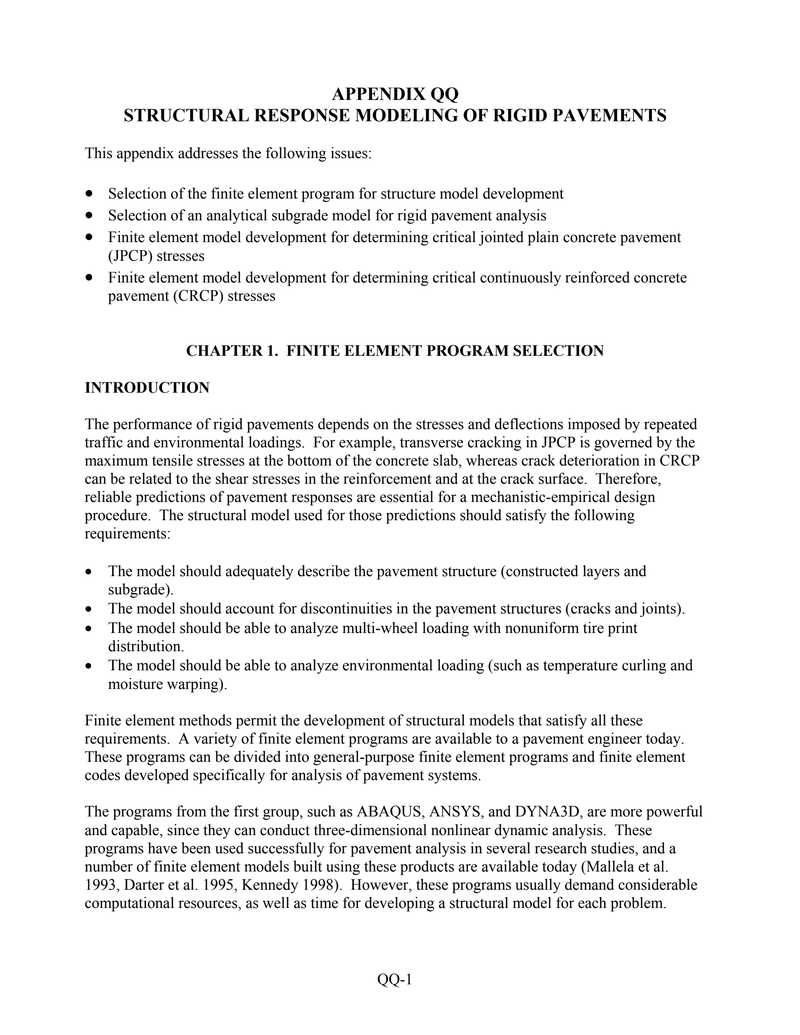
APPENDIX QQ
STRUCTURAL RESPONSE MODELING OF RIGID PAVEMENTS
This appendix addresses the following issues:
- Selection of the finite element program for structure model development
- Selection of an analytical subgrade model for rigid pavement analysis
- Finite element model development for determining critical jointed plain concrete pavement (JPCP) stresses
- Finite element model development for determining critical continuously reinforced concrete pavement (CRCP) stresses
CHAPTER 1. FINITE ELEMENT PROGRAM SELECTION
INTRODUCTION
The performance of rigid pavements depends on the stresses and deflections imposed by repeated traffic and environmental loadings. For example, transverse cracking in JPCP is governed by the maximum tensile stresses at the bottom of the concrete slab, whereas crack deterioration in CRCP can be related to the shear stresses in the reinforcement and at the crack surface. Therefore, reliable predictions of pavement responses are essential for a mechanistic-empirical design procedure. The structural model used for those predictions should satisfy the following requirements:
- The model should adequately describe the pavement structure (constructed layers and subgrade).
- The model should account for discontinuities in the pavement structures (cracks and joints).
- The model should be able to analyze multi-wheel loading with nonuniform tire print distribution.
- The model should be able to analyze environmental loading (such as temperature curling and moisture warping).
Finite element methods permit the development of structural models that satisfy all these requirements. A variety of finite element programs are available to a pavement engineer today. These programs can be divided into general-purpose finite element programs and finite element codes developed specifically for analysis of pavement systems.
The programs from the first group, such as ABAQUS, ANSYS, and DYNA3D, are more powerful and capable, since they can conduct three-dimensional nonlinear dynamic analysis. These programs have been used successfully for pavement analysis in several research studies, and a number of finite element models built using these products are available today (Mallela et al. 1993, Darter et al. 1995, Kennedy 1998). However, these programs usually demand considerable computational resources, as well as time for developing a structural model for each problem.
3
Evaluation Criteria
The programs developed specially for analysis of concrete pavement systems include:
- ILLI-SLAB (Tabatabie and Barenberg 1980)
- WESLIQID (Chou 1981)
- J-SLAB (Tayabji and Colley 1983)
- FEACONS-IV (Choubane and Tia 1995)
- KENSLAB (Huang 1993)
- KOLA (Kok 1990)
- EVERFE (Davids, Turkiyyah, and Mahoney 1998)
Most of these programs can analyze multi-wheel loading of one- or two-layered medium thick plates resting on a Winkler foundation or an elastic solid (ILLI-SLAB, WESLIQID, KENSLAB). The latest enhancements to ILLI-SLAB include ILSL2, developed at the University of Illinois, and a revised version of ILSL2 developed by ERES Consultants (Khazanovich 1994, Khazanovich and Yu 1998). These two programs contain many advanced features that distinguish them from other pavement programs that are based on plate theory. EVERFE can analyze multi-layered pavement systems using a 3D-continuum brick element for the portland cement concrete (PCC) and base layers.
Evaluation Criteria
Selection of an appropriate analysis method for the Design Guide was based upon a clear set of defensible criteria. The selection procedure must first focus on the appropriate analysis approach, defined here as the underlying theories, assumptions, approximations, and algorithms. Once a short list of appropriate analysis approaches has been identified, specific computer implementations/programs can then be evaluated. Program details such as maximum number of layers/nodes/elements/material types should be deferred until an appropriate analysis approach has been selected. These details usually have no theoretical basis and are merely the features/limitations of each program.
Evaluation criteria can be divided into two categories:
- Technical – the ability to predict the correct answer.
- Operational – the ability to implement the method in a practical design environment.
Within each category, the criteria can be subdivided into those that are of high importance and those that are of comparatively less importance.
Table 1.1 summarizes the technical evaluation criteria for the analysis methods and their relevant importance for rigid pavement criteria. The "moderate" designation means either that the criterion is moderately important under all conditions or that it is very important in some cases (e.g., some rehabilitation scenarios) and less important in others (e.g., new construction). Operational evaluation criteria are summarized in table 1.2. The same operational criteria were used for flexible and rigid pavements.
4
| Criterion | Rigid Pavements |
|---|---|
| Ability to calculate/predict critical pavement response parameters accurately | High |
| Material behavior | |
| - Stress dependence | Low/None |
| - Tension/shear failure (unbound materials) | Low |
| - Temperature sensitivity of material properties | Low1 |
| - Moisture sensitivity of material properties | High2 |
| - Rate sensitivity | Low/None |
| - Aging | Moderate |
| - Interface slip | Moderate3 |
| Geometry | |
| - Semi-infinite vs. finite boundaries | High |
| - Contact/gap interfaces | High |
| - Many (i.e., more than 3) layers | Moderate |
| Loading | |
| - User-defined axle/wheel configurations | High |
| - Nonuniform tire contact pressures | High |
| - Horizontal loading | Low |
| - Thermal loading | High |
| - Moisture-induced deformations (non-freeze/thaw) | High |
| - Freeze/thaw effects | High |
| Special Requirements | |
| - Fracture analysis (e.g., specialized crack tip elements, J-integral calculations) | Low4 |
| Algorithm robustness | High |
1Temperature-induced curling is covered under the "loading" category.
2Important primarily for unbound layers and subgrade.
3For some rehabilitation scenarios.
4May be more important if selected distress transfer function requires explicit calculation of crack tip response.
Initial Selection Process
In the first step of the analytical tool selection, the most promising program from each group of programs was selected. ABAQUS was selected as the most promising tool among general-purpose finite element packages, and ILSL2 and ISLAB2000 were selected among the plate theory-based pavement programs. Since these programs represent an extension of ILLI-SLAB, they may be referred as ILLI-SLAB in some portions of this document. EVERFE was selected as a 3D-pavement program specifically developed for rigid pavement analysis.
5
Table 1.2. Operational evaluation criteria and their level of importance.
| Criterion | High Importance | Moderate Importance | Low Importance |
|---|---|---|---|
| Computational efficiency/time | X | ||
| Ability to modify program (e.g., source code availability) | X1 | ||
| Licensing/proprietary restrictions | X | ||
| Documentation | X2 | ||
| User support | X3 | ||
| Verification, validation, and acceptance with the profession | X | ||
| Ability of agencies, contractors, etc. to use the analysis method | X | ||
| Cost (initial acquisition, modification, annual licensing) | X4 | ||
| Platform (e.g., Windows 95/NT PC vs. UNIX workstation) | X | ||
| Pre- and post-processing capabilities | X | ||
| Provides migration path for future technical advances | X |
1It is assumed that any selected analysis program will require some modification.
2Necessary primarily for the project team to be able to use and modify the program effectively. New end user documentation will be provided as part of the 2002 Design Guide.
3End user support will be provided as part of the overall 2002 Design Guide software support and not by the analysis program author/vendor.
4Assumes that any initial acquisition and modification costs will be spread over a large number of copies of the 2002 Design Guide software.
ABAQUS
ABAQUS is a very powerful and reliable general-purpose, production-oriented, finite-3D, dynamic, nonlinear finite element code designed to address structural and heat transfer problems. ABAQUS incorporates implicit (ABAQUS/STANDARD) and explicit (ABAQUS/EXPLICIT) dynamic solvers to allow analysis of a wide range of linear and nonlinear applications. The ABAQUS solvers are well integrated, allowing a single analysis to switch between solvers as needed.
ABAQUS is a modular code consisting of a library of over 300 different element types, a comprehensive material model library, and a library procedure with different procedures (static, heat transfer, dynamic). This makes ABAQUS the most powerful general-purpose code available.
Selecting ABAQUS is further justified by the fact that the majority of 3D finite element rigid pavement models were developed using it. Zaghloul and White (1993) developed a nonlinear, dynamic model of rigid pavements. Mallela and George (1994) developed a three-dimensional finite element model for load-deflection analysis of concrete pavement when subject to a falling weight deflectometer type raid loading. Darter et al. (1995) used ABAQUS to investigate the effect of foundation support and base layers on pavement responses. Hammons (1997) used
6
预览内容由文件识别整理,表格、公式及文字请以原始文件为准。
原文图片预览
PAGE IMAGES
下载标准文件
2appendices_QQ
英语 · PDF · 6 页 · 878.19 KB