标准信息
STANDARD INFORMATION- 标准编号
- 2appendices_GG
- 所属分类
- 其他国外标准与工程资料
- 文件语言
- 英语
- 文件格式
- 文件页数
- 6 页
- 文件大小
- 3.91 MB
· 更新:
标准简介
OVERVIEW中文简介
标准 2appendices_GG 的预览内容
English summary
Preview of standard 2appendices_GG
以上为根据文件整理的内容简介。
标准内容预览
DOCUMENT PREVIEWFigure 1 Typical Repeated Load Permanent Deformation Behavior of Pavement Materials.
6
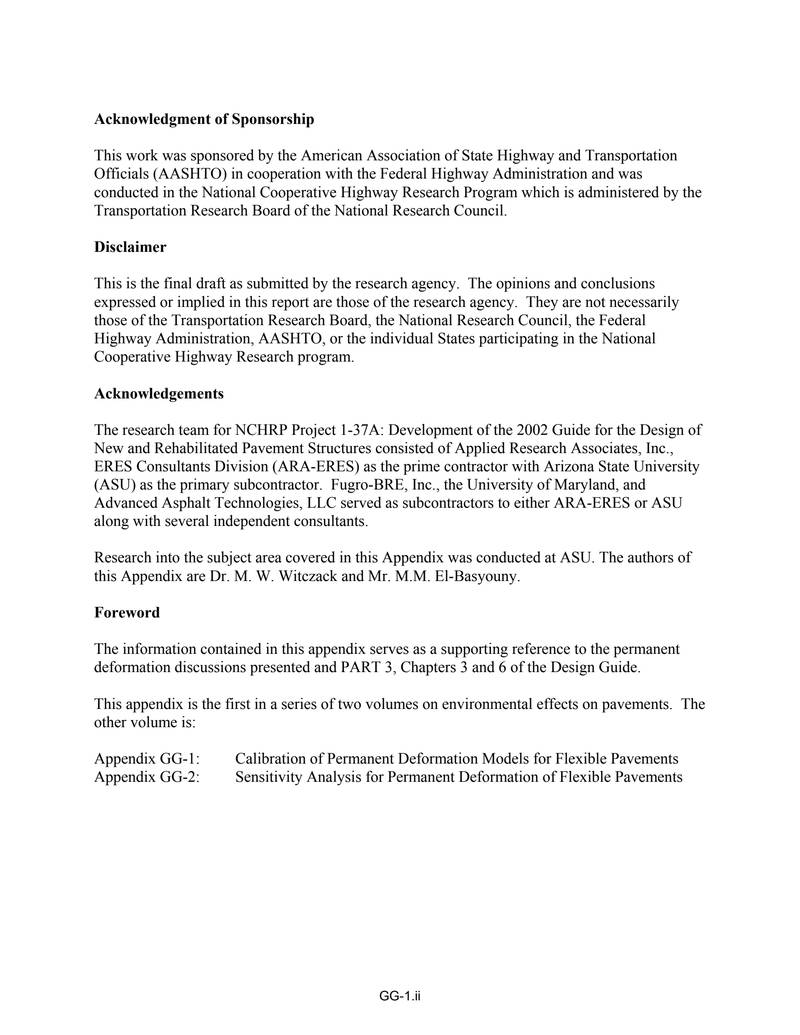
Acknowledgment of Sponsorship
This work was sponsored by the American Association of State Highway and Transportation Officials (AASHTO) in cooperation with the Federal Highway Administration and was conducted in the National Cooperative Highway Research Program which is administered by the Transportation Research Board of the National Research Council.
Disclaimer
This is the final draft as submitted by the research agency. The opinions and conclusions expressed or implied in this report are those of the research agency. They are not necessarily those of the Transportation Research Board, the National Research Council, the Federal Highway Administration, AASHTO, or the individual States participating in the National Cooperative Highway Research program.
Acknowledgements
The research team for NCHRP Project 1-37A: Development of the 2002 Guide for the Design of New and Rehabilitated Pavement Structures consisted of Applied Research Associates, Inc., ERES Consultants Division (ARA-ERES) as the prime contractor with Arizona State University (ASU) as the primary subcontractor. Fugro-BRE, Inc., the University of Maryland, and Advanced Asphalt Technologies, LLC served as subcontractors to either ARA-ERES or ASU along with several independent consultants.
Research into the subject area covered in this Appendix was conducted at ASU. The authors of this Appendix are Dr. M. W. Witczack and Mr. M.M. El-Basyouny.
Foreword
The information contained in this appendix serves as a supporting reference to the permanent deformation discussions presented and PART 3, Chapters 3 and 6 of the Design Guide.
This appendix is the first in a series of two volumes on environmental effects on pavements. The other volume is:
| Appendix GG-1: | Calibration of Permanent Deformation Models for Flexible Pavements |
| Appendix GG-2: | Sensitivity Analysis for Permanent Deformation of Flexible Pavements |
2
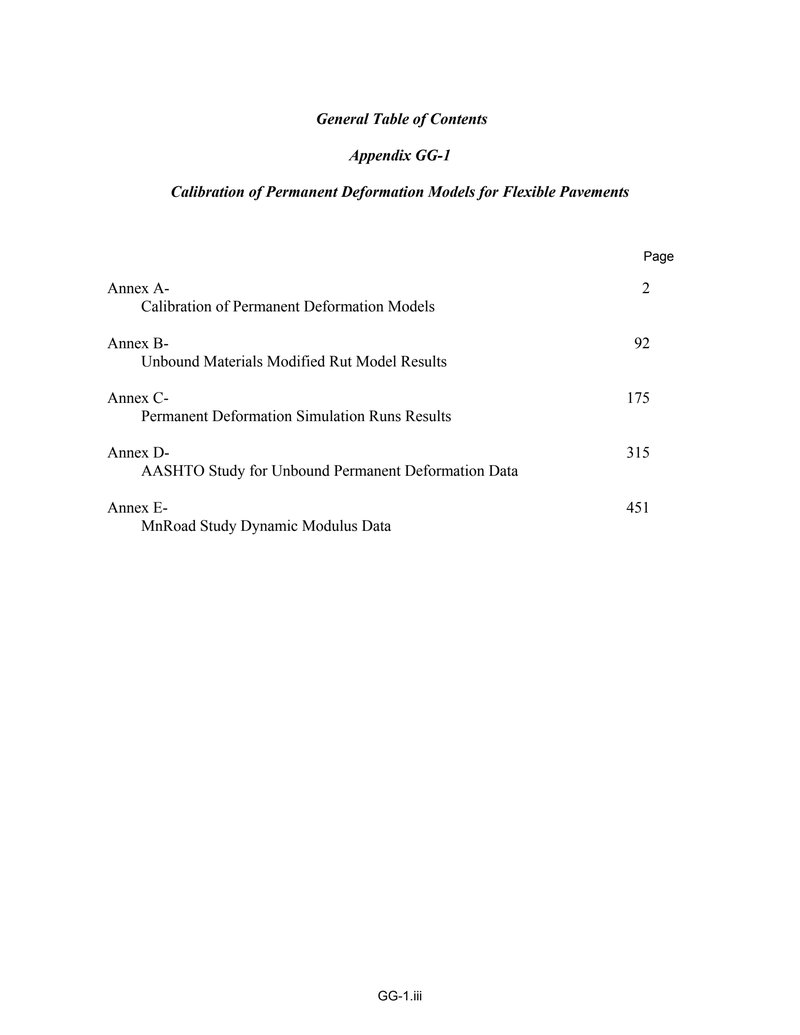
General Table of Contents
Appendix GG-1
Calibration of Permanent Deformation Models for Flexible Pavements
| Page | |
|---|---|
| Annex A- Calibration of Permanent Deformation Models | 2 |
| Annex B- Unbound Materials Modified Rut Model Results | 92 |
| Annex C- Permanent Deformation Simulation Runs Results | 175 |
| Annex D- AASHTO Study for Unbound Permanent Deformation Data | 315 |
| Annex E- MnRoad Study Dynamic Modulus Data | 451 |
3
Annex A - CALIBRATION OF PERMANENT DEFORMATION MODELS
Introduction
Permanent deformation is one of the most important types of load-associated distresses occurring in flexible pavement systems. It is associated with rutting in the wheel path, which develops gradually as the number of load repetitions accumulates. In addition, it is the longitudinal variation of rut depth in the wheel path, that is a primary factor in the road roughness, affecting serviceability or IRI. Rutting normally appears as longitudinal depressions in the wheel paths accompanied by small upheavals to the sides. The width and depth of the rutting profile is highly dependent upon the pavement structure (layer thickness and quality), traffic matrix and quantity as well as the environment at the design site.
In general, the design engineer is concerned with the total deformation of the pavement structure and how it affects the lateral and longitudinal profiles at the surface, as this may be a significant safety concern. Major problems can be associated with changes in these profiles due to differential consolidation altering the surface level. In the transverse profile, rutting along the wheel path modifies drainage characteristics and reduces runoff capability. Water can accumulate in traffic lanes, creating conditions for aquaplaning of vehicles, reduced skid resistance of the surface course, and unsafe traffic conditions. Also, in colder environments, snow and ice removal is impeded because the surface is not flat. In the longitudinal profile, differential permanent deformations due to variability of materials and/or construction increase roughness and reduce the overall serviceability of the road.
Permanent Deformation in the 2002 Design Guide
For many years it has been common practice in several mechanistic-empirical pavement design approaches to associate permanent deformation to excessive vertical strains on top of the subgrade. It was assumed that if the pavement was well designed and the quality of pavement materials above the subgrade were well controlled, rutting could be reduced to tolerable levels by limiting the vertical strain on the subgrade. This approach mirrored the historic design approach for flexible pavements by assuming that structural design was merely a procedure to decrease the shear stresses in the controlling subgrade layer. Nevertheless, with time and enhanced technical capabilities and knowledge; it became quite clear to design engineers that the total permanent deformation was a product of cumulative ruts occurring in all layers of the pavement system.
One major and allied objective of the permanent deformation subsystem developed in the Design Guide is to insure that mixture design of the asphaltic mixtures is definitely linked to the structural design process. It is to be recognized and understood that this project task (under NCHRP 1-37A) is highly interactive and integrally tied to the analysis of AC permanent deformation development under NCHRP 9-19.
In the Design Guide, a predictive rutting system was developed to evaluate the permanent deformation within all rut susceptible layers (generally asphaltic and all unbound material
4
layers) in the pavement within the analysis period. Individual layer rut depths are predicted for each layer as a function of time and traffic repetition. This also allow for the prediction of the total pavement rut depth, with time and traffic repetitions.
Regardless of the material type considered, there are generally three distinct stages for the permanent deformation behavior of pavement materials under a given set of material, load and environmental conditions. Figure 1 illustrates the three stages, which can be described as follows:
Primary Stage: high initial level of rutting, with a decreasing rate of plastic deformations, predominantly associated with volumetric change.
Secondary Stage: small rate of rutting exhibiting a constant rate of change of rutting that is also associated with volumetric changes; however, shear deformations increase at increasing rate.
Tertiary Stage: high rate (level) of rutting predominantly associated with plastic (shear) deformations under no volume change conditions.
The Design Guide utilizes an approach that models both the primary and secondary stages, with the primary stage modeled using an extrapolation of the secondary stage trend. The tertiary stage, though also very important, is not taken into account explicitly in the Design Guide methodology. Permanent deformation tests to reach this stage are extremely time consuming, difficult to perform, and lack a prediction methodology for implementation. However, major research studies are currently in progress to analytically treat this type of deformation (e.g. NCHRP 9-19). It should be understood that true plastic shear deformations are not modeled within the system (in fact, few, if any, rutting prediction models incorporate this stage). While, at first, this may seem to be a major limitation; it is generally not. This is because the magnitude of rutting associated with tertiary flow yields a rut depth much greater than what would be typically tolerated in actual practice.
5
Figure 1 Typical Repeated Load Permanent Deformation Behavior of Pavement Materials.
6
预览内容由文件识别整理,表格、公式及文字请以原始文件为准。
原文图片预览
PAGE IMAGES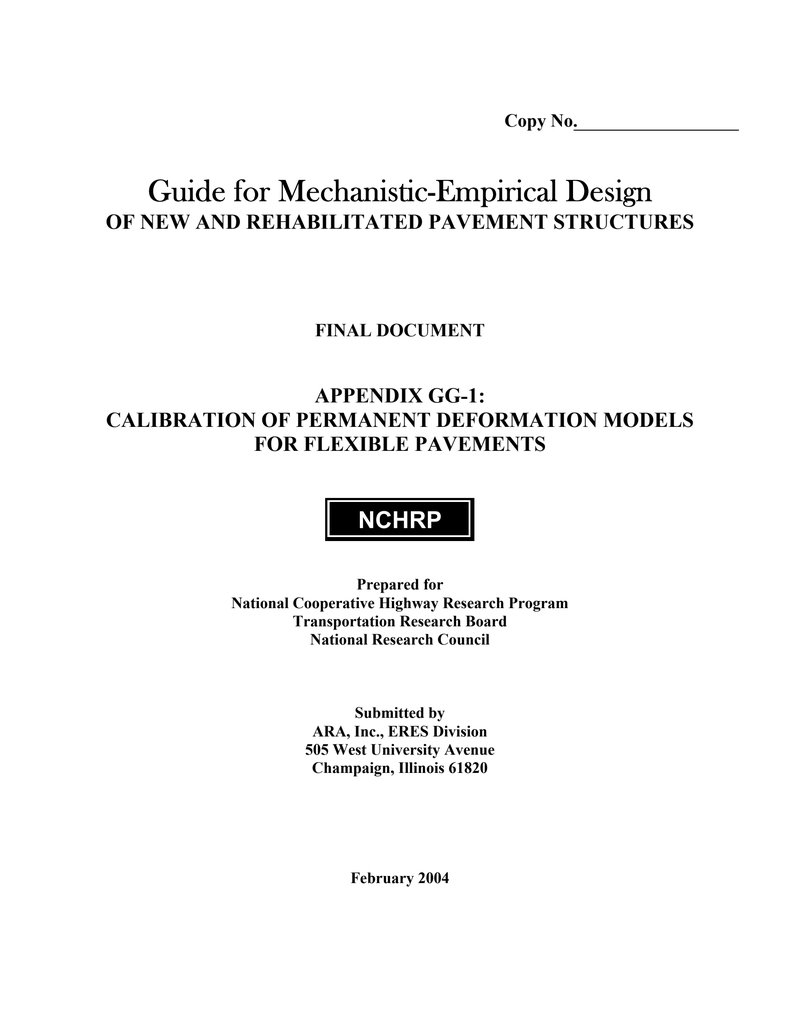
下载标准文件
2appendices_GG
英语 · PDF · 6 页 · 3.91 MB