
标准信息
STANDARD INFORMATION- 标准编号
- EC2-3
- 所属分类
- 其他国外标准与工程资料
- 文件语言
- 英语
- 文件格式
- 文件页数
- 6 页
- 文件大小
- 348.05 KB
· 更新:
标准简介
OVERVIEW中文简介
标准 EC2-3 的预览内容
English summary
Preview of standard EC2-3
以上为根据文件整理的内容简介。
标准内容预览
DOCUMENT PREVIEWPrEN 1992-3
particular attention is drawn to the approved Prestandard ENV 206 -1 (Concrete - performance, production, placing and compliance criteria).
For ENV 1992-3, the following additional sub-clauses apply.
This Part 3 of Eurocode 2 complements EN 1992-1-1 for the particular aspects of liquid retaining structures and structures for the containment of granular solids.
(21) The framework and structure of this Part 3 correspond to EN 1992-1-1. However, Part 3 contains Principles and Application Rules which are specific to liquid retaining and containment structures.
Where a particular sub-clause of EN 1992-1-1 is not mentioned in this EN 1992-3, that sub-clause of EN 1992-1-1 applies as far as deemed appropriate in each case.
Some Principles and Application Rules of EN 1992-1-1 are modified or replaced in this Part, in which case the modified versions supersede those in EN 1992-1-1 for the design of liquid retaining or containment structures.
Where a Principle or Application Rule in EN 1992-1-1 is modified or replaced, the new number is identified by the addition of 100 to the original number. Where a new Principle or Application Rule is added, it is identified by a number which follows the last number in the appropriate clause in EN 1992-1-1 with 100 added to it.
A subject not covered by EN 1992-1-1 is introduced in this Part by a new sub-clause. The sub-clause number for this follows the most appropriate clause number in EN 1992-1-1.
The numbering of equations, figures, footnotes and tables in this Part follow the same principles as the clause numbering as described above.
6
Contents
| Page | ||
|---|---|---|
| Foreword | ||
| 1 | Introduction | |
| 1.1 | Scope | |
| 1.1.2 | Scope of Part 3 of Eurocode 2 | |
| 1.6 | Symbols | |
| 1.7 | Special symbols used in Part 3 of EN1992 | |
| 2 | Basis of design | |
| 2.1 | Requirements | |
| 2.1.1 | Basic requirements | |
| 2.3 | Basic variables | |
| 2.3.1 | Actions and environmental influences | |
| 2.3.1.1 | General | |
| 3 | Material Properties | |
| 3.1 | Concrete | |
| 3.1.3 | Elastic deformation | |
| 3.1.4 | Creep and shrinkage | |
| 3.1.10 | Specific heat capacity of concrete | |
| 3.1.11 | Heat evolution and temperature development due to hydration | |
| 4 | Durability and cover to reinforcement | |
| 4.1 | Durability requirements | |
| 4.4.1.2 | Minimum cover, Cmin | |
| 4.4.2 | Surfaces of structures designed to contain potable water | |
| 5 | STRUCTURAL ANALYSIS | |
| 5.12 | Determination of the effects of temperature | |
| 5.12.1 | General | |
| 5.13 | Calculation of the effects of internal pressure. |
2
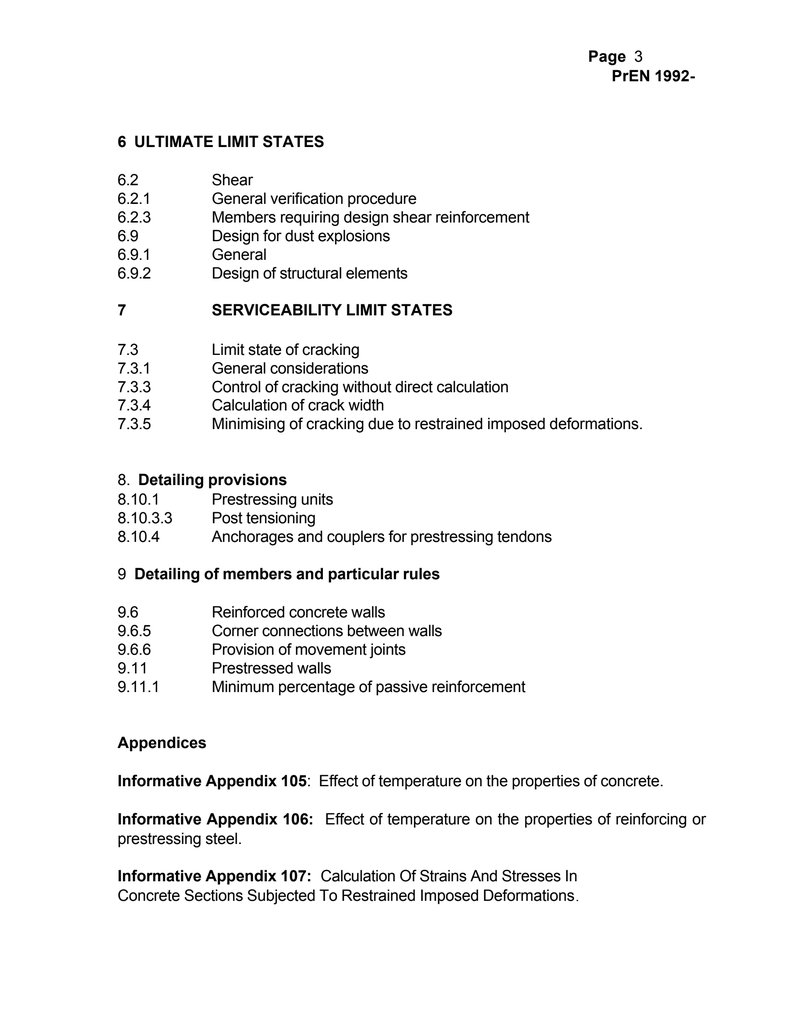
6 ULTIMATE LIMIT STATES
| 6.2 | Shear |
| 6.2.1 | General verification procedure |
| 6.2.3 | Members requiring design shear reinforcement |
| 6.9 | Design for dust explosions |
| 6.9.1 | General |
| 6.9.2 | Design of structural elements |
7 SERVICEABILITY LIMIT STATES
| 7.3 | Limit state of cracking |
| 7.3.1 | General considerations |
| 7.3.3 | Control of cracking without direct calculation |
| 7.3.4 | Calculation of crack width |
| 7.3.5 | Minimising of cracking due to restrained imposed deformations. |
8. Detailing provisions
| 8.10.1 | Prestressing units |
| 8.10.3.3 | Post tensioning |
| 8.10.4 | Anchorages and couplers for prestressing tendons |
9 Detailing of members and particular rules
| 9.6 | Reinforced concrete walls |
| 9.6.5 | Corner connections between walls |
| 9.6.6 | Provision of movement joints |
| 9.11 | Prestressed walls |
| 9.11.1 | Minimum percentage of passive reinforcement |
Appendices
Informative Appendix 105: Effect of temperature on the properties of concrete.
Informative Appendix 106: Effect of temperature on the properties of reinforcing or prestressing steel.
Informative Appendix 107: Calculation Of Strains And Stresses In Concrete Sections Subjected To Restrained Imposed Deformations.
3
Informative Appendix 108: Calculation Of Crack Widths due to Restraint of Imposed Deformations.
Foreword
Objectives Of The Eurocodes.
The "Structural Eurocodes" comprise a group of standards for the structural and geotechnical design of buildings and civil engineering works.
They cover execution and control only to the extent that is necessary to indicate the quality of the construction products, and the standard of the workmanship needed to comply with the assumptions of the design rules.
Until the necessary set of harmonised technical specifications for products and for the methods of testing their performance are available, some of the Structural Eurocodes cover some of these aspects in informative Appendices.
Background Of The Eurocode Programme
The Commission of the European Communities (CEC) initiated the work of establishing a set of harmonized technical rules for the design of building and civil engineering works which would initially serve as alternatives to the different rules in force in the various Member States and would ultimately replace them. These technical rules became known as the "Structural Eurocodes".
In 1990, after consulting their respective Member States, the CEC transferred the work of further development, issue and updating of the Structural Eurocodes to CEN, and the EFTA Secretariat agreed to support the CEN work.
CEN Technical Committee CEN/TC250 is responsible for all Structural Eurocodes.
Eurocode Programme
Work is in hand on the following Structural Eurocodes, each generally consisting of a number of parts:
| EN 1990 Eurocode 0 EN 1991 Eurocode 1 EN 1992 Eurocode 2 EN 1993 Eurocode 3 EN 1994 Eurocode 4 |
Basis of design. Actions on structures. Design of concrete structures. Design of steel structures. Design of composite steel and concrete structures. |
4
PrEN 1992-
| EN 1995 Eurocode 5 | Design of timber structures. |
| EN 1996 Eurocode 6 | Design of masonry structures. |
| EN 1997 Eurocode 7 | Geotechnical design. |
| EN 1998 Eurocode 8 | Design provisions for earthquake resistance of structures. |
| EN 1999 Eurocode 9 | Design of aluminium alloy structures. |
Separate sub-committees have been formed by CEN/TC250 for the various Eurocodes listed above.
National annex for EN 1992-3
This standard gives values with notes indicating where national choices may have to be made. Therefore the national Standard implementing EN 1992-3 should have a National annex containing all Nationally Determined Parameters to be used for the design of liquid retaining and containment structures to be constructed in the relevant country.
National choice is allowed in EN 1992-3 through the following clauses:
7.3.1 (111)
7.3.1 (112)
8.10.3.3 (103)
9.6.6 (102)
Matters specific to this standard
The scope of Eurocode 2 is defined in 1.1.1 of EN 1992-1-1 and the scope of this Part of Eurocode 2 is defined in 1.1.2. Other Additional Parts of Eurocode 2 which are planned are indicated in 1.1.3 of EN 1992-1-1; these will cover additional technologies or applications, and will complement and supplement this Part.
In using this Prestandard in practice, particular regard should be paid to the underlying assumptions and conditions given in 1.3 of EN 1992-1-1.
The five chapters of this Prestandard are complemented by four Informative Annexes. These Annexes have been introduced to provide general information on material and structural behaviour which may be used in the absence of information specifically related to the actual materials used or actual conditions of service.
As indicated above, reference should be made to National annexes which will give details of compatible supporting standards to be used. For this Part of Eurocode 2,
5
PrEN 1992-3
particular attention is drawn to the approved Prestandard ENV 206 -1 (Concrete - performance, production, placing and compliance criteria).
For ENV 1992-3, the following additional sub-clauses apply.
This Part 3 of Eurocode 2 complements EN 1992-1-1 for the particular aspects of liquid retaining structures and structures for the containment of granular solids.
(21) The framework and structure of this Part 3 correspond to EN 1992-1-1. However, Part 3 contains Principles and Application Rules which are specific to liquid retaining and containment structures.
Where a particular sub-clause of EN 1992-1-1 is not mentioned in this EN 1992-3, that sub-clause of EN 1992-1-1 applies as far as deemed appropriate in each case.
Some Principles and Application Rules of EN 1992-1-1 are modified or replaced in this Part, in which case the modified versions supersede those in EN 1992-1-1 for the design of liquid retaining or containment structures.
Where a Principle or Application Rule in EN 1992-1-1 is modified or replaced, the new number is identified by the addition of 100 to the original number. Where a new Principle or Application Rule is added, it is identified by a number which follows the last number in the appropriate clause in EN 1992-1-1 with 100 added to it.
A subject not covered by EN 1992-1-1 is introduced in this Part by a new sub-clause. The sub-clause number for this follows the most appropriate clause number in EN 1992-1-1.
The numbering of equations, figures, footnotes and tables in this Part follow the same principles as the clause numbering as described above.
6
预览内容由文件识别整理,表格、公式及文字请以原始文件为准。
原文图片预览
PAGE IMAGES

下载标准文件
EC2-3
英语 · PDF · 6 页 · 348.05 KB