
标准信息
STANDARD INFORMATION- 标准编号
- EC2-1-2
- 所属分类
- 其他国外标准与工程资料
- 文件语言
- 英语
- 文件格式
- 文件页数
- 6 页
- 文件大小
- 808.06 KB
· 更新:
标准简介
OVERVIEW中文简介
标准 EC2-1-2 的预览内容
English summary
Preview of standard EC2-1-2
以上为根据文件整理的内容简介。
标准内容预览
DOCUMENT PREVIEWNational Standards implementing Eurocodes
The National Standards implementing Eurocodes will comprise the full text of the Eurocode (including any annexes), as published by CEN, which may be preceded by a National title page and National foreword, and may be followed by a National Annex.
The National Annex may only contain information on those parameters which are left open in the Eurocode for national choice, known as Nationally Determined Parameters, to be used for the design of buildings and civil engineering works to be constructed in the country concerned, i.e. :
- values and/or classes where alternatives are given in the Eurocode,
- values to be used where a symbol only is given in the Eurocode,
- country specific data (geographical, climatic, etc.), e.g. snow map,
- the procedure to be used where alternative procedures are given in the Eurocode,
- decisions on the application of informative annexes,
- references to non-contradictory complementary information to assist the user to apply the Eurocode.
Links between Eurocodes and products harmonised technical specifications (ENs and ETAs)
There is a need for consistency between the harmonised technical specifications for construction products and the technical rules for works4. Furthermore, all the information accompanying the CE Marking of the construction products which refer to Eurocodes should clearly mention which Nationally Determined Parameters have been taken into account.
Additional information specific to EN 1992-1-2
EN 1992- 1-2 describes the Principles, requirements and rules for the structural design of buildings exposed to fire, including the following aspects.
Safety requirements
EN 1992-1-2 is intended for clients (e.g. for the formulation of their specific requirements), designers, contractors and relevant authorities.
The general objectives of fire protection are to limit risks with respect to the individual and society, neighbouring property, and where required, environment or directly exposed property, in the case of fire.
Construction Products Directive 89/106/EEC gives the following essential requirement for the limitation of fire risks:
"The construction works must be designed and build in such a way, that in the event of an outbreak of fire
- the load bearing resistance of the construction can be assumed for a specified period of time
- the generation and spread of fire and smoke within the works are limited
4 see Art.3.3 and Art.12 of the CPD, as well as clauses 4.2, 4.3.1, 4.3.2 and 5.2 of ID 1.
6
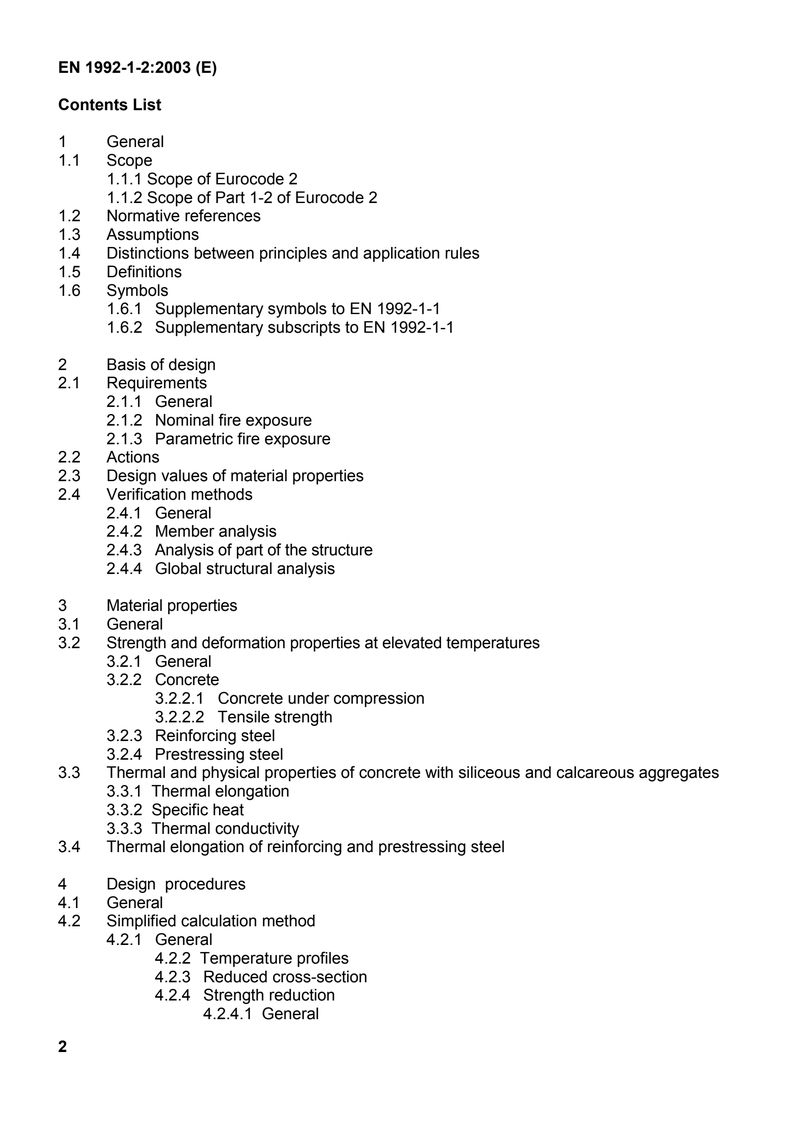
Contents List
| 1 | General |
| 1.1 | Scope |
| 1.1.1 | Scope of Eurocode 2 |
| 1.1.2 | Scope of Part 1-2 of Eurocode 2 |
| 1.2 | Normative references |
| 1.3 | Assumptions |
| 1.4 | Distinctions between principles and application rules |
| 1.5 | Definitions |
| 1.6 | Symbols |
| 1.6.1 | Supplementary symbols to EN 1992-1-1 |
| 1.6.2 | Supplementary subscripts to EN 1992-1-1 |
| 2 | Basis of design |
| 2.1 | Requirements |
| 2.1.1 | General |
| 2.1.2 | Nominal fire exposure |
| 2.1.3 | Parametric fire exposure |
| 2.2 | Actions |
| 2.3 | Design values of material properties |
| 2.4 | Verification methods |
| 2.4.1 | General |
| 2.4.2 | Member analysis |
| 2.4.3 | Analysis of part of the structure |
| 2.4.4 | Global structural analysis |
| 3 | Material properties |
| 3.1 | General |
| 3.2 | Strength and deformation properties at elevated temperatures |
| 3.2.1 | General |
| 3.2.2 | Concrete |
| 3.2.2.1 | Concrete under compression |
| 3.2.2.2 | Tensile strength |
| 3.2.3 | Reinforcing steel |
| 3.2.4 | Prestressing steel |
| 3.3 | Thermal and physical properties of concrete with siliceous and calcareous aggregates |
| 3.3.1 | Thermal elongation |
| 3.3.2 | Specific heat |
| 3.3.3 | Thermal conductivity |
| 3.4 | Thermal elongation of reinforcing and prestressing steel |
| 4 | Design procedures |
| 4.1 | General |
| 4.2 | Simplified calculation method |
| 4.2.1 | General |
| 4.2.2 | Temperature profiles |
| 4.2.3 | Reduced cross-section |
| 4.2.4 | Strength reduction |
| 4.2.4.1 | General |
2
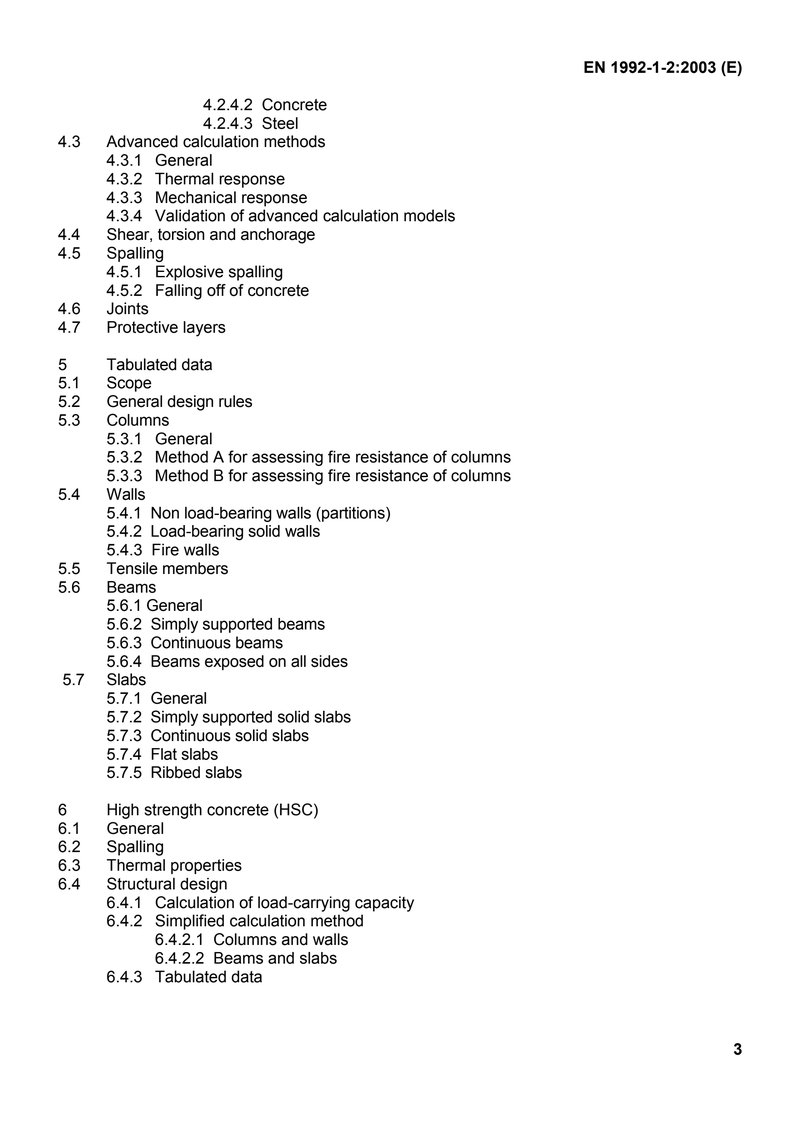
4.2.4.2 Concrete
4.2.4.3 Steel
4.3 Advanced calculation methods
4.3.1 General
4.3.2 Thermal response
4.3.3 Mechanical response
4.3.4 Validation of advanced calculation models
4.4 Shear, torsion and anchorage
4.5 Spalling
4.5.1 Explosive spalling
4.5.2 Falling off of concrete
4.6 Joints
4.7 Protective layers
5 Tabulated data
5.1 Scope
5.2 General design rules
5.3 Columns
5.3.1 General
5.3.2 Method A for assessing fire resistance of columns
5.3.3 Method B for assessing fire resistance of columns
5.4 Walls
5.4.1 Non load-bearing walls (partitions)
5.4.2 Load-bearing solid walls
5.4.3 Fire walls
5.5 Tensile members
5.6 Beams
5.6.1 General
5.6.2 Simply supported beams
5.6.3 Continuous beams
5.6.4 Beams exposed on all sides
5.7 Slabs
5.7.1 General
5.7.2 Simply supported solid slabs
5.7.3 Continuous solid slabs
5.7.4 Flat slabs
5.7.5 Ribbed slabs
6 High strength concrete (HSC)
6.1 General
6.2 Spalling
6.3 Thermal properties
6.4 Structural design
6.4.1 Calculation of load-carrying capacity
6.4.2 Simplified calculation method
6.4.2.1 Columns and walls
6.4.2.2 Beams and slabs
6.4.3 Tabulated data
3
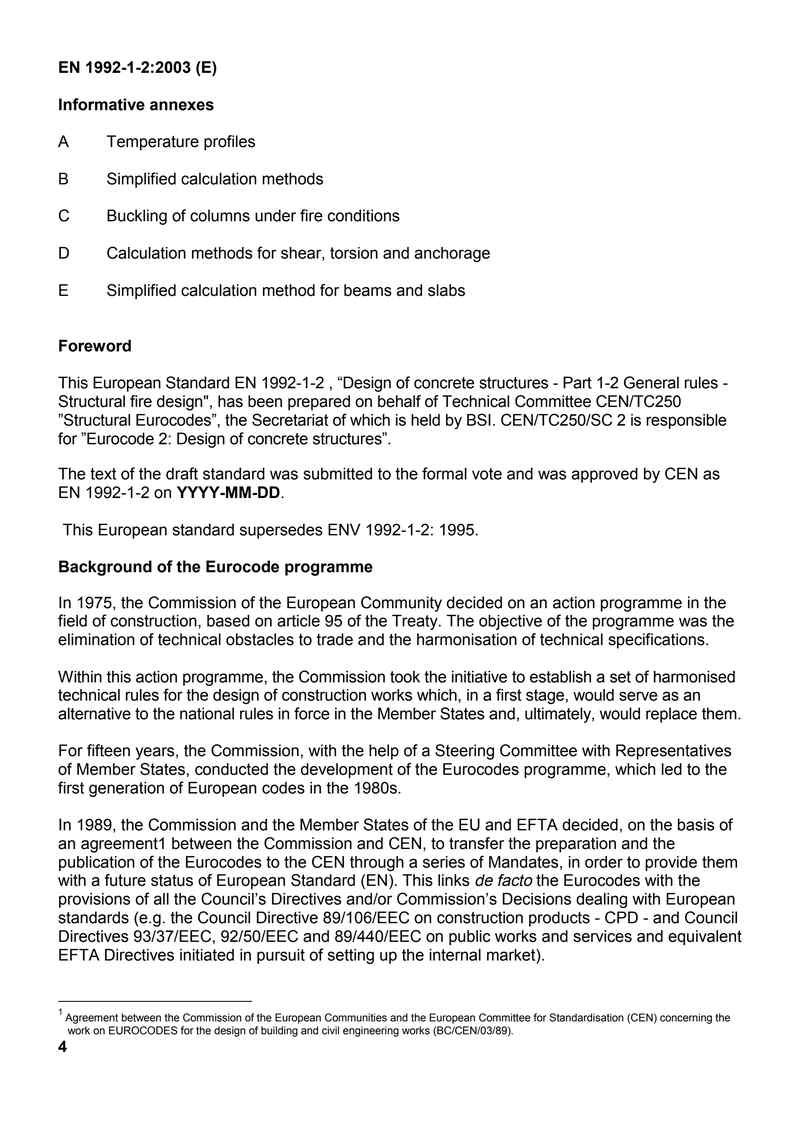
Informative annexes
| A | Temperature profiles |
| B | Simplified calculation methods |
| C | Buckling of columns under fire conditions |
| D | Calculation methods for shear, torsion and anchorage |
| E | Simplified calculation method for beams and slabs |
Foreword
This European Standard EN 1992-1-2, "Design of concrete structures - Part 1-2 General rules - Structural fire design", has been prepared on behalf of Technical Committee CEN/TC250 "Structural Eurocodes", the Secretariat of which is held by BSI. CEN/TC250/SC 2 is responsible for "Eurocode 2: Design of concrete structures".
The text of the draft standard was submitted to the formal vote and was approved by CEN as EN 1992-1-2 on YYYY-MM-DD.
This European standard supersedes ENV 1992-1-2: 1995.
Background of the Eurocode programme
In 1975, the Commission of the European Community decided on an action programme in the field of construction, based on article 95 of the Treaty. The objective of the programme was the elimination of technical obstacles to trade and the harmonisation of technical specifications.
Within this action programme, the Commission took the initiative to establish a set of harmonised technical rules for the design of construction works which, in a first stage, would serve as an alternative to the national rules in force in the Member States and, ultimately, would replace them.
For fifteen years, the Commission, with the help of a Steering Committee with Representatives of Member States, conducted the development of the Eurocodes programme, which led to the first generation of European codes in the 1980s.
In 1989, the Commission and the Member States of the EU and EFTA decided, on the basis of an agreement1 between the Commission and CEN, to transfer the preparation and the publication of the Eurocodes to the CEN through a series of Mandates, in order to provide them with a future status of European Standard (EN). This links de facto the Eurocodes with the provisions of all the Council's Directives and/or Commission's Decisions dealing with European standards (e.g. the Council Directive 89/106/EEC on construction products - CPD - and Council Directives 93/37/EEC, 92/50/EEC and 89/440/EEC on public works and services and equivalent EFTA Directives initiated in pursuit of setting up the internal market).
1 Agreement between the Commission of the European Communities and the European Committee for Standardisation (CEN) concerning the work on EUROCODES for the design of building and civil engineering works (BC/CEN/03/89).
4
EN 1992-1-2:2003 (E)
The Structural Eurocode programme comprises the following standards generally consisting of a number of Parts:
| EN 1990 | Eurocode: | Basis of Structural Design |
| EN 1991 | Eurocode 1: | Actions on structures |
| EN 1992 | Eurocode 2: | Design of concrete structures |
| EN 1993 | Eurocode 3: | Design of steel structures |
| EN 1994 | Eurocode 4: | Design of composite steel and concrete structures |
| EN 1995 | Eurocode 5: | Design of timber structures |
| EN 1996 | Eurocode 6: | Design of masonry structures |
| EN 1997 | Eurocode 7: | Geotechnical design |
| EN 1998 | Eurocode 8: | Design of structures for earthquake resistance |
| EN 1999 | Eurocode 9: | Design of aluminium structures |
Eurocode standards recognise the responsibility of regulatory authorities in each Member State and have safeguarded their right to determine values related to regulatory safety matters at national level where these continue to vary from State to State.
Status and field of application of Eurocodes
The Member States of the EU and EFTA recognise that Eurocodes serve as reference documents for the following purposes :
- as a means to prove compliance of building and civil engineering works with the essential requirements of Council Directive 89/106/EEC, particularly Essential Requirement N°1 – Mechanical resistance and stability – and Essential Requirement N°2 – Safety in case of fire ;
- as a basis for specifying contracts for construction works and related engineering services ;
- as a framework for drawing up harmonised technical specifications for construction products (ENs and ETAs)
The Eurocodes, as far as they concern the construction works themselves, have a direct relationship with the Interpretative Documents2 referred to in Article 12 of the CPD, although they are of a different nature from harmonised product standards3. Therefore, technical aspects arising from the Eurocodes work need to be adequately considered by CEN Technical Committees and/or EOTA Working Groups working on product standards with a view to achieving full compatibility of these technical specifications with the Eurocodes.
The Eurocode standards provide common structural design rules for everyday use for the design of whole structures and component products of both a traditional and an innovative nature. Unusual forms of construction or design conditions are not specifically covered and additional expert consideration will be required by the designer in such cases.
2 According to Art. 3.3 of the CPD, the essential requirements (ERs) shall be given concrete form in interpretative documents for the creation of the necessary links between the essential requirements and the mandates for harmonised ENs and ETAGs/ETAs.
3 According to Art. 12 of the CPD the interpretative documents shall :
a) give concrete form to the essential requirements by harmonising the terminology and the technical bases and indicating classes or levels for each requirement where necessary ;
b) indicate methods of correlating these classes or levels of requirement with the technical specifications, e.g. methods of calculation and of proof, technical rules for project design, etc. ;
c) serve as a reference for the establishment of harmonised standards and guidelines for European technical approvals.
The Eurocodes, de facto, play a similar role in the field of the ER 1 and a part of ER 2.
5
National Standards implementing Eurocodes
The National Standards implementing Eurocodes will comprise the full text of the Eurocode (including any annexes), as published by CEN, which may be preceded by a National title page and National foreword, and may be followed by a National Annex.
The National Annex may only contain information on those parameters which are left open in the Eurocode for national choice, known as Nationally Determined Parameters, to be used for the design of buildings and civil engineering works to be constructed in the country concerned, i.e. :
- values and/or classes where alternatives are given in the Eurocode,
- values to be used where a symbol only is given in the Eurocode,
- country specific data (geographical, climatic, etc.), e.g. snow map,
- the procedure to be used where alternative procedures are given in the Eurocode,
- decisions on the application of informative annexes,
- references to non-contradictory complementary information to assist the user to apply the Eurocode.
Links between Eurocodes and products harmonised technical specifications (ENs and ETAs)
There is a need for consistency between the harmonised technical specifications for construction products and the technical rules for works4. Furthermore, all the information accompanying the CE Marking of the construction products which refer to Eurocodes should clearly mention which Nationally Determined Parameters have been taken into account.
Additional information specific to EN 1992-1-2
EN 1992- 1-2 describes the Principles, requirements and rules for the structural design of buildings exposed to fire, including the following aspects.
Safety requirements
EN 1992-1-2 is intended for clients (e.g. for the formulation of their specific requirements), designers, contractors and relevant authorities.
The general objectives of fire protection are to limit risks with respect to the individual and society, neighbouring property, and where required, environment or directly exposed property, in the case of fire.
Construction Products Directive 89/106/EEC gives the following essential requirement for the limitation of fire risks:
"The construction works must be designed and build in such a way, that in the event of an outbreak of fire
- the load bearing resistance of the construction can be assumed for a specified period of time
- the generation and spread of fire and smoke within the works are limited
4 see Art.3.3 and Art.12 of the CPD, as well as clauses 4.2, 4.3.1, 4.3.2 and 5.2 of ID 1.
6
预览内容由文件识别整理,表格、公式及文字请以原始文件为准。
原文图片预览
PAGE IMAGES
下载标准文件
EC2-1-2
英语 · PDF · 6 页 · 808.06 KB