标准信息
STANDARD INFORMATION- 标准编号
- EN 10025+A3
- 所属分类
- EN 欧洲标准
- 文件语言
- 英语
- 文件格式
- 文件页数
- 6 页
- 文件大小
- 4.46 MB
· 更新:
标准简介
OVERVIEW中文简介
标准 EN 10025+A3 的预览内容
English summary
Preview of standard EN 10025+A3
以上为根据文件整理的内容简介。
标准内容预览
DOCUMENT PREVIEW我们需要回答用户:作为OCR引擎,将工程标准PDF页面精确转成HTML片段,只返回HTML,不要解释。需要遵守严格标签和class限制。现在分析页面内容。
页面顶部页眉:CEN EN*10025*A1 90 ... Page 5 EN 10025:1990 + A1:1993。页眉忽略?规则页眉页脚忽略,页码忽略。但页面内标题?页面正文有 2.2 Standards on dimensions and tolerances 和 2.3 Standards on testing。每页输出必须以
开头(页面内标题)。这里第一个标题是 2.2 Standards on dimensions and tolerances,应该用 h2。页码由占位符生成,结尾
5
。页面布局是两栏列表:左栏标准编号和描述,右栏标准编号和描述。可用 table class="layout-columns" 两栏。但内容复杂:左右两栏各自有标题和条目。可以用一个两列表格,左td包含左栏内容,右td包含右栏内容。允许 table class layout-columns,tr td。td内可以有 p, h3? 页面内标题 2.3 Standards on testing 在右栏中间,应该作为 h3? 规则页内标题:第1页用 h2,后续页用 h2 或 h3(根据视觉层级)。这里 2.2 和 2.3 是同级?视觉层级可能 h2? 但每页必须以 h2 开头,可以用 h2 2.2,然后右栏内 2.3 用 h3? 或者两个都 h2? 由于在表格td内允许 h2? 标签允许 h2-h5。但页面内标题层级:2.2 和 2.3 同级,可能都用 h2。但每页开头 h2 即可。为了结构,左栏 h2 2.2,右栏 h2 2.3? 但 h2 inside td okay. However maybe better: h2 2.2, then table layout columns; right td contains h3 2.3? But 2.3 is same level as 2.2, but due to layout maybe h2. The rule says page内标题:第1页用 h2,后续页用 h2 或 h3(根据视觉层级). Since this is page 5, not first page? It says 每页输出必须以
开头(页面内标题). So first heading on page must h2. Other headings can h2/h3. I can use h2 for 2.2 and h3 for 2.3? But 2.3 is same section level; maybe h2. But if h2 inside right td after table start? The page starts with h2 outside table. Then table. Inside right td can h2? It's okay. But maybe to avoid multiple h2? allowed.
Need preserve numbering and footnotes. Footnotes at bottom: 1) Draft is under discussion. 2) Until these EURONORMS are transformed into European Standards, they can either be implemented or reference made to the corresponding national standards, the list of which is given in annex B to this European Standard. 3) EURONORM 24 is added because it contains channel sections. 4) EURONORM 56 and 57 are added because they contain the nominal dimensions.
Need output footnotes as
...
at original position? They are at bottom after content. Use small-note.Need handle superscript footnote markers in text: e.g. 1) 2) 3) 4). Allowed sup. Use 1) etc. But original uses superscript numbers? In OCR, entries have 1) before descriptions, 2) etc. We can represent as 1). Need not use ol/ul? Could use p for each entry. But many entries. Could use table? The two-column layout can be table with each row? But entries are not aligned row-wise exactly. Better use layout-columns table with two td containing lists of p. But p per entry. Need avoid continuous spaces. Use p class indent? The entries have hanging indent? Could use p class="indent" for descriptions? But standard code and description maybe separate. We can output each entry as
EN 10029 Hot-rolled plates...
. But original has italic descriptions. Use em for italic. Standard codes not italic. Descriptions italic. Some descriptions have line breaks; can use? Rule says 不要用
制造段落间距, but line breaks within entry? Could use spaces. But long descriptions can wrap naturally. Need not use br. But if original line breaks are not semantic, can combine into one paragraph. However OCR exact? It says 精确转成HTML片段, but not preserve line breaks. Use paragraphs.
Need table? The main content is two columns. Use
| ... | ... |
Need ensure no disallowed tags. No div. No style. No nbsp. No tabs. No multiple spaces. Use single spaces.
Need page header? Ignore. But maybe EN 10025:1990 + A1:1993 is page header? It's top right, likely header. Ignore. Page 5 ignore.
Need bottom copyright? Footer ignore.
Need content:
2.2 Standards on dimensions and tolerances
Left column entries:
EN 10029 Hot-rolled plates 3 mm thick or above — Tolerances on dimensions, shape and mass
EN 10051 Continuously hot-rolled uncoated plate, sheet and strip of non-alloy and alloy steels — Tolerances on dimensions and shape
prEN 10024 1) Taper flange I sections — Tolerances on shape and dimensions
prEN 10034 1) Structural steel I and H sections — Tolerances on shape and dimensions
prEN 10048 1) Hot rolled narrow steel strip — Tolerances on dimensions and shape
prEN 10055 1) Hot-rolled steel equal flange tees with radiused root and toes — Dimensions and tolerances on shape and dimensions
prEN 10056-2 1) Structural steel equal and unequal leg angles — Part 2: Tolerances on shape and dimensions
prEN 10067 1) Hot rolled bulb flats — Dimensions and tolerances on shape and dimensions
EURONORM 17 (1970) Non-alloy base steel wire rod for cold drawing — Dimensions and tolerances
EURONORM 19 IPE beams: parallel-flanged beams
EURONORM 24 (1962) 2) 3) Standard beams and channel sections — Tolerances? Wait original: EURONORM 24 (1962) 2) 3) Standard beams and channel sections - Tolerances. Actually footnote markers: 2) and 3) before description? It shows:
EURONORM 24
(1962)
2) 3) Standard beams and channel
sections - Tolerances
Maybe markers 2) and 3) are superscript before description. Need include both.
EURONORM 53 (1962) Wide-flanged beams with parallel flanges
Right column entries:
EURONORM 54 (1980) 2) Small hot-rolled steel channels
EURONORM 56 (1977) 3) 4) Hot-rolled equal angles (with radiused root and toes)
EURONORM 57 (1978) 3) 4) (with radiused root and toes) Hot-rolled unequal angles? Let's inspect: Right column:
EURONORM 54
(1980)
2) Small hot-rolled steel channels
EURONORM 56
(1977)
3) 4) Hot-rolled equal angles (with radiused root and toes)
EURONORM 57
(1978)
3) 4) (with radiused root and toes) Hot-rolled unequal angles? The OCR line: "3) 4) (with radiused root and toes)" then next line "Hot-rolled unequal angles"? Actually image:
EURONORM 57
(1978)
3) 4) (with radiused root and toes)
Hot-rolled unequal angles
Maybe description is "Hot-rolled unequal angles (with radiused root and toes)" but line order weird. Need faithful? Could output "Hot-rolled unequal angles (with radiused root and toes)". But original line has parenthetical before? Let's parse:
EURONORM 56 (1977) 3) 4) Hot-rolled equal angles (with radiused root and toes)
EURONORM 57 (1978) 3) 4) (with radiused root and toes) Hot-rolled unequal angles
Maybe due to OCR line wrap: "Hot-rolled unequal angles (with radiused root and toes)" likely. But rule not rewrite? We can preserve order? If preserve exact visual: "3) 4) (with radiused root and toes) Hot-rolled unequal angles". That seems odd but faithful to OCR. Need decide. The standard likely: EURONORM 57: Hot-rolled unequal angles (with radiused root and toes). The OCR line may have parenthetical on previous line due to column? Let's look: Right column lines:
EURONORM 54 (1980) Small hot-rolled steel channels
2)
EURONORM 56 (1977) Hot-rolled equal angles (with
3) 4) radiused root and toes)
EURONORM 57 (1978) Hot-rolled unequal angles
3) 4) (with radiused root and toes)
EURONORM 58 (1978) Hot-rolled flats for general
2) purposes
EURONORM 59 (1978) Hot-rolled square bars for
2) general purposes
EURONORM 60 (1977) Hot-rolled round bars for
2) general purposes
EURONORM 61 (1982) Hot-rolled steel hexagons
2)
EURONORM 65 (1980) Hot-rolled round steel bars for
2) screws and rivets
EURONORM 66 (1967) Hot-rolled half-rounds and
2) flattened half-rounds
EURONORM 91 (1981) Hot-rolled wide flats
2) Tolerances on dimensions, shape and mass
Actually footnote markers are superscript before description? For EURONORM 56: 3) 4) before Hot-rolled equal angles. For 57: 3) 4) before (with radiused root and toes)? Hmm.
Need include footnote markers as sup before description. For EURONORM 54: 2) before Small hot-rolled steel channels. For 56: 3) 4) before Hot-rolled equal angles... For 57: 3) 4) before Hot-rolled unequal angles? The parenthetical maybe part of description. I can output: 3) 4) Hot-rolled unequal angles (with radiused root and toes). This is likely correct. But "不要改写原文" maybe not reorder. However OCR line order may be due to layout; semantic description should be natural. But exact? Hmm.
Continue right column:
EURONORM 58 (1978) 2) Hot-rolled flats for general purposes
EURONORM 59 (1978) 2) Hot-rolled square bars for general purposes
EURONORM 60 (1977) 2) Hot-rolled round bars for general purposes
EURONORM 61 (1982) 2) Hot-rolled steel hexagons
EURONORM 65 (1980) 2) Hot-rolled round steel bars for screws and rivets
EURONORM 66 (1967) 2) Hot-rolled half-rounds and flattened half-rounds
EURONORM 91 (1981) 2) Hot-rolled wide flats Tolerances on dimensions, shape and mass
Then 2.3 Standards on testing
EN 10002-1 Metallic materials — Tensile testing — Part 1: method of test (at ambient temperature)
EN 10045-1 Metallic materials — Charpy impact test — Part 1: Test method
EURONORM 18 (1979) Selection and preparation of samples and test pieces for steel and iron and steel products
EURONORM 103 (1971) Microscopic determination of the ferritic and austenitic grain size of steel
ISO 2566/1 (1984) Steel — Conversion of elongation values — Part 1: Carbon and low alloy steels
Need footnotes:
1) Draft is under discussion.
2) Until these EURONORMS are transformed into European Standards, they can either be implemented or reference made to the corresponding national standards, the list of which is given in annex B to this European Standard.
3) EURONORM 24 is added because it contains channel sections.
4) EURONORM 56 and 57 are added because they contain the nominal dimensions.
Need decide formatting for standard codes and years. Could output each entry as p:
EN 10029 Hot-rolled plates 3 mm thick or above — Tolerances on dimensions, shape and mass
. For EURONORM with year:EURONORM 17 (1970) Non-alloy base steel wire rod for cold drawing — Dimensions and tolerances
. For footnote markers:prEN 10024 1) Taper flange I sections — Tolerances on shape and dimensions
.Need em dash? Use —. Allowed. No special restrictions.
Need maybe use for headings? No, h2/h3.
Need table layout: If using table class layout-columns, inside td we can have h2? The first h2 outside table. Then table. But if 2.3 inside right td as h2? Could be okay. But table layout with headings inside td. Need ensure table has no caption? Not necessary. Use
. No thead. Allowed.... ...
Potential issue: The page content is two columns but not exactly equal; using table is acceptable. Need maybe include 2.3 heading in right td. But if 2.3 is same level, use h2. However if h2 inside td after table, page still starts with h2 outside. Fine.
Need maybe not use indent class? It is allowed. Could use p class="indent" for entries. But if all entries indent, okay. Could also use p without class. The original has hanging indent; class indent approximates. Use indent for entries. For headings no indent.
Need footnotes: Use
1) Draft is under discussion.
etc. But footnote markers in footnotes are not superscript? Original has 1) at start. Could use sup? Allowed. But small-note. Use 1) maybe. But if footnote text starts with 1) not superscript? It's okay.Need ensure no continuous two spaces. Use single spaces. For multiple footnote markers: 3) 4) has single space between. Good.
Need no Markdown fences.
Need final only HTML.
Let's craft carefully.
Potential issue: "每页输出必须以
开头(页面内标题)" So first characters should be . Good.
Need page number at end:
5
. Good.Need maybe include "EN 10025:1990 + A1:1993"? It's header, ignore. But maybe page title? It's top right, likely header. Ignore.
Need maybe include "CEN EN*10025*A1 90 ..." header ignore.
Need maybe include "Page 5" ignore.
Need maybe include bottom "Copyright by the European Committee For Standardization Thu Jul 15 08:58:12 2004" footer ignore.
Need preserve numbering: 2.2, 2.3. Good.
Need decide if use h3 for 2.3. Since 2.2 and 2.3 are same level, but page starts h2. Could use h2 for 2.3 too. But if inside right td, okay. However multiple h2 may be okay. The rule says page内标题:第1页用 h2,后续页用 h2 或 h3(根据视觉层级). This is page 5, but first heading must h2. 2.3 visual same as 2.2, so h2. But if h2 inside table, maybe okay. I'll use h2 for 2.3? But then page has two h2. Fine.
But if using table layout, the right td begins with entries then h2 2.3. That's okay.
Need maybe use
5
after footnotes. Good.Let's consider exact text:
Left:
EN 10029 Hot-rolled plates 3 mm thick or above — Tolerances on dimensions, shape and mass
EN 10051 Continuously hot-rolled uncoated plate, sheet and strip of non-alloy and alloy steels — Tolerances on dimensions and shape
prEN 10024 1) Taper flange I sections — Tolerances on shape and dimensions
prEN 10034 1) Structural steel I and H sections — Tolerances on shape and dimensions
prEN 10048 1) Hot rolled narrow steel strip — Tolerances on dimensions and shape
prEN 10055 1) Hot-rolled steel equal flange tees with radiused root and toes — Dimensions and tolerances on shape and dimensions
prEN 10056-2 1) Structural steel equal and unequal leg angles — Part 2: Tolerances on shape and dimensions
prEN 10067 1) Hot rolled bulb flats — Dimensions and tolerances on shape and dimensions
EURONORM 17 (1970) Non-alloy base steel wire rod for cold drawing — Dimensions and tolerances
EURONORM 19 IPE beams: parallel-flanged beams
EURONORM 24 (1962) 2) 3) Standard beams and channel sections — Tolerances
EURONORM 53 (1962) Wide-flanged beams with parallel flanges
Check EURONORM 19: no year? Original: EURONORM 19 IPE beams: parallel-flanged beams. Yes.
Right:
EURONORM 54 (1980) 2) Small hot-rolled steel channels
EURONORM 56 (1977) 3) 4) Hot-rolled equal angles (with radiused root and toes)
EURONORM 57 (1978) 3) 4) Hot-rolled unequal angles (with radiused root and toes)
EURONORM 58 (1978) 2) Hot-rolled flats for general purposes
EURONORM 59 (1978) 2) Hot-rolled square bars for general purposes
EURONORM 60 (1977) 2) Hot-rolled round bars for general purposes
EURONORM 61 (1982) 2) Hot-rolled steel hexagons
EURONORM 65 (1980) 2) Hot-rolled round steel bars for screws and rivets
EURONORM 66 (1967) 2) Hot-rolled half-rounds and flattened half-rounds
EURONORM 91 (1981) 2) Hot-rolled wide flats Tolerances on dimensions, shape and mass
Maybe for EURONORM 91: "Hot-rolled wide flats Tolerances on dimensions, shape and mass" no dash? Original: Hot-rolled wide flats / Tolerances on dimensions, shape and mass. Could include dash? Not in original. Use space.
2.3:
EN 10002-1 Metallic materials — Tensile testing — Part 1: method of test (at ambient temperature)
EN 10045-1 Metallic materials — Charpy impact test — Part 1: Test method
EURONORM 18 (1979) Selection and preparation of samples and test pieces for steel and iron and steel products
EURONORM 103 (1971) Microscopic determination of the ferritic and austenitic grain size of steel
ISO 2566/1 (1984) Steel — Conversion of elongation values — Part 1: Carbon and low alloy steels
Need italicize descriptions. For entries with footnote markers, markers not italic. For year not italic. For standard code not italic. For descriptions italic. For "Tolerances on dimensions, shape and mass" in EURONORM 91 maybe italic. Good.
Need maybe use em for entire description including parentheses. Good.
Potential issue: class indent on p inside td may be okay. But if all entries are p indent, no blank lines. Good.
Need maybe use
for footnotes? No small-note.
Need maybe use
for footnotes with sup. Good.
Need ensure no
. Good.
Need no attributes on td except none. Good.
Need no style. Good.
Need no nbsp. Good.
Need no multiple spaces. Check strings: "EURONORM 24 (1962) 2) 3) Standard beams..." single spaces. Good.
Need maybe use "EURONORMS" in footnote 2 exactly. Good. Need maybe footnote 2: "Until these EURONORMS are transformed into European Standards, they can either be implemented or reference made to the corresponding national standards, the list of which is given in annex B to this European Standard." Good. Need maybe footnote 4: "EURONORM 56 and 57 are added because they contain the nominal dimensions." Good. Need maybe include footnote markers in text as sup with parentheses. Good. Could there be footnote marker 2) after EURONORM 54 description? Original: EURONORM 54 (1980) Small hot-rolled steel channels 2) maybe marker after? It shows 2) on next line under description? Actually right column: EURONORM 54 (1980) Small hot-rolled steel channels 2) Maybe marker 2) is superscript after description? In OCR, footnote markers often superscript before or after? For EURONORM 54, 2) appears below description, likely superscript after "channels"? It might be "Small hot-rolled steel channels 2)". For EURONORM 56: 3) 4) before description? It appears left of description? Let's inspect: Right column: EURONORM 54 (1980) Small hot-rolled steel channels 2) EURONORM 56 (1977) Hot-rolled equal angles (with 3) 4) radiused root and toes) EURONORM 57 (1978) Hot-rolled unequal angles 3) 4) (with radiused root and toes) EURONORM 58 (1978) Hot-rolled flats for general 2) purposes ... It seems footnote markers are placed at beginning of continuation line? Actually for EURONORM 54, description "Small hot-rolled steel channels" then next line "2)" maybe marker after description? For EURONORM 56, description line "Hot-rolled equal angles (with" then next line "3) 4) radiused root and toes)"? That would mean markers before continuation? Hmm. Maybe original formatting: Standard number and year in left subcolumn, description in right subcolumn. Footnote markers are superscript at end of description? For EURONORM 54: description "Small hot-rolled steel channels" with superscript 2) at end, but OCR placed 2) on next line due to line wrap. For EURONORM 56: description "Hot-rolled equal angles (with radiused root and toes)" with superscript 3) 4) at end? OCR line: "3) 4) radiused root and toes)" maybe markers before continuation? Could be markers at end of first line? Let's think: If description wraps: "Hot-rolled equal angles (with radiused root and toes)" and footnote markers 3) 4) are superscript after description, they would appear after "toes)" not before. But OCR shows "3) 4) radiused root and toes)" on second line, maybe because markers are at start of second line? Could be due to superscript markers placed before description? For EURONORM 58: "Hot-rolled flats for general purposes" with 2) maybe after? OCR: "Hot-rolled flats for general" then "2) purposes". That suggests marker 2) is before "purposes"? Maybe the marker is superscript after "general"? No, if after "general", line would be "Hot-rolled flats for general 2)" then next line "purposes". OCR shows "2) purposes" on next line, maybe marker before purposes because it's at start of line? Hard. For left column: prEN 10024 1) Taper flange I sections — ... marker 1) before description. So markers can be before description. For EURONORM 24: 2) 3) before description. For EURONORM 54: maybe 2) before description? But OCR placed after? It shows "Small hot-rolled steel channels" then "2)" maybe because marker before description but OCR line order? Actually right column layout: standard code left, description right. For EURONORM 54, code line "EURONORM 54 (1980)" then description line "Small hot-rolled steel channels" and footnote marker "2)" maybe on next line under description? Could be marker after description. For EURONORM 56, code line, description line "Hot-rolled equal angles (with" then next line "3) 4) radiused root and toes)". If markers are before description, they'd be before "Hot-rolled equal angles", not before continuation. If markers are after description, they'd be after "toes)". Neither matches. Maybe OCR misaligned due to superscript markers placed in left subcolumn? Let's not overthink. We can place markers before description consistently for EURONORM entries with footnotes, as left column does. But for EURONORM 54, if marker after description, our output before description may be considered rewrite? But footnote markers are not content? Need preserve. Could place marker after description for those where OCR shows after? Let's inspect each: - EURONORM 54: OCR: "EURONORM 54 (1980) Small hot-rolled steel channels 2)"? The 2) is below channels, likely after. Could output description then 2). - EURONORM 56: OCR: "EURONORM 56 (1977) Hot-rolled equal angles (with radiused root and toes) 3) 4)"? The 3)4) appear before continuation but likely after description? Could output description then markers. - EURONORM 57: description then markers. - EURONORM 58: description then marker. - EURONORM 59: description then marker. - EURONORM 60: description then marker. - EURONORM 61: description then marker. - EURONORM 65: description then marker. - EURONORM 66: description then marker. - EURONORM 91: description then marker? OCR: "Hot-rolled wide flats 2) Tolerances..." marker before Tolerances? Maybe marker after "flats"? Could output "Hot-rolled wide flats 2) Tolerances...". Left column markers: prEN entries show 1) before description. EURONORM 24 shows 2) 3) before description. So inconsistent. Maybe markers are placed before description for prEN and EURONORM 24, after for EURONORMs? Need faithful to visual. Let's parse original layout more carefully from image text: Left column: EN 10029 Hot-rolled plates 3 mm thick or above — Tolerances on dimensions, shape and mass EN 10051 Continuously hot-rolled uncoated plate, sheet and strip of non-alloy and alloy steels — Tolerances on dimensions and shape prEN 10024 1) Taper flange I sections — Tolerances on shape and dimensions prEN 10034 1) Structural steel I and H sections — Tolerances on shape and dimensions prEN 10048 1) Hot rolled narrow steel strip — Tolerances on dimensions and shape prEN 10055 1) Hot-rolled steel equal flange tees with radiused root and toes — Dimensions and tolerances on shape and dimensions prEN 10056-2 1) Structural steel equal and unequal leg angles — Part 2: Tolerances on shape and dimensions prEN 10067 1) Hot rolled bulb flats — Dimensions and tolerances on shape and dimensions EURONORM 17 (1970) Non-alloy base steel wire rod for cold drawing — Dimensions and tolerances EURONORM 19 IPE beams: parallel-flanged beams EURONORM 24 (1962) 2) 3) Standard beams and channel sections — Tolerances EURONORM 53 (1962) Wide-flanged beams with parallel flanges Right column: EURONORM 54 (1980) Small hot-rolled steel channels 2) EURONORM 56 (1977) Hot-rolled equal angles (with 3) 4) radiused root and toes) EURONORM 57 (1978) Hot-rolled unequal angles 3) 4) (with radiused root and toes) EURONORM 58 (1978) Hot-rolled flats for general 2) purposes EURONORM 59 (1978) Hot-rolled square bars for 2) general purposes EURONORM 60 (1977) Hot-rolled round bars for 2) general purposes EURONORM 61 (1982) Hot-rolled steel hexagons 2) EURONORM 65 (1980) Hot-rolled round steel bars for 2) screws and rivets EURONORM 66 (1967) Hot-rolled half-rounds and 2) flattened half-rounds EURONORM 91 (1981) Hot-rolled wide flats 2) Tolerances on dimensions, shape and mass It appears footnote markers are placed at beginning of continuation lines, not necessarily before/after semantic. This is due to superscript markers being in a separate column? Maybe the markers are actually in the left subcolumn aligned with description line? For EURONORM 54, marker 2) is on line below description, maybe aligned under standard code? Hmm. Maybe the original table has three columns: standard code/year, footnote markers, description. For EURONORM 54: code/year "EURONORM 54 (1980)", marker column "2)", description "Small hot-rolled steel channels". OCR line order may put description then marker due to reading order? For EURONORM 56: code/year, marker "3) 4)", description "Hot-rolled equal angles (with radiused root and toes)". OCR line: description first line then marker+continuation. So marker column is before description. For EURONORM 54, marker column should be before description, but OCR placed after? Could be because description short and marker on next line? Actually if marker column before description, line would be "2) Small hot-rolled steel channels". OCR shows "Small hot-rolled steel channels" then "2)". Maybe OCR reading order failed. We can choose semantic marker before description for all EURONORMs with markers. That likely matches original table. For EURONORM 91: marker before description? "2) Hot-rolled wide flats Tolerances..." But OCR shows "Hot-rolled wide flats 2) Tolerances". Could be marker column before description but description wraps: first line "Hot-rolled wide flats", second line marker "2)" then continuation "Tolerances..."? If marker column before description, second line would be "2) Tolerances...". Yes. So marker before description overall. Good. So output markers before description for EURONORM 54,56,57,58,59,60,61,65,66,91. For EURONORM 24, markers before description. Good. But for EURONORM 57, description likely "Hot-rolled unequal angles (with radiused root and toes)". Markers before. Good. Need maybe include year in parentheses after code. Good. Potential issue: Use em for descriptions but if marker before description, em starts after marker. Good. Need maybe use "EURONORM 19" no year, description italic. Good. Need maybe use "EURONORM 17 (1970)" year not italic. Good. Need maybe use "ISO 2566/1 (1984)" code not italic. Good. Need maybe use "EN 10002-1" etc. Good. Need maybe use "Part 1: method of test" lower-case method? Original: "method of test". Keep. Need maybe use "Test method" capital T. Keep. Need maybe use "samples and test pieces" lower-case. Keep. Need maybe use "steel and iron and steel products" weird but keep. Need maybe use "the ferritic and austenitic grain size of steel". Keep. Need maybe use "Carbon and low alloy steels". Keep. Need maybe use "Hot rolled" vs "Hot-rolled" inconsistent. Keep as OCR: prEN 10048 "Hot rolled narrow steel strip", prEN 10067 "Hot rolled bulb flats". EURONORM 54 "Small hot-rolled steel channels". Keep. Need maybe use "Taper flange I sections" vs "Taper flange I sections". Keep. Need maybe use "I and H sections". Keep. Need maybe use "equal flange tees". Keep. Need maybe use "radiused root and toes". Keep. Need maybe use "unequal leg angles". Keep. Need maybe use "bulb flats". Keep. Need maybe use "parallel-flanged beams". Keep. Need maybe use "channel sections". Keep. Need maybe use "Wide-flanged beams with parallel flanges". Keep. Need maybe use "half-rounds and flattened half-rounds". Keep. Need maybe use "hexagons". Keep. Need maybe use "screws and rivets". Keep. Need maybe use "wide flats". Keep. Need maybe use "Tolerances on dimensions, shape and mass". Keep. Need maybe use "Metallic materials — Tensile testing — Part 1: method of test (at ambient temperature)". Keep. Need maybe use "Charpy impact test". Keep. Need maybe use "Microscopic determination". Keep. Need maybe use "Conversion of elongation values". Keep. Need maybe use "annex B" lower-case. Keep. Need maybe use "EURONORMS" plural. Keep. Need maybe use "European Standards". Keep. Need maybe use "European Standard". Keep. Need maybe use "nominal dimensions
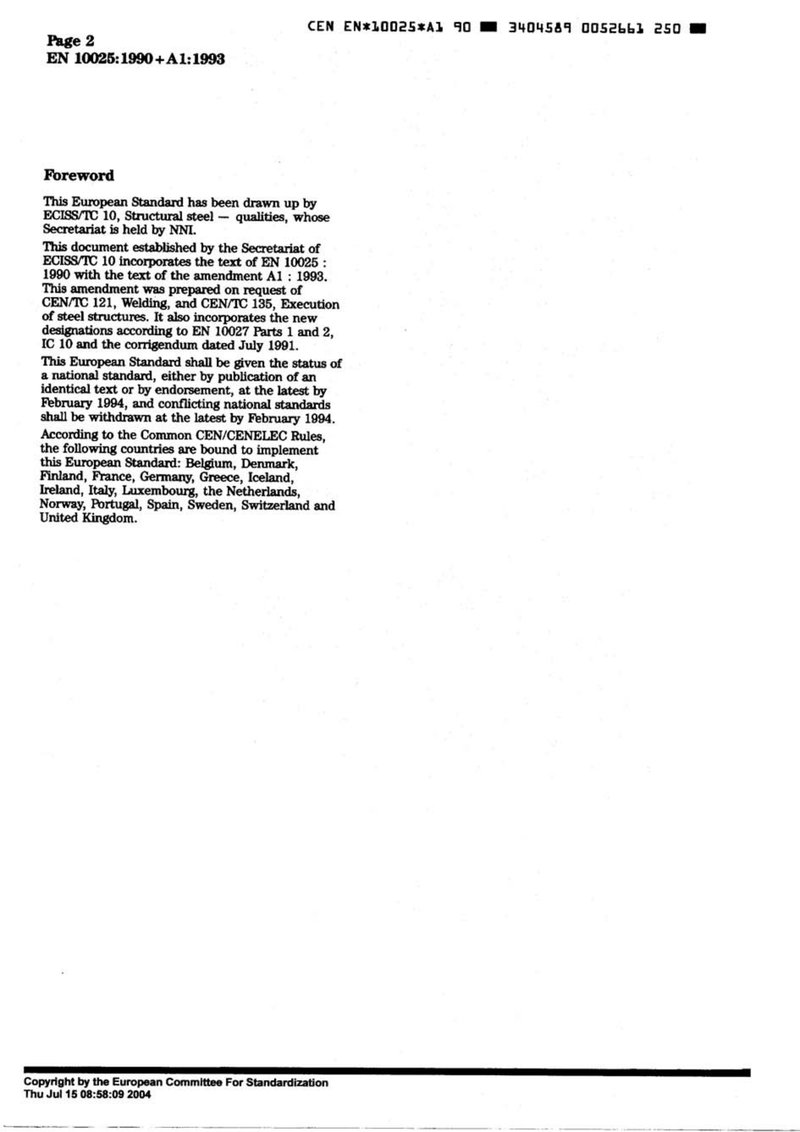
Foreword
This European Standard has been drawn up by ECISS/TC 10, Structural steel — qualities, whose Secretariat is held by NNI.
This document established by the Secretariat of ECISS/TC 10 incorporates the text of EN 10025 : 1990 with the text of the amendment A1 : 1993. This amendment was prepared on request of CEN/TC 121, Welding, and CEN/TC 135, Execution of steel structures. It also incorporates the new designations according to EN 10027 Parts 1 and 2, IC 10 and the corrigendum dated July 1991.
This European Standard shall be given the status of a national standard, either by publication of an identical text or by endorsement, at the latest by February 1994, and conflicting national standards shall be withdrawn at the latest by February 1994.
According to the Common CEN/CENELEC Rules, the following countries are bound to implement this European Standard: Belgium, Denmark, Finland, France, Germany, Greece, Iceland, Ireland, Italy, Luxembourg, the Netherlands, Norway, Portugal, Spain, Sweden, Switzerland and United Kingdom.
2
Contents
|
|
3
1 Scope
|
1.1 This European Standard specifies requirements for long products and flat products of hot rolled non-alloy, base and quality steels in the grades and qualities given in tables 2 and 3 (chemical composition) and 5 and 6 (mechanical properties) in the usual delivery condition as given in 7.2. The steels specified in this European Standard are intended for use in welded, bolted and riveted structures, for service at ambient temperatures (subject to the restrictions described in 7.5.1). They are not intended to be heat treated except products delivered in the delivery condition N. Stress relief annealing is permitted. Products delivered in N condition may be normalized and hot formed after delivery (see clause 3). NOTE 1. Semi-finished products which are to be converted to rolled finished products conforming to this European Standard should be the subject of special agreement at the time of the enquiry and order. The chemical composition can also be agreed at the time of enquiry and order, however the values should be within the limits of table 2. NOTE 2. For certain grades and product forms suitability for particular applications may be specified at the time of the enquiry and order (see 7.5.3, 7.5.4 and table 7). 1.2 This European Standard does not apply to coated products and products for which other EURONORMS exist or European Standards dealing with steels for general structural applications are being prepared
2 Normative referencesThis European Standard incorporates by dated or undated reference, provisions from other publications. These normative references are cited at the appropriate places in the text and the publications are listed hereafter. For dated |
references, subsequent amendments to or revisions of any of these publications apply to this European Standard only when incorporated in it by amendment or revision. For undated references the latest edition of the publication referred to applies. 2.1 General standards
|
1) Draft is under discussion.
2) Until these EURONORMS are transformed into European Standards, they can either be implemented or reference made to the corresponding national standards, the list of which is given in annex B to this European Standard.
4
预览内容由文件识别整理,表格、公式及文字请以原始文件为准。
原文图片预览
PAGE IMAGES

下载标准文件
EN 10025+A3
英语 · PDF · 6 页 · 4.46 MB