ecp_46_ 2003_high_voltage_live_line_work
ecp_46_ 2003_high_voltage_live_line_work
ecp_46_ 2003_high_voltage_live_line_work
标准信息
STANDARD INFORMATION- 标准编号
- ecp_46_ 2003_high_voltage_live_line_work
- 所属分类
- 其他国外标准与工程资料
- 文件语言
- 英语
- 文件格式
- 文件页数
- 6 页
- 文件大小
- 778.64 KB
· 更新:
标准简介
OVERVIEW中文简介
标准 ecp_46_ 2003_high_voltage_live_line_work 的预览内容
English summary
Preview of standard ecp_46_ 2003_high_voltage_live_line_work
以上为根据文件整理的内容简介。
标准内容预览
DOCUMENT PREVIEW1.2 INTERPRETATION
The kinds of work listed above must be carried out using safe procedures and associated equipment designed specifically for the purpose.
1.2.1 Approved – means certified by the Service Provider as complying with the requirements of this code.
1.2.2 Asset Manager - means an organisation responsible and accountable for the equipment to be worked on. An Asset Manager may also be a Service Provider.
1.2.3 Bonded - means conductors and or fittings are connected together in such a manner as to ensure that they are at the same electrical potential.
1.2.4 De-Energised – means disconnected from all sources of supply but not necessarily isolated, tested and earthed.
1.2.5 Earthed – means effectively connected to the general mass of earth.
1.2.6 High-Voltage – means any voltage exceeding 1000 V a.c. or 1500 V d.c.
1.2.7 Insulating Elevating Work Platform (Insulating EWP) – means an approved and tested insulated aerial device.
1.2.8 Insulating Rope – means standard commercial grade synthetic rope that is tested and manufactured to ensure good insulating properties but should not be intentionally placed across phase to phase or phase to earth air gaps.
1.2.9 Live (or Alive or Energised) – means connected to a source of electrical supply.
1.2.10 Live Line Rope – means rope that is specially designed, manufactured, tested and maintained so as to have very high insulating qualities and may be intentionally placed across phase to phase or phase to earth air gaps.
1.2.11 Live Line Equipment – means all live line tools, rope, gloves and insulating equipment used for live line work.
1.2.12 Live Line Minimum Approach Distance (Live Line MAD) – means the minimum air gap that shall be maintained between a lineworker and any other component at different potential during live line work, in order to prevent flashover and provide for worker safety.
1.2.13 Live Line Permit – means a permit issued by the system controller or equivalent to verify to a live line work party that the control measures are in place on the circuit being worked on and to authorise work.
1.2.14 Live Line Stick (also called Hot Stick) – means a solid or filled stick of insulating material specially designed, approved and tested for use in physically bridging the distance between;
(a) the lineworker and energised components; or
(b) the energised components and earth; or
(c) adjacent phases; or
(d) to enable physical loads to be taken or tools to be applied.
1.2.15 Live Line Work – means any high voltage work performed under approved procedures inside the minimum approach distance (MAD), on or near components of a line capable of being energised to high voltage without implementing the full protective practice of isolating, proving de-energised and earthing.
6
THE ELECTRICITY ACT 1992
Approval of the New Zealand Electrical Code of Practice for High Voltage Live Line Work 2003 (NZECP 46:2003)
Pursuant to section 38 of the Electricity Act 1992, I hereby approve the New Zealand Electrical Code of Practice for Live line Work 2003 (NZECP 46:2003) which comprises three parts:
ECP46.1: Glove and Barrier
ECP46.2: Barehand
ECP46.3: Stick
The New Zealand Electrical Code of Practice for Live Line Work 2003 (NZECP 46.2003) was issued by the Manager, Standards and Safety, Ministry of Consumer Affairs, acting under delegated authority (pursuant to section 41 of the State Sector Act 1998) from the Chief Executive, Ministry of Economic Development on the 12th day of October 2001.
Dated this 19th day of March, 2003
Hon Harry Duynhoven
Associate Minister of Energy
2
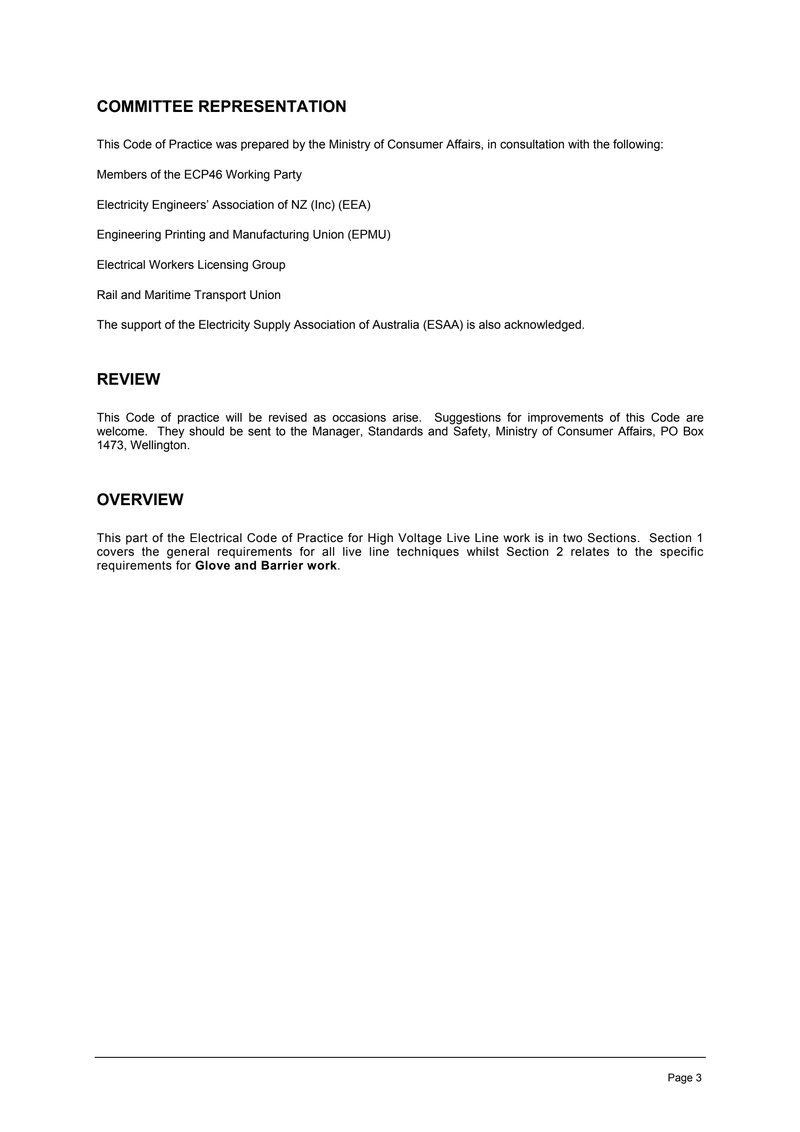
COMMITTEE REPRESENTATION
This Code of Practice was prepared by the Ministry of Consumer Affairs, in consultation with the following:
Members of the ECP46 Working Party
Electricity Engineers' Association of NZ (Inc) (EEA)
Engineering Printing and Manufacturing Union (EPMU)
Electrical Workers Licensing Group
Rail and Maritime Transport Union
The support of the Electricity Supply Association of Australia (ESAA) is also acknowledged.
REVIEW
This Code of practice will be revised as occasions arise. Suggestions for improvements of this Code are welcome. They should be sent to the Manager, Standards and Safety, Ministry of Consumer Affairs, PO Box 1473, Wellington.
OVERVIEW
This part of the Electrical Code of Practice for High Voltage Live Line work is in two Sections. Section 1 covers the general requirements for all live line techniques whilst Section 2 relates to the specific requirements for Glove and Barrier work.
3
TABLE OF CONTENTS
1.1 SCOPE | 5 |
1.2 INTERPRETATION | 6 |
1.3 GENERAL REQUIREMENTS RELATING TO ALL TECHNIQUES | 8 |
1.3.1 Minimum Standards and Responsibilities | 8 |
1.3.2 Electric and Magnetic Fields | 8 |
1.3.3 Work Techniques and Procedures | 8 |
1.3.4 Personnel Selection, Training, Certification, Records and Maintenance of Competency | 9 |
1.3.5 Equipment | 13 |
1.3.6 Safety Observer | 16 |
1.3.7 Work Considerations | 16 |
1.3.8 Procedures in the Event of an Accident | 18 |
1.3.9 General Work Practices | 18 |
1.4 MINIMUM REQUIREMENTS FOR ALL CATEGORIES OF LIVE LINE WORK | 21 |
1.4.1 Theory/Standards | 21 |
1.4.2 Work Site Management and Participation | 21 |
1.4.3 Practical Skills | 21 |
2.1 GENERAL | 22 |
2.2 DEFINITIONS SPECIFIC TO THIS SECTION | 22 |
2.3 CONCEPTS | 22 |
2.4 APPROACH DISTANCES | 23 |
2.5 WORK TECHNIQUES AND PROCEDURES | 23 |
2.5.1 Combination Glove and Barrier and Stick Methods | 23 |
2.6 EQUIPMENT | 23 |
2.6.1 Cranes and Crane Insulation | 23 |
2.6.2 Insulating Elevating Work Platforms (Insulating EWPs) | 24 |
2.6.3 Insulating Gloves and Sleeves | 24 |
2.6.4 Insulating Covers | 25 |
2.6.5 Insulating Platforms | 25 |
2.6.6 Temporary Dropout Tools | 26 |
2.6.7 Temporary Insulated Jumpers | 26 |
2.6.8 Proof Test/Use Voltage Relationship | 26 |
2.6.9 Rating/Use Voltage Relationship | 26 |
2.6.10 Testing | 27 |
2.7 WORK CONSIDERATIONS | 27 |
2.7.1 Integrity of Insulation | 27 |
2.8 GENERAL WORK PRACTICES | 28 |
2.8.1 Insulating Barriers | 28 |
2.9 MINIMUM REQUIREMENTS FOR LIVE LINE GLOVE AND BARRIER WORK | 29 |
APPENDIX A | 31 |
4
SECTION 1: SCOPE, INTERPRETATION AND GENERAL REQUIREMENTS
1.1 SCOPE
1.1.1 This Code sets out the minimum industry standards for high voltage live line work. The principles may be enhanced or supplemented, provided this does not result in reduced safety standards.
1.1.2 This Code applies to all work undertaken on live high voltage overhead lines using approved procedures, tools and equipment, and by persons holding the minimum competencies detailed under this Code. Other work on live high voltage overhead lines including, but not limited to, operating, is not covered by the Code.
1.1.3 This Code does not constitute a live line training manual, nor does it set down live line work procedures. These procedures should be developed in accordance with the principles in this Code.
1.1.4 The objectives of this Code are:
(a) To ensure the safety of electrical workers and the general public.
(b) To specify the minimum standards for equipment required for live line work.
1.1.5 Equipment not specifically designed for a live line method shall not be used.
1.1.6 Throughout this Code:
(c) The word "shall" is to be interpreted as mandatory.
(d) "Should" is to be interpreted as advisory or discretionary.
(e) Reference to lineworker unless specifically notified shall refer to a certificated live line mechanic.
1.1.7 While the principles of live line work contained in this Code have been written around work on overhead lines, the concepts may be equally applicable to work in other areas such as substation equipment, when combined with other appropriate training and work controls.
1.1.8 This Code does not substitute or override any regulation or legislation.
1.1.9 This Code does not apply to the following kinds of work:
(a) The operation of fuses and the changing of the fuse elements;
(b) The operation of isolators and switches;
(c) The taking of electrical measurements;
(d) The measurement of distances;
(e) The phasing of conductors and fittings;
(f) The checking and testing of insulator strings;
(g) The removal of impediments on lines;
(h) The greasing of fittings.
(i) Traction live line work under 2,000 volts d.c.
5
1.2 INTERPRETATION
The kinds of work listed above must be carried out using safe procedures and associated equipment designed specifically for the purpose.
1.2.1 Approved – means certified by the Service Provider as complying with the requirements of this code.
1.2.2 Asset Manager - means an organisation responsible and accountable for the equipment to be worked on. An Asset Manager may also be a Service Provider.
1.2.3 Bonded - means conductors and or fittings are connected together in such a manner as to ensure that they are at the same electrical potential.
1.2.4 De-Energised – means disconnected from all sources of supply but not necessarily isolated, tested and earthed.
1.2.5 Earthed – means effectively connected to the general mass of earth.
1.2.6 High-Voltage – means any voltage exceeding 1000 V a.c. or 1500 V d.c.
1.2.7 Insulating Elevating Work Platform (Insulating EWP) – means an approved and tested insulated aerial device.
1.2.8 Insulating Rope – means standard commercial grade synthetic rope that is tested and manufactured to ensure good insulating properties but should not be intentionally placed across phase to phase or phase to earth air gaps.
1.2.9 Live (or Alive or Energised) – means connected to a source of electrical supply.
1.2.10 Live Line Rope – means rope that is specially designed, manufactured, tested and maintained so as to have very high insulating qualities and may be intentionally placed across phase to phase or phase to earth air gaps.
1.2.11 Live Line Equipment – means all live line tools, rope, gloves and insulating equipment used for live line work.
1.2.12 Live Line Minimum Approach Distance (Live Line MAD) – means the minimum air gap that shall be maintained between a lineworker and any other component at different potential during live line work, in order to prevent flashover and provide for worker safety.
1.2.13 Live Line Permit – means a permit issued by the system controller or equivalent to verify to a live line work party that the control measures are in place on the circuit being worked on and to authorise work.
1.2.14 Live Line Stick (also called Hot Stick) – means a solid or filled stick of insulating material specially designed, approved and tested for use in physically bridging the distance between;
(a) the lineworker and energised components; or
(b) the energised components and earth; or
(c) adjacent phases; or
(d) to enable physical loads to be taken or tools to be applied.
1.2.15 Live Line Work – means any high voltage work performed under approved procedures inside the minimum approach distance (MAD), on or near components of a line capable of being energised to high voltage without implementing the full protective practice of isolating, proving de-energised and earthing.
6
预览内容由文件识别整理,表格、公式及文字请以原始文件为准。
原文图片预览
PAGE IMAGES


下载标准文件
ecp_46_ 2003_high_voltage_live_line_work
英语 · PDF · 6 页 · 778.64 KB