标准信息
STANDARD INFORMATION- 标准编号
- clause-d2
- 所属分类
- 其他国外标准与工程资料
- 文件语言
- 英语
- 文件格式
- 文件页数
- 6 页
- 文件大小
- 172.42 KB
· 更新:
标准简介
OVERVIEW中文简介
标准 clause-d2 的预览内容
English summary
Preview of standard clause-d2
以上为根据文件整理的内容简介。
标准内容预览
DOCUMENT PREVIEWContents
| Page | |
|---|---|
| References | 9 |
| Definitions | 11 |
| Verification Method D2/VM1 Passenger Carrying Lifts |
13 |
| Acceptable Solution D2/AS1 Passenger Carrying Lifts |
15 |
| 1.0 Reference Document NZS 4332 | 15 |
| 2.0 Reference Document EN 81 Parts 1 and 2 |
15 |
| Verification Method D2/VM2 Domestic and Service Lifts |
21 |
| Acceptable Solution D2/AS2 Domestic and Service Lifts |
23 |
| 1.0 Reference Document | 23 |
| 2.0 Modified Rules | 23 |
| 3.0 Additional Rules | 24 |
| Verification Method D2/VM3 Escalators and Moving Walks |
25 |
| Acceptable Solution D2/AS3 Escalators and Moving Walks |
27 |
| 1.0 Reference Document | 27 |
| 2.0 Modified Rules | 27 |
| 3.0 Additional Rules | 28 |
6
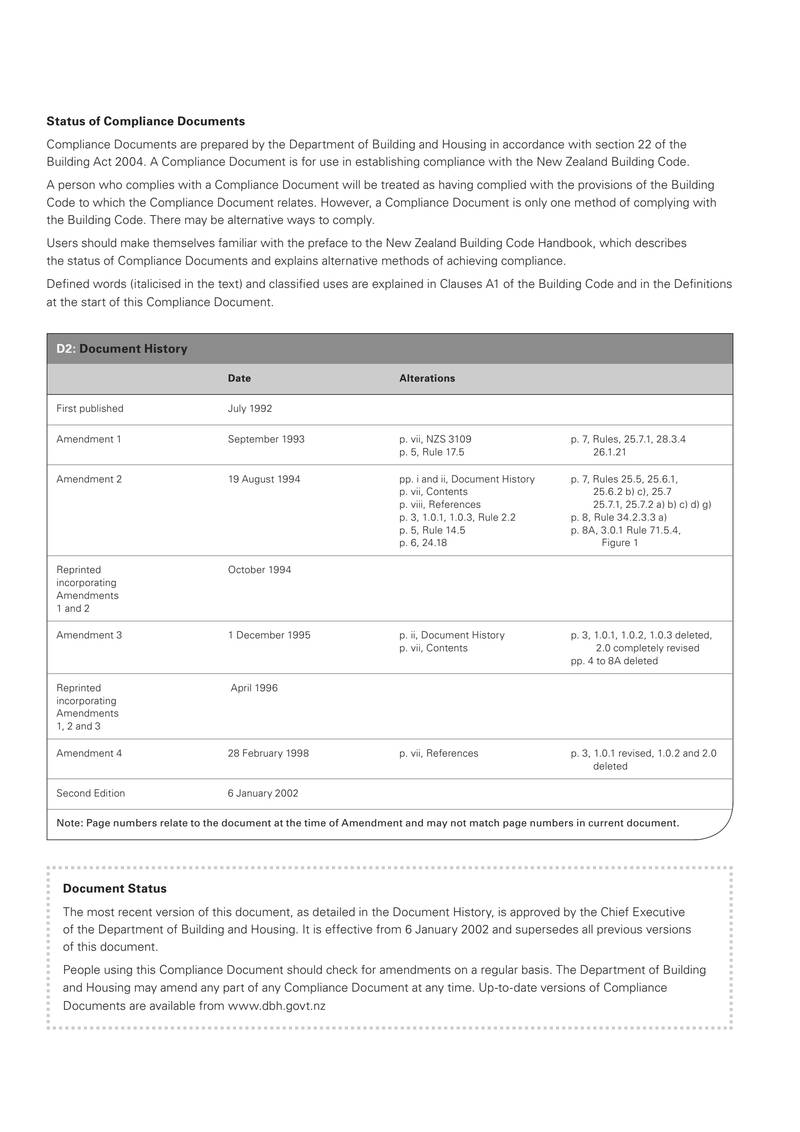
Status of Compliance Documents
Compliance Documents are prepared by the Department of Building and Housing in accordance with section 22 of the Building Act 2004. A Compliance Document is for use in establishing compliance with the New Zealand Building Code.
A person who complies with a Compliance Document will be treated as having complied with the provisions of the Building Code to which the Compliance Document relates. However, a Compliance Document is only one method of complying with the Building Code. There may be alternative ways to comply.
Users should make themselves familiar with the preface to the New Zealand Building Code Handbook, which describes the status of Compliance Documents and explains alternative methods of achieving compliance.
Defined words (italicised in the text) and classified uses are explained in Clauses A1 of the Building Code and in the Definitions at the start of this Compliance Document.
| Date | Alterations | ||
|---|---|---|---|
| First published | July 1992 | ||
| Amendment 1 | September 1993 | p. vii, NZS 3109 p. 5, Rule 17.5 | p. 7, Rules, 25.7.1, 28.3.4 26.1.21 |
| Amendment 2 | 19 August 1994 | pp. i and ii, Document History p. vii, Contents p. viii, References p. 3, 1.0.1, 1.0.3, Rule 2.2 p. 5, Rule 14.5 p. 6, 24.18 | p. 7, Rules 25.5, 25.6.1, 25.6.2 b) c), 25.7 25.7.1, 25.7.2 a) b) c) d) g) p. 8, Rule 34.2.3.3 a) p. 8A, 3.0.1 Rule 71.5.4, Figure 1 |
| Reprinted incorporating Amendments 1 and 2 | October 1994 | ||
| Amendment 3 | 1 December 1995 | p. ii, Document History p. vii, Contents | p. 3, 1.0.1, 1.0.2, 1.0.3 deleted, 2.0 completely revised pp. 4 to 8A deleted |
| Reprinted incorporating Amendments 1, 2 and 3 | April 1996 | ||
| Amendment 4 | 28 February 1998 | p. vii, References | p. 3, 1.0.1 revised, 1.0.2 and 2.0 deleted |
| Second Edition | 6 January 2002 | ||
| Note: Page numbers relate to the document at the time of Amendment and may not match page numbers in current document. | |||
Document Status
The most recent version of this document, as detailed in the Document History, is approved by the Chief Executive of the Department of Building and Housing. It is effective from 6 January 2002 and supersedes all previous versions of this document.
People using this Compliance Document should check for amendments on a regular basis. The Department of Building and Housing may amend any part of any Compliance Document at any time. Up-to-date versions of Compliance Documents are available from www.dbh.govt.nz
2
New Zealand Building Code Clause D2 Mechanical Installations for Access
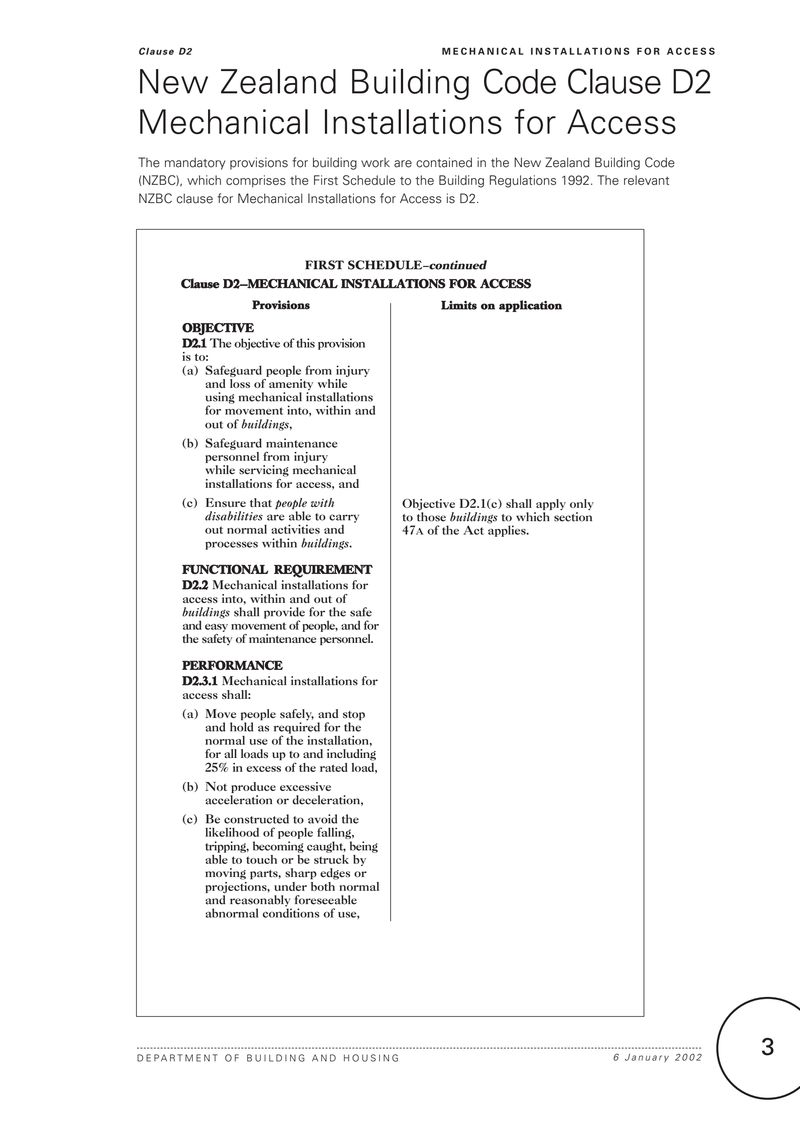
The mandatory provisions for building work are contained in the New Zealand Building Code (NZBC), which comprises the First Schedule to the Building Regulations 1992. The relevant NZBC clause for Mechanical Installations for Access is D2.
FIRST SCHEDULE–continued
Clause D2–MECHANICAL INSTALLATIONS FOR ACCESS
| Provisions | Limits on application |
|---|---|
|
OBJECTIVE D2.1 The objective of this provision is to:
FUNCTIONAL REQUIREMENT D2.2 Mechanical installations for access into, within and out of buildings shall provide for the safe and easy movement of people, and for the safety of maintenance personnel. PERFORMANCE D2.3.1 Mechanical installations for access shall:
|
Objective D2.1(c) shall apply only to those buildings to which section 47A of the Act applies. |
3
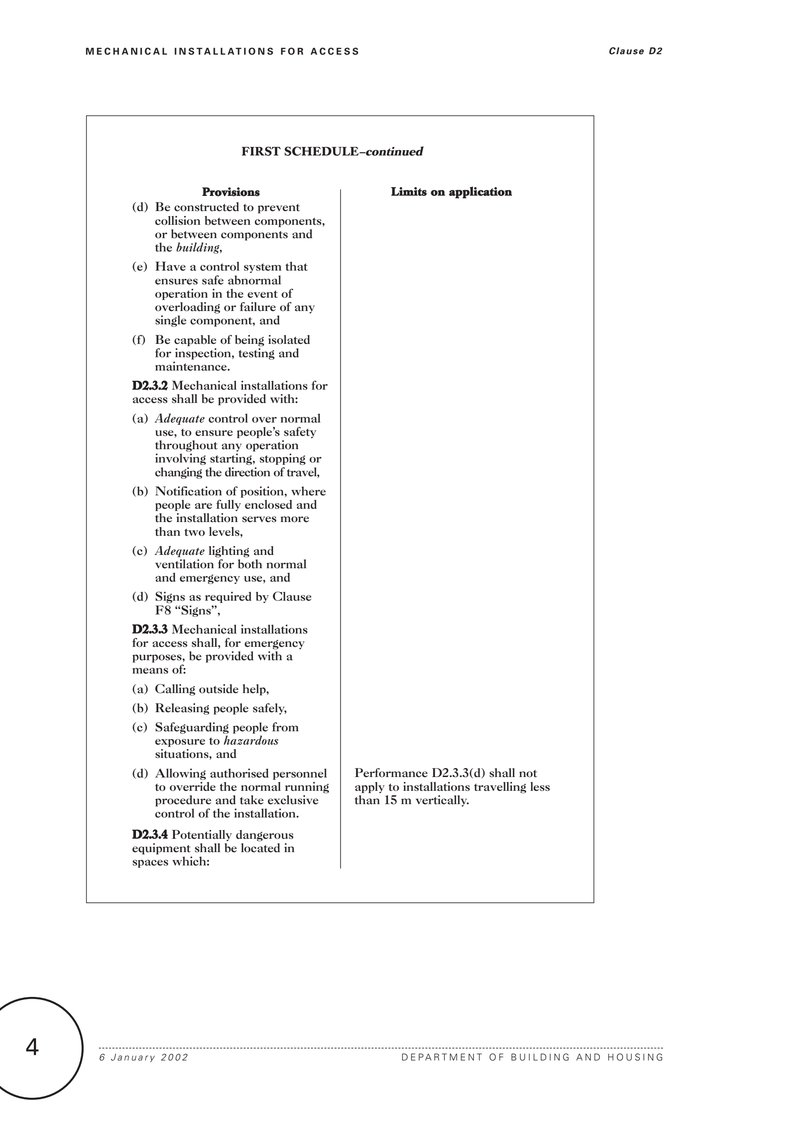
FIRST SCHEDULE–continued
|
Provisions (d) Be constructed to prevent collision between components, or between components and the building, (e) Have a control system that ensures safe abnormal operation in the event of overloading or failure of any single component, and (f) Be capable of being isolated for inspection, testing and maintenance. D23.2 Mechanical installations for access shall be provided with: (a) Adequate control over normal use, to ensure people's safety throughout any operation involving starting, stopping or changing the direction of travel, (b) Notification of position, where people are fully enclosed and the installation serves more than two levels, (c) Adequate lighting and ventilation for both normal and emergency use, and (d) Signs as required by Clause F8 "Signs", D23.3 Mechanical installations for access shall, for emergency purposes, be provided with a means of: (a) Calling outside help, (b) Releasing people safely, (c) Safeguarding people from exposure to hazardous situations, and (d) Allowing authorised personnel to override the normal running procedure and take exclusive control of the installation. D23.4 Potentially dangerous equipment shall be located in spaces which: |
Limits on application Performance D23.3(d) shall not apply to installations travelling less than 15 m vertically. |
4
FIRST SCHEDULE–continued
|
Provisions (a) Are secure from unauthorised entry and contain only equipment associated with the installation, (b) Are appropriately sized and suitably guarded to provide adequate safe working areas for maintenance personnel, (c) Are provided with adequate power and lighting for maintenance, and (d) Have an environment that ensures the safe operation of the equipment under all likely conditions of use. D2.3.5 Mechanical installations on accessible routes shall: (a) Where the passenger conveyor is manually controlled, provide: (i) controls which are easily identifiable and easy to use, (ii) adequate notification that the passenger conveyor has registered a summoning call, and (iii) adequate notification that the passenger conveyor has arrived, and of its future direction of travel, (b) Where the passenger conveyor is fully enclosed and serves more than two levels, provide an adequate means of informing occupants of their location, (c) Where appropriate, have doors which: (i) are power operated, (ii) are readily distinguishable from their surroundings, and (iii) where automatic, remain open sufficiently long to enable people with disabilities to pass through, and (d) Have handrails within the passenger conveyor. |
Limits on application |
5
Contents
| Page | |
|---|---|
| References | 9 |
| Definitions | 11 |
| Verification Method D2/VM1 Passenger Carrying Lifts |
13 |
| Acceptable Solution D2/AS1 Passenger Carrying Lifts |
15 |
| 1.0 Reference Document NZS 4332 | 15 |
| 2.0 Reference Document EN 81 Parts 1 and 2 |
15 |
| Verification Method D2/VM2 Domestic and Service Lifts |
21 |
| Acceptable Solution D2/AS2 Domestic and Service Lifts |
23 |
| 1.0 Reference Document | 23 |
| 2.0 Modified Rules | 23 |
| 3.0 Additional Rules | 24 |
| Verification Method D2/VM3 Escalators and Moving Walks |
25 |
| Acceptable Solution D2/AS3 Escalators and Moving Walks |
27 |
| 1.0 Reference Document | 27 |
| 2.0 Modified Rules | 27 |
| 3.0 Additional Rules | 28 |
6
预览内容由文件识别整理,表格、公式及文字请以原始文件为准。
原文图片预览
PAGE IMAGES
下载标准文件
clause-d2
英语 · PDF · 6 页 · 172.42 KB