标准信息
STANDARD INFORMATION- 标准编号
- clause-ca-c2-c3-c4
- 所属分类
- 其他国外标准与工程资料
- 文件语言
- 英语
- 文件格式
- 文件页数
- 6 页
- 文件大小
- 1.95 MB
· 更新:
标准简介
OVERVIEW中文简介
标准 clause-ca-c2-c3-c4 的预览内容
English summary
Preview of standard clause-ca-c2-c3-c4
以上为根据文件整理的内容简介。
标准内容预览
DOCUMENT PREVIEWFIRST SCHEDULE–continued
Clause C3–SPREAD OF FIRE
|
Provisions OBJECTIVE C3.1 The objective of this provision is to: (a) Safeguard people from injury or illness when evacuating a building during fire. (b) Provide protection to fire service personnel during firefighting operations. (c) Protect adjacent household units, other residential units, and other property from the effects of fire. Amend 1 Jan 2002 (d) Safeguard the environment from adverse effects of fire. FUNCTIONAL REQUIREMENT C3.2 Buildings shall be provided with safeguards against fire spread so that: (a) Occupants have time to escape to a safe place without being overcome by the effects of fire, (b) Firefighters may undertake rescue operations and protect property, (c) Adjacent household units, other residential units, and other property are protected from damage, and Amend 1 Jan 2002 (d) Significant quantities of hazardous substances are not released into the environment during fire. PERFORMANCE C3.3.1 Interior surface finishes on walls, floors, ceilings and suspended building elements, shall resist the spread of fire and limit the generation of toxic gases, smoke and heat, to a degree appropriate to: (a) The travel distance, (b) The number of occupants, |
Limits on application Requirement C3.2(d) applies only to buildings where significant quantities of hazardous substances are stored and processed. |
6
Status of Compliance Documents
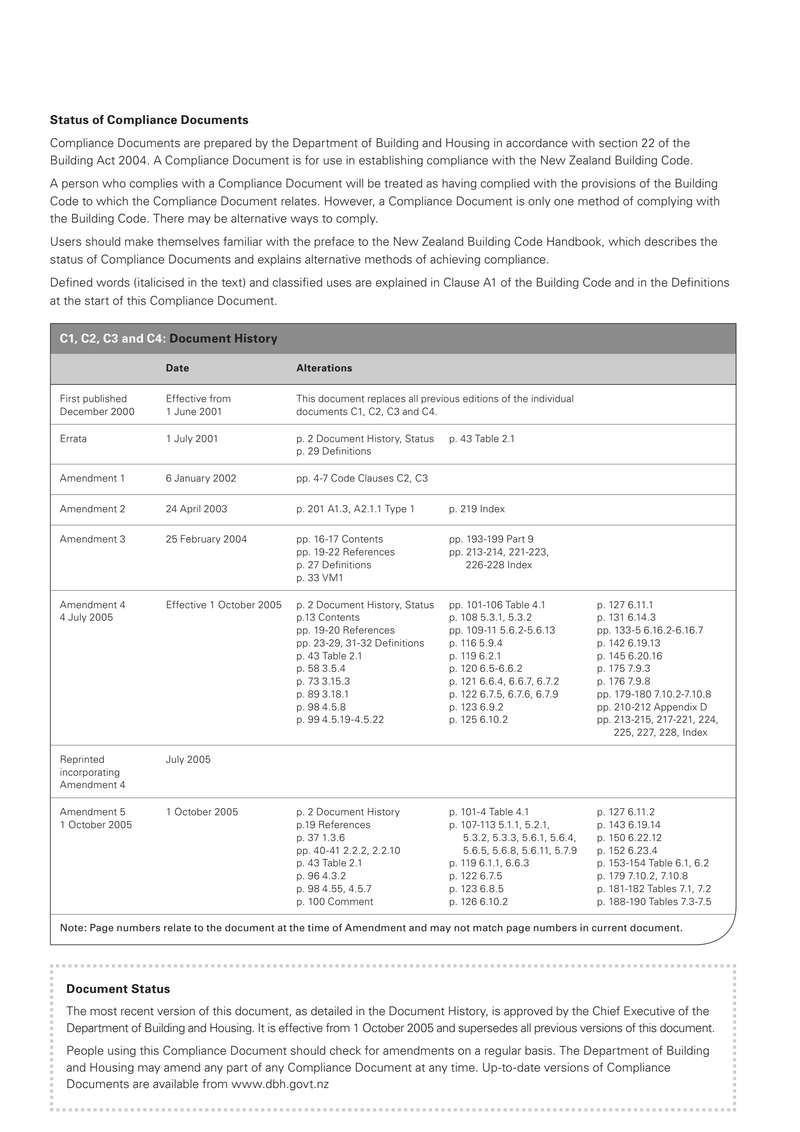
Compliance Documents are prepared by the Department of Building and Housing in accordance with section 22 of the Building Act 2004. A Compliance Document is for use in establishing compliance with the New Zealand Building Code.
A person who complies with a Compliance Document will be treated as having complied with the provisions of the Building Code to which the Compliance Document relates. However, a Compliance Document is only one method of complying with the Building Code. There may be alternative ways to comply.
Users should make themselves familiar with the preface to the New Zealand Building Code Handbook, which describes the status of Compliance Documents and explains alternative methods of achieving compliance.
Defined words (italicised in the text) and classified uses are explained in Clause A1 of the Building Code and in the Definitions at the start of this Compliance Document.
| Date | Alterations | |||
|---|---|---|---|---|
| First published December 2000 | Effective from 1 June 2001 | This document replaces all previous editions of the individual documents C1, C2, C3 and C4. | ||
| Errata | 1 July 2001 | p. 2 Document History, Status p. 29 Definitions | p. 43 Table 2.1 | |
| Amendment 1 | 6 January 2002 | pp. 4-7 Code Clauses C2, C3 | ||
| Amendment 2 | 24 April 2003 | p. 201 A1.3, A2.1.1 Type 1 | p. 219 Index | |
| Amendment 3 | 25 February 2004 | pp. 16-17 Contents pp. 19-22 References p. 27 Definitions p. 33 VM1 | pp. 193-199 Part 9 pp. 213-214, 221-223, 226-228 Index | |
| Amendment 4 4 July 2005 | Effective 1 October 2005 | p. 2 Document History, Status p.13 Contents pp. 19-20 References pp. 23-29, 31-32 Definitions p. 43 Table 2.1 p. 58 3.5.4 p. 73 3.15.3 p. 89 3.18.1 p. 98 4.5.8 p. 99 4.5.19-4.5.22 | pp. 101-106 Table 4.1 p. 108 5.3.1, 5.3.2 pp. 109-11 5.6.2-5.6.13 p. 116 5.9.4 p. 119 6.2.1 p. 120 6.5-6.6.2 p. 121 6.6.4, 6.6.7, 6.7.2 p. 122 6.7.5, 6.7.6, 6.7.9 p. 123 6.9.2 p. 125 6.10.2 | p. 127 6.11.1 p. 131 6.14.3 pp. 133-5 6.16.2-6.16.7 p. 142 6.19.13 p. 145 6.20.16 p. 175 7.9.3 p. 176 7.9.8 pp. 179-180 7.10.2-7.10.8 pp. 210-212 Appendix D pp. 213-215, 217-221, 224, 225, 227, 228, Index |
| Reprinted incorporating Amendment 4 | July 2005 | |||
| Amendment 5 1 October 2005 | 1 October 2005 | p. 2 Document History p.19 References p. 37 1.3.6 pp. 40-41 2.2.2, 2.2.10 p. 43 Table 2.1 p. 96 4.3.2 p. 98 4.55, 4.5.7 p. 100 Comment | p. 101-4 Table 4.1 p. 107-113 5.1.1, 5.2.1, 5.3.2, 5.3.3, 5.6.1, 5.6.4, 5.6.5, 5.6.8, 5.6.11, 5.7.9 p. 119 6.1.1, 6.6.3 p. 122 6.7.5 p. 123 6.8.5 p. 126 6.10.2 | p. 127 6.11.2 p. 143 6.19.14 p. 150 6.22.12 p. 152 6.23.4 p. 153-154 Table 6.1, 6.2 p. 179 7.10.2, 7.10.8 p. 181-182 Tables 7.1, 7.2 p. 188-190 Tables 7.3-7.5 |
| Note: Page numbers relate to the document at the time of Amendment and may not match page numbers in current document. | ||||
Document Status
The most recent version of this document, as detailed in the Document History, is approved by the Chief Executive of the Department of Building and Housing. It is effective from 1 October 2005 and supersedes all previous versions of this document.
People using this Compliance Document should check for amendments on a regular basis. The Department of Building and Housing may amend any part of any Compliance Document at any time. Up-to-date versions of Compliance Documents are available from www.dbh.govt.nz
2
New Zealand Building Code Fire Safety Clauses
The mandatory provisions for building work are contained in the New Zealand Building Code (NZBC), which comprises the First Schedule to the Building Regulations 1992. The relevant NZBC Clauses for Fire Safety in buildings are C1, C2, C3 and C4.
| Provisions | Limits on application |
|---|---|
| FIRST SCHEDULE—continued | |
| Clause C1—OUTBREAK OF FIRE | |
|
OBJECTIVE C1.1 The objective of this provision is to safeguard people from injury or illness caused by fire. FUNCTIONAL REQUIREMENT C1.2 In buildings fixed appliances using the controlled combustion of solid, liquid or gaseous fuel, shall be installed in a way which reduces the likelihood of fire. PERFORMANCE C1.3.1 Fixed appliances and services shall be installed so as to avoid the accumulation of gases within the installation and in building spaces, where heat or ignition could cause uncontrolled combustion or explosion. C1.3.2 Fixed appliances shall be installed in a manner that does not raise the temperature of any building element by heat transfer or concentration to a level that would adversely affect its physical or mechanical properties or function. |
|
3
FIRST SCHEDULE–continued
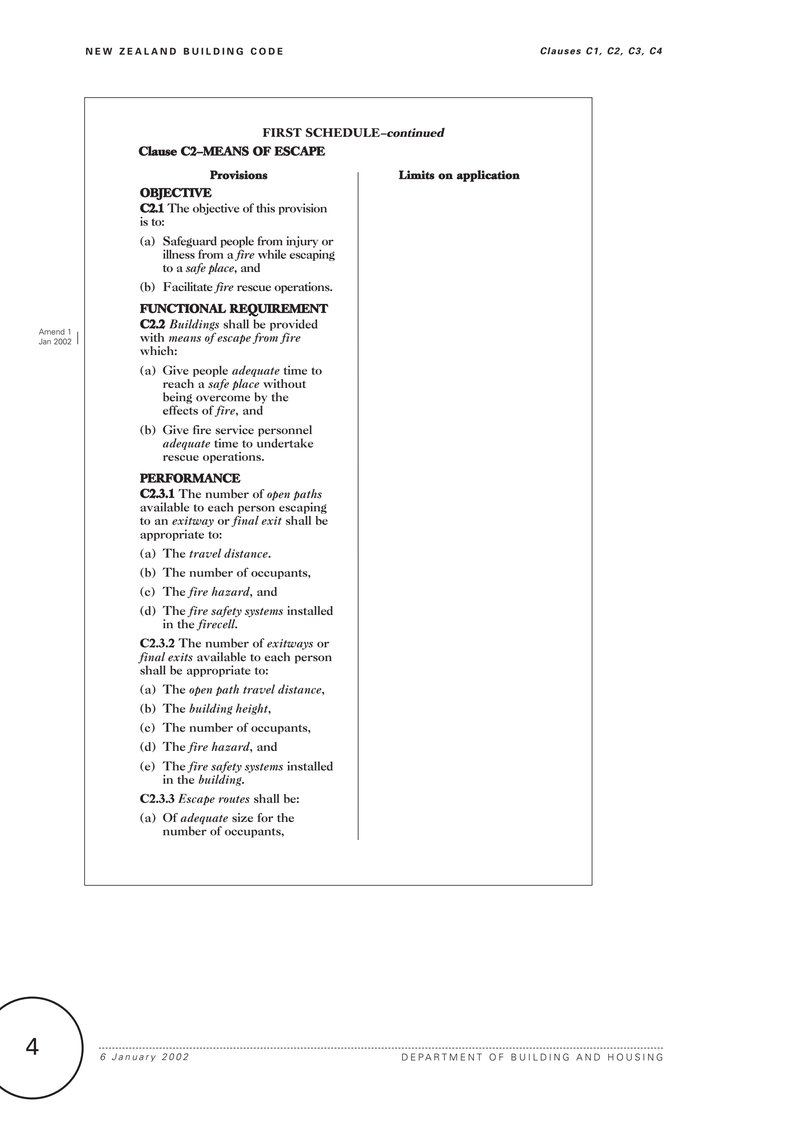
Clause C2–MEANS OF ESCAPE
|
Provisions OBJECTIVE C2.1 The objective of this provision is to: (a) Safeguard people from injury or illness from a fire while escaping to a safe place, and (b) Facilitate fire rescue operations. FUNCTIONAL REQUIREMENT C2.2 Buildings shall be provided with means of escape from fire which: (a) Give people adequate time to reach a safe place without being overcome by the effects of fire, and (b) Give fire service personnel adequate time to undertake rescue operations. PERFORMANCE C2.3.1 The number of open paths available to each person escaping to an exitway or final exit shall be appropriate to: (a) The travel distance. (b) The number of occupants, (c) The fire hazard, and (d) The fire safety systems installed in the firecell. C2.3.2 The number of exitways or final exits available to each person shall be appropriate to: (a) The open path travel distance, (b) The building height, (c) The number of occupants, (d) The fire hazard, and (e) The fire safety systems installed in the building. C2.3.3 Escape routes shall be: (a) Of adequate size for the number of occupants, |
Limits on application |
4
FIRST SCHEDULE–continued
|
Provisions (b) Free of obstruction in the direction of escape, (c) Of length appropriate to the mobility of the people using them, (d) Resistant to the spread of fire as required by Clause C3 "Spread of Fire", (e) Easy to find as required by Clause F8 "Signs", (f) Provided with adequate illumination as required by Clause F6 "Lighting for Emergency", and (g) Easy and safe to use as required by Clause D1.3.3 "Access Routes". |
Limits on application Performance C2.3.3(b) must not prevent a door that forms part of an escape route from being locked if the person who locks it is satisfied that no-one is in that part of the building served by the escape route and that no one is likely to enter that part of the building, except in an emergency, without unlocking that door. |
Amend 1 Jan 2002
5
FIRST SCHEDULE–continued
Clause C3–SPREAD OF FIRE
|
Provisions OBJECTIVE C3.1 The objective of this provision is to: (a) Safeguard people from injury or illness when evacuating a building during fire. (b) Provide protection to fire service personnel during firefighting operations. (c) Protect adjacent household units, other residential units, and other property from the effects of fire. Amend 1 Jan 2002 (d) Safeguard the environment from adverse effects of fire. FUNCTIONAL REQUIREMENT C3.2 Buildings shall be provided with safeguards against fire spread so that: (a) Occupants have time to escape to a safe place without being overcome by the effects of fire, (b) Firefighters may undertake rescue operations and protect property, (c) Adjacent household units, other residential units, and other property are protected from damage, and Amend 1 Jan 2002 (d) Significant quantities of hazardous substances are not released into the environment during fire. PERFORMANCE C3.3.1 Interior surface finishes on walls, floors, ceilings and suspended building elements, shall resist the spread of fire and limit the generation of toxic gases, smoke and heat, to a degree appropriate to: (a) The travel distance, (b) The number of occupants, |
Limits on application Requirement C3.2(d) applies only to buildings where significant quantities of hazardous substances are stored and processed. |
6
预览内容由文件识别整理,表格、公式及文字请以原始文件为准。
原文图片预览
PAGE IMAGES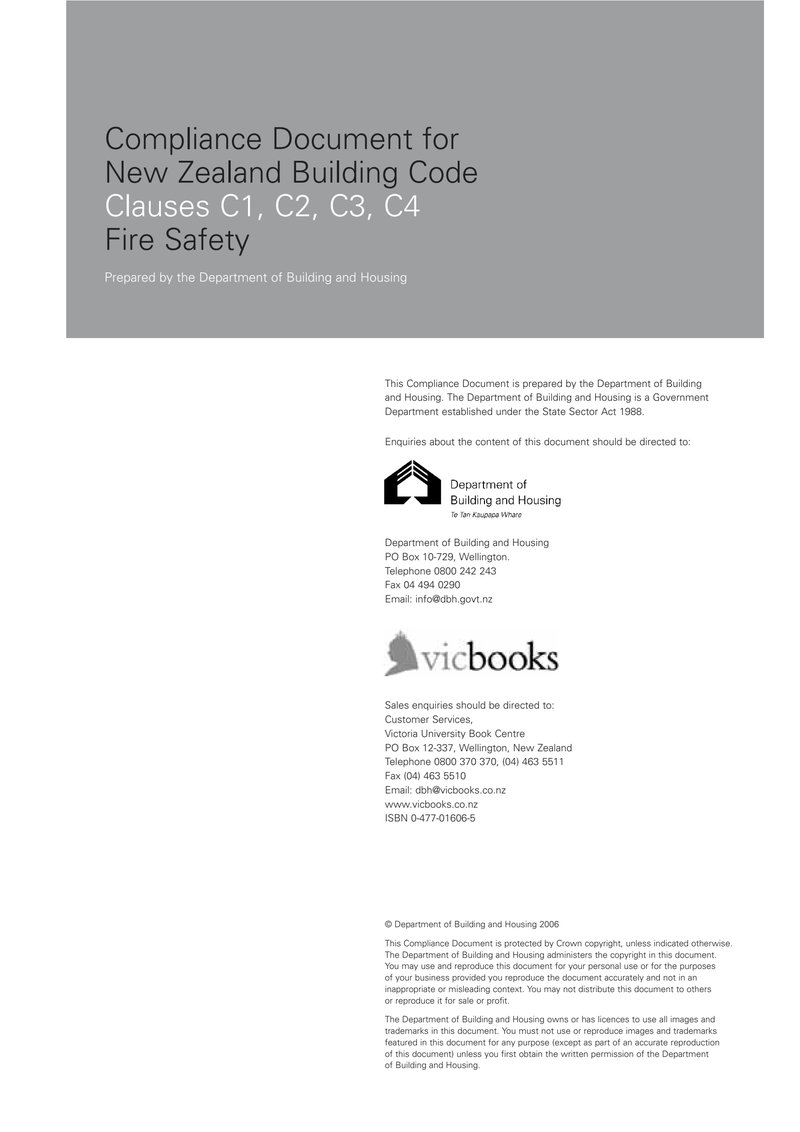

下载标准文件
clause-ca-c2-c3-c4
英语 · PDF · 6 页 · 1.95 MB