标准信息
STANDARD INFORMATION- 标准编号
- clause-b2
- 所属分类
- 其他国外标准与工程资料
- 文件语言
- 英语
- 文件格式
- 文件页数
- 6 页
- 文件大小
- 205.02 KB
· 更新:
标准简介
OVERVIEW中文简介
标准 clause-b2 的预览内容
English summary
Preview of standard clause-b2
以上为根据文件整理的内容简介。
标准内容预览
DOCUMENT PREVIEWReferences
Amend 3 Jul 2001
For the purposes of New Zealand Building Code compliance, acceptable reference documents include only the quoted edition and specific amendments as listed below.
|
Standards New Zealand NZS 3101:- Concrete structures standard Part 1: 1995 The design of concrete structures NZS 3602:- Amend 5 Apr 2004 Part 1: 1995 Timber and wood-based products for use in building Amend 4 Apr 2004 Part 1: 2003 Timber and wood-based products for use in building Amend 3 Jul 2001 NZS 3604: 1999 Timber framed buildings Amend: 1 NZS 4251:- Solid plastering Part 1: 1998 Cement plaster for walls, ceilings and soffits NZS 4297: 1998 Engineering design for earth buildings Amend 2 Dec 2000 NZS 4299: 1998 Earth buildings not requiring specific design Amend: 1 |
Where Quoted AS1 3.1.1 AS1 3.2.2 Amend 5 Apr 2004 AS1 3.2.1 AS1 3.2.3 Amend 5 Apr 2004 AS1 3.3.1 AS1 3.4.1 AS1 3.4.1 |
6
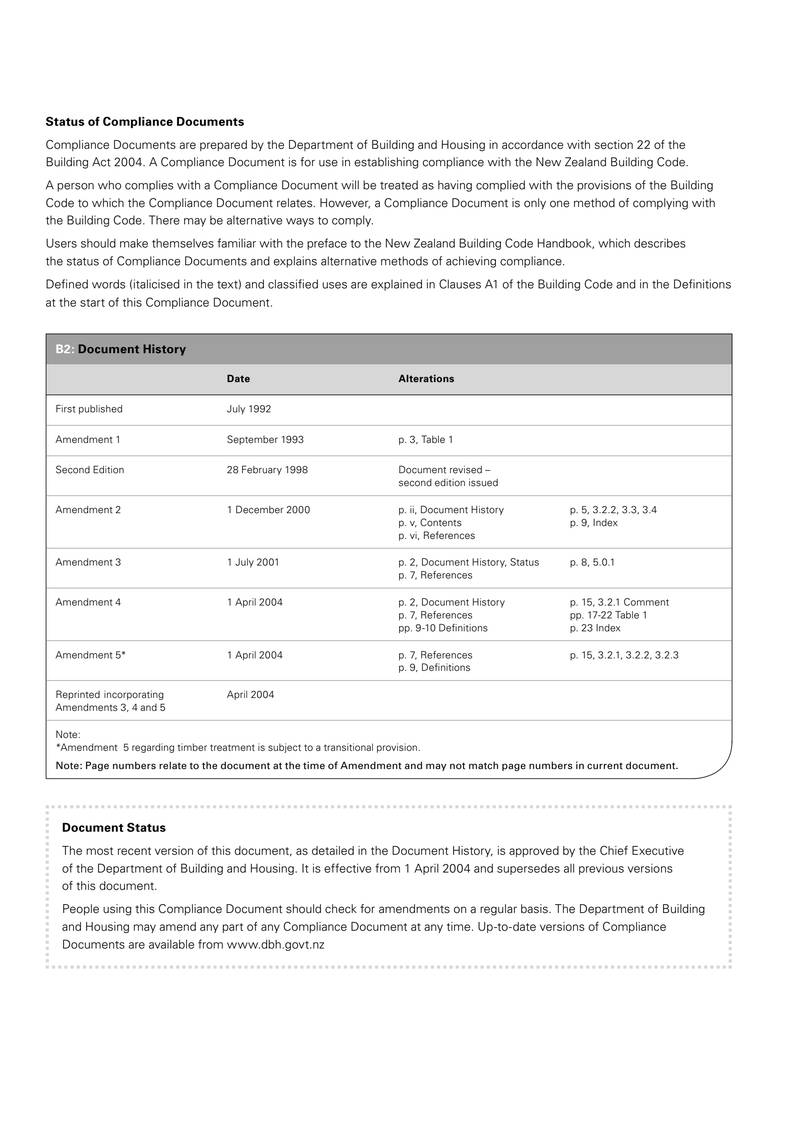
Status of Compliance Documents
Compliance Documents are prepared by the Department of Building and Housing in accordance with section 22 of the Building Act 2004. A Compliance Document is for use in establishing compliance with the New Zealand Building Code.
A person who complies with a Compliance Document will be treated as having complied with the provisions of the Building Code to which the Compliance Document relates. However, a Compliance Document is only one method of complying with the Building Code. There may be alternative ways to comply.
Users should make themselves familiar with the preface to the New Zealand Building Code Handbook, which describes the status of Compliance Documents and explains alternative methods of achieving compliance.
Defined words (italicised in the text) and classified uses are explained in Clauses A1 of the Building Code and in the Definitions at the start of this Compliance Document.
| B2: Document History | |||
|---|---|---|---|
| Date | Alterations | ||
| First published | July 1992 | ||
| Amendment 1 | September 1993 | p. 3, Table 1 | |
| Second Edition | 28 February 1998 | Document revised – second edition issued | |
| Amendment 2 | 1 December 2000 | p. ii, Document History p. v, Contents p. v, References | p. 5, 3.2.2, 3.3, 3.4 p. 9, Index |
| Amendment 3 | 1 July 2001 | p. 2, Document History, Status p. 7, References | p. 8, 5.0.1 |
| Amendment 4 | 1 April 2004 | p. 2, Document History p. 7, References pp. 9-10 Definitions | p. 15, 3.2.1 Comment pp. 17-22 Table 1 p. 23 Index |
| Amendment 5* | 1 April 2004 | p. 7, References p. 9, Definitions | p. 15, 3.2.1, 3.2.2, 3.2.3 |
| Reprinted incorporating Amendments 3, 4 and 5 | April 2004 | ||
| Note: *Amendment 5 regarding timber treatment is subject to a transitional provision. Note: Page numbers relate to the document at the time of Amendment and may not match page numbers in current document. | |||
Document Status
The most recent version of this document, as detailed in the Document History, is approved by the Chief Executive of the Department of Building and Housing. It is effective from 1 April 2004 and supersedes all previous versions of this document.
People using this Compliance Document should check for amendments on a regular basis. The Department of Building and Housing may amend any part of any Compliance Document at any time. Up-to-date versions of Compliance Documents are available from www.dbh.govt.nz
2
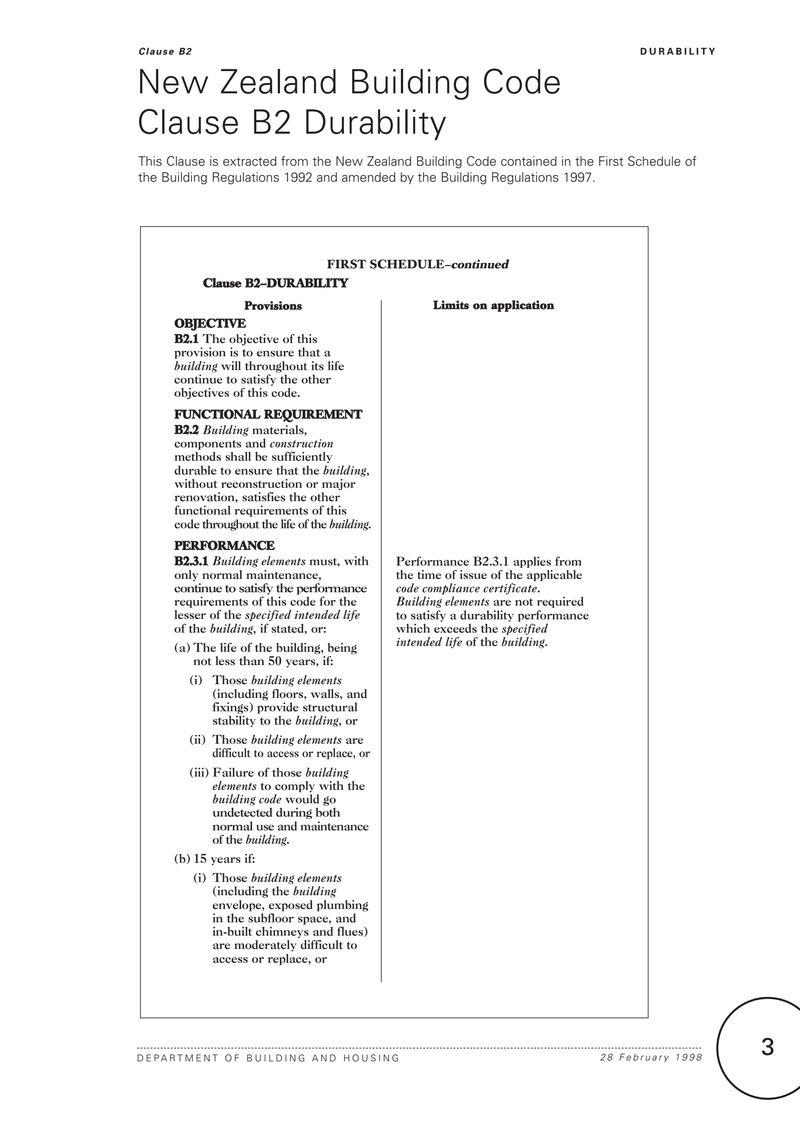
New Zealand Building Code Clause B2 Durability
This Clause is extracted from the New Zealand Building Code contained in the First Schedule of the Building Regulations 1992 and amended by the Building Regulations 1997.
FIRST SCHEDULE–continued
Clause B2–DURABILITY
|
Provisions OBJECTIVE B2.1 The objective of this provision is to ensure that a building will throughout its life continue to satisfy the other objectives of this code. FUNCTIONAL REQUIREMENT B2.2 Building materials, components and construction methods shall be sufficiently durable to ensure that the building, without reconstruction or major renovation, satisfies the other functional requirements of this code throughout the life of the building. PERFORMANCE B2.3.1 Building elements must, with only normal maintenance, continue to satisfy the performance requirements of this code for the lesser of the specified intended life of the building, if stated, or: (a) The life of the building, being not less than 50 years, if: (i) Those building elements (including floors, walls, and fixings) provide structural stability to the building, or (ii) Those building elements are difficult to access or replace, or (iii) Failure of those building elements to comply with the building code would go undetected during both normal use and maintenance of the building. (b) 15 years if: (i) Those building elements (including the building envelope, exposed plumbing in the subfloor space, and in-built chimneys and flues) are moderately difficult to access or replace, or |
Limits on application Performance B2.3.1 applies from the time of issue of the applicable code compliance certificate. Building elements are not required to satisfy a durability performance which exceeds the specified intended life of the building. |
3
Provisions (ii) Failure of those building elements to comply with the building code would go undetected during normal use of the building, but would be easily detected during normal maintenance. (c) 5 years if: (i) The building elements (including services, linings, renewable protective coatings, and fixtures) are easy to access and replace, and (ii) Failure of those building elements to comply with the building code would be easily detected during normal use of the building. B2.3.2 Individual building elements which are components of a building system and are difficult to access or replace must either: (a) All have the same durability, or (b) Be installed in a manner that permits the replacement of building elements of lesser durability without removing building elements that have greater durability and are not specifically designed for removal and replacement. | Limits on application |
4
Contents
| Page | ||
|---|---|---|
| References | 7 | |
| Definitions | 9 | |
| Verification Method B2/VM1 | 11 | |
| 1.0 Durability Evaluation | 11 | |
| 1.1 In-service history | 11 | |
| 1.2 Laboratory testing | 11 | |
| 1.3 Similar materials | 11 | |
| Acceptable Solution B2/AS1 | 13 | |
| 1.0 Durability Applications | 13 | |
| 1.1 Approved Documents | 13 | |
| 1.2 Assessing required durability | 13 | |
| 1.3 Examples of durability requirements | 14 | |
| 2.0 Maintenance | 14 | |
| 2.1 Normal maintenance | 14 | |
| 2.2 Scheduled maintenance | 14 | |
| 3.0 Generic Materials | 14 | |
| 3.1 Concrete | 14 | |
| 3.2 Timber | 15 | |
Amend 2 | 3.3 Solid plastering | 15 |
| 3.4 Earth buildings | 15 | |
| Index | 19 |
5
References
Amend 3 Jul 2001
For the purposes of New Zealand Building Code compliance, acceptable reference documents include only the quoted edition and specific amendments as listed below.
|
Standards New Zealand NZS 3101:- Concrete structures standard Part 1: 1995 The design of concrete structures NZS 3602:- Amend 5 Apr 2004 Part 1: 1995 Timber and wood-based products for use in building Amend 4 Apr 2004 Part 1: 2003 Timber and wood-based products for use in building Amend 3 Jul 2001 NZS 3604: 1999 Timber framed buildings Amend: 1 NZS 4251:- Solid plastering Part 1: 1998 Cement plaster for walls, ceilings and soffits NZS 4297: 1998 Engineering design for earth buildings Amend 2 Dec 2000 NZS 4299: 1998 Earth buildings not requiring specific design Amend: 1 |
Where Quoted AS1 3.1.1 AS1 3.2.2 Amend 5 Apr 2004 AS1 3.2.1 AS1 3.2.3 Amend 5 Apr 2004 AS1 3.3.1 AS1 3.4.1 AS1 3.4.1 |
6
预览内容由文件识别整理,表格、公式及文字请以原始文件为准。
原文图片预览
PAGE IMAGES

下载标准文件
clause-b2
英语 · PDF · 6 页 · 205.02 KB