标准信息
STANDARD INFORMATION- 标准编号
- clause-b1
- 所属分类
- 其他国外标准与工程资料
- 文件语言
- 英语
- 文件格式
- 文件页数
- 6 页
- 文件大小
- 1.27 MB
· 更新:
标准简介
OVERVIEW中文简介
标准 clause-b1 的预览内容
English summary
Preview of standard clause-b1
以上为根据文件整理的内容简介。
标准内容预览
DOCUMENT PREVIEWFIRST SCHEDULE—continued
| Provisions | Limits on application |
|---|---|
|
(d) Earth pressure. (e) Water and other liquids, (f) Earthquake, (g) Snow, (h) Wind, (i) Fire, (j) Impact, (k) Explosion, (l) Reversing or fluctuating effects, (m) Differential movement, (n) Vegetation, (o) Adverse effects due to insufficient separation from other buildings, (p) Influence of equipment, services, non-structural elements and contents, (q) Time dependent effects including creep and shrinkage, and (r) Removal of support. B1.3.4 Due allowance shall be made for: (a) The consequences of failure, (b) The intended use of the building, (c) Effects of uncertainties resulting from construction activities, or the sequence in which construction activities occur, (d) Variation in the properties of materials and the characteristics of the site, and (e) Accuracy limitations inherent in the methods used to predict the stability of buildings. B1.3.5 The demolition of buildings shall be carried out in a way that avoids the likelihood of premature collapse. B1.3.6 Sitework, where necessary, shall be carried out to: |
6
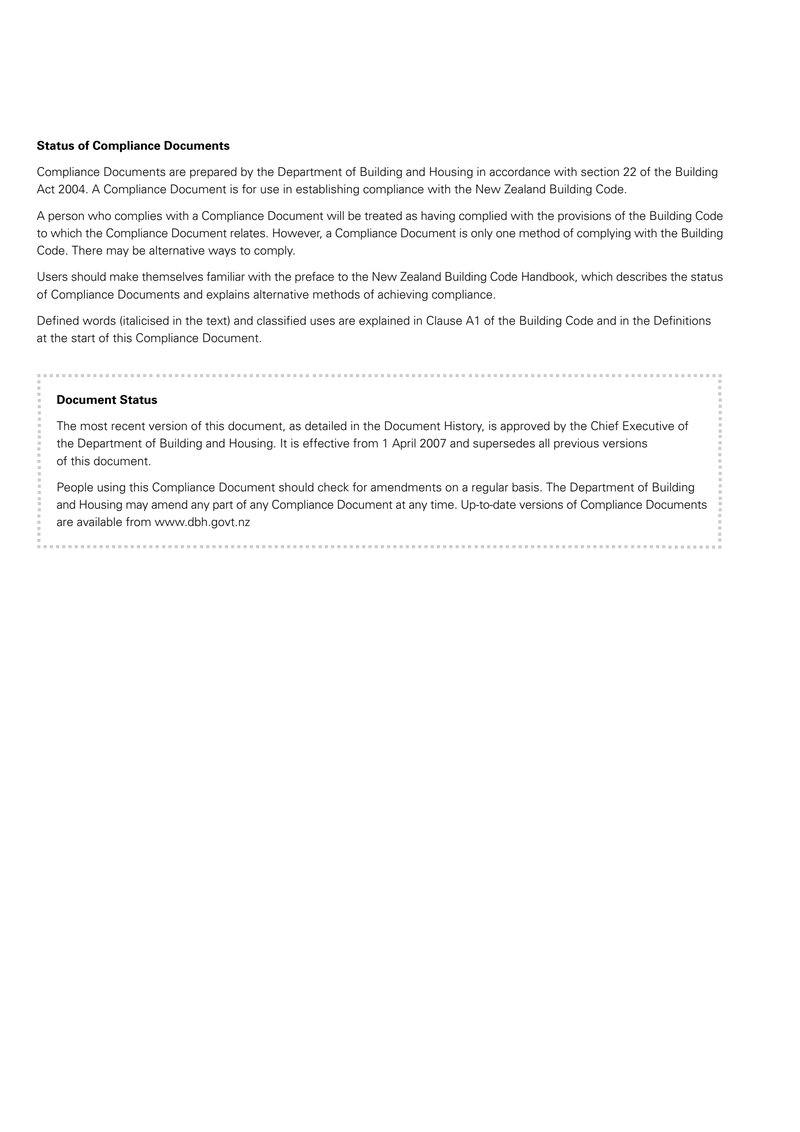
Status of Compliance Documents
Compliance Documents are prepared by the Department of Building and Housing in accordance with section 22 of the Building Act 2004. A Compliance Document is for use in establishing compliance with the New Zealand Building Code.
A person who complies with a Compliance Document will be treated as having complied with the provisions of the Building Code to which the Compliance Document relates. However, a Compliance Document is only one method of complying with the Building Code. There may be alternative ways to comply.
Users should make themselves familiar with the preface to the New Zealand Building Code Handbook, which describes the status of Compliance Documents and explains alternative methods of achieving compliance.
Defined words (italicised in the text) and classified uses are explained in Clause A1 of the Building Code and in the Definitions at the start of this Compliance Document.
Document Status
The most recent version of this document, as detailed in the Document History, is approved by the Chief Executive of the Department of Building and Housing. It is effective from 1 April 2007 and supersedes all previous versions of this document.
People using this Compliance Document should check for amendments on a regular basis. The Department of Building and Housing may amend any part of any Compliance Document at any time. Up-to-date versions of Compliance Documents are available from www.dbh.govt.nz
2
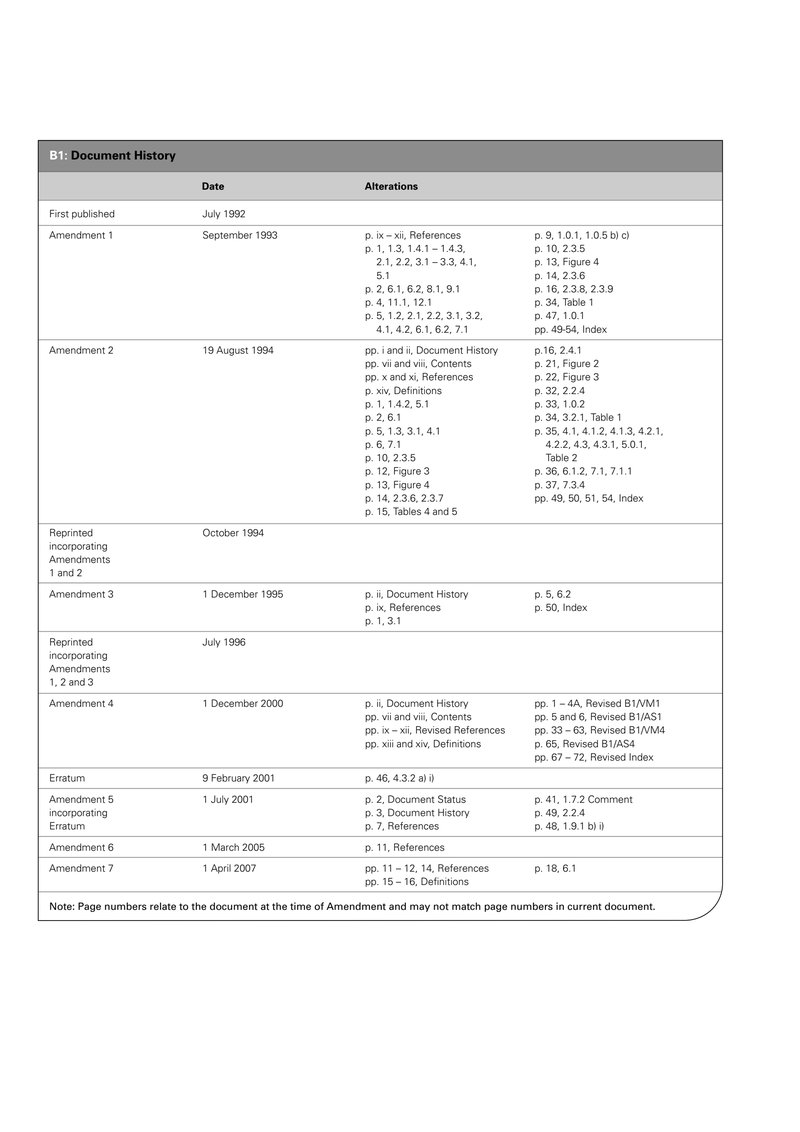
B1: Document History
| Date | Alterations | ||
|---|---|---|---|
| First published | July 1992 | ||
| Amendment 1 | September 1993 | p. ix – xii, References p. 1, 1.3, 1.4.1 – 1.4.3, 2.1, 2.2, 3.1 – 3.3, 4.1, 5.1 p. 2, 6.1, 6.2, 8.1, 9.1 p. 4, 11.1, 12.1 p. 5, 1.2, 2.1, 2.2, 3.1, 3.2, 4.1, 4.2, 6.1, 6.2, 7.1 | p. 9, 1.0.1, 1.0.5 b) c) p. 10, 2.3.5 p. 13, Figure 4 p. 14, 2.3.6 p. 16, 2.3.8, 2.3.9 p. 34, Table 1 p. 47, 1.0.1 pp. 49-54, Index |
| Amendment 2 | 19 August 1994 | pp. i and ii, Document History pp. vii and viii, Contents pp. x and xi, References p. xiv, Definitions p. 1, 1.4.2, 5.1 p. 2, 6.1 p. 5, 1.3, 3.1, 4.1 p. 6, 7.1 p. 10, 2.3.5 p. 12, Figure 3 p. 13, Figure 4 p. 14, 2.3.6, 2.3.7 p. 15, Tables 4 and 5 | p. 16, 2.4.1 p. 21, Figure 2 p. 22, Figure 3 p. 32, 2.2.4 p. 33, 1.0.2 p. 34, 3.2.1, Table 1 p. 35, 4.1, 4.1.2, 4.1.3, 4.2.1, 4.2.2, 4.3, 4.3.1, 5.0.1, Table 2 p. 36, 6.1.2, 7.1, 7.1.1 p. 37, 7.3.4 pp. 49, 50, 51, 54, Index |
| Reprinted incorporating Amendments 1 and 2 | October 1994 | ||
| Amendment 3 | 1 December 1995 | p. ii, Document History p. ix, References p. 1, 3.1 | p. 5, 6.2 p. 50, Index |
| Reprinted incorporating Amendments 1, 2 and 3 | July 1996 | ||
| Amendment 4 | 1 December 2000 | p. ii, Document History pp. vii and viii, Contents pp. ix – xii, Revised References pp. xiii and xiv, Definitions | pp. 1 – 4A, Revised B1/VM1 pp. 5 and 6, Revised B1/AS1 pp. 33 – 63, Revised B1/VM4 p. 65, Revised B1/AS4 pp. 67 – 72, Revised Index |
| Erratum | 9 February 2001 | p. 46, 4.3.2 a) i) | |
| Amendment 5 incorporating Erratum | 1 July 2001 | p. 2, Document Status p. 3, Document History p. 7, References | p. 41, 1.7.2 Comment p. 49, 2.2.4 p. 48, 1.9.1 b) i) |
| Amendment 6 | 1 March 2005 | p. 11, References | |
| Amendment 7 | 1 April 2007 | pp. 11 – 12, 14, References pp. 15 – 16, Definitions | p. 18, 6.1 |
Note: Page numbers relate to the document at the time of Amendment and may not match page numbers in current document.
3
4
New Zealand Building Code Clause B1 Structure
This Clause is extracted from the New Zealand Building Code contained in the First Schedule of the Building Regulations 1992.
16 Building Regulations 1992 1992/150
FIRST SCHEDULE—continued
Clause B1—STRUCTURE
|
Provisions OBJECTIVE B1.1 The objective of this provision is to: (a) Safeguard people from injury caused by structural failure, (b) Safeguard people from loss of amenity caused by structural behaviour; and (c) Protect other property from physical damage caused by structural failure. FUNCTIONAL REQUIREMENT B1.2 Buildings, building elements and sitework shall withstand the combination of loads that they are likely to experience during construction or alteration and throughout their lives. PERFORMANCE B1.3.1 Buildings, building elements and sitework shall have a low probability of rupturing, becoming unstable, losing equilibrium, or collapsing during construction or alteration and throughout their lives. B1.3.2 Buildings, building elements and sitework shall have a low probability of causing loss of amenity through undue deformation, vibratory response, degradation, or other physical characteristics throughout their lives, or during construction or alteration when the building is in use. B1.3.3 Account shall be taken of all physical conditions likely to affect the stability of buildings, building elements and sitework, including: (a) Self-weight, (b) Imposed gravity loads arising from use, (c) Temperature, |
Limits on application |
5
FIRST SCHEDULE—continued
| Provisions | Limits on application |
|---|---|
|
(d) Earth pressure. (e) Water and other liquids, (f) Earthquake, (g) Snow, (h) Wind, (i) Fire, (j) Impact, (k) Explosion, (l) Reversing or fluctuating effects, (m) Differential movement, (n) Vegetation, (o) Adverse effects due to insufficient separation from other buildings, (p) Influence of equipment, services, non-structural elements and contents, (q) Time dependent effects including creep and shrinkage, and (r) Removal of support. B1.3.4 Due allowance shall be made for: (a) The consequences of failure, (b) The intended use of the building, (c) Effects of uncertainties resulting from construction activities, or the sequence in which construction activities occur, (d) Variation in the properties of materials and the characteristics of the site, and (e) Accuracy limitations inherent in the methods used to predict the stability of buildings. B1.3.5 The demolition of buildings shall be carried out in a way that avoids the likelihood of premature collapse. B1.3.6 Sitework, where necessary, shall be carried out to: |
6
预览内容由文件识别整理,表格、公式及文字请以原始文件为准。
原文图片预览
PAGE IMAGES

下载标准文件
clause-b1
英语 · PDF · 6 页 · 1.27 MB