clause-H1-Energy-Efficiency
clause-H1-Energy-Efficiency
clause-H1-Energy-Efficiency
标准信息
STANDARD INFORMATION- 标准编号
- clause-H1-Energy-Efficiency
- 所属分类
- 其他国外标准与工程资料
- 文件语言
- 英语
- 文件格式
- 文件页数
- 6 页
- 文件大小
- 217.9 KB
· 更新:
标准简介
OVERVIEW中文简介
标准 clause-H1-Energy-Efficiency 的预览内容
English summary
Preview of standard clause-H1-Energy-Efficiency
以上为根据文件整理的内容简介。
标准内容预览
DOCUMENT PREVIEWFIRST SCHEDULE–continued
4.0.2 Assembly Service
Applies to a building or use where limited care and service is provided. Examples: a church, cinema, clubroom, hall, museum, public swimming pool, stadium, theatre, or whare runanga (the assembly house).
4.0.3 Assembly Care
Applies to a building or use where a large degree of care and service is provided. Examples: an early childhood centre, college, day care institution, centre for handicapped persons, kindergarten, school or university.
5.0 COMMERCIAL
5.0.1 Applies to a building or use in which any natural resources, goods, services or money are either developed, sold, exchanged or stored. Examples: an amusement park, auction room, bank, car-park, catering facility, coffee bar, computer centre, fire station, funeral parlour, hairdresser, library, office (commercial or government), police station, post office, public laundry, radio station, restaurant, service station, shop, showroom, storage facility, television station or transport terminal.
6.0 INDUSTRIAL
6.0.1 Applies to a building or use where people use material and physical effort to:
(a) extract or convert natural resources,
(b) produce goods or energy from natural or converted resources,
(c) repair goods, or
(d) store goods (ensuing from the industrial process).
Examples: an agricultural building, agricultural processing facility, aircraft hangar, factory, power station, sewage treatment works, warehouse or utility.
7.0 OUTBUILDINGS
7.0.1 Applies to a building or use which may be included within each classified use but are not intended for human habitation, and are accessory to the principal use of associated buildings. Examples: a carport, farm building, garage, greenhouse, machinery room, private swimming pool, public toilet, or shed.
8.0 ANCILLARY
8.0.1 Applies to a building or use not for human habitation and which may be exempted from some amenity provisions, but which are required to comply with structural and safety-related aspects of the building code. Examples: a bridge, derrick, fence, free standing outdoor fireplace, jetty, mast, path, platform, pylon, retaining wall, tank, tunnel or dam.
6
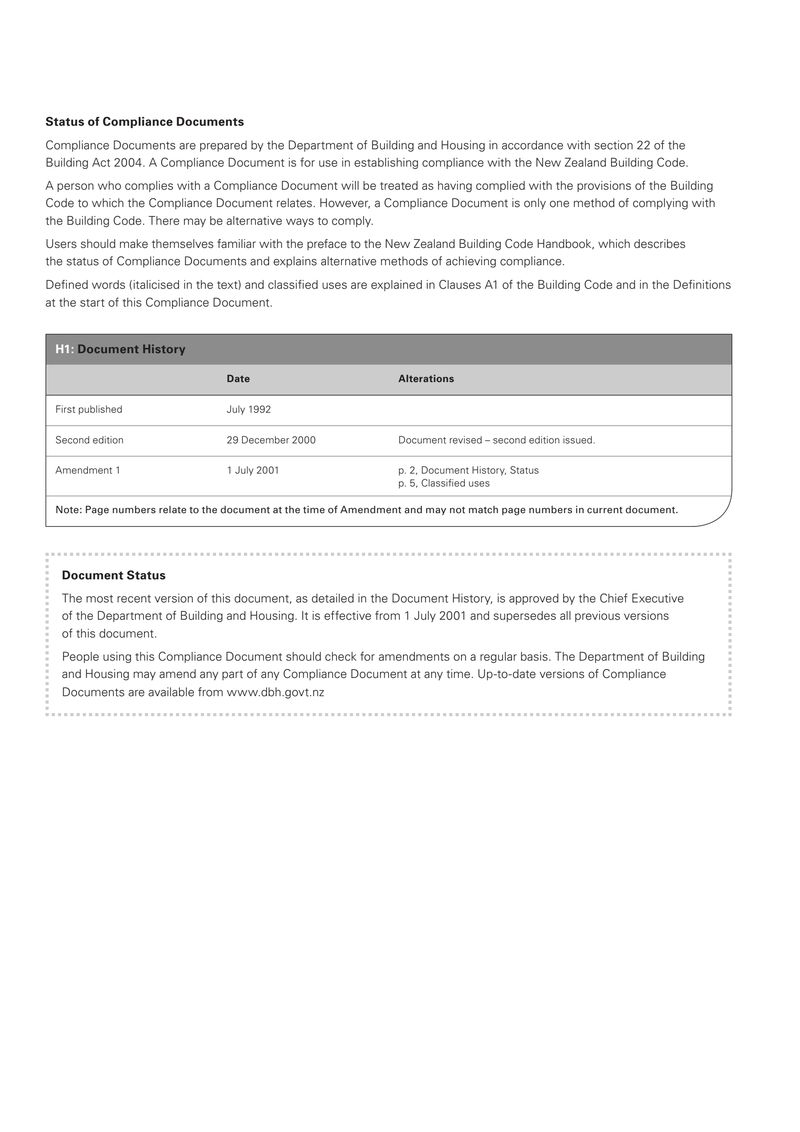
Status of Compliance Documents
Compliance Documents are prepared by the Department of Building and Housing in accordance with section 22 of the Building Act 2004. A Compliance Document is for use in establishing compliance with the New Zealand Building Code.
A person who complies with a Compliance Document will be treated as having complied with the provisions of the Building Code to which the Compliance Document relates. However, a Compliance Document is only one method of complying with the Building Code. There may be alternative ways to comply.
Users should make themselves familiar with the preface to the New Zealand Building Code Handbook, which describes the status of Compliance Documents and explains alternative methods of achieving compliance.
Defined words (italicised in the text) and classified uses are explained in Clauses A1 of the Building Code and in the Definitions at the start of this Compliance Document.
| Date | Alterations | |
|---|---|---|
| First published | July 1992 | |
| Second edition | 29 December 2000 | Document revised – second edition issued. |
| Amendment 1 | 1 July 2001 | p. 2, Document History, Status p. 5, Classified uses |
| Note: Page numbers relate to the document at the time of Amendment and may not match page numbers in current document. | ||
Document Status
The most recent version of this document, as detailed in the Document History, is approved by the Chief Executive of the Department of Building and Housing. It is effective from 1 July 2001 and supersedes all previous versions of this document.
People using this Compliance Document should check for amendments on a regular basis. The Department of Building and Housing may amend any part of any Compliance Document at any time. Up-to-date versions of Compliance Documents are available from www.dbh.govt.nz
2
New Zealand Building Code Clause H1 Energy Efficiency
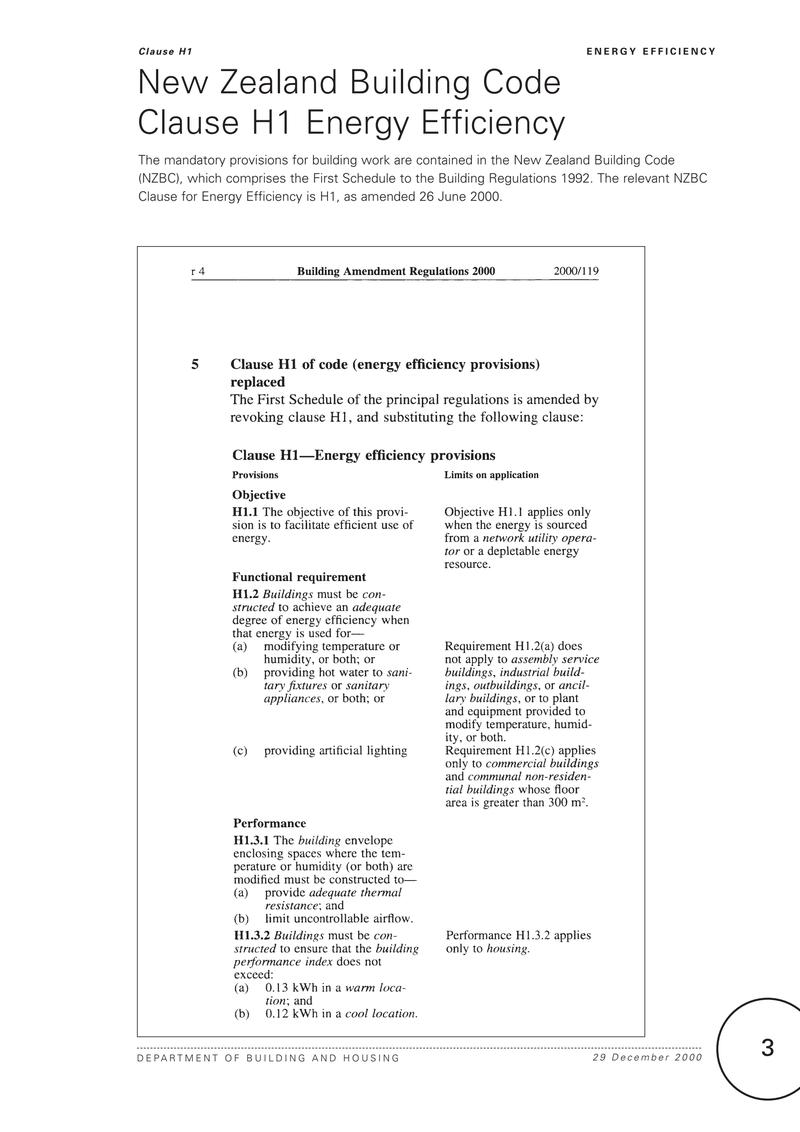
The mandatory provisions for building work are contained in the New Zealand Building Code (NZBC), which comprises the First Schedule to the Building Regulations 1992. The relevant NZBC Clause for Energy Efficiency is H1, as amended 26 June 2000.
| r 4 | Building Amendment Regulations 2000 | 2000/119 |
5 Clause H1 of code (energy efficiency provisions) replaced
The First Schedule of the principal regulations is amended by revoking clause H1, and substituting the following clause:
Clause H1—Energy efficiency provisions
ProvisionsObjectiveH1.1 The objective of this provision is to facilitate efficient use of energy. Functional requirementH1.2 Buildings must be constructed to achieve an adequate degree of energy efficiency when that energy is used for— (a) modifying temperature or humidity, or both; or (b) providing hot water to sanitary fixtures or sanitary appliances, or both; or (c) providing artificial lighting PerformanceH1.3.1 The building envelope enclosing spaces where the temperature or humidity (or both) are modified must be constructed to— (a) provide adequate thermal resistance; and (b) limit uncontrollable airflow. H1.3.2 Buildings must be constructed to ensure that the building performance index does not exceed: (a) 0.13 kWh in a warm location; and (b) 0.12 kWh in a cool location. |
Limits on applicationObjective H1.1 applies only when the energy is sourced from a network utility operator or a depletable energy resource. Requirement H1.2(a) does not apply to assembly service buildings, industrial buildings, outbuildings, or ancillary buildings, or to plant and equipment provided to modify temperature, humidity, or both. Requirement H1.2(c) applies only to commercial buildings and communal non-residential buildings whose floor area is greater than 300 m3. Performance H1.3.2 applies only to housing. |
3
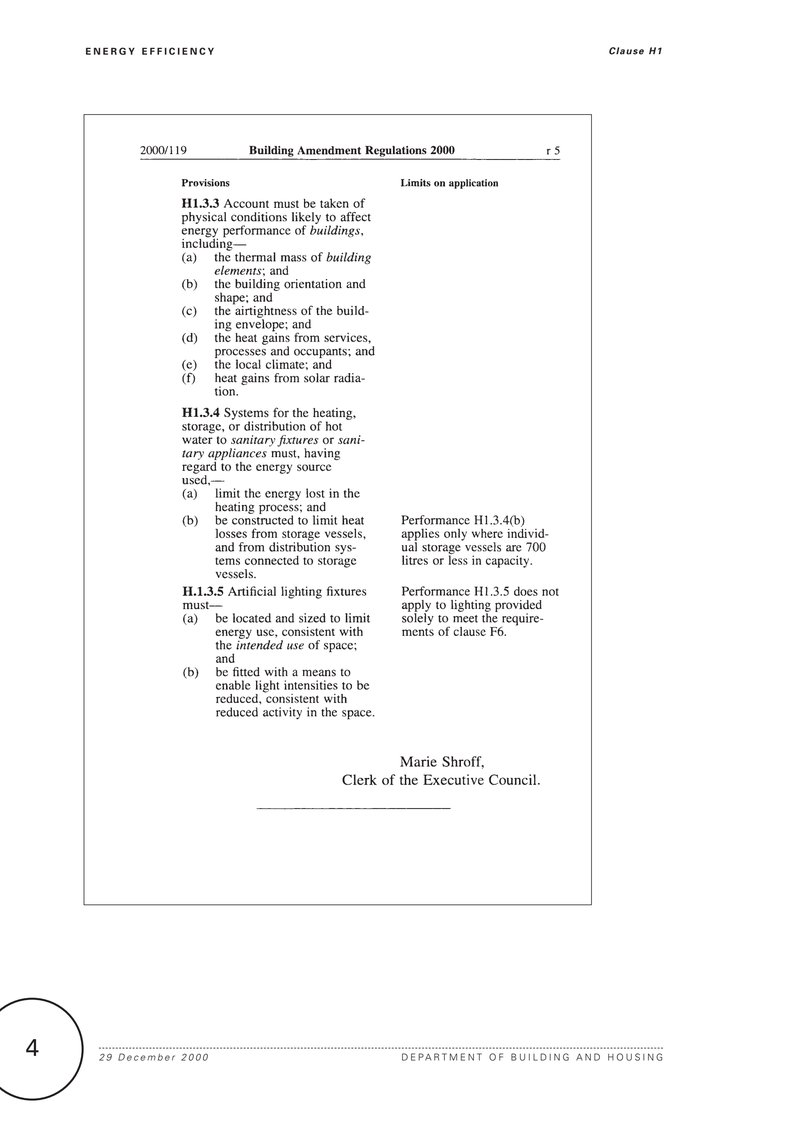
| Provisions | Limits on application |
|---|---|
|
H1.3.3 Account must be taken of physical conditions likely to affect energy performance of buildings, including— (a) the thermal mass of building elements; and (b) the building orientation and shape; and (c) the airtightness of the building envelope; and (d) the heat gains from services, processes and occupants; and (e) the local climate; and (f) heat gains from solar radiation. |
|
|
H1.3.4 Systems for the heating, storage, or distribution of hot water to sanitary fixtures or sanitary appliances must, having regard to the energy source used,— (a) limit the energy lost in the heating process; and (b) be constructed to limit heat losses from storage vessels, and from distribution systems connected to storage vessels. |
Performance H1.3.4(b) applies only where individual storage vessels are 700 litres or less in capacity. |
|
H1.3.5 Artificial lighting fixtures must— (a) be located and sized to limit energy use, consistent with the intended use of space; and (b) be fitted with a means to enable light intensities to be reduced, consistent with reduced activity in the space. |
Performance H1.3.5 does not apply to lighting provided solely to meet the requirements of clause F6. |
Marie Shroff,
Clerk of the Executive Council.
4
New Zealand Building Code Clause A1 Classified Uses
The regulatory classification of buildings according to use is contained in the New Zealand Building Code (NZBC), which comprises the First Schedule to the Building Regulations 1992. The relevant NZBC clause for Classified Uses is A1.
FIRST SCHEDULE–continued
Clause A1–CLASSIFIED USES
1.0 EXPLANATION
1.0.1 For the purposes of this building code buildings are classified according to type, under seven categories.
1.0.2 A building with a given classified use may have one or more intended uses as defined in the Act.
2.0 HOUSING
2.0.1 Applies to buildings or use where there is self care and service (internal management). There are three types.
2.0.2 Detached Dwellings
Applies to a building or use where a group of people live as a single household or family. Examples: a holiday cottage, boarding house accommodating fewer than 6 people, dwelling or hut.
2.0.3 Multi-unit Dwelling
Applies to a building or use which contains more than one separate household or family. Examples: an attached dwelling, flat or multi-unit apartment.
2.0.4 Group Dwelling
Applies to a building or use where groups of people live as one large extended family. Examples: within a commune or marae.
3.0 COMMUNAL RESIDENTIAL
3.0.1 Applies to buildings or use where assistance or care is extended to the principal users. There are two types.
3.0.2 Community Service
Applies to a residential building or use where limited assistance or care is extended to the principal users. Examples: a boarding house, hall of residence, holiday cabin, hostel, hotel, motel, nurse's home, retirement village, time-share accommodation, a work camp, or camping ground.
3.0.3 Community Care
Applies to a residential building or use where a large degree of assistance or care is extended to the principal users. There are two types:
- Unrestrained; where the principal users are free to come and go. Examples; a hospital, an old people's home or a health camp.
- Restrained; where the principals users are legally or physically constrained in their movements. Examples: a borstal or drug rehabilitation centre, an old people's home where substantial care is extended, a prison or hospital.
4.0 COMMUNAL NON-RESIDENTIAL
4.0.1 Applies to a building or use being a meeting place for people where care and service is provided by people other than the principal users. There are two types.
FIRST SCHEDULE–continued
4.0.2 Assembly Service
Applies to a building or use where limited care and service is provided. Examples: a church, cinema, clubroom, hall, museum, public swimming pool, stadium, theatre, or whare runanga (the assembly house).
4.0.3 Assembly Care
Applies to a building or use where a large degree of care and service is provided. Examples: an early childhood centre, college, day care institution, centre for handicapped persons, kindergarten, school or university.
5.0 COMMERCIAL
5.0.1 Applies to a building or use in which any natural resources, goods, services or money are either developed, sold, exchanged or stored. Examples: an amusement park, auction room, bank, car-park, catering facility, coffee bar, computer centre, fire station, funeral parlour, hairdresser, library, office (commercial or government), police station, post office, public laundry, radio station, restaurant, service station, shop, showroom, storage facility, television station or transport terminal.
6.0 INDUSTRIAL
6.0.1 Applies to a building or use where people use material and physical effort to:
(a) extract or convert natural resources,
(b) produce goods or energy from natural or converted resources,
(c) repair goods, or
(d) store goods (ensuing from the industrial process).
Examples: an agricultural building, agricultural processing facility, aircraft hangar, factory, power station, sewage treatment works, warehouse or utility.
7.0 OUTBUILDINGS
7.0.1 Applies to a building or use which may be included within each classified use but are not intended for human habitation, and are accessory to the principal use of associated buildings. Examples: a carport, farm building, garage, greenhouse, machinery room, private swimming pool, public toilet, or shed.
8.0 ANCILLARY
8.0.1 Applies to a building or use not for human habitation and which may be exempted from some amenity provisions, but which are required to comply with structural and safety-related aspects of the building code. Examples: a bridge, derrick, fence, free standing outdoor fireplace, jetty, mast, path, platform, pylon, retaining wall, tank, tunnel or dam.
6
预览内容由文件识别整理,表格、公式及文字请以原始文件为准。
原文图片预览
PAGE IMAGES
下载标准文件
clause-H1-Energy-Efficiency
英语 · PDF · 6 页 · 217.9 KB