标准信息
STANDARD INFORMATION- 标准编号
- clause-G6
- 所属分类
- 其他国外标准与工程资料
- 发布机构
- Department of Building and Housing
- 版本年份
- 2006
- 文件语言
- 英语
- 文件格式
- 文件页数
- 6 页
- 文件大小
- 362.11 KB
中文名称为参考译名,文件语言以原文为准。
· 更新:
标准简介
OVERVIEW中文简介
该合规文档用于支持新西兰建筑规范G6条款,规定相邻住户之间空气声和撞击声的隔声要求。它适用于住宅单元之间共用的墙体、楼板和天花板等建筑构件,要求空气声隔声等级和撞击声隔声等级不低于55,并提供现场测试验证方法和可接受构造方案。
English summary
This compliance document supports New Zealand Building Code Clause G6 on airborne and impact sound. It sets minimum sound insulation requirements for building elements between household units, including STC and IIC values of at least 55, and provides field test verification methods and acceptable construction solutions.
以上为根据文件整理的内容简介。
相关标签
标准内容预览
DOCUMENT PREVIEWDefinitions
This is an abbreviated list of definitions for words or terms particularly relevant to this Approved Document. The definitions for any other italicised words may be found in the New Zealand Building Code Handbook.
|
Adequate Adequate to achieve the objectives of the building code. Amenity An attribute of a building which contributes to the health, physical independence, and well being of the building's users but which is not associated with disease or a specific illness. Building has the meaning ascribed to it by the Building Act 1991. Building element Any structural and non-structural component or assembly incorporated into or associated with a building. Included are fixtures, services, drains, permanent mechanical installations for access, glazing, partitions, ceilings and temporary supports. Fixture An article intended to remain permanently attached to and form part of a building. Habitable space A space used for activities normally associated with domestic living, but excludes any bathroom, laundry, water-closet, pantry, walk-in wardrobe, corridor, hallway, lobby, clothes-drying room, or other space of a specialised nature occupied neither frequently nor for extended periods. Household unit means any building or group of buildings, or part of any building or group of buildings, used or intended to be used solely or principally for residential purposes and occupied or intended to be occupied exclusively as the home or residence of not more than one household; but does not include a hostel or boardinghouse or other specialised accommodation. |
Impact insulation class (IIC) A single number rating derived from measured values of normalized impact sound pressure levels in accordance with Method of ASTM E 492, Annex A1, Laboratory Measurement of Impact Sound Transmission Through Floor-Ceiling Assemblies Using the Tapping Machine. It provides an estimate of the impact sound insulating performance of a floor-ceiling assembly. Sound transmission class (STC) A single number rating derived from measured values of transmission loss in accordance with classification ASTM E 413, Determination of Sound Transmission Class. It provides an estimate of the performance of a partition in certain common sound insulation situations. |
6
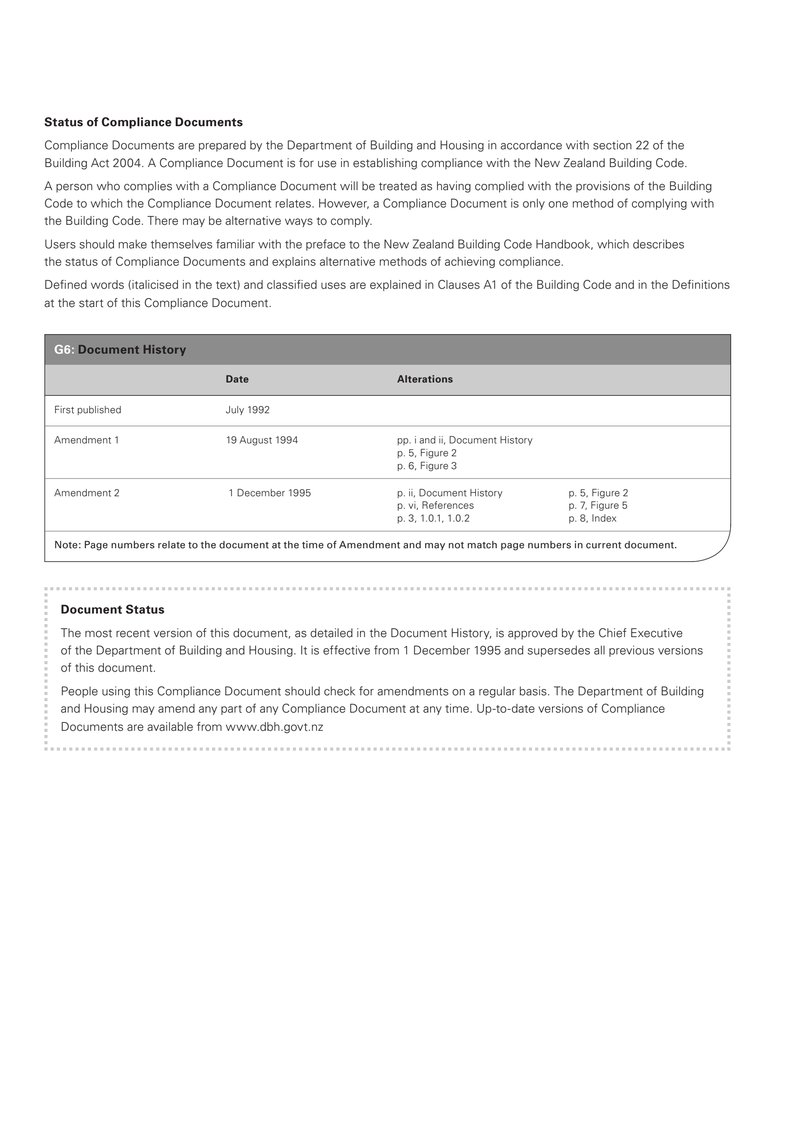
Status of Compliance Documents
Compliance Documents are prepared by the Department of Building and Housing in accordance with section 22 of the Building Act 2004. A Compliance Document is for use in establishing compliance with the New Zealand Building Code.
A person who complies with a Compliance Document will be treated as having complied with the provisions of the Building Code to which the Compliance Document relates. However, a Compliance Document is only one method of complying with the Building Code. There may be alternative ways to comply.
Users should make themselves familiar with the preface to the New Zealand Building Code Handbook, which describes the status of Compliance Documents and explains alternative methods of achieving compliance.
Defined words (italicised in the text) and classified uses are explained in Clauses A1 of the Building Code and in the Definitions at the start of this Compliance Document.
| Date | Alterations | ||
|---|---|---|---|
| First published | July 1992 | ||
| Amendment 1 | 19 August 1994 | pp. i and ii, Document History p. 5, Figure 2 p. 6, Figure 3 | |
| Amendment 2 | 1 December 1995 | p. ii, Document History p. vi, References p. 3, 1.0.1, 1.0.2 | p. 5, Figure 2 p. 7, Figure 5 p. 8, Index |
| Note: Page numbers relate to the document at the time of Amendment and may not match page numbers in current document. | |||
Document Status
The most recent version of this document, as detailed in the Document History, is approved by the Chief Executive of the Department of Building and Housing. It is effective from 1 December 1995 and supersedes all previous versions of this document.
People using this Compliance Document should check for amendments on a regular basis. The Department of Building and Housing may amend any part of any Compliance Document at any time. Up-to-date versions of Compliance Documents are available from www.dbh.govt.nz
New Zealand Building Code Clause G6 Airborne and Impact Sound
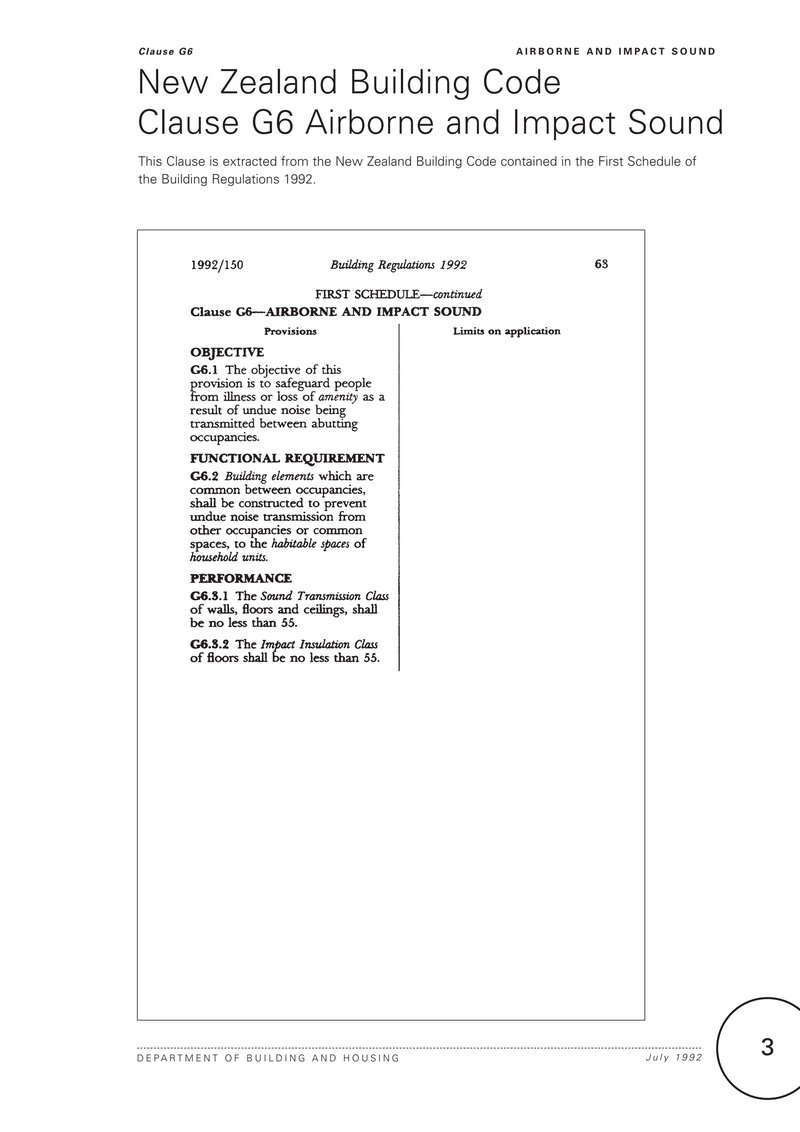
This Clause is extracted from the New Zealand Building Code contained in the First Schedule of the Building Regulations 1992.
| 1992/150 | Building Regulations 1992 | 63 |
FIRST SCHEDULE—continued
Clause G6—AIRBORNE AND IMPACT SOUND
|
Provisions OBJECTIVE G6.1 The objective of this provision is to safeguard people from illness or loss of amenity as a result of undue noise being transmitted between abutting occupancies. FUNCTIONAL REQUIREMENT G6.2 Building elements which are common between occupancies, shall be constructed to prevent undue noise transmission from other occupancies or common spaces, to the habitable spaces of household units. PERFORMANCE G6.3.1 The Sound Transmission Class of walls, floors and ceilings, shall be no less than 55. G6.3.2 The Impact Insulation Class of floors shall be no less than 55. |
Limits on application |
3
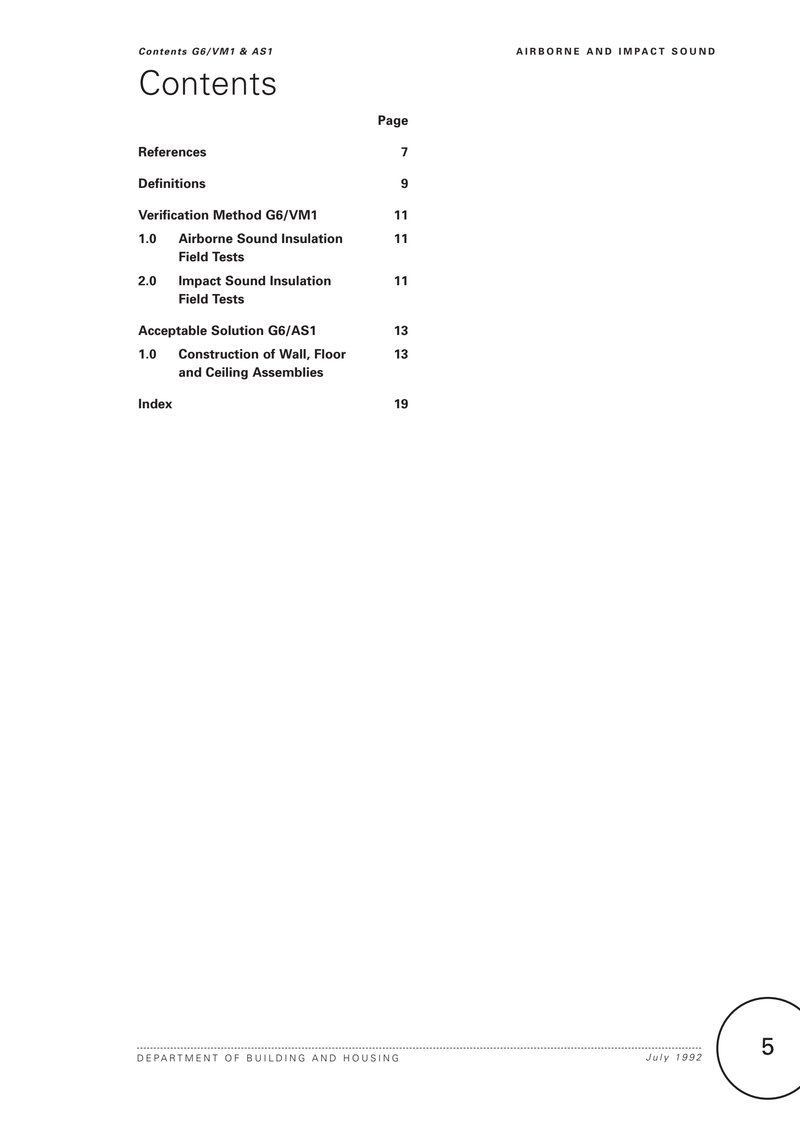
Contents
Page | |
|---|---|
| References | 7 |
| Definitions | 9 |
| Verification Method G6/VM1 | 11 |
1.0 Airborne Sound Insulation Field Tests | 11 |
2.0 Impact Sound Insulation Field Tests | 11 |
| Acceptable Solution G6/AS1 | 13 |
1.0 Construction of Wall, Floor and Ceiling Assemblies | 13 |
| Index | 19 |
4
References
For the purposes of New Zealand Building Code compliance, referenced documents shall be deemed to include any amendments issued prior to the date of the Approved Document as displayed at the foot of the page on which the references are listed.
|
American Society for Testing and Materials Amend 2 Dec 1995 ASTM E 336: 1990 Method for measurement of airborne sound insulation in buildings ASTM E 413: 1987 Classification for rating sound insulation Amend 2 Dec 1995 ASTM E 492: 1990 Test method for laboratory measurement of impact sound transmission through floor-ceiling assemblies using the tapping machine Amend 2 Dec 1995 ASTM E 989: 1989 Classification for determination of impact insulation class (IIC) International Standards Organisation ISO 140/VII: 1978 Field measurements of impact sound insulation of floors |
Where quoted VM1 1.0.1 VM1 1.0.1, Definitions Definitions VM1 2.0.1 VM1 2.0.1 |
5
Definitions
This is an abbreviated list of definitions for words or terms particularly relevant to this Approved Document. The definitions for any other italicised words may be found in the New Zealand Building Code Handbook.
|
Adequate Adequate to achieve the objectives of the building code. Amenity An attribute of a building which contributes to the health, physical independence, and well being of the building's users but which is not associated with disease or a specific illness. Building has the meaning ascribed to it by the Building Act 1991. Building element Any structural and non-structural component or assembly incorporated into or associated with a building. Included are fixtures, services, drains, permanent mechanical installations for access, glazing, partitions, ceilings and temporary supports. Fixture An article intended to remain permanently attached to and form part of a building. Habitable space A space used for activities normally associated with domestic living, but excludes any bathroom, laundry, water-closet, pantry, walk-in wardrobe, corridor, hallway, lobby, clothes-drying room, or other space of a specialised nature occupied neither frequently nor for extended periods. Household unit means any building or group of buildings, or part of any building or group of buildings, used or intended to be used solely or principally for residential purposes and occupied or intended to be occupied exclusively as the home or residence of not more than one household; but does not include a hostel or boardinghouse or other specialised accommodation. |
Impact insulation class (IIC) A single number rating derived from measured values of normalized impact sound pressure levels in accordance with Method of ASTM E 492, Annex A1, Laboratory Measurement of Impact Sound Transmission Through Floor-Ceiling Assemblies Using the Tapping Machine. It provides an estimate of the impact sound insulating performance of a floor-ceiling assembly. Sound transmission class (STC) A single number rating derived from measured values of transmission loss in accordance with classification ASTM E 413, Determination of Sound Transmission Class. It provides an estimate of the performance of a partition in certain common sound insulation situations. |
6
预览内容由文件识别整理,表格、公式及文字请以原始文件为准。
原文图片预览
PAGE IMAGES
下载标准文件
clause-G6
英语 · PDF · 6 页 · 362.11 KB