building-code-handbook
新西兰建筑规范手册
building-code-handbook
New Zealand Building Code Handbook
标准信息
STANDARD INFORMATION- 标准编号
- building-code-handbook
- 所属分类
- 其他国外标准与工程资料
- 发布机构
- Department of Building and Housing
- 版本年份
- 2007
- 文件语言
- 英语
- 文件格式
- 文件页数
- 6 页
- 文件大小
- 1.54 MB
中文名称为参考译名,文件语言以原文为准。
· 更新:
标准简介
OVERVIEW中文简介
该手册介绍新西兰建筑控制框架,包括《2004年建筑法》、建筑法规以及《建筑规范》之间的关系。它适用于新西兰建筑工作、设计、施工、检查及相关合规要求,旨在保障建筑安全、健康、可持续使用。
English summary
This handbook explains the New Zealand building control framework, including the Building Act 2004, Building Regulations, and the Building Code. It applies to building work, design, construction, inspection, and compliance requirements to ensure buildings are safe, healthy, and sustainable.
以上为根据文件整理的内容简介。
相关标签
标准内容预览
DOCUMENT PREVIEW2.2 Building Regulations
Building Regulations are made under and in accordance with the Building Act.
A number of regulations have been made under the Building Act. Currently (as at May 2007) there are seven sets of regulations.
|
4. Building (Fee for Determinations) Regulations 2005 5. Building Levy Order 2005 6. Building (Accreditation of Building Consent Authorities) Regulations 2006 7. Building (Consent Authority Accreditation Fees) Regulations 2007 Note: these regulations can be found at www.legislation.govt.nz 2.3 The New Zealand Building CodeThe Building Code is contained in Schedule 1 of the Building Regulations 1992. The Building Code contains compulsory rules for all new building work. 2.3.1 ContentThe Building Code sets out performance criteria that building work must meet. It covers aspects such as structural stability, fire safety, access, moisture control, durability, services and facilities, and energy efficiency. The Building Code does not prescribe how work should be done, but states how completed building work and its parts must perform. An advantage of a performance-based Building Code is flexibility. It contains no prescriptive requirements stipulating that certain products or designs must be used. This flexibility allows developments and innovation in building design, technology and systems. The Building Code is currently under review. Any changes to the current Building Code, and its supporting Compliance Documents, will take place from 2008 onwards. This Building Code Handbook will be updated once the review is complete. |
6
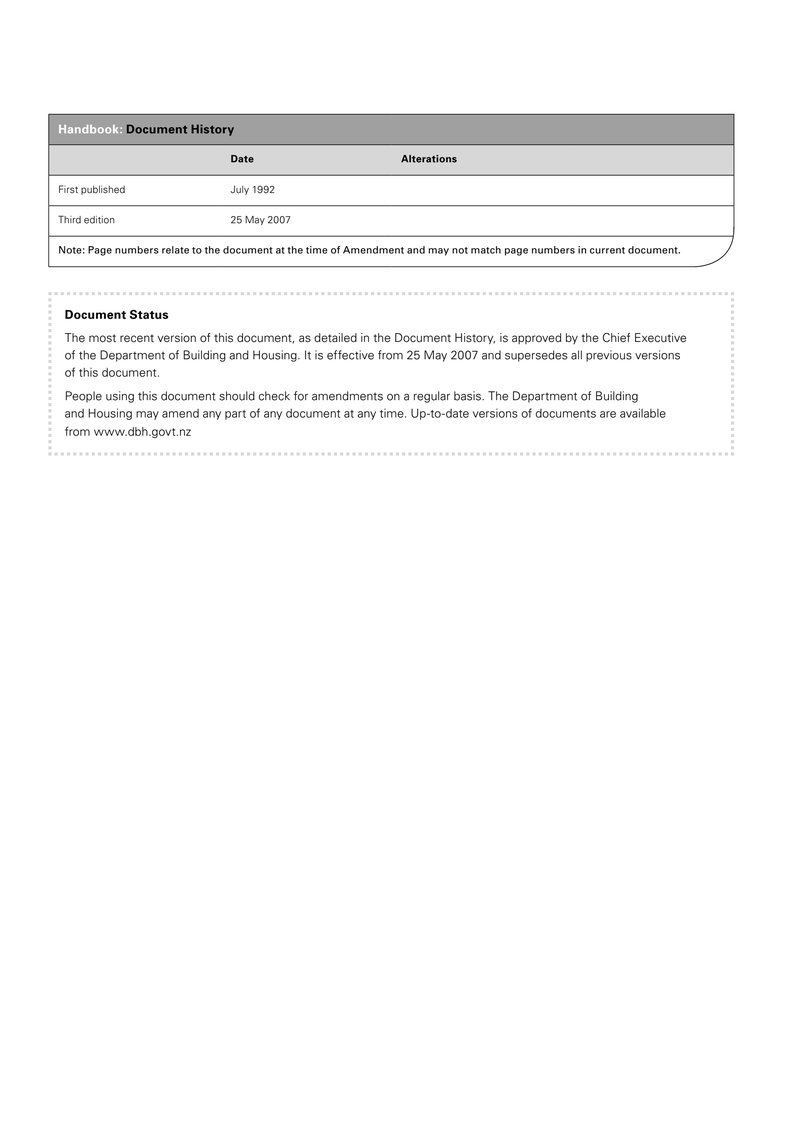
Handbook: Document History
| Handbook: Document History | ||
|---|---|---|
| Date | Alterations | |
| First published | July 1992 | |
| Third edition | 25 May 2007 | |
| Note: Page numbers relate to the document at the time of Amendment and may not match page numbers in current document. | ||
Document Status
The most recent version of this document, as detailed in the Document History, is approved by the Chief Executive of the Department of Building and Housing. It is effective from 25 May 2007 and supersedes all previous versions of this document.
People using this document should check for amendments on a regular basis. The Department of Building and Housing may amend any part of any document at any time. Up-to-date versions of documents are available from www.dbh.govt.nz
2
Preface
1.0 INTRODUCTION1.1 This preface provides an introduction to building controls in New Zealand. This section shows the relationship between the New Zealand Building Code (the Building Code) and various other Provisions that ensure buildings in New Zealand are safe and healthy to use. 1.2 The preface provides a convenient user reference. However, legal interpretation must be based on the actual wording of the Building Act 2004 (the Building Act), and amendments and respective Building Regulations. |
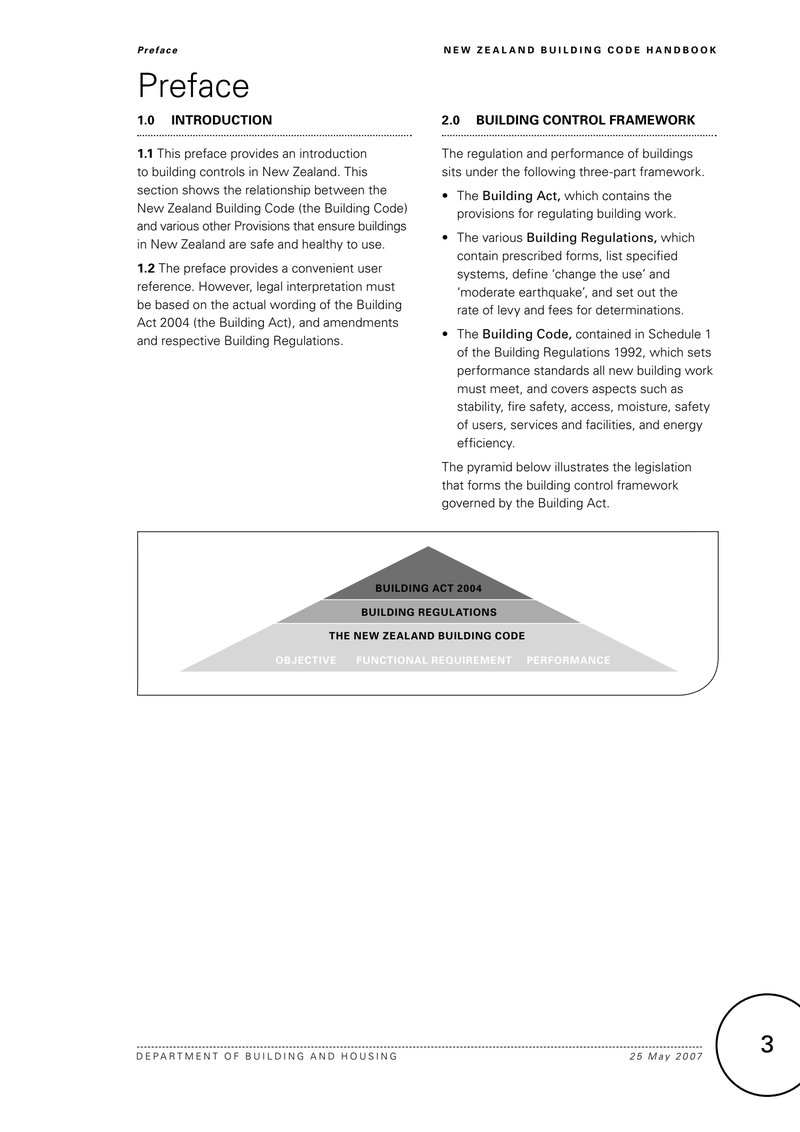
2.0 BUILDING CONTROL FRAMEWORKThe regulation and performance of buildings sits under the following three-part framework.
The pyramid below illustrates the legislation that forms the building control framework governed by the Building Act. |
3
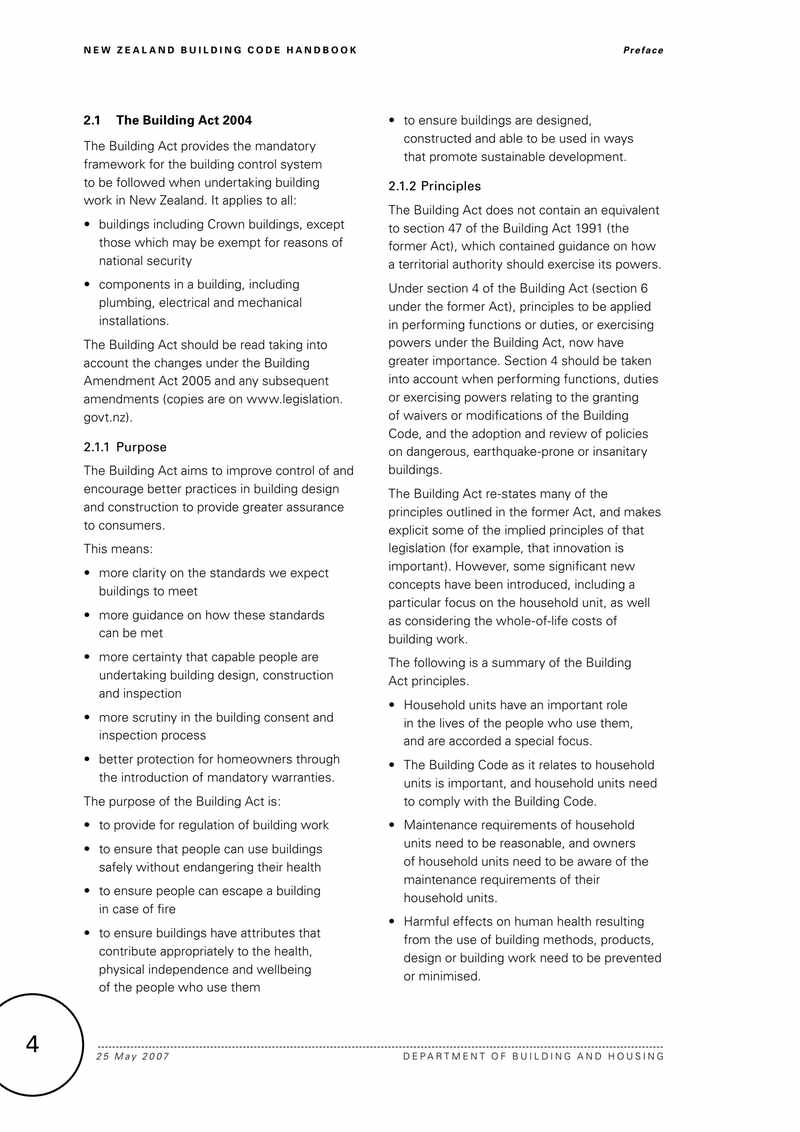
2.1 The Building Act 2004
The Building Act provides the mandatory framework for the building control system to be followed when undertaking building work in New Zealand. It applies to all:
- buildings including Crown buildings, except those which may be exempt for reasons of national security
- components in a building, including plumbing, electrical and mechanical installations.
The Building Act should be read taking into account the changes under the Building Amendment Act 2005 and any subsequent amendments (copies are on www.legislation.govt.nz).
2.1.1 Purpose
The Building Act aims to improve control of and encourage better practices in building design and construction to provide greater assurance to consumers.
This means:
- more clarity on the standards we expect buildings to meet
- more guidance on how these standards can be met
- more certainty that capable people are undertaking building design, construction and inspection
- more scrutiny in the building consent and inspection process
- better protection for homeowners through the introduction of mandatory warranties.
The purpose of the Building Act is:
- to provide for regulation of building work
- to ensure that people can use buildings safely without endangering their health
- to ensure people can escape a building in case of fire
- to ensure buildings have attributes that contribute appropriately to the health, physical independence and wellbeing of the people who use them
- to ensure buildings are designed, constructed and able to be used in ways that promote sustainable development.
2.1.2 Principles
The Building Act does not contain an equivalent to section 47 of the Building Act 1991 (the former Act), which contained guidance on how a territorial authority should exercise its powers.
Under section 4 of the Building Act (section 6 under the former Act), principles to be applied in performing functions or duties, or exercising powers under the Building Act, now have greater importance. Section 4 should be taken into account when performing functions, duties or exercising powers relating to the granting of waivers or modifications of the Building Code, and the adoption and review of policies on dangerous, earthquake-prone or insanitary buildings.
The Building Act re-states many of the principles outlined in the former Act, and makes explicit some of the implied principles of that legislation (for example, that innovation is important). However, some significant new concepts have been introduced, including a particular focus on the household unit, as well as considering the whole-of-life costs of building work.
The following is a summary of the Building Act principles.
- Household units have an important role in the lives of the people who use them, and are accorded a special focus.
- The Building Code as it relates to household units is important, and household units need to comply with the Building Code.
- Maintenance requirements of household units need to be reasonable, and owners of household units need to be aware of the maintenance requirements of their household units.
- Harmful effects on human health resulting from the use of building methods, products, design or building work need to be prevented or minimised.
4
Preface
|
2.1.3 ApplicationThe Building Act applies to:
The Building Act does not cover:
2.1.4 StructureThe Building Act has five parts. Part 1: Contains the purpose and principles of the Building Act, together with an overview, commencement dates for various Provisions and definitions. These sections provide an important reference when reading and interpreting the Building Act. Part 2 (and Schedules 1 and 2): Outlines matters relating to the Building Code and building control (such as building consents), including requirements of building work, requirements for the use of buildings, Provisions for certain categories of buildings and Provisions for the safety of dams. Part 3: Sets out the functions, duties and powers of the Chief Executive of the Department of Building and Housing (the Department), territorial authorities, regional authorities and building consent authorities. It also deals with the accreditation and registration of building consent authorities, accreditation of dam owners, and product certification. Part 4 (and Schedule 3): Covers matters relating to the licensing and disciplining of building practitioners. Part 5 (and Schedule 4): Describes miscellaneous matters, including offences and criminal proceedings, implied terms of contracts, regulation-making powers, amendments to other enactments and the repeal of the former Act, and the transitional Provisions from the former Act to the Building Act. |
5
2.2 Building Regulations
Building Regulations are made under and in accordance with the Building Act.
A number of regulations have been made under the Building Act. Currently (as at May 2007) there are seven sets of regulations.
|
4. Building (Fee for Determinations) Regulations 2005 5. Building Levy Order 2005 6. Building (Accreditation of Building Consent Authorities) Regulations 2006 7. Building (Consent Authority Accreditation Fees) Regulations 2007 Note: these regulations can be found at www.legislation.govt.nz 2.3 The New Zealand Building CodeThe Building Code is contained in Schedule 1 of the Building Regulations 1992. The Building Code contains compulsory rules for all new building work. 2.3.1 ContentThe Building Code sets out performance criteria that building work must meet. It covers aspects such as structural stability, fire safety, access, moisture control, durability, services and facilities, and energy efficiency. The Building Code does not prescribe how work should be done, but states how completed building work and its parts must perform. An advantage of a performance-based Building Code is flexibility. It contains no prescriptive requirements stipulating that certain products or designs must be used. This flexibility allows developments and innovation in building design, technology and systems. The Building Code is currently under review. Any changes to the current Building Code, and its supporting Compliance Documents, will take place from 2008 onwards. This Building Code Handbook will be updated once the review is complete. |
6
预览内容由文件识别整理,表格、公式及文字请以原始文件为准。
原文图片预览
PAGE IMAGES
下载标准文件
building-code-handbook
英语 · PDF · 6 页 · 1.54 MB