标准信息
STANDARD INFORMATION- 标准编号
- clause-G2
- 所属分类
- 其他国外标准与工程资料
- 文件语言
- 英语
- 文件格式
- 文件页数
- 6 页
- 文件大小
- 127.27 KB
· 更新:
标准简介
OVERVIEW中文简介
标准 clause-G2 的预览内容
English summary
Preview of standard clause-G2
以上为根据文件整理的内容简介。
标准内容预览
DOCUMENT PREVIEWDefinitions
This is an abbreviated list of definitions for words or terms particularly relevant to this Approved Document. The definitions for any other italicised words may be found in the New Zealand Building Code Handbook.
|
Accessible Having features to permit use by people with disabilities. Adequate Adequate to achieve the objectives of the building code. Amenity An attribute of a building which contributes to the health, physical independence, and well being of the building's users but which is not associated with disease or a specific illness. Building has the meaning ascribed to it by the Building Act 1991. Discharge pipe Any pipe which is intended to convey discharge from sanitary fixtures or sanitary appliances and includes a waste pipe, combined waste pipe, branch discharge pipe and discharge stack. Fixture An article intended to remain permanently attached to and form part of a building. Intended use of a building includes: a) Any reasonably foreseeable occasional other use that is not incompatible with the intended use; and b) Normal maintenance; and c) Activities taken in response to fire or any other reasonably foreseeable emergency – but does not include any other maintenance and repairs or rebuilding. Amend 1 Jul 2001 People with disabilities means any person who suffers from physical or mental disability to such a degree that he or she is seriously limited in the extent to which he or she can engage in the activities, pursuits, and the processes of everyday life. Socket outlet An accessory fixed to a wall or ceiling and designed to accept a plug that extends the electrical supply to an appliance by means of a flexible cable. |
Water seal The depth of water that can be retained in a water trap. Water trap A fitting designed to retain a depth of water that prevents foul air and gases escaping from the plumbing system or foul water drainage system and entering a building. Amend 1 Jul 2001 |
6
Status of Compliance Documents
Compliance Documents are prepared by the Department of Building and Housing in accordance with section 22 of the Building Act 2004. A Compliance Document is for use in establishing compliance with the New Zealand Building Code.
A person who complies with a Compliance Document will be treated as having complied with the provisions of the Building Code to which the Compliance Document relates. However, a Compliance Document is only one method of complying with the Building Code. There may be alternative ways to comply.
Users should make themselves familiar with the preface to the New Zealand Building Code Handbook, which describes the status of Compliance Documents and explains alternative methods of achieving compliance.
Defined words (italicised in the text) and classified uses are explained in Clauses A1 of the Building Code and in the Definitions at the start of this Compliance Document.
| Date | Alterations | |
|---|---|---|
| First published | July 1992 | |
| Amendment 1 | 1 July 2001 | p. 2, Document History, Status p. 9, Definitions |
| Note: Page numbers relate to the document at the time of Amendment and may not match page numbers in current document. | ||
Document Status
The most recent version of this document, as detailed in the Document History, is approved by the Chief Executive of the Department of Building and Housing. It is effective from 1 July 2001 and supersedes all previous versions of this document.
People using this Compliance Document should check for amendments on a regular basis. The Department of Building and Housing may amend any part of any Compliance Document at any time. Up-to-date versions of Compliance Documents are available from www.dbh.govt.nz
2
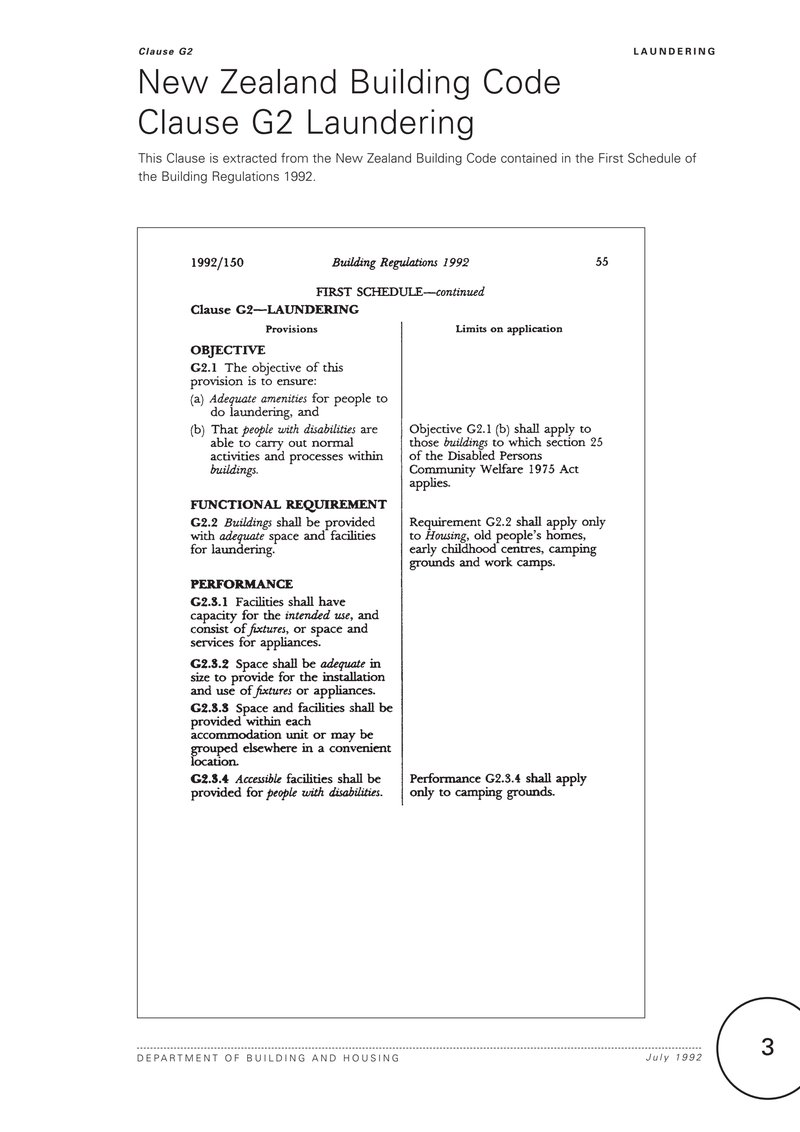
New Zealand Building Code Clause G2 Laundering
This Clause is extracted from the New Zealand Building Code contained in the First Schedule of the Building Regulations 1992.
FIRST SCHEDULE—continued
Clause G2—LAUNDERING
| Provisions | Limits on application |
|---|---|
|
OBJECTIVE G2.1 The objective of this provision is to ensure: (a) Adequate amenities for people to do laundering, and (b) That people with disabilities are able to carry out normal activities and processes within buildings. |
Objective G2.1 (b) shall apply to those buildings to which section 25 of the Disabled Persons Community Welfare 1975 Act applies. |
|
FUNCTIONAL REQUIREMENT G2.2 Buildings shall be provided with adequate space and facilities for laundering. |
Requirement G2.2 shall apply only to Housing, old people's homes, early childhood centres, camping grounds and work camps. |
|
PERFORMANCE G2.3.1 Facilities shall have capacity for the intended use, and consist of fixtures, or space and services for appliances. G2.3.2 Space shall be adequate in size to provide for the installation and use of fixtures or appliances. G2.3.3 Space and facilities shall be provided within each accommodation unit or may be grouped elsewhere in a convenient location. G2.3.4 Accessible facilities shall be provided for people with disabilities. |
Performance G2.3.4 shall apply only to camping grounds. |
3
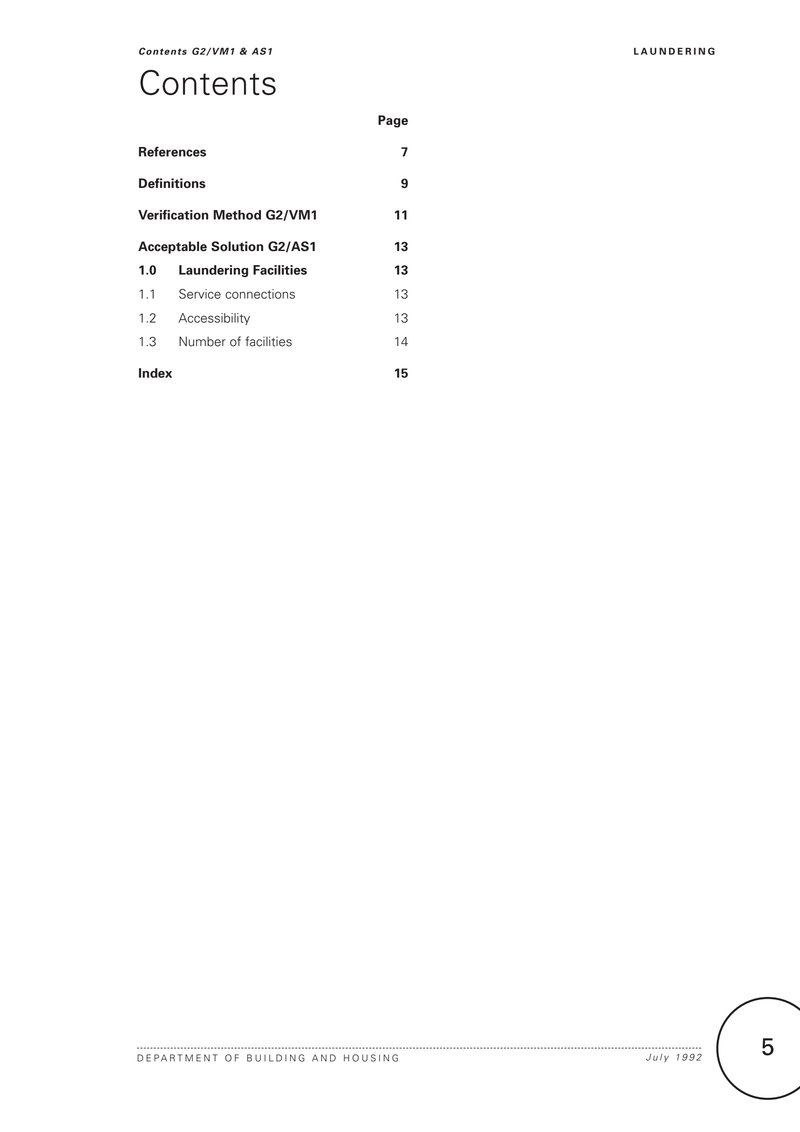
Contents
| Page | |
|---|---|
| References | 7 |
| Definitions | 9 |
| Verification Method G2/VM1 | 11 |
| Acceptable Solution G2/AS1 | 13 |
| 1.0 Laundering Facilities | 13 |
| 1.1 Service connections | 13 |
| 1.2 Accessibility | 13 |
| 1.3 Number of facilities | 14 |
| Index | 15 |
4
References
For the purposes of New Zealand Building Code compliance, referenced documents shall be deemed to include any amendments issued prior to the date of the Approved Document as displayed at the foot of the page on which the references are listed.
Standards Association of Australia AS 1229: 1989 Laundry troughs |
Where quoted AS1 1.0.3 |
5
Definitions
This is an abbreviated list of definitions for words or terms particularly relevant to this Approved Document. The definitions for any other italicised words may be found in the New Zealand Building Code Handbook.
|
Accessible Having features to permit use by people with disabilities. Adequate Adequate to achieve the objectives of the building code. Amenity An attribute of a building which contributes to the health, physical independence, and well being of the building's users but which is not associated with disease or a specific illness. Building has the meaning ascribed to it by the Building Act 1991. Discharge pipe Any pipe which is intended to convey discharge from sanitary fixtures or sanitary appliances and includes a waste pipe, combined waste pipe, branch discharge pipe and discharge stack. Fixture An article intended to remain permanently attached to and form part of a building. Intended use of a building includes: a) Any reasonably foreseeable occasional other use that is not incompatible with the intended use; and b) Normal maintenance; and c) Activities taken in response to fire or any other reasonably foreseeable emergency – but does not include any other maintenance and repairs or rebuilding. Amend 1 Jul 2001 People with disabilities means any person who suffers from physical or mental disability to such a degree that he or she is seriously limited in the extent to which he or she can engage in the activities, pursuits, and the processes of everyday life. Socket outlet An accessory fixed to a wall or ceiling and designed to accept a plug that extends the electrical supply to an appliance by means of a flexible cable. |
Water seal The depth of water that can be retained in a water trap. Water trap A fitting designed to retain a depth of water that prevents foul air and gases escaping from the plumbing system or foul water drainage system and entering a building. Amend 1 Jul 2001 |
6
预览内容由文件识别整理,表格、公式及文字请以原始文件为准。
原文图片预览
PAGE IMAGES

下载标准文件
clause-G2
英语 · PDF · 6 页 · 127.27 KB