AS 1824.1-1995 Amdt 1-1997 Insulation co-ordinatio
统一交通控制设备手册 第2部分:通用交通控制设备
AS 1824.1-1995 Amdt 1-1997 Insulation co-ordination - Definitions, principles and rules
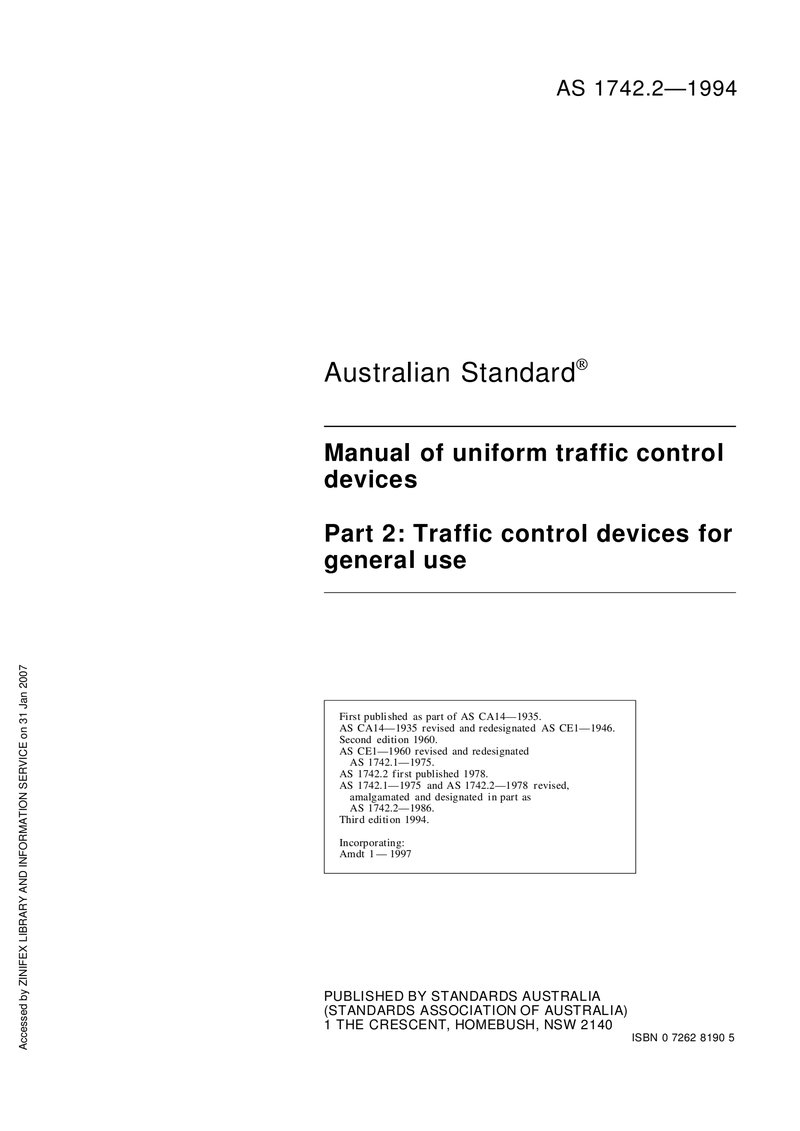
Manual of uniform traffic control devices Part 2: Traffic control devices for general use
标准信息
STANDARD INFORMATION- 标准编号
- AS 1824.1-1995 Amdt 1-1997 Insulation co-ordinatio
- 所属分类
- AS 澳大利亚标准
- 发布机构
- Standards Australia
- 版本年份
- 1997
- 文件语言
- 英语
- 文件格式
- 文件页数
- 6 页
- 文件大小
- 100.68 KB
中文名称为参考译名,文件语言以原文为准。
· 更新:
标准简介
OVERVIEW中文简介
该标准是澳大利亚统一交通控制设备手册系列的一部分,专门针对除高速公路外所有道路上的通用交通控制设备。内容涵盖交叉口控制和路段控制,包括道路标线、标志设置及特定交通状况下的控制措施。
English summary
This standard is part of the Australian Manual of Uniform Traffic Control Devices series, focusing on traffic control devices for general use on all roads except freeways. It covers controls at intersections and between intersections, including road markings, signage, and specific traffic situation management.
以上为根据文件整理的内容简介。
相关标签
标准内容预览
DOCUMENT PREVIEWLICENCE
for
Licensee:
Date:
Conditions of use: Click here for full conditions of Licence
WEB LINKS
- Check if this document is current
- Find similar documents
- StandardsWatch (info and login)
- Visit our website
International Standards on-line at www.saiglobal.com/shop
1
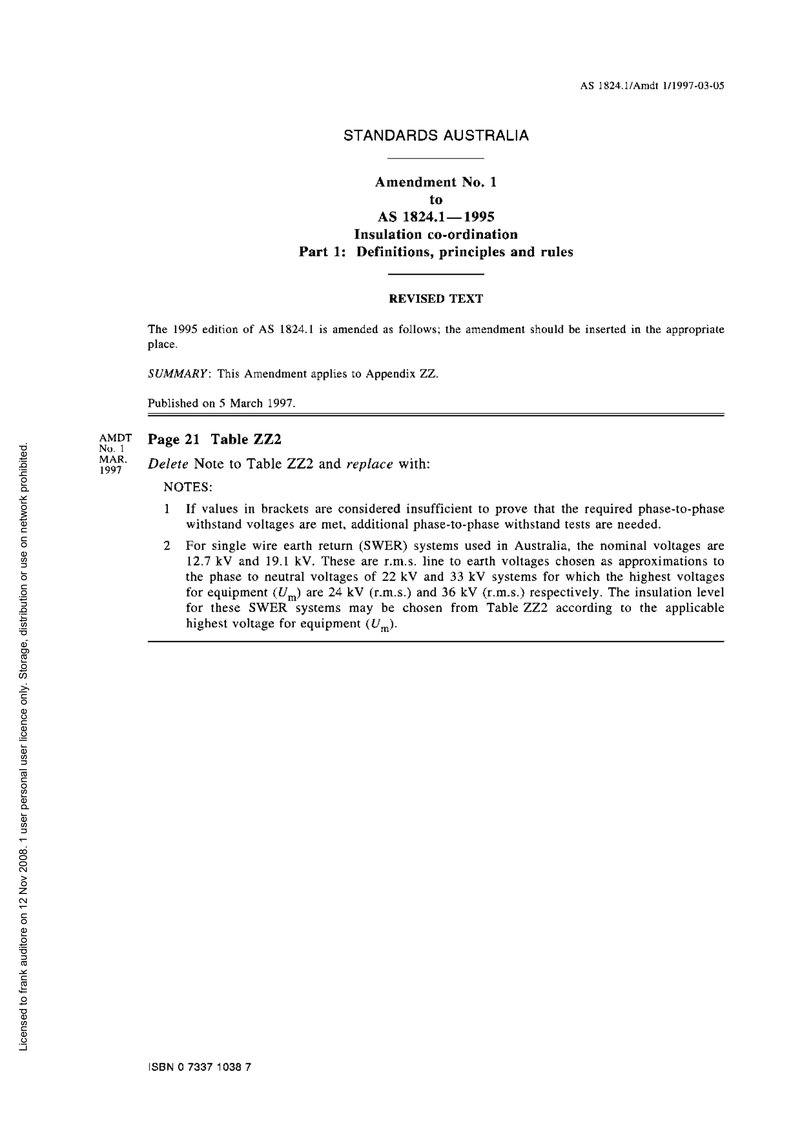
Amendment No. 1 to AS 1824.1—1995 Insulation co-ordination Part 1: Definitions, principles and rules
REVISED TEXT
The 1995 edition of AS 1824.1 is amended as follows; the amendment should be inserted in the appropriate place.
SUMMARY: This Amendment applies to Appendix ZZ.
Published on 5 March 1997.
Page 21 Table ZZ2
Delete Note to Table ZZ2 and replace with:
NOTES:
- If values in brackets are considered insufficient to prove that the required phase-to-phase withstand voltages are met, additional phase-to-phase withstand tests are needed.
- For single wire earth return (SWER) systems used in Australia, the nominal voltages are 12.7 kV and 19.1 kV. These are r.m.s. line to earth voltages chosen as approximations to the phase to neutral voltages of 22 kV and 33 kV systems for which the highest voltages for equipment (Um) are 24 kV (r.m.s.) and 36 kV (r.m.s.) respectively. The insulation level for these SWER systems may be chosen from Table ZZ2 according to the applicable highest voltage for equipment (Um).
2
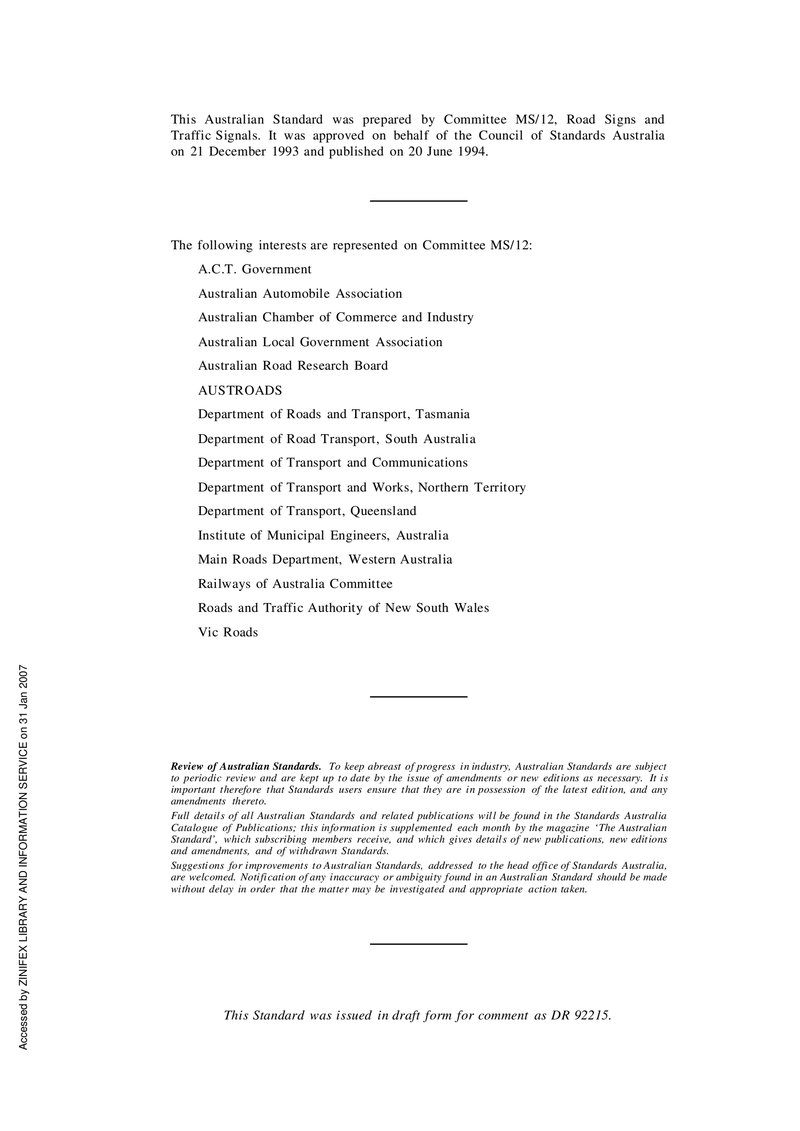
This Australian Standard was prepared by Committee MS/12, Road Signs and Traffic Signals. It was approved on behalf of the Council of Standards Australia on 21 December 1993 and published on 20 June 1994.
The following interests are represented on Committee MS/12:
- A.C.T. Government
- Australian Automobile Association
- Australian Chamber of Commerce and Industry
- Australian Local Government Association
- Australian Road Research Board
- AUSTROADS
- Department of Roads and Transport, Tasmania
- Department of Road Transport, South Australia
- Department of Transport and Communications
- Department of Transport and Works, Northern Territory
- Department of Transport, Queensland
- Institute of Municipal Engineers, Australia
- Main Roads Department, Western Australia
- Railways of Australia Committee
- Roads and Traffic Authority of New South Wales
- Vic Roads
Review of Australian Standards. To keep abreast of progress in industry, Australian Standards are subject to periodic review and are kept up to date by the issue of amendments or new editions as necessary. It is important therefore that Standards users ensure that they are in possession of the latest edition, and any amendments thereto.
Full details of all Australian Standards and related publications will be found in the Standards Australia Catalogue of Publications; this information is supplemented each month by the magazine ‘The Australian Standard’, which subscribing members receive, and which gives details of new publications, new editions and amendments, and of withdrawn Standards.
Suggestions for improvements to Australian Standards, addressed to the head office of Standards Australia, are welcomed. Notification of any inaccuracy or ambiguity found in an Australian Standard should be made without delay in order that the matter may be investigated and appropriate action taken.
This Standard was issued in draft form for comment as DR 92215.
3
Australian Standard®
Manual of uniform traffic control devices
Part 2: Traffic control devices for general use
|
First published as part of AS CA14—1935. AS CA14—1935 revised and redesignated AS CE1—1946. Second edition 1960. AS CE1—1960 revised and redesignated AS 1742.1—1975. AS 1742.2 first published 1978. AS 1742.1—1975 and AS 1742.2—1978 revised, amalgamated and designated in part as AS 1742.2—1986. Third edition 1994. Incorporating: Amdt 1—1997 |
PUBLISHED BY STANDARDS AUSTRALIA (STANDARDS ASSOCIATION OF AUSTRALIA) 1 THE CRESCENT, HOMEBUSH, NSW 2140
ISBN 0 7262 8190 5
4
PREFACE
This Standard was prepared by the Standards Australia Committee on Road Signs and Traffic Signals to supersede AS 1742.2—1986, Manual of uniform traffic control devices, Part 2: Traffic control devices for general use. It is one of a series of thirteen Standards as follows:
| AS | |
| 1742 | Manual of uniform traffic control devices |
| 1742.1 | Part 1: General introduction and index of signs |
| 1742.2 | Part 2: Traffic control devices for general use (this Standard) |
| 1742.3 | Part 3: Traffic control devices for works on roads |
| 1742.4 | Part 4: Speed controls |
| 1742.5 | Part 5: Street name and community facility name signs |
| 1742.6 | Part 6: Service and tourist signs for motorists |
| 1742.7 | Part 7: Railway crossings |
| 1742.8 | Part 8: Freeways |
| 1742.9 | Part 9: Bicycle facilities |
| 1742.10 | Part 10: Pedestrian control and protection |
| 1742.11 | Part 11: Parking controls |
| 1742.12 | Part 12: Bus, transit and truck lanes |
| 1742.13 | Part 13: Local area traffic management |
A further Part, Traffic signals, is in the course of preparation.
This Standard deals with traffic control devices for general use and is applicable to all roads other than freeways. It has been divided into two main sections, one dealing with controls at intersections and the other with controls between intersections. The latter section has been further divided by relating the devices to specific traffic situations and problem areas between intersections.
This edition of this Standard contains a number of amendments which reflect changes in practice which have evolved since the earlier edition of the Standard was published. The more significant changes are as follows:
- The former ‘hybrid’ signs No Left (Right, U) Turn and Two-way Traffic, have been changed to symbol only signs, by deleting the words from the sign. The NO ENTRY sign now has the words within the symbol.
- Sight distance warrants for use of STOP signs are now included.
- Additional symbols for intersection warning signs are now permitted. They are listed in Appendices F and G.
- Route names on direction signs are always to be in a white panel.
- Overhead lane indication signs are to have upward rather than downward pointing arrows.
- Finger boards indicating destinations now have white letters on standard green background with white chevron. The black and white finger board is now to be used only as a rural road name board.
- The chevron alignment sign has been introduced for the delineation of substandard curves.
- Climbing lanes (as opposed to overtaking lanes) are now to be used only on one-way carriageways, except for very short sections on two-way carriageways, now known as turnouts for heavy vehicles.
- Additional warning and information signs for long and very steep descents are now included.
5
(j) Yellow is no longer an acceptable option for barrier lines. All lines for moving traffic are now white.
(k) Material relating to traffic signals has now been omitted from this Standard and will shortly be published in a new Part of AS 1742.
The terms ‘normative’ and ‘informative’ have been used in this Standard to define the application of the appendix to which they apply. A ‘normative’ appendix is an integral part of a Standard, whereas an ‘informative’ appendix is only for information and guidance.
The Department of Transport and Works, Northern Territory did not agree to the publication of Amendment No. 1.
© Copyright — STANDARDS AUSTRALIA
Users of Standards are reminded that copyright subsists in all Standards Australia publications and software. Except where the Copyright Act allows and except where provided for below no publications or software produced by Standards Australia may be reproduced, stored in a retrieval system in any form or transmitted by any means without prior permission in writing from Standards Australia. Permission may be conditional on an appropriate royalty payment. Requests for permission and information on commercial software royalties should be directed to the head office of Standards Australia.
Standards Australia will permit up to 10 percent of the technical content pages of a Standard to be copied for use exclusively in-house by purchasers of the Standard without payment of a royalty or advice to Standards Australia.
Standards Australia will also permit the inclusion of its copyright material in computer software programs for no royalty payment provided such programs are used exclusively in-house by the creators of the programs.
Care should be taken to ensure that material used is from the current edition of the Standard and that it is updated whenever the Standard is amended or revised. The number and date of the Standard should therefore be clearly identified.
The use of material in print form or in computer software programs to be used commercially, with or without payment, or in commercial contracts is subject to the payment of a royalty. This policy may be varied by Standards Australia at any time.
6
预览内容由文件识别整理,表格、公式及文字请以原始文件为准。
原文图片预览
PAGE IMAGES
下载标准文件
AS 1824.1-1995 Amdt 1-1997 Insulation co-ordinatio
英语 · PDF · 6 页 · 100.68 KB