AS 1720.1 1997 Timber structures Part 1 Design met
木结构 第1部分:设计方法
AS 1720.1 1997 Timber structures Part 1 Design methods
Timber structures Part 1: Design methods
标准信息
STANDARD INFORMATION- 标准编号
- AS 1720.1 1997 Timber structures Part 1 Design met
- 所属分类
- AS 澳大利亚标准
- 发布机构
- Standards Australia
- 版本年份
- 1997
- 文件语言
- 英语
- 文件格式
- 文件页数
- 6 页
- 文件大小
- 6.14 MB
中文名称为参考译名,文件语言以原文为准。
· 更新:
标准简介
OVERVIEW中文简介
该标准提供了木结构设计的极限状态设计方法、设计数据和测试程序。它适用于木结构的设计师和制造商,旨在从工作应力设计(WSD)格式平滑过渡到极限状态设计(LSD)格式。
English summary
This standard provides limit state design methods, design data, and testing procedures for timber structures. It is applicable to designers and manufacturers of timber structures, aiming for a smooth transition from working stress design (WSD) to limit state design (LSD) formats.
以上为根据文件整理的内容简介。
相关标签
标准内容预览
DOCUMENT PREVIEWAS 1720.1—1997
(Incorporating Amendment Nos 1, 2, 3 and 4)
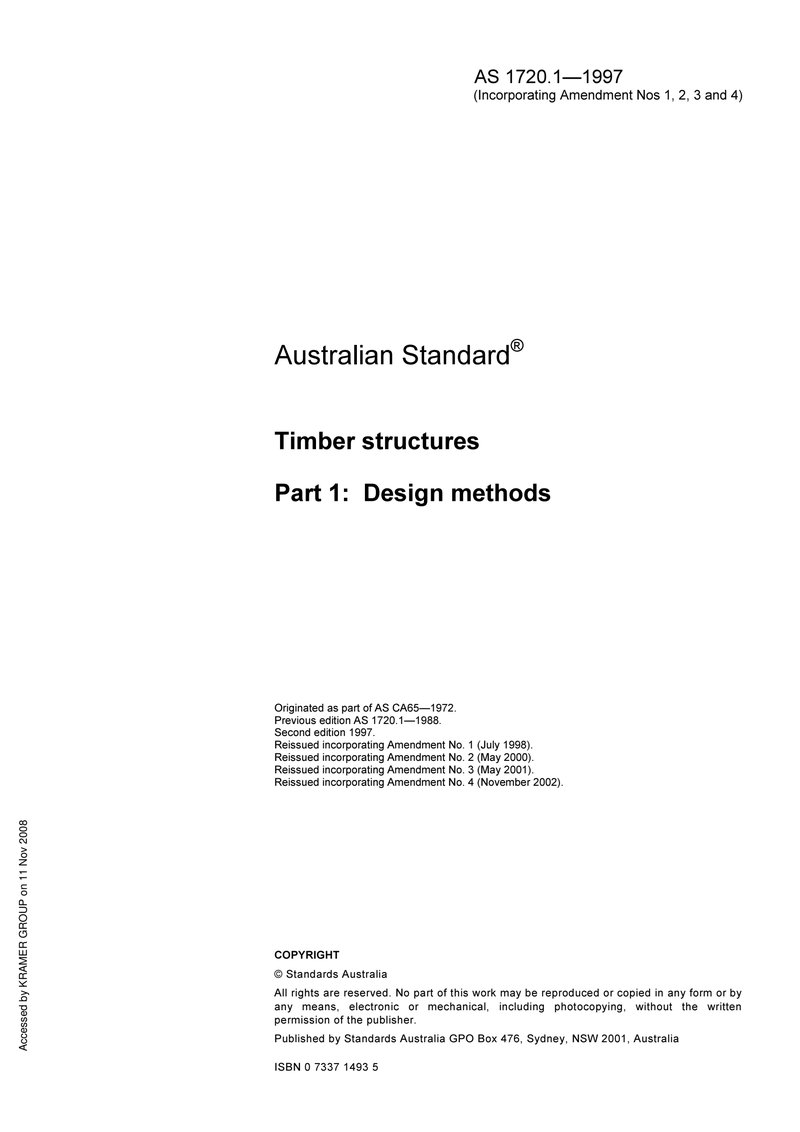
Australian Standard®
Timber structures
Part 1: Design methods
1
AS IS
内部资料
仅供参考
张忠辉惠存
禁止一切非法目的和活动行为,否则后果自负。
NOT FOR PUBLIC RELEASE
2
Foreword
This Australian Standard® was prepared by Committee TM-001, Timber Structures. It was approved on behalf of the Council of Standards Australia on 5 September 1997.
This Standard was published on 5 November 1997.
The following are represented on Committee TM-001:
- The Association of Consulting Engineers Australia
- Australian Building Codes Board
- Building Research Association of New Zealand
- CSIRO Division of Building, Construction and Engineering
- Curtin University of Technology
- Monash University
- National Association of Forest Industries
- New Zealand Forest Research Institute
- New Zealand Timber Industry Federation
- New Zealand Timber Suppliers Group
- Pine Australia
- Plywood Association of Australia
- University of Technology, Sydney
This Standard was issued in draft form for comment as DR 94276.
Standards Australia wishes to acknowledge the participation of the expert individuals that contributed to the development of this Standard through their representation on the Committee and through the public comment period.
Keeping Standards up-to-date
Australian Standards® are living documents that reflect progress in science, technology and systems. To maintain their currency, all Standards are periodically reviewed, and new editions are published. Between editions, amendments may be issued.
Standards may also be withdrawn. It is important that readers assure themselves they are using a current Standard, which should include any amendments that may have been published since the Standard was published.
Detailed information about Australian Standards, drafts, amendments and new projects can be found by visiting www.standards.org.au
Standards Australia welcomes suggestions for improvements, and encourages readers to notify us immediately of any apparent inaccuracies or ambiguities. Contact us via email at mail@standards.org.au, or write to Standards Australia, GPO Box 476, Sydney, NSW 2001.
3
AS 1720.1—1997
(Incorporating Amendment Nos 1, 2, 3 and 4)
Australian Standard®
Timber structures
Part 1: Design methods
Originated as part of AS CA65—1972.
Previous edition AS 1720.1—1988.
Second edition 1997.
Reissued incorporating Amendment No. 1 (July 1998).
Reissued incorporating Amendment No. 2 (May 2000).
Reissued incorporating Amendment No. 3 (May 2001).
Reissued incorporating Amendment No. 4 (November 2002).
COPYRIGHT
© Standards Australia
All rights are reserved. No part of this work may be reproduced or copied in any form or by any means, electronic or mechanical, including photocopying, without the written permission of the publisher.
Published by Standards Australia GPO Box 476, Sydney, NSW 2001, Australia
ISBN 0 7337 1493 5
4
PREFACE
This Standard was prepared by the Joint Standards Australia/Standards New Zealand Committee TM/1, Timber Structures, to supersede AS 1720.1—1988.
This Standard incorporates Amendment Nos 1 (July 1998), 2 (May 2000), 3 (May 2001) and 4 (November 2002). The changes required by the Amendments are indicated in the text by a marginal bar and amendment number against the clause, note, table, figure, or part thereof affected.
This Standard is the result of a consensus among representatives on the Joint Committee to produce it as an Australian Standard.
The objective of this Standard is to provide designers and manufacturers of timber structures with limit state design methods, design data and testing procedures for such structures.
This Standard is a ‘soft conversion’ of the working stress design (WSD) version to the limit state design (LSD) format. The term ‘soft conversion’ implies that average similar design solutions would be obtained from WSD and LSD codes. This approach was taken to ensure a smooth transition from WSD format to the LSD format. Hence only essential changes have been made to facilitate this conversion, and the contents of the LSD code remain substantially the same as the WSD code. New clauses and appendices have been added and the existing text has been thoroughly revised and updated to accommodate the conversion to LSD format.
Differences from the 1988 edition include the following:
(a) Conversion from WSD to LSD.
(b) Requirements for design data and details on drawings (Clauses 1.6.2, 1.6.3).
(c) The properties assigned to each strength group and F-grade multiplied by a factor to reflect the change to LSD.
(d) Joint types introduced for shear and withdrawal loadings.
(e) In-plane bending for plywood.
(f) Glulam grades, including characteristic strengths and elastic moduli.
(g) New Section on structural laminated veneer lumber.
(h) Section properties for plywood diaphragms.
(i) Guidance on appropriate deflection limits for various applications.
(j) Clauses on beam and column design and on curved and tapered members.
(k) Design properties for monitored, in-grade tested material.
(l) An appendix detailing the method for the assignment of capacity factors.
The terms ‘normative’ and ‘informative’ have been used in this Standard to define the application of the appendix to which they apply. A ‘normative’ appendix is an integral part of a Standard, whereas an ‘informative’ appendix is only for information and guidance.
5
CONTENTS
Page
SECTION 1 SCOPE AND GENERAL
1.1 SCOPE AND APPLICATION................................................5
1.2 REFERENCED DOCUMENTS................................................5
1.3 NEW MATERIALS AND METHODS................................................5
1.4 TIMBER................................................6
1.5 GENERAL DESIGN CONSIDERATIONS................................................7
1.6 DESIGN AND SUPERVISION................................................10
1.7 WORKMANSHIP AND MAINTENANCE................................................10
1.8 DEFINITIONS................................................11
1.9 NOTATION................................................15
1.10 UNITS................................................15
SECTION 2 DESIGN PROPERTIES OF STRUCTURAL TIMBER ELEMENTS
2.1 GENERAL................................................16
2.2 DESIGN PROPERTIES................................................16
2.3 CAPACITY FACTOR................................................22
2.4 MODIFICATION FACTORS................................................26
SECTION 3 DESIGN CAPACITY OF BASIC STRUCTURAL MEMBERS
3.1 GENERAL................................................34
3.2 BEAM DESIGN................................................34
3.3 COLUMN DESIGN................................................42
3.4 TENSION MEMBER DESIGN................................................46
3.5 DESIGN CAPACITY IN TENSION PERPENDICULAR TO GRAIN................................................46
3.6 COMBINED BENDING AND AXIAL ACTIONS................................................47
SECTION 4 DESIGN CAPACITY OF JOINTS IN TIMBER STRUCTURES
4.1 GENERAL................................................49
4.2 DESIGN OF NAILED JOINTS................................................51
4.3 DESIGN OF SCREWED JOINTS................................................60
4.4 DESIGN OF BOLTED JOINTS................................................66
4.5 DESIGN OF COACH SCREWED JOINTS................................................80
4.6 DESIGN OF SPLIT-RING FASTENER JOINTS................................................84
4.7 DESIGN OF SHEAR-PLATE FASTENER JOINTS................................................87
SECTION 5 PLYWOOD
5.1 GENERAL................................................89
5.2 DESIGN PROPERTIES................................................89
5.3 MODIFICATION FACTORS................................................90
5.4 LOADING NORMAL TO THE PLANE OF THE PLYWOOD PANEL................................................91
5.5 LOADING IN THE PLANE OF THE PLYWOOD PANEL................................................93
5.6 JOINTS IN COMPOSITE PLYWOOD TO TIMBER CONSTRUCTION................................................96
SECTION 6 ROUND TIMBERS
6.1 GENERAL................................................99
6.2 CHARACTERISTIC STRENGTHS AND ELASTIC MODULI................................................99
6.3 DESIGN................................................99
6.4 ADDITIONAL MODIFICATION FACTORS................................................101
6.5 DESIGN DETAILS................................................102
6
预览内容由文件识别整理,表格、公式及文字请以原始文件为准。
原文图片预览
PAGE IMAGES
下载标准文件
AS 1720.1 1997 Timber structures Part 1 Design met
英语 · PDF · 6 页 · 6.14 MB