AS 5100.3 2004 Bridge design Part 3 Foundations
桥梁设计 第3部分:基础和土体支撑结构
AS 5100.3 2004 Bridge design Part 3 Foundations
Bridge design Part 3: Foundations and soil-supporting structures

标准信息
STANDARD INFORMATION- 标准编号
- AS 5100.3 2004 Bridge design Part 3 Foundations
- 所属分类
- AS 澳大利亚标准
- 发布机构
- Standards Australia International
- 版本年份
- 2004
- 文件语言
- 英语
- 文件格式
- 文件页数
- 6 页
- 文件大小
- 685.19 KB
中文名称为参考译名,文件语言以原文为准。
· 更新:
标准简介
OVERVIEW中文简介
该标准规定了道路、铁路、人行及自行车道桥梁的基础和土体支撑结构的设计要求。它取代了HB 77.3—1996,并将铁路补充要求整合进AS 5100系列,以提供全国可接受的设计准则。
English summary
This standard specifies the design requirements for foundations and soil-supporting structures for road, rail, pedestrian, and bicycle-path bridges. It supersedes HB 77.3—1996 and integrates railway supplement requirements into the AS 5100 series to provide nationally acceptable design criteria.
以上为根据文件整理的内容简介。
相关标签
标准内容预览
DOCUMENT PREVIEWAustralian Standard™
Bridge design
Part 3: Foundations and soil-supporting structures
1
AS IS
内部资料
仅供参考
张忠辉惠存
禁止一切非法目的和活动行为,否则后果自负。
NOT FOR PUBLIC RELEASE
2
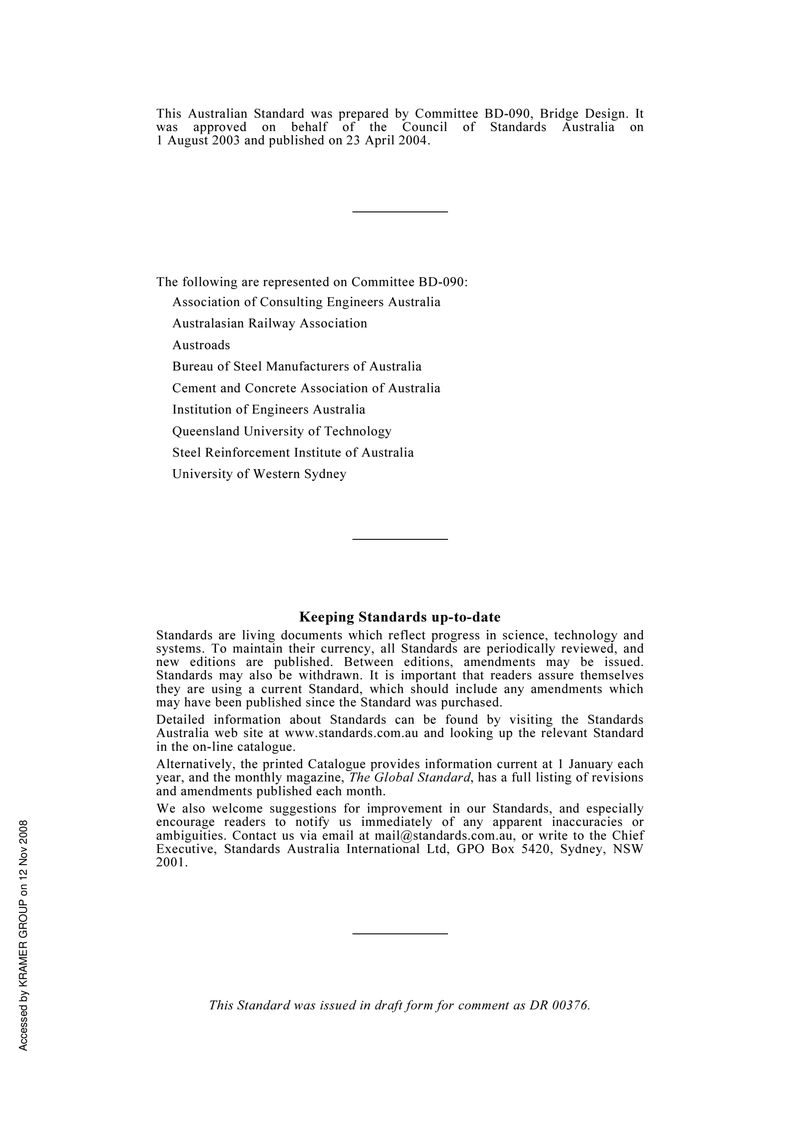
This Australian Standard was prepared by Committee BD-090, Bridge Design. It was approved on behalf of the Council of Standards Australia on 1 August 2003 and published on 23 April 2004.
The following are represented on Committee BD-090:
- Association of Consulting Engineers Australia
- Australasian Railway Association
- Austroads
- Bureau of Steel Manufacturers of Australia
- Cement and Concrete Association of Australia
- Institution of Engineers Australia
- Queensland University of Technology
- Steel Reinforcement Institute of Australia
- University of Western Sydney
Keeping Standards up-to-date
Standards are living documents which reflect progress in science, technology and systems. To maintain their currency, all Standards are periodically reviewed, and new editions are published. Between editions, amendments may be issued. Standards may also be withdrawn. It is important that readers assure themselves they are using a current Standard, which should include any amendments which may have been published since the Standard was purchased.
Detailed information about Standards can be found by visiting the Standards Australia web site at www.standards.com.au and looking up the relevant Standard in the on-line catalogue.
Alternatively, the printed Catalogue provides information current at 1 January each year, and the monthly magazine, The Global Standard, has a full listing of revisions and amendments published each month.
We also welcome suggestions for improvement in our Standards, and especially encourage readers to notify us immediately of any apparent inaccuracies or ambiguities. Contact us via email at mail@standards.com.au, or write to the Chief Executive, Standards Australia International Ltd, GPO Box 5420, Sydney, NSW 2001.
This Standard was issued in draft form for comment as DR 00376.
3
Australian StandardTM
Bridge design
Part 3: Foundations and soil-supporting structures
Originated as HB 77.3—1996.
Revised and redesignated as AS 5100.3—2004.
COPYRIGHT
© Standards Australia International
All rights are reserved. No part of this work may be reproduced or copied in any form or by any means, electronic or mechanical, including photocopying, without the written permission of the publisher.
Published by Standards Australia International Ltd
GPO Box 5420, Sydney, NSW 2001, Australia
ISBN 0 7337 5478 3
4
PREFACE
This Standard was prepared by the Standards Australia Committee BD-090, Bridge Design to supersede HB 77.3—1996, Australian Bridge Design Code, Section 3: Foundations.
The AS 5100 series represents a revision of the 1996 HB 77 series, Australian Bridge Design Code, which contained a separate Railway Supplement to Sections 1 to 5, together with Section 6, Steel and composite construction, and Section 7, Rating. AS 5100 takes the requirements of the Railway Supplement and incorporates them into Parts 1 to 5 of the present series, to form integrated documents covering requirements for both road and rail bridges. In addition, technical material has been updated.
This Standard is also designated as AUSTRoads publication AP-G15.3/04.
The objectives of AS 5100 are to provide nationally acceptable requirements for—
(a) the design of road, rail, pedestrian and bicycle-path bridges;
(b) the specific application of concrete, steel and composite steel/concrete construction, which embody principles that may be applied to other materials in association with relevant Standards; and
(c) the assessment of the load capacity of existing bridges.
These requirements are based on the principles of structural mechanics and knowledge of material properties, for both the conceptual and detailed design, to achieve acceptable probabilities that the bridge or associated structure being designed will not become unfit for use during its design life.
Whereas earlier editions of the Australian Bridge Design Code were essentially administered by the infrastructure owners and applied to their own inventory, an increasing number of bridges are being built under the design-construct-operate principle and being handed over to the relevant statutory authority after several years of operation. This Standard includes clauses intended to facilitate the specification to the designer of the functional requirements of the owner, to ensure the long-term performance and serviceability of the bridge and associated structure.
Significant differences between this Standard and HB 77.3 are the following:
(i) Foundation design principles In recognition that geotechnical engineering design principles differ from structural engineering design principles, the design procedures have been extensively revised. Designers are required to use geotechnical engineering methods appropriate to the foundation problem at hand, together with appropriate characteristic values and factors, when deriving economical and safe solutions. It is further required that designers apply engineering judgement to the application of sound rational design methods outlined in texts, technical literature and other design codes to supplement the design requirements of this Standard.
(ii) Design procedures Substructures have been classified as either foundations, where most of the loads on the substructure come from the bridge structure and loads on it, or as soil-supporting structures, where most of the applied loads are from earth pressure. Different design procedures are required for each. The loads and resistances for a soil-supporting structure will largely depend on the soil properties, whereas the loads for a foundation will not be as dependent on the soil properties.
(iii) Relevant Standard The philosophy used for the design of earth-retaining structures in this Standard differs from that contained in AS 4678, Earth-retaining structures, which was prepared by Standards Australia Committee CE-032. It is considered that for bridges and road-related structures, where soil/structure interaction occurs and the loads are predominantly soil-imposed, the design method adopted is more realistic.
5
3
However, AS 4678 contains much useful information that can be used to supplement the design of structures covered by this Standard.
In line with Standards Australia policy, the words ‘shall’ and ‘may’ are used consistently throughout this Standard to indicate respectively, a mandatory provision and an acceptable or permissible alternative.
Statements expressed in mandatory terms in Notes to Tables are deemed to be requirements of this Standard.
The terms ‘normative’ and ‘informative’ have been used in this Standard to define the application of the appendix to which they apply. A ‘normative’ appendix is an integral part of the Standard, whereas an ‘informative’ appendix is only for information and guidance.
6
预览内容由文件识别整理,表格、公式及文字请以原始文件为准。
原文图片预览
PAGE IMAGES
下载标准文件
AS 5100.3 2004 Bridge design Part 3 Foundations
英语 · PDF · 6 页 · 685.19 KB