AS 1055.1-1997 Acoustics - Description and measure
AS 1055.1-1997 Acoustics - Description and measurement of environmental noise - General procedures
AS 1055.1-1997 Acoustics - Description and measurement of environmental noise - General procedures
标准信息
STANDARD INFORMATION- 标准编号
- AS 1055.1-1997 Acoustics - Description and measure
- 所属分类
- AS 澳大利亚标准
- 文件语言
- 英语
- 文件格式
- 文件页数
- 6 页
- 文件大小
- 228.16 KB
· 更新:
标准简介
OVERVIEW中文简介
标准 AS 1055.1-1997 Acoustics - Description and measurement of environmental noise - General procedures 的预览内容
English summary
Preview of standard AS 1055.1-1997 Acoustics - Description and measurement of environmental noise - General procedures
以上为根据文件整理的内容简介。
标准内容预览
DOCUMENT PREVIEWLICENCE
for
Licensee:
Date:
Click on the red box above to activate the Licence Agreement scroll bar.
WEB LINKS
- Check if this document is current
- Find similar documents
- Visit our website
International Standards on-line at infostore.saiglobal.com/store
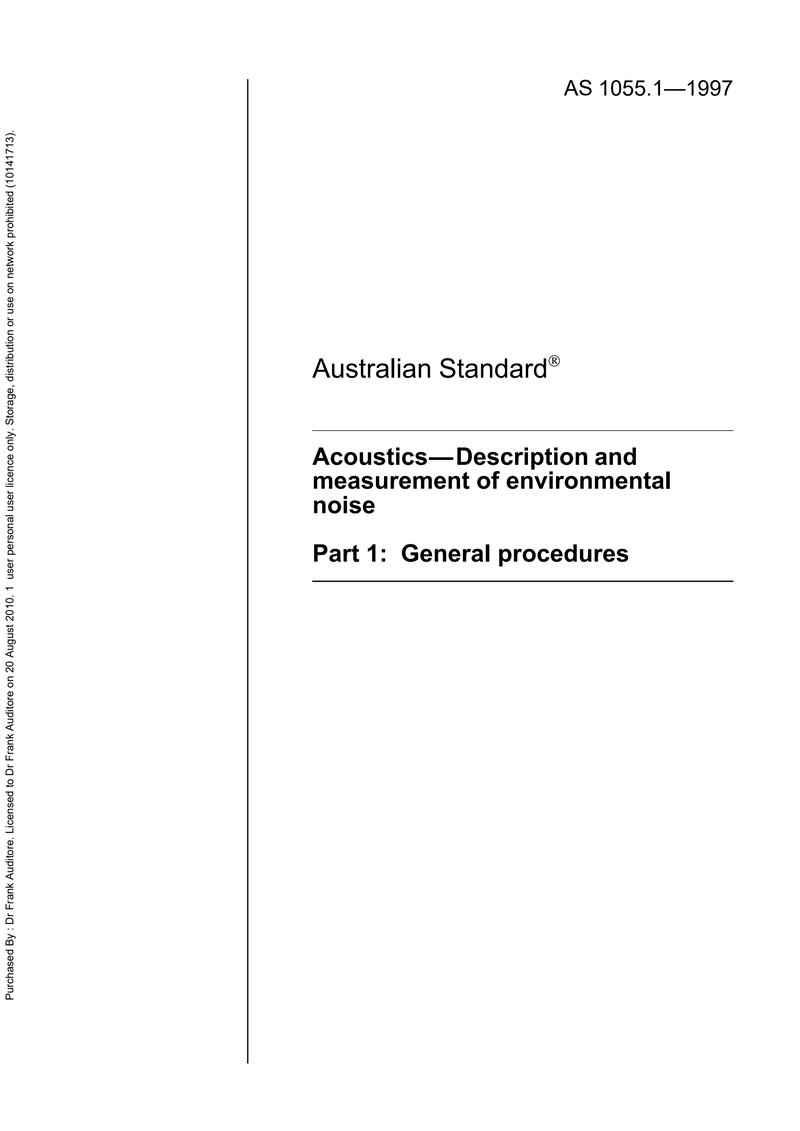
AS 1055.1—1997
Australian Standard®
Acoustics—Description and measurement of environmental noise
Part 1: General procedures
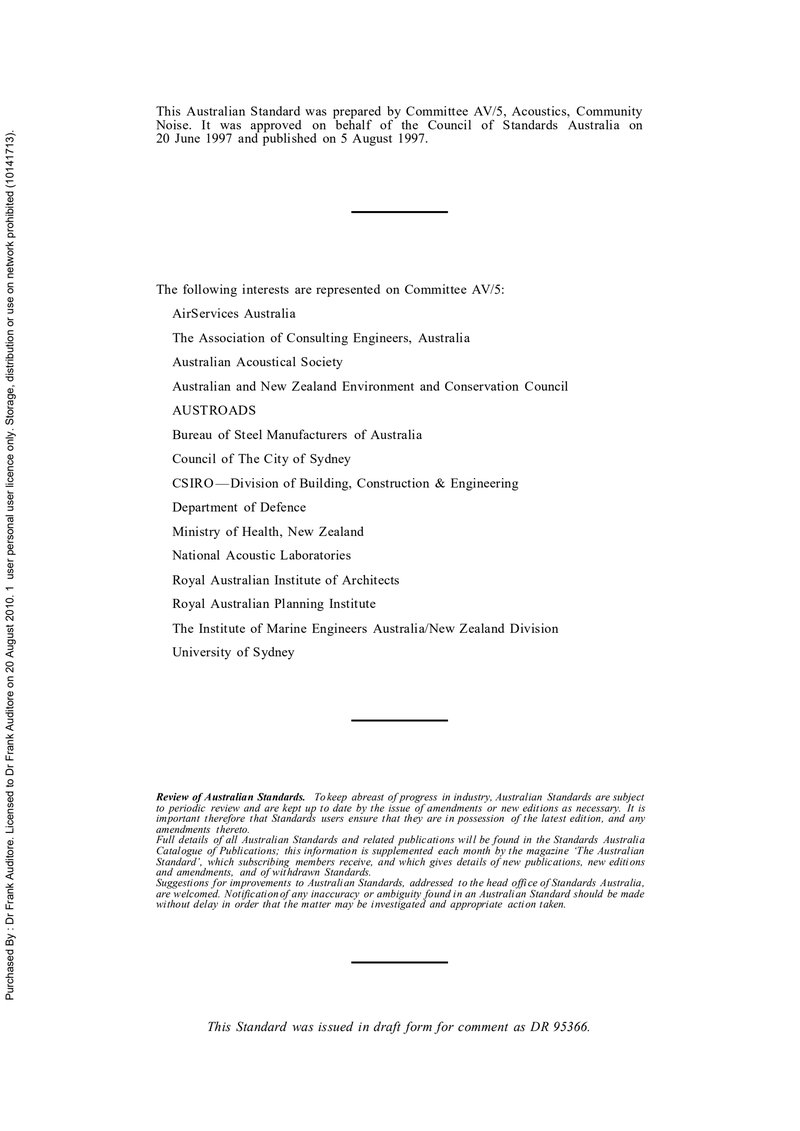
This Australian Standard was prepared by Committee AV/5, Acoustics, Community Noise. It was approved on behalf of the Council of Standards Australia on 20 June 1997 and published on 5 August 1997.
The following interests are represented on Committee AV/5:
- AirServices Australia
- The Association of Consulting Engineers, Australia
- Australian Acoustical Society
- Australian and New Zealand Environment and Conservation Council
- AUSTROADS
- Bureau of Steel Manufacturers of Australia
- Council of The City of Sydney
- CSIRO—Division of Building, Construction & Engineering
- Department of Defence
- Ministry of Health, New Zealand
- National Acoustic Laboratories
- Royal Australian Institute of Architects
- Royal Australian Planning Institute
- The Institute of Marine Engineers Australia/New Zealand Division
- University of Sydney
Review of Australian Standards. To keep abreast of progress in industry, Australian Standards are subject to periodic review and are kept up to date by the issue of amendments or new editions as necessary. It is important therefore that Standards users ensure that they are in possession of the latest edition, and any amendments thereto.
Full details of all Australian Standards and related publications will be found in the Standards Australia Catalogue of Publications; this information is supplemented each month by the magazine 'The Australian Standard', which subscribing members receive, and which gives details of new publications, new editions and amendments, and of withdrawn Standards.
Suggestions for improvements to Australian Standards, addressed to the head office of Standards Australia, are welcomed. Notification of any inaccuracy or ambiguity found in an Australian Standard should be made without delay in order that the matter may be investigated and appropriate action taken.
This Standard was issued in draft form for comment as DR 95366.
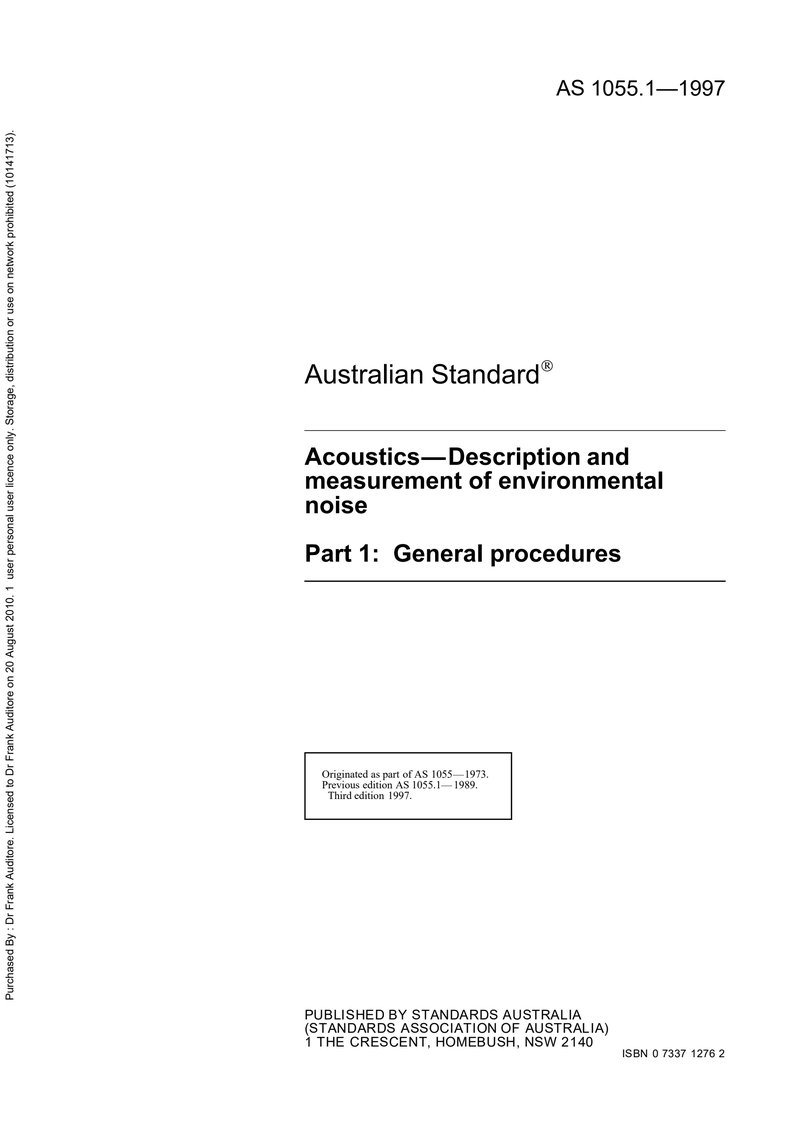
AS 1055.1—1997
Australian Standard®

Acoustics—Description and measurement of environmental noise
Part 1: General procedures

Originated as part of AS 1055—1973.
Previous edition AS 1055.1—1989.
Third edition 1997.
PUBLISHED BY STANDARDS AUSTRALIA
(STANDARDS ASSOCIATION OF AUSTRALIA)
1 THE CRESCENT, HOMEBUSH, NSW 2140
ISBN 0 7337 1276 2
AS 1055.1 — 1997
2
PREFACE
This Standard was prepared by the Joint Standards Australia/Standards New Zealand Committee AV/5 on Acoustics, Community Noise, to supersede AS 1055.1—1989, Acoustics—Description and measurement of environmental noise, Part 1: General procedures. This Standard is based on ISO 1996-1:1982, Acoustic—Description and measurement of environmental noise—Part 1: Basic quantities and procedures. This Standard is a result of a consensus among representatives on the Joint Committee to produce it as an Australian Standard. New Zealand has proceeded with a separate review of its environmental noise Standard NZS 6802:1991.
It is Part 1 in a series of Standards on the measurement and assessment of environmental noise. The objective of this Part is to serve as a general guide for the evaluation of environmental noise in order to meet the needs of public bodies and persons interested in its control. It applies primarily to noise emitted from industrial, commercial and residential premises, and is intended for use in the evaluation of existing problems, as well as for planning purposes. It may be used for noises which include impulsive components, but it is not suitable for noise which consists solely of discrete impulses, e.g. shooting, blasting.
The objective of this revision is to reflect the rapid technological advances in acoustical measurement techniques. Although a sound level meter set on A-weighting and ‘F’ response may be used to make a quick assessment of a possible community noise problem, more sophisticated instrumentation is now readily available and should be used for the purposes of the AS 1055 series. A choice may be made between the time average A-weighted sound pressure level or other descriptor(s) such as the percent exceedance A-weighted sound pressure level as the basic quantity, or other quantities as specified by the relevant regulatory authority.
This Standard is not a regulatory document and users should ascertain, from the relevant regulatory authority, details of specific requirements laid down in each State or Territory.
Extensive research concerning the way in which human beings are affected by noise from a single kind of source such as rail or road vehicles, aircraft or industrial plants, has led to a variety of descriptors for assessment of different kinds of noise, many of which are in common use. Conversion from one descriptor to another is often beset with significant uncertainty.
If an acoustical environment were always dominated by a single kind of noise, the confusion caused by the existence of different descriptors would not be so serious. But often environmental noise is a composite of sounds from many sources, and the distribution of the different kinds of noise is likely to change from moment to moment. The methods and procedures described in this Standard are intended to be applicable to sounds from all sources, individually and in combination, which contribute to the total noise at a site. For certain types of sources more detailed procedures may be used, e.g. reference is made to AS 1269, Acoustics—Hearing conservation, for situations where the noise may cause hearing impairment. Specific measurements for road traffic, aircraft and ship noise are dealt with in AS 2702 Acoustics—Methods for the measurement of road traffic noise, AS 2021 Acoustics—Aircraft noise intrusion—Building siting and construction and AS 1949 Acoustics—Measurement of airborne noise emitted by vessels in waterways, ports and harbours respectively.
This Standard aims at providing authorities with material for the description of noise in community environments. Based on the principles described in this Standard, acceptable limits of noise can be specified and compliance with these limits can be controlled.
It has been assumed that the user of this Standard is adequately trained in the science of acoustics and thoroughly experienced in noise measurement and assessment, but to familiarize the user with some of the special terms introduced in this Standard, an example of its application is included (see Appendix A). For further information see also AS 2659 Guide to the use of sound measuring equipment, Parts 1 and 2.
The term ‘informative’ has been used in this Standard to define the application of the appendix to which it applies. An ‘informative’ appendix is only for information and guidance.
© Copyright — STANDARDS AUSTRALIA
Users of Standards are reminded that copyright subsists in all Standards Australia publications and software. Except where the Copyright Act allows and except where provided for below no publications or software produced by Standards Australia may be reproduced, stored in a retrieval system in any form or transmitted by any means without prior permission in writing from Standards Australia. Permission may be conditional on an appropriate royalty payment. Requests for permission and information on commercial software royalties should be directed to the head office of Standards Australia.
Standards Australia will permit up to 10 percent of the technical content pages of a Standard to be copied for use exclusively in-house by purchasers of the Standard without payment of a royalty or advice to Standards Australia.
Standards Australia will also permit the inclusion of its copyright material in computer software programs for no royalty payment provided such programs are used exclusively in-house by the creators of the programs.
Care should be taken to ensure that material used is from the current edition of the Standard and that it is updated whenever the Standard is amended or revised. The number and date of the Standard should therefore be clearly identified.
The use of material in print form or in computer software programs to be used commercially, with or without payment, or in commercial contracts is subject to the payment of a royalty. This policy may be varied by Standards Australia at any time.
3
预览内容由文件识别整理,表格、公式及文字请以原始文件为准。
原文图片预览
PAGE IMAGES
下载标准文件
AS 1055.1-1997 Acoustics - Description and measure
英语 · PDF · 6 页 · 228.16 KB