iso8528-8
往复内燃机驱动的交流发电机组 — 第8部分:低功率发电机组的要求和试验
iso8528-8
Reciprocating internal combustion engine driven alternating current generating sets — Part 8: Requirements and tests for low-power generating sets
标准信息
STANDARD INFORMATION- 标准编号
- iso8528-8
- 所属分类
- ISO 国际标准
- 发布机构
- ISO
- 版本年份
- 1995
- 文件语言
- 英语
- 文件格式
- 文件页数
- 6 页
- 文件大小
- 864.79 KB
中文名称为参考译名,文件语言以原文为准。
· 更新:
标准简介
OVERVIEW中文简介
该标准规定了用于陆地和海洋应用(家用、娱乐和工业)的低功率往复内燃机驱动交流发电机组的要求、最低性能和型式试验。适用范围包括单相或多相交流或直流电压不超过500V的发电机组,功率通常不超过10kW,且不包括用于航空器的发电机组。
English summary
This standard defines requirements, minimum performances, and type tests for low-power generating sets driven by reciprocating internal combustion engines for land and marine use. It applies to standard manufactured sets generating single or multiphase alternating current or direct current up to 500 V, typically with a power magnitude up to approximately 10 kW, excluding those used on aircraft.
以上为根据文件整理的内容简介。
相关标签
标准内容预览
DOCUMENT PREVIEWISO 8528-8:1995(E)
|
ISO 8528-1:1993, Reciprocating internal combustion engine driven alternating current generating sets — Part 1: Application, ratings and performance. ISO 8528-2:1993, Reciprocating internal combustion engine driven alternating current generating sets — Part 2: Engines. ISO 8528-3:1993, Reciprocating internal combustion engine driven alternating current generating sets — Part 3: Alternating current generators for generating sets. ISO 8528-4:1993, Reciprocating internal combustion engine driven alternating current generating sets — Part 4: Controlgear and switchgear. ISO 8528-5:1993, Reciprocating internal combustion engine driven alternating current generating sets — Part 5: Generating sets. ISO 8528-6:1993, Reciprocating internal combustion engine driven alternating current generating sets — Part 6: Test methods. ISO 7000:1989, Graphical symbols for use on equipment — Index and synopsis. IEC 34-1:1994, Rotating electrical machines — Part 1: Rating and performance. IEC 34-5:1991, Rotating electrical machines — Part 5: Classification of degrees of protection provided by enclosures for rotating electrical machines. IEC 68-2-63:1991, Environmental testing — Part 2: Tests — Test Eg.: Impact, spring hammer. IEC 83:1975, Plugs and socket-outlets for domestic and similar general use — Standards. IEC 245-4:1980, Rubber insulated cables of rated voltages up to and including 450/750 V — Part 4: Cords and flexible cables. IEC 309-1:1988, Plugs, socket-outlets and couplers for industrial purposes — Part 1: General requirements. IEC 309-2:1989, Plugs, socket-outlets and couplers for industrial purposes — Part 2: Dimensional interchangeability requirements for pin and contact-tube accessories. IEC 335-1:1991, Safety of household and similar electrical appliances — Part 1: General requirements. |
IEC 364-4-41:1992, Electrical installations of buildings — Part 4: Protection for safety — Chapter 41: Protection against electric shock. IEC 417:1973, Graphic symbols for use on equipment — Index, survey and compilation of the single sheets. IEC 529:1989, Degrees of protection provided by enclosures (IP Code). CISPR 12:1990, Limits and methods of measurement of radio interference characteristics of vehicles, motor boats, and spark ignited engine-driven devices. CISPR 14:1993, Limits and methods of measurement of radio disturbance characteristics of electrical motor-operated and thermal appliances for household and similar purposes, electric tools and electric apparatus. 3 DefinitionsFor the purposes of this part of ISO 8528 the following definitions and those of ISO 8528-1 shall apply. 3.1 layman: A person who does not necessarily recognize potential danger resulting from electricity, moving parts or hot parts (see also clause 6). The layman has a lack of training, knowledge and experience, and has insufficient knowledge of the relevant regulations. 3.2 close proximity: The 30 mm space immediately around the operating and adjusting controls and carrying handles, including their whole movement range. 3.3 power rating: The electric power available at the outlets or sockets of the generator, expressed in kilowatts (kW) at the rated frequency and the rated power factor. 3.4 rated power: The prime power according to ISO 8528-1:1993, 13.3.2 as assigned by the generating set manufacturer. NOTE 2 Due to the variable power sequence for this kind of low-power generating set the average permissible power is 90 % of the rated power. 3.5 thermal steady-state condition: State reached when the temperature rise of the generator does not vary by more than 2 K over a period of 1 h. For electrical parts see IEC 34-1:1994, 2.11; for RIC engines see ISO 3046-3, 4.2. NOTE 3 Under normal test conditions the RIC engine has first reached a steady-state condition before a set of |
6
Révision de la présente publication
Le contenu technique des publications de la CEI est constamment revu par la Commission afin d'assurer qu'il reflète bien l'état actuel de la technique.
Les renseignements relatifs à ce travail de révision, à l'établissement des éditions révisées et aux mises à jour peuvent être obtenus auprès des Comités nationaux de la CEI et en consultant les documents ci-dessous :
- Bulletin de la CEI
- Annuaire de la CEI
- Catalogue des publications de la CEI
Publié annuellement
Terminologie
En ce qui concerne la terminologie générale, le lecteur se reportera à la Publication 50 de la CEI : Vocabulaire Electrotechnique International (VEI), qui est établie sous forme de chapitres séparés traitant chacun d'un sujet défini, l'Index général étant publié séparément. Des détails complets sur le VEI peuvent être obtenus sur demande.
Les termes et définitions figurant dans la présente publication ont été soit repris du VEI, soit spécifiquement approuvés aux fins de cette publication.
Symboles graphiques et littéraux
Pour les symboles graphiques, symboles littéraux et signes d'usage général approuvés par la CEI, le lecteur consultera :
- la Publication 27 de la CEI : Symboles littéraux à utiliser en électrotechnique ;
- la Publication 617 de la CEI : Symboles graphiques pour schémas.
Les symboles et signes contenus dans la présente publication ont été soit repris des Publications 27 ou 617 de la CEI, soit spécifiquement approuvés aux fins de cette publication.
Publications de la CEI établies par le même Comité d'Etudes
L'attention du lecteur est attirée sur la page 3 de la couverture, qui énumère les publications de la CEI préparées par le Comité d'Etudes qui a établi la présente publication.
Revision of this publication
The technical content of IEC publications is kept under constant review by the IEC, thus ensuring that the content reflects current technology.
Information on the work of revision, the issue of revised editions and amendment sheets may be obtained from IEC National Committees and from the following IEC sources :
- IEC Bulletin
- IEC Yearbook
- Catalogue of IEC Publications
Published yearly
Terminology
For general terminology, readers are referred to IEC Publication 50 : International Electrotechnical Vocabulary (IEV), which is issued in the form of separate chapters each dealing with a specific field, the General Index being published as a separate booklet. Full details of the IEV will be supplied on request.
The terms and definitions contained in the present publication have either been taken from the IEV or have been specifically approved for the purpose of this publication.
Graphical and letter symbols
For graphical symbols, and letter symbols and signs approved by the IEC for general use, readers are referred to :
- IEC Publication 27 : Letter symbols to be used in electrical technology ;
- IEC Publication 617 : Graphical symbols for diagrams.
The symbols and signs contained in the present publication have either been taken from IEC Publications 27 or 617, or have been specifically approved for the purpose of this publication.
IEC publications prepared by the same Technical Committee
The attention of readers is drawn to the inside of the back cover, which lists IEC publications issued by the Technical Committee which has prepared the present publication.
2
NORME INTERNATIONALE INTERNATIONAL STANDARD МЕЖДУНАРОДНЫЙ СТАНДАРТ
|
NORME INTERNATIONALE INTERNATIONAL STANDARD МЕЖДУНАРОДНЫЙ СТАНДАРТ |
CEI IEC 50(426) Première édition First edition 1990-10 Vocabulaire Electrotechnique InternationalChapitre 426 : Matériel électrique pour atmosphères explosives International Electrotechnical VocabularyChapter 426 : Electrical apparatus for explosive atmospheres Международный Электротехнический СловарьГлава 426 : Электрооборудование для взрывоопасных сред © CEI 1990 Droits de reproduction réservés - Copyright - all rights reserved - Право издания охраняется законом Aucune partie de cette publication ne peut être reproduite ni utilisée sous quelque forme que ce soit et par aucun procédé, électronique ou mécanique, y compris la photocopie et les microfilms, sans l'accord écrit de l'éditeur. No part of this publication may be reproduced or utilized in any form or by any means, electronic or mechanical, including photocopying and microfilm, without permission in writing from the publisher. Запрещается Без письменного разрешения издателя воспроизведение или копирование этой публикации или ее части в любой форме или любыми средствами — электронными или механическими, включая фотоконю и микрофильм. Bureau central de la Commission Electrotechnique Internationale 3, rue de Varembé Genève Suisse
|
50(715) © IEC:1996
CONTENTS
| FOREWORD | VII | |
| PREFACE | VII | |
| Sections | ||
| 715-01 | Basic terms | 1 |
| 715-02 | Resources | 10 |
| 715-03 | Calls | 17 |
| 715-04 | Times and delays | 22 |
| 715-05 | Traffic | 24 |
| 715-06 | Circuit groups | 32 |
| 715-07 | Traffic engineering | 34 |
| 715-08 | Networks | 41 |
| 715-09 | Circuit switched networks | 46 |
| 715-10 | Message switched networks | 51 |
| 715-11 | Packet switched networks | 52 |
| Index | 53 |
:current
Foreword
This document (EN 10216-3:2002) has been prepared by Technical Committee EC/TC 29, "Steel tubes and fittings for steel tubes", the secretariat of which is held by UNI.
This European Standard shall be given the status of a national standard, either by publication of an identical text or by endorsement, at the latest by November 2002, and conflicting national standards shall be withdrawn at the latest by November 2002.
This document has been prepared under a mandate given to CEN by the European Commission and the European Free Trade Association, and supports essential requirements of EU Directive(s).
For relationship with EU Directive(s), see informative annex ZA, which is an integral part of this document.
Other Parts of EN 10216 are:
| Part 1: | Non-alloy steel tubes with specified room temperature properties |
| Part 2: | Non-alloy and alloy steel tubes with specified elevated temperature properties |
| Part 4: | Non-alloy and alloy steel tubes with specified low temperature properties |
| Part 5: | Stainless steel tubes |
Another European Standard series covering tubes for pressure purposes is:
| EN 10217: | Welded steel tubes for pressure purposes |
According to the CEN/CENELEC Internal Regulations, the national standards organizations of the following countries are bound to implement this European Standard: Austria, Belgium, Czech Republic, Denmark, Finland, France, Germany, Greece, Iceland, Ireland, Italy, Luxembourg, Malta, Netherlands, Norway, Portugal, Spain, Sweden, Switzerland and the United Kingdom.
5
ISO 657-1 : 1988 (E)
Table 1 — Dimensions and sectional properties of hot-rolled equal-leg angles (concluded)
| Designation | Mass kg/m | Sectional area cm² | Dimensions | Distances of centre of gravity | Sectional properties about axes | |||||||||||
|---|---|---|---|---|---|---|---|---|---|---|---|---|---|---|---|---|
| X-X = Y-Y | U-U | V-V | ||||||||||||||
| A mm | l mm | rroot mm | cx = cy cm | cu cm | cv cm | Ix = Iy cm⁴ | rx = ry cm | Zx = Zy cm³ | Iu cm⁴ | ru cm | Iv cm⁴ | rv cm | Zv cm³ | |||
| (1) | (2) | (3) | (4) | (5) | (6) | (7) | (8) | (9) | (10) | (11) | (12) | (13) | (14) | (15) | (16) | (17) |
| 200 × 200 × 16 | 48,5 | 61,8 | 200 | 16 | 18 | 5,52 | 14,1 | 7,81 | 2 340 | 6,16 | 162 | 3 720 | 7,76 | 960 | 3,94 | 123 |
| 200 × 200 × 20 | 59,9 | 76,3 | 200 | 20 | 18 | 5,68 | 14,1 | 8,04 | 2 850 | 6,11 | 199 | 4 530 | 7,70 | 1 170 | 3,92 | 146 |
| 200 × 200 × 24 | 71,1 | 90,6 | 200 | 24 | 18 | 5,84 | 14,1 | 8,26 | 3 330 | 6,06 | 235 | 5 280 | 7,64 | 1 380 | 3,90 | 167 |
| 250 × 250 × 28 | 104 | 133 | 250 | 28 | 18 | 7,24 | 17,7 | 10,2 | 7 700 | 7,62 | 433 | 12 200 | 9,61 | 3 170 | 4,89 | 309 |
| 250 × 250 × 35 | 128 | 163 | 250 | 35 | 18 | 7,50 | 17,7 | 10,6 | 9 260 | 7,54 | 529 | 14 700 | 9,48 | 3 860 | 4,87 | 364 |
NOTES
- Member countries may choose, to be included in their national standards, the sizes which are required to meet their demand.
- For the angles so chosen, only thicknesses which can be rolled in their mills to meet the demand of the users may be selected from the list of thicknesses corresponding to equal angles in table 1.
- The sectional area has been calculated using the formula
S = [l/2 A - l) + 0,214 6 (rroot² - 2rtoe²)] × 1/100
where
S is the sectional area, in square centimetres;
l is the thickness, in millimetres;
rroot is the root radius, in millimetres;
rtoe is the toe radius, in millimetres;
A is the leg length, in millimetres.
- Mass is calculated on the basis of density of steel of 7,85 kg/dm³.
4
预览内容由文件识别整理,表格、公式及文字请以原始文件为准。
原文图片预览
PAGE IMAGES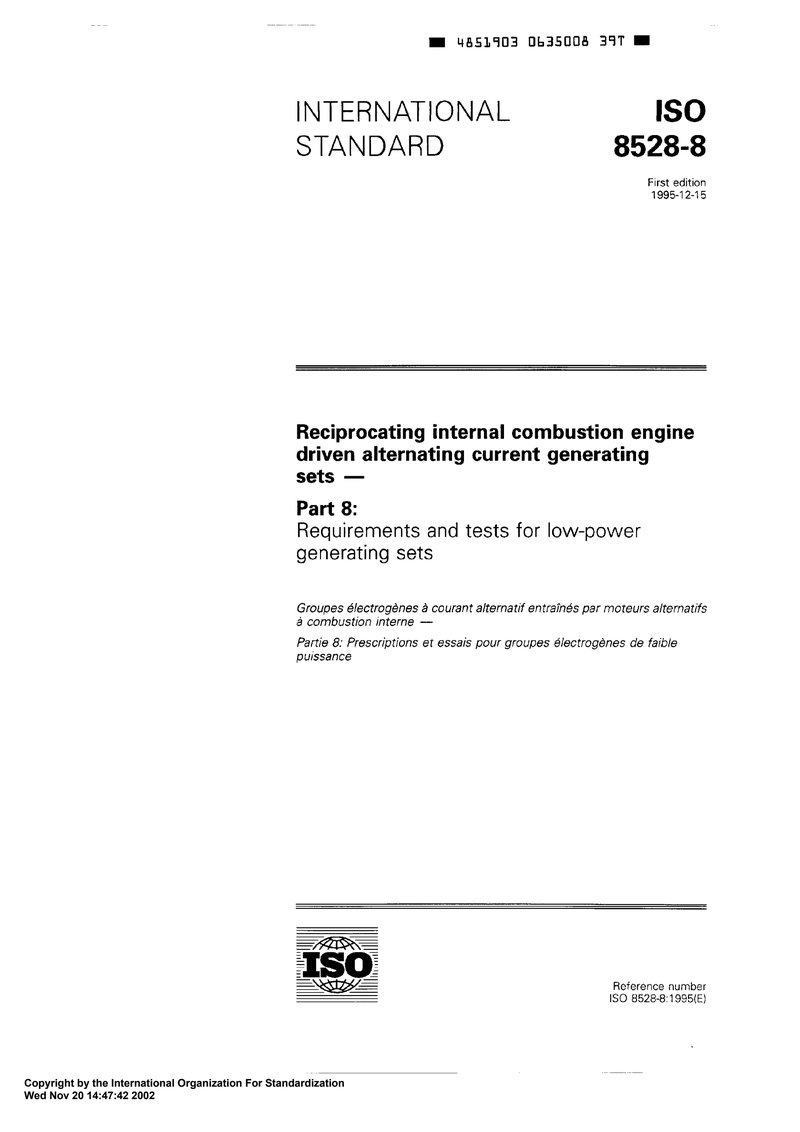
下载标准文件
iso8528-8
英语 · PDF · 6 页 · 864.79 KB