Earthing Systems – Fundamentals of Calculation and
接地与电磁兼容 - 接地系统计算与设计基础
Earthing Systems – Fundamentals of Calculation and Design
Earthing Systems - Fundamentals of Calculation and Design
标准信息
STANDARD INFORMATION- 标准编号
- Earthing Systems – Fundamentals of Calculation and
- 所属分类
- 其他国外标准与工程资料
- 发布机构
- Copper Development Association
- 版本年份
- 2003
- 文件语言
- 英语
- 文件格式
- 文件页数
- 6 页
- 文件大小
- 322.41 KB
中文名称为参考译名,文件语言以原文为准。
· 更新:
标准简介
OVERVIEW中文简介
该文档是Leonardo电力质量倡议(LPQI)的一部分,由Copper Development Association发布。它详细阐述了接地系统在建筑安装中的设计原则,重点包括接地电极的计算、土壤电阻率的特性及其对接地电阻的影响。内容涵盖了防雷保护、人身安全(接触电压和跨步电压)、电磁兼容性(EMC)以及电网正常运行所需的接地要求。
English summary
This document, part of the Leonardo Power Quality Initiative (LPQI) and published by the Copper Development Association, outlines the fundamental principles for calculating and designing earthing systems in building installations. It focuses on the design of ground electrodes, the electrical properties of the ground (specifically earth resistivity), and their impact on earthing resistance. The guide addresses requirements for lightning protection, human safety (limiting touch and step voltages), electromagnetic compatibility (EMC), and the correct operation of electricity supply networks.
以上为根据文件整理的内容简介。
相关标签
标准内容预览
DOCUMENT PREVIEWEarthing Systems - Fundamentals of Calculation and Design
dependence of the soil humidity on the earth resistivity. For Europe, this dependence has an approximate sine form, where the maximum value of earthing resistance occurs in February and the minimum value in August. The average value occurs in May and November. The amplitude in February is approximately 30% larger than average, while in August it is about 30% smaller than the average [4].
It must be remembered that the effect of freezing is similar to that of drying – the resistivity increases significantly.
For these reasons the calculations of earth resistance and the planning of electrodes can be performed up to a limited level of accuracy.
Electrical properties of the earthing system
The electrical properties of earthing depend essentially on two parameters:
- earthing resistance
- configuration of the earth electrode.
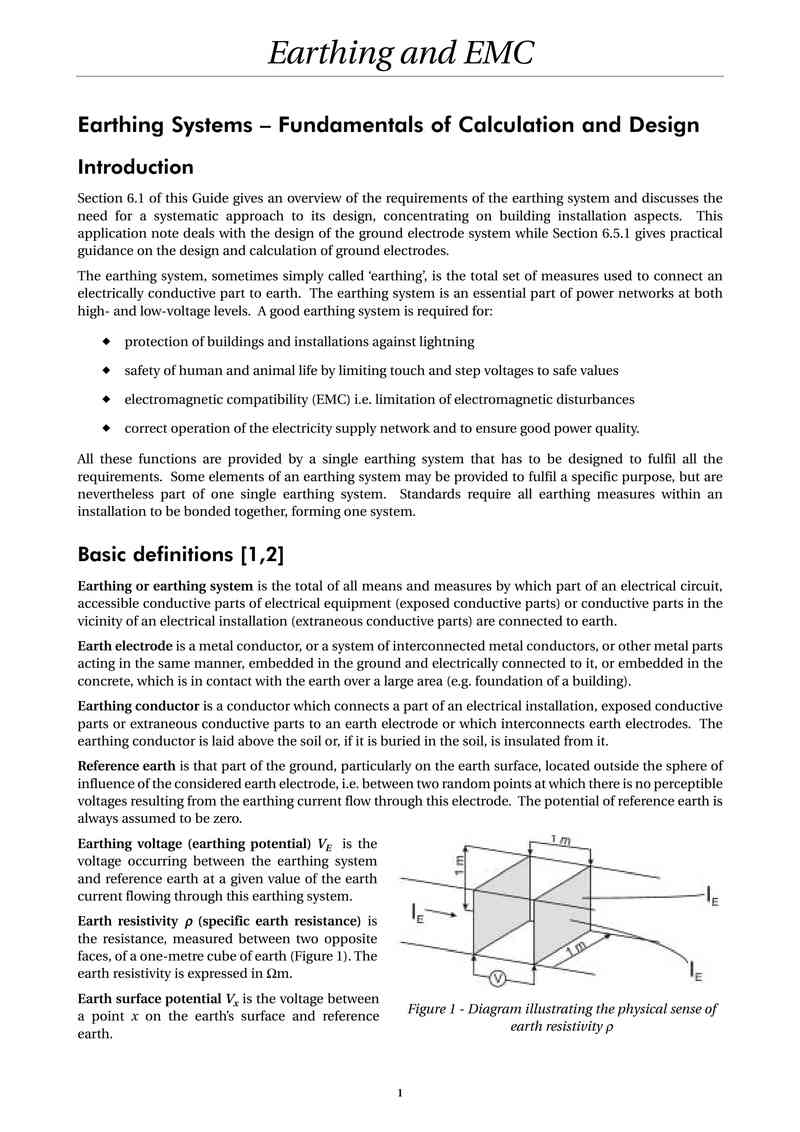
Earthing resistance determines the relation between earth voltage VE and the earth current value. The configuration of the earth electrode determines the potential distribution on the earth surface, which occurs as a result of current flow in the earth. The potential distribution on the earth surface is an important consideration in assessing the degree of protection against electric shock because it determines the touch and step potentials. These questions are discussed briefly below.
The earthing resistance has two components:
- dissipation resistance RD, which is the resistance of the earth between the earth electrode and the reference earth
- resistance RL of the metal parts of the earth electrode and of the earthing conductor.
The resistance RL is usually much smaller than the dissipation resistance RD. Thus, usually the earthing resistance is estimated to be equal to the dissipation resistance RD. In the literature, ‘earthing resistance’ usually refers to the dissipation resistance.
Any earth connection made available by the supplier appears in parallel with the locally provided earth and may well be expected to have a lower impedance at fundamental and harmonic frequencies. However, the availability and characteristics of this path are beyond the designer’s control and hence should not be considered in the design of the earthing system which should be adequate for the required purpose in its own right.
Earthing resistance and potential distribution
In AC circuits one must consider essentially the impedance of an earthing ZE, which is the impedance between the earthing system and the reference earth at a given operating frequency. The reactance of the earthing system is the reactance of the earthing conductor and of metal parts of the earth electrode. At low frequencies - the supply frequency and associated harmonics - reactance is usually negligible in comparison to earthing resistance, but must be taken into account for high frequencies such as lightning transients. Thus, for low frequencies, it is assumed that the earthing impedance ZE is equal the dissipation resistance RD, which is in turn assumed to be approximately equal to the earthing resistance, R:
ZE ≈ RD ≈ R (1)
The earthing resistance R of an earth electrode depends on the earth resistivity ρ as well as the electrode geometry. In order to achieve low values of R the current density flowing from the electrode metal to earth should be low, i.e. the volume of earth through which the current flows is as large as possible. Once the current flows from metal to earth it spreads out, reducing current density. If the electrode is physically small, e.g. a point, this effect is large, but is very much reduced for a plate where spreading is only effective at the edges. This means that rod, pipe, or wire electrodes have a much lower dissipation resistance than,
6
2 Scope
2
EUROPEAN STANDARD
NORME EUROPÉENNE
EUROPÄISCHE NORM
EN 10216-3
May 2002
ICS 23.040.10; 77.140.75
English version
Seamless steel tubes for pressure purposes –
Technical delivery conditions
Part 3: Alloy fine grain steel tubes
Tubes sans soudure en acier pour service sous pression – Conditions techniques de livraison – Partie 3: Tubes en acier allié à grain fin
Nahtlose Stahlrohre für Druckbeanspruchungen – Technische Lieferbedingungen – Teil 3: Rohre aus legierten Feinkornbaustählen
This European Standard was approved by CEN on 2002-04-25.
CEN members are bound to comply with the CEN/CENELEC Internal Regulations which stipulate the conditions for giving this European Standard the status of a national standard without any alteration.
Up-to-date lists and bibliographical references concerning such national standards may be obtained on application to the Management Centre or to any CEN member.
The European Standards exist in three official versions (English, French, German). A version in any other language made by translation under the responsibility of a CEN member into its own language and notified to the Management Centre has the same status as the official versions.
CEN members are the national standards bodies of Austria, Belgium, the Czech Republic, Denmark, Finland, France, Germany, Greece, Iceland, Ireland, Italy, Luxembourg, Malta, the Netherlands, Norway, Portugal, Spain, Sweden, Switzerland, and the United Kingdom.
CEN
European Committee for Standardization
Comité Européen de Normalisation
Europäisches Komitee für Normung
Management Centre: rue de Stassart 36, B-1050 Brussels
© 2002. CEN – All rights of exploitation in any form and by any means reserved worldwide for CEN national members.
Ref. No. EN 10216-3 : 2002 E
Contents
| Section | Page |
|---|---|
| Foreword | 3 |
| Introduction | 4 |
| 1 Scope | 4 |
| 2 Normative references | 5 |
| 3 Definitions | 5 |
| 3.1 DN | 5 |
| 3.2 PN | 5 |
| 4 Designations | 6 |
| 4.1 Range of PN designations | 6 |
| 4.2 Range of DN (nominal sizes) | 6 |
| 4.3 Gasket types | 6 |
| 4.4 Information to be supplied by the purchaser | 6 |
| 5 Gasket designs | 6 |
| 6 Gasket types | 7 |
| 7 Dimensions | 7 |
| 8 Marking | 10 |
| Annex A (informative) Information to be supplied by the purchaser | 10 |
| Annex B (informative) A-deviation | 11 |
:current
Foreword
This document (EN 10216-3:2002) has been prepared by Technical Committee EC/TC 29, "Steel tubes and fittings for steel tubes", the secretariat of which is held by UNI.
This European Standard shall be given the status of a national standard, either by publication of an identical text or by endorsement, at the latest by November 2002, and conflicting national standards shall be withdrawn at the latest by November 2002.
This document has been prepared under a mandate given to CEN by the European Commission and the European Free Trade Association, and supports essential requirements of EU Directive(s).
For relationship with EU Directive(s), see informative annex ZA, which is an integral part of this document.
Other Parts of EN 10216 are:
| Part 1: | Non-alloy steel tubes with specified room temperature properties |
| Part 2: | Non-alloy and alloy steel tubes with specified elevated temperature properties |
| Part 4: | Non-alloy and alloy steel tubes with specified low temperature properties |
| Part 5: | Stainless steel tubes |
Another European Standard series covering tubes for pressure purposes is:
| EN 10217: | Welded steel tubes for pressure purposes |
According to the CEN/CENELEC Internal Regulations, the national standards organizations of the following countries are bound to implement this European Standard: Austria, Belgium, Czech Republic, Denmark, Finland, France, Germany, Greece, Iceland, Ireland, Italy, Luxembourg, Malta, Netherlands, Norway, Portugal, Spain, Sweden, Switzerland and the United Kingdom.
5
1 Scope
This Part of EN 10216 specifies the technical delivery conditions in two test categories for seamless tubes of circular cross section, made of weldable alloyed fine grained steel.
2 Normative references
This European Standard incorporates by date or undated reference, provisions from other publications. These normative references are cited at the appropriate places in the text and the publications are listed hereafter. For date references, subsequent amendments to or revisions of, any of these publications apply to this European Standard only when incorporated in it by amendment or revision. For undated references the latest edition of the publication referred to applies (including amendments).
The requirements of this European Standard rule when they differ from those in the standards and documents referred to below:
EN 10002-1, Metallic materials - Tensile testing - Part 1: Method of test (at ambient temperature).
EN 10002-5, Metallic materials - Tensile testing - Part 5: Method of testing (at elevated temperature).
EN 10020, Definitions and classification of grades of steel.
EN 10021, General technical delivery requirements for steel and iron products.
EN 10045-1, Metallic materials - Charpy impact test - Part 1: Test method.
EN 10052, Vocabulary of heat treatment terms for ferrous products.
EN 10204, Metallic products - Types of inspection documents.
EN 10027-1, Designation systems for steels - Part 1: Steel names, principle symbols.
EN 10027-2, Designation systems for steels Part 2: Numerical systems.
ENV 10220, Seamless and welded steel tubes - Dimensions and masses per unit length
EN 10233, Metallic materials - Tubes - Flattening test.
EN 10234, Metallic materials - Tubes - Drift expanding test.
EN 10236, Metallic materials - Tubes - Ring expanding test.
EN 10237, Metallic materials - Tubes - Ring tensile test.
EN 10246-1, Non-Destructive Testing of steel tubes Part 1: Automatic electromagnetic testing of seamless and welded (except submerged arc welded) ferromagnetic steel tubes for verification of hydraulic leak-tightness.
EN 10246-5, Non-Destructive Testing of steel tubes - Part 5: Automatic full peripheral magnetic transducer/flux leakage testing of seamless and welded (except submerged arc-welded) ferromagnetic steel tubes for the detection of longitudinal imperfections.
EN 10246-6, Non-Destructive Testing of steel tubes - Part 6: Automatic full peripheral ultrasonic testing of seamless steel tubes for the detection of transverse imperfections.
EN 10246-7, Non-Destructive Testing of steel tubes - Part 7: Automatic full peripheral ultrasonic testing of seamless and welded (except submerged arc welded) steel tubes for the detection of longitudinal imperfections.
6
预览内容由文件识别整理,表格、公式及文字请以原始文件为准。
原文图片预览
PAGE IMAGES


下载标准文件
Earthing Systems – Fundamentals of Calculation and
英语 · PDF · 6 页 · 322.41 KB