DIN EN 10028-2
压力容器用钢扁平制品 第2部分:具有规定高温特性的非合金钢和合金钢
DIN EN 10028-2
Flat products made from steel for pressure purposes - Part 2: Non-alloy and alloy steels with specified elevated temperature properties
标准信息
STANDARD INFORMATION- 标准编号
- DIN EN 10028-2
- 所属分类
- DIN 德国标准
- 发布机构
- CEN
- 版本年份
- 1992
- 文件语言
- 英语
- 文件格式
- 文件页数
- 6 页
- 文件大小
- 389.51 KB
中文名称为参考译名,文件语言以原文为准。
· 更新:
标准简介
OVERVIEW中文简介
该标准规定了用于压力容器制造的具有规定高温特性的非合金钢和合金钢扁平制品的要求。它涵盖了钢的牌号分类、化学成分、机械性能、交货状态、测试方法及标记等具体技术条件。
English summary
This standard specifies requirements for flat products made from weldable unalloyed and alloy steels with elevated temperature properties, intended for the construction of pressure vessels. It covers steel grades, chemical composition, mechanical properties, delivery conditions, testing methods, and marking.
以上为根据文件整理的内容简介。
相关标签
标准内容预览
DOCUMENT PREVIEWFlat products made from steel for pressure purposes
Unalloyed and alloy steels with elevated temperature properties
English version of DIN EN 10 028 Part 2
Flacherzeugnisse aus Druckbehälterstählen; unlegierte und legierte warmfeste Stähle
This standard, together with DIN EN 10 028 Part 1, supersedes DIN 17 155, October 1983 edition.
European Standard EN 10 028-2:1992 has the status of a DIN Standard.
A comma is used as the decimal marker.
National foreword
This standard has been prepared by ECISS/TC 22.
The responsible German body involved in its preparation was the Normenausschuß Eisen und Stahl (Steel and Iron Standards Committee), Technical Committee Stähle für den Druckbehälterbau.
This standard is based in large part on the June 1989 draft of DIN 17 155 Part 2 (cf. Amendments), and incorporates general requirements that will also be specified in EN 10 028-4 (currently in preparation).
Continued on pages 2 and 3.
EN comprises 10 pages.
1
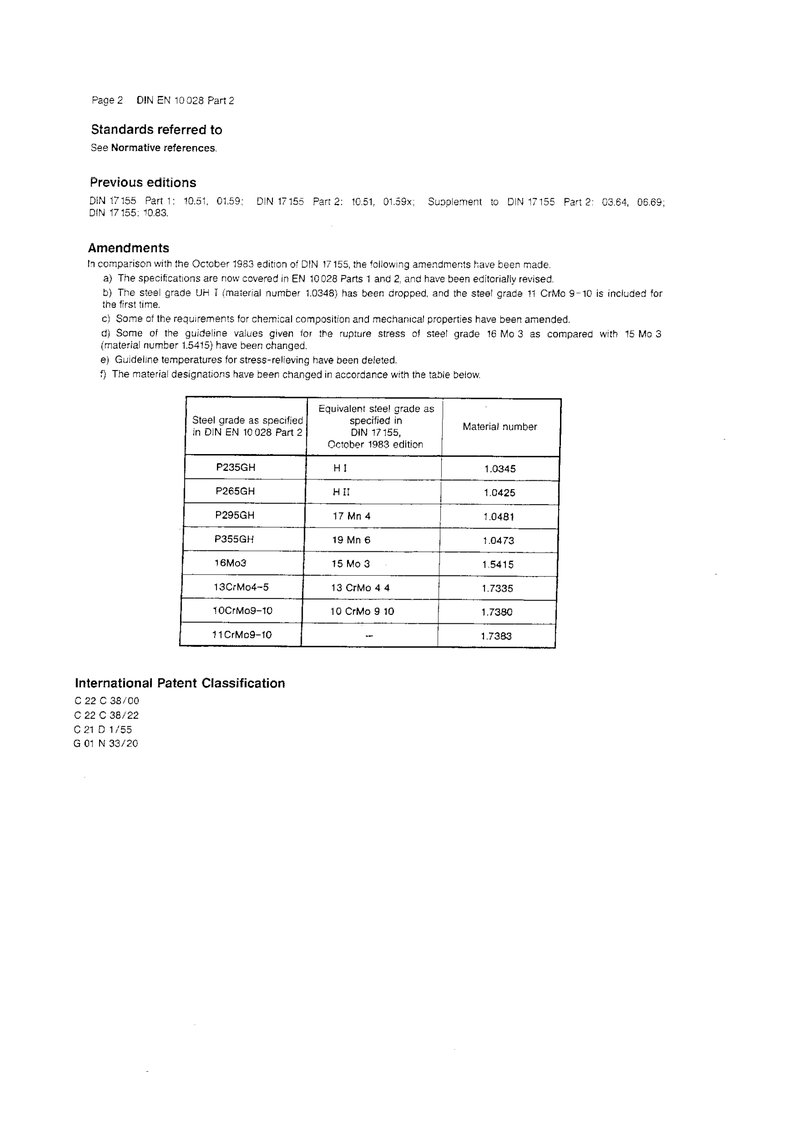
Standards referred to
See Normative references.
Previous editions
DIN 17155 Part 1: 10.51, 01.59; DIN 17155 Part 2: 10.51, 01.59x; Supplement to DIN 17155 Part 2: 03.64, 06.69; DIN 17155: 10.83.
Amendments
In comparison with the October 1983 edition of DIN 17155, the following amendments have been made.
a) The specifications are now covered in EN 10028 Parts 1 and 2, and have been editorially revised.
b) The steel grade UH I (material number 1.0348) has been dropped, and the steel grade 11 CrMo 9-10 is included for the first time.
c) Some of the requirements for chemical composition and mechanical properties have been amended.
d) Some of the guideline values given for the rupture stress of steel grade 16 Mo 3 as compared with 15 Mo 3 (material number 1.5415) have been changed.
e) Guideline temperatures for stress-relieving have been deleted.
f) The material designations have been changed in accordance with the table below.
| Steel grade as specified in DIN EN 10028 Part 2 | Equivalent steel grade as specified in DIN 17155, October 1983 edition | Material number |
|---|---|---|
| P235GH | H I | 1.0345 |
| P265GH | H II | 1.0425 |
| P295GH | 17 Mn 4 | 1.0481 |
| P355GH | 19 Mn 6 | 1.0473 |
| 16Mo3 | 15 Mo 3 | 1.5415 |
| 13CrMo4-5 | 13 CrMo 4 4 | 1.7335 |
| 10CrMo9-10 | 10 CrMo 9 10 | 1.7380 |
| 11CrMo9-10 | -- | 1.7383 |
International Patent Classification
C 22 C 38/00
C 22 C 38/22
C 21 D 1/55
G 01 N 33/20
2
Editor's note
This Standard reproduces the official text of the English version of EN 10028-2 as issued by CEN. In its preparation for publication as DIN EN 10028 Part 2 (English version), certain points have been noted which we consider to be in need of correction. These have been marked "•". The suggested amendments are given below and will be forwarded to the responsible CEN Secretariat for its consideration.
In presentation, orthography, punctuation and hyphenation, the aim has been to implement the PNE Rules consistently. Obvious errors (e.g. redundancies and omissions) have been rectified without further reference.
Suggested amendments
- For the sake of consistency, the subtitle of the EN should be amended to read: 'Unalloyed and alloy steels with elevated temperature properties'.
- To avoid confusion, the term 'delivery condition' should be replaced by 'heat treatment condition' in subclause 8.2 and table 3.
- To facilitate comprehension, the Note to subclause 8.2.3 should be amended to read: 'In the case of samples treated as described above, the party responsible for further processing is still to provide proof that the properties of the finished product comply with the relevant requirements.'
- By way of correction, the title of subclause 9.3 should read: 'Scope of testing'.
- For the sake of clarity, footnote 3) to table 1 should be amended to read: 'Subject to agreement, a lower Cu content than that given and a maximum Ti content may be specified to enhance, for example, workability.'
- For the sake of clarity, the title of table 2 should be amended to read: 'Amounts by which the chemical composition as determined by product analysis may deviate from the limiting values specified for cast analysis (cf. table 1)'.
- In table 3, it should be noted that the wording of the last column does not reflect the German text, which translates the parenthetical phrase as 'V-notch test pieces', not 'quenched test pieces'.
- For ease of comprehension, footnote 2) to table 3 should be amended to read: 'Until the values of yield stress are harmonized among the various national codes of practice, it shall be permitted to determine the 0.2 % proof stress, Rp0.2, instead of ReH. In this case, the values specified for ReH shall be reduced by 10 N/mm².'
- For ease of comprehension, Note 1 to Annex A should be amended to read: 'The values given in table A.1 are for information only. However, where reference is made to them in the relevant standards or codes of practice, they shall be regarded as being binding for design purposes.'
- By way of correction, Note 2 to Annex A should be amended to read: 'The values given in table A.1 for 1 % creep stress and rupture stress do not mean that the steels can be used continuously at the temperatures specified. The governing factor is the total stress in service, particularly the oxidation conditions.' For the sake of consistency, the heading of column 4 of table A.1 should then read: 'Rupture stress'.
- To make the sense complete, footnote 2) to table A.1 should be amended to read: 'The values represent the stress required to produce a permanent elongation of 1 %, relative to the initial cross section of the test piece, after 10 000 or 100 000 h.'
- To make the sense complete, footnote 3) to table A.1 should be amended to read: 'The values represent the stress required to cause the test piece to fracture after 10 000, 100 000 or 200 000 h.'
- In the Note to Annex B, the term 'stress relief annealing' should be replaced by 'stress-relieving', which is the more common technical term.
- To reflect the German text, the term 'quenching' as used in table B.1 should be replaced by 'quenching and tempering' (which is the more common technical term in this context).
3
EN 10 028-2
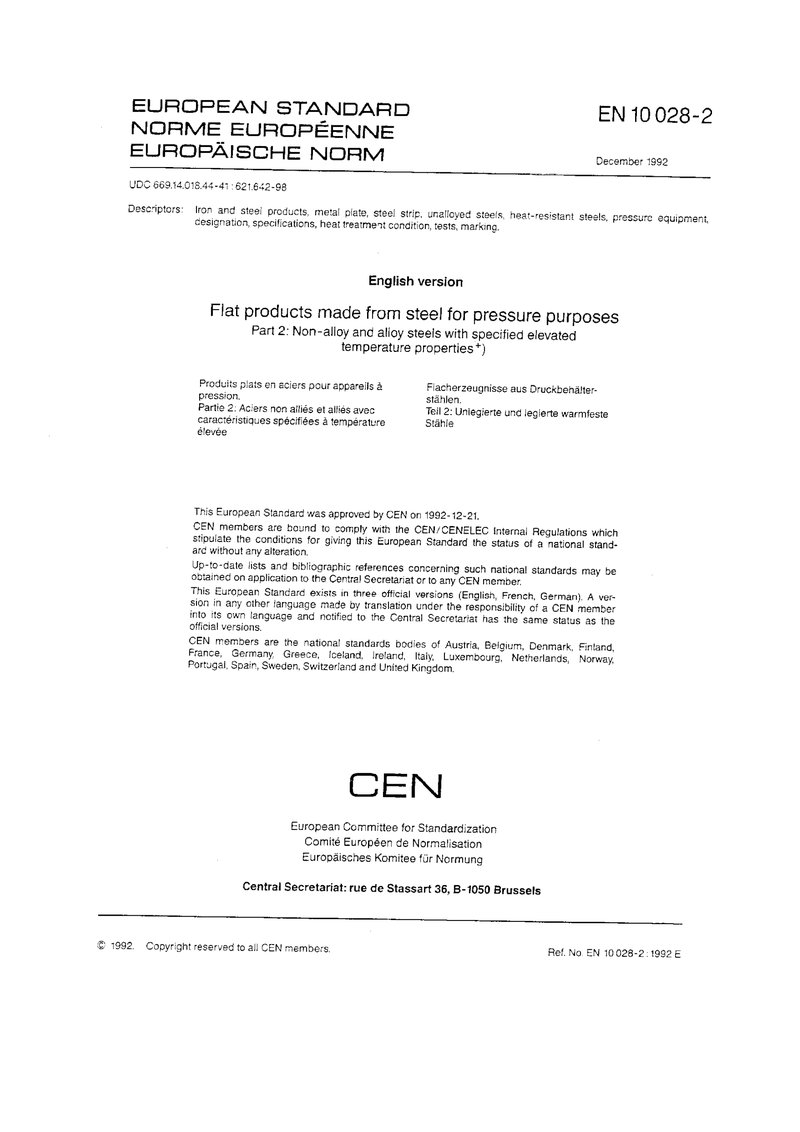
EUROPEAN STANDARD
NORME EUROPÉENNE
EUROPÄISCHE NORM
December 1992
UDC 669.14.018.44-41 : 621.642-98
Descriptors: Iron and steel products, metal plate, steel strip, unalloyed steels, heat-resistant steels, pressure equipment, designation, specifications, heat treatment condition, tests, marking.
English version
Flat products made from steel for pressure purposes
Part 2: Non-alloy and alloy steels with specified elevated temperature properties†)
| Produits plats en aciers pour appareils à pression. Partie 2: Aciers non alliés et alliés avec caractéristiques spécifiées à température élevée |
Flacherzeugnisse aus Druckbehälterstählen. Teil 2: Unlegierte und legierte warmfeste Stähle |
This European Standard was approved by CEN on 1992-12-21.
CEN members are bound to comply with the CEN/CENELEC Internal Regulations which stipulate the conditions for giving this European Standard the status of a national standard without any alteration.
Up-to-date lists and bibliographic references concerning such national standards may be obtained on application to the Central Secretariat or to any CEN member.
This European Standard exists in three official versions (English, French, German). A version in any other language made by translation under the responsibility of a CEN member into its own language and notified to the Central Secretariat has the same status as the official versions.
CEN members are the national standards bodies of Austria, Belgium, Denmark, Finland, France, Germany, Greece, Iceland, Ireland, Italy, Luxembourg, Netherlands, Norway, Portugal, Spain, Sweden, Switzerland and United Kingdom.
CEN
European Committee for Standardization
Comité Européen de Normalisation
Europäisches Komitee für Normung
Central Secretariat: rue de Stassart 36, B-1050 Brussels
© 1992. Copyright reserved to all CEN members.
Ref. No. EN 10 028-2 : 1992 E
4
Contents
|
Foreword 1 Scope 2 Normative references 3 Definitions 4 Dimensions and tolerances on dimensions 5 Calculation of mass 6 Designation and ordering 7 Classification into grades 8 Requirements 8.1 Steelmaking process 8.2 Delivery condition 8.3 Chemical composition 8.4 Mechanical properties 8.5 Surface condition 8.6 Internal soundness |
9 Testing 9.1 Type and content of inspection documents 9.2 Tests to be carried out 9.3 Number of tests 9.4 Sampling and sample preparation 9.5 Test procedure 9.6 Retests 10 Marking Annex A (informative) Preliminary guideline values for creep stress Annex B (informative) Guideline temperatures for heat treatment NOTE: The clauses marked contain information relating to agreements which may be made at the time of ordering. |
Foreword
This European Standard was prepared by ECISS/TC 22 'Steels for pressure purposes; qualities', the Secretariat of which is held by DIN.
Within the framework of the ECISS (European Committee for Iron and Steel Standardization) programme, ECISS/TC 22 was allocated the task of revising EURONORM 28-85 'Steel plate, sheet and strip with elevated temperature properties; technical delivery conditions' and (where relevant to pressure vessel construction) EURONORM 113-72 'Weldable fine grain structural steels' and replacing them with a European Standard.
At its meeting in November 1990, ECISS/TC 22 approved the present document. The following ECISS members were represented at the meeting: Austria, Finland, France, Germany, Italy, Norway, Sweden, United Kingdom.
This European Standard shall be given the status of a national standard, either by publication of an identical text or by endorsement, and conflicting national standards withdrawn, by June 1993 at the latest.
In accordance with the CEN/CENELEC Internal Regulations, the following countries are bound to implement this European Standard: Austria, Belgium, Denmark, Finland, France, Germany, Greece, Iceland, Ireland, Italy, Luxembourg, Netherlands, Norway, Portugal, Spain, Sweden, Switzerland and United Kingdom.
5
1 Scope
1.1 This Part of EN 10028 specifies requirements for flat products, used for the construction of pressure vessels, made from the weldable unalloyed and alloy steels with elevated temperature properties specified in table 1.
1.2 The requirements specified in EN 10028-1 shall also apply.
2 Normative references
This European Standard incorporates, by dated or undated reference, provisions from other publications. These normative references are cited at the appropriate places in the text and the publications are listed hereafter. For dated references, subsequent amendments to or revisions of any of these publications apply to this European Standard only when incorporated in it by amendment or revision. For undated references, the latest edition of the publication referred to applies.
EN 10020 Definition and classification of grades of steel
EN 10028-1 Flat products made from steels for pressure purposes. Part 1: General requirements
3 Definitions
See EN 10028-1.
4 Dimensions and tolerances on dimensions
See EN 10028-1.
5 Calculation of mass
See EN 10028-1.
6 Designation and ordering
See EN 10028-1.
7 Classification into grades
This EN covers the steel grades given in table 1. In accordance with EN 10020, grades P235GH, P265GH, P295GH and P355GH are unalloyed quality steels, and grades 16 Mo 3, 13 CrMo 4-5, 10 CrMo 9-10 and 11 CrMo 9-10 are alloy special steels.
8 Requirements
8.1 Steelmaking process
See EN 10028-1.
8.2 Delivery condition +)
8.2.1 Unless otherwise agreed at the time of ordering, the products covered by this EN shall be supplied in one of the usual conditions given in table 3.
8.2.2 Normalizing rolling may be carried out instead of normalizing for steel grades P235GH, P265GH, P295GH and P355GH. This means that the requirements are still to be met even after subsequent normalizing.
8.2.3 Subject to agreement, products made from steel grades P235GH, P265GH, P295GH, P355GH and 16 Mo 3 may also be supplied in the untreated condition, and products made from steel grades 13 CrMo 4-5, 10 CrMo 9-10 and 11 CrMo 9-10 may be supplied in the tempered or normalized condition or, in exceptional cases, in the untreated condition. (Guideline temperatures for heat treatment are given in Annex B.)
In these cases, the test pieces shall be tested in their as delivered condition as indicated in table 3.
NOTE: The testing of the test pieces in a simulated heat treated condition does not discharge the processor from the obligation of providing proof of the specified properties in the finished product. +)
8.3 Chemical composition
8.3.1 The chemical composition, as determined by cast analysis, shall be in compliance with table 1.
8.3.2 Where a product analysis is to be carried out, the results may deviate from the values given in table 1 by the amounts listed in table 2.
8.3.3 A maximum value for the carbon equivalent may be agreed upon at the time of ordering for steel grades P235GH, P265GH, P295GH and P355GH.
8.4 Mechanical properties
Tables 3 and 4 shall apply for the mechanical properties (cf. EN 10028-1).
Preliminary guideline values for creep stress are given in Annex A.
8.5 Surface condition
See EN 10028-1.
8.6 Internal soundness
See EN 10028-1.
9 Testing
See EN 10028-1.
9.1 Type and content of inspection documents
See EN 10028-1.
9.2 Tests to be carried out
See EN 10028-1.
9.3 Number of tests +)
See EN 10028-1.
9.4 Sampling and sample preparation
See EN 10028-1.
9.5 Test procedures
See EN 10028-1.
9.6 Retests
See EN 10028-1.
10 Marking
See EN 10028-1.
6
预览内容由文件识别整理,表格、公式及文字请以原始文件为准。
原文图片预览
PAGE IMAGES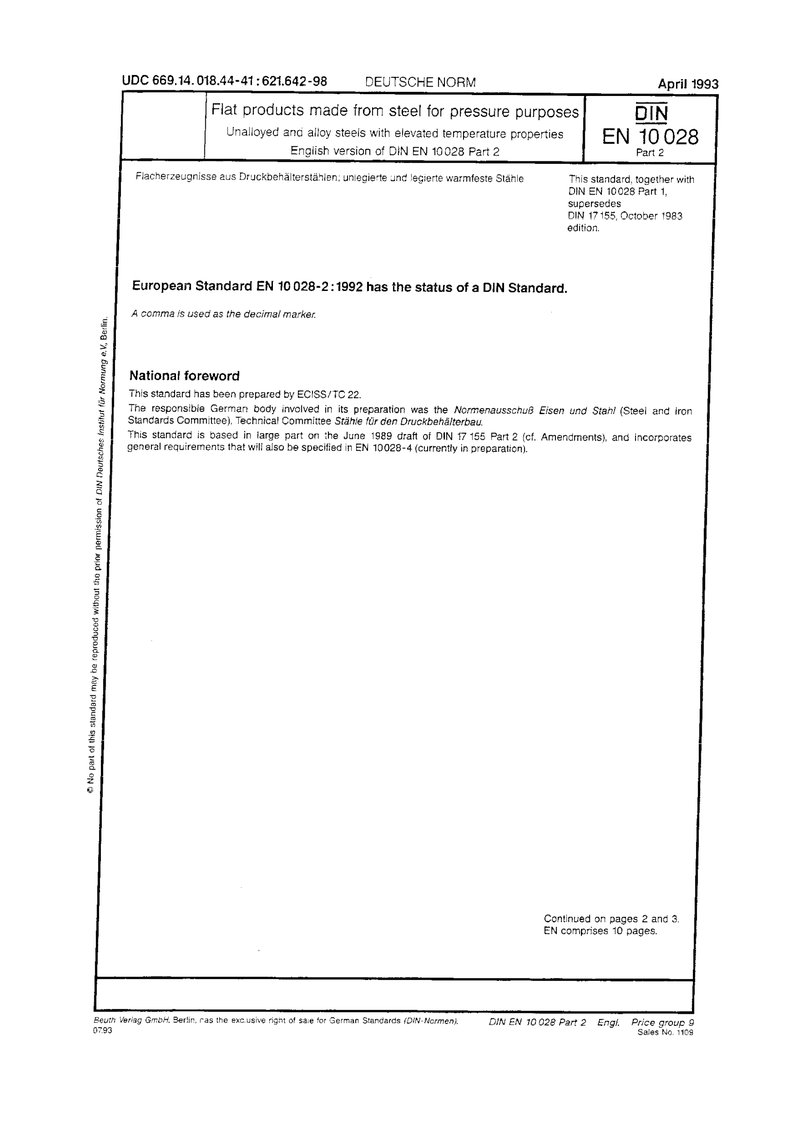

下载标准文件
DIN EN 10028-2
英语 · PDF · 6 页 · 389.51 KB