DIN 281
拼花地板用胶粘剂 - 要求、测试与应用
DIN 281
Adhesives for parquet flooring - Requirements, testing and application
标准信息
STANDARD INFORMATION- 标准编号
- DIN 281
- 所属分类
- DIN 德国标准
- 发布机构
- DIN
- 版本年份
- 1997
- 文件语言
- 英语
- 文件格式
- 文件页数
- 6 页
- 文件大小
- 2.27 MB
中文名称为参考译名,文件语言以原文为准。
· 更新:
标准简介
OVERVIEW中文简介
该标准规定了用于拼花地板的乳液型和溶剂型胶粘剂的要求、测试方法及施工程序。它详细描述了胶粘剂的物理性能指标(如剪切强度、耐碱性、气味等)及相应的测试规程,并提供了具体的施工指导,包括表面处理、涂布量和储存条件。
English summary
This standard specifies the requirements, test methods, and application procedures for emulsion and solvent-borne adhesives used in parquet flooring. It details physical property requirements such as shear strength, alkali resistance, and odour, along with specific testing protocols and practical application guidelines including surface preparation and storage conditions.
以上为根据文件整理的内容简介。
相关标签
标准内容预览
DOCUMENT PREVIEWAdhesives for parquet flooring
Requirements, testing and application
DIN 281
Parkeklebstoffe – Anforderungen, Prüfung, Verarbeitungshinweise
Supersedes
April 1991 edition.
A comma has been used throughout as the decimal marker.
Dimensions in mm
1 Scope and field of application
This standard specifies requirements, methods of test and application procedures for emulsion and solvent-borne adhesives to be used in parquet flooring.
2 Concepts
The adhesives covered by this standard are intended for parquet flooring and are designated by the letter P. Such adhesives are not fully cured until they are dry.
Emulsion adhesives, designated in this standard by the letter D, are formed by a dispersion of synthetic resin binders, or other suitable binders, in a liquid carrier (i.e. water) and contain additives. This standard applies only to emulsion adhesives with a water content not exceeding 40 %.
Solvent-borne adhesives, designated in this standard by the letter G, are formed by the dissolution of natural or synthetic resin binders in a suitable solvent carrier and contain additives.
3 Designation
Designation of an emulsion adhesive in accordance with this standard and intended for parquet flooring:
Adhesive DIN 281 – P – D
Continued on pages 2 to 6.
Translation by DIN-Sprachendienst.
In case of doubt, the German-language original should be consulted as the authoritative text.
No part of this translation may be reproduced without the prior permission of DIN Deutsches Institut für Normung e.V., Berlin. Beuth Verlag GmbH, D-10772 Berlin, has the exclusive right of sale for German Standards (DIN-Normen).
Ref. No. DIN 281 : 1994-03
English price group 04 Sales No. 0104
10.97
1
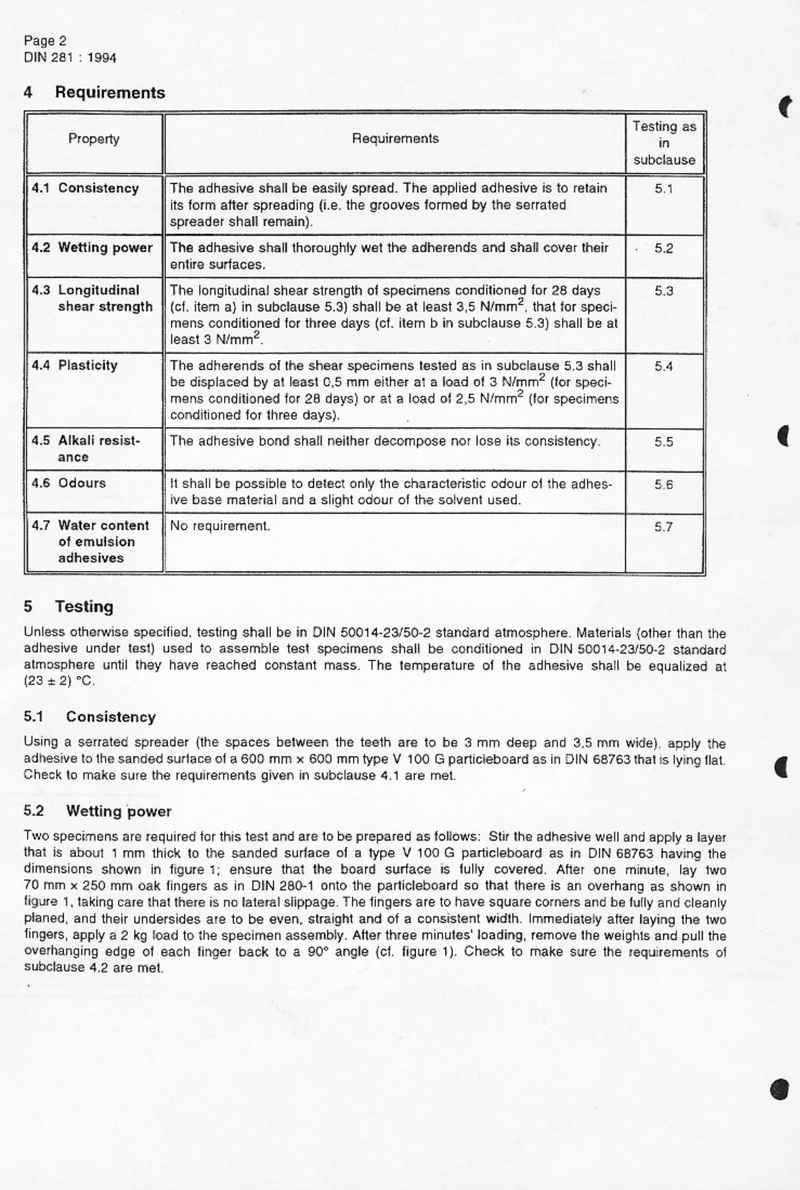
4 Requirements
| Property | Requirements | Testing as in subclause |
|---|---|---|
| 4.1 Consistency | The adhesive shall be easily spread. The applied adhesive is to retain its form after spreading (i.e. the grooves formed by the serrated spreader shall remain). | 5.1 |
| 4.2 Wetting power | The adhesive shall thoroughly wet the adherends and shall cover their entire surfaces. | 5.2 |
| 4.3 Longitudinal shear strength | The longitudinal shear strength of specimens conditioned for 28 days (cf. item a) in subclause 5.3) shall be at least 3,5 N/mm2, that for specimens conditioned for three days (cf. item b in subclause 5.3) shall be at least 3 N/mm2. | 5.3 |
| 4.4 Plasticity | The adherends of the shear specimens tested as in subclause 5.3 shall be displaced by at least 0,5 mm either at a load of 3 N/mm2 (for specimens conditioned for 28 days) or at a load of 2,5 N/mm2 (for specimens conditioned for three days). | 5.4 |
| 4.5 Alkali resistance | The adhesive bond shall neither decompose nor lose its consistency. | 5.5 |
| 4.6 Odours | It shall be possible to detect only the characteristic odour of the adhesive base material and a slight odour of the solvent used. | 5.6 |
| 4.7 Water content of emulsion adhesives | No requirement. | 5.7 |
5 Testing
Unless otherwise specified, testing shall be in DIN 50014-23/50-2 standard atmosphere. Materials (other than the adhesive under test) used to assemble test specimens shall be conditioned in DIN 50014-23/50-2 standard atmosphere until they have reached constant mass. The temperature of the adhesive shall be equalized at (23 ± 2) °C.
5.1 Consistency
Using a serrated spreader (the spaces between the teeth are to be 3 mm deep and 3.5 mm wide), apply the adhesive to the sanded surface of a 600 mm × 600 mm type V 100 G particleboard as in DIN 68763 that is lying flat. Check to make sure the requirements given in subclause 4.1 are met.
5.2 Wetting power
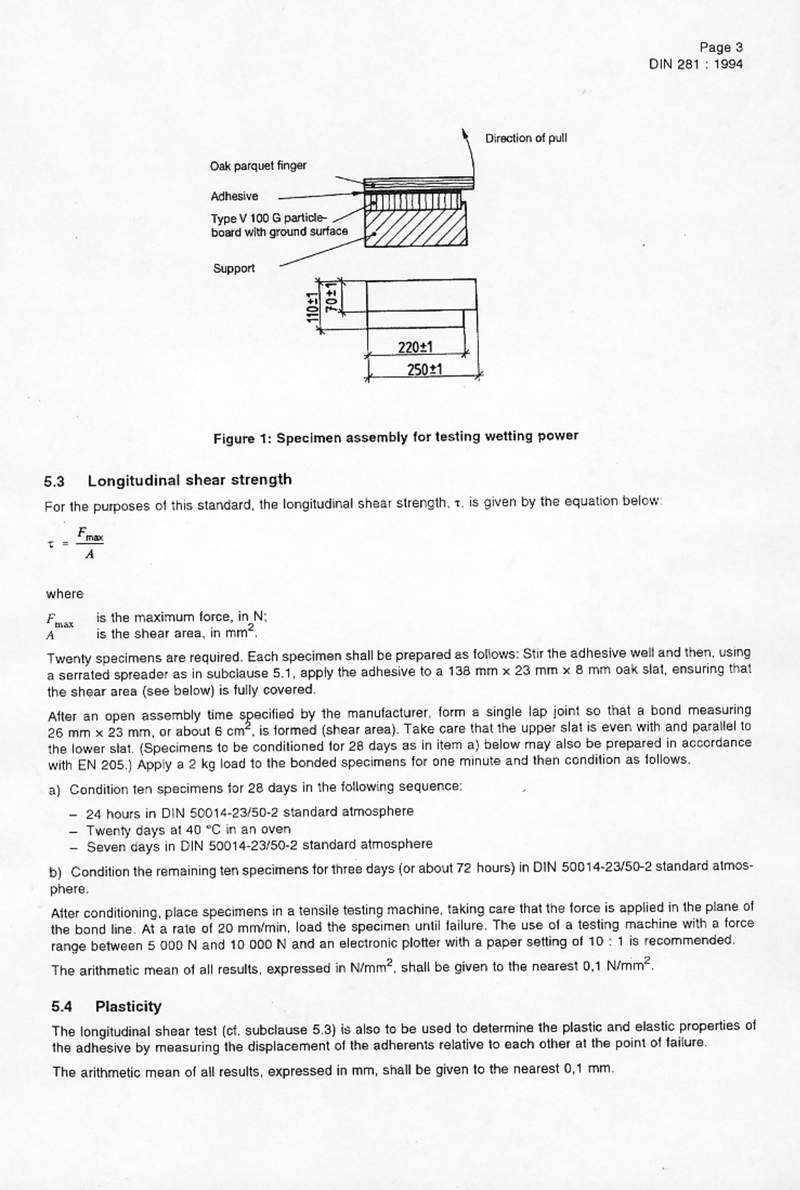
Two specimens are required for this test and are to be prepared as follows: Stir the adhesive well and apply a layer that is about 1 mm thick to the sanded surface of a type V 100 G particleboard as in DIN 68763 having the dimensions shown in figure 1; ensure that the board surface is fully covered. After one minute, lay two 70 mm × 250 mm oak fingers as in DIN 280-1 onto the particleboard so that there is an overhang as shown in figure 1, taking care that there is no lateral slippage. The fingers are to have square corners and be fully and cleanly planed, and their undersides are to be even, straight and of a consistent width. Immediately after laying the two fingers, apply a 2 kg load to the specimen assembly. After three minutes' loading, remove the weights and pull the overhanging edge of each finger back to a 90° angle (cf. figure 1). Check to make sure the requirements of subclause 4.2 are met.
2
5.3 Longitudinal shear strength
Figure 1: Specimen assembly for testing wetting power
For the purposes of this standard, the longitudinal shear strength, τ, is given by the equation below:
τ = Fmax / A
where
Fmax is the maximum force, in N;
A is the shear area, in mm2.
Twenty specimens are required. Each specimen shall be prepared as follows: Stir the adhesive well and then, using a serrated spreader as in subclause 5.1, apply the adhesive to a 138 mm × 23 mm × 8 mm oak slat, ensuring that the shear area (see below) is fully covered.
After an open assembly time specified by the manufacturer, form a single lap joint so that a bond measuring 26 mm × 23 mm, or about 6 cm2, is formed (shear area). Take care that the upper slat is even with and parallel to the lower slat. (Specimens to be conditioned for 28 days as in item a) below may also be prepared in accordance with EN 205.) Apply a 2 kg load to the bonded specimens for one minute and then condition as follows.
a) Condition ten specimens for 28 days in the following sequence:
- 24 hours in DIN 50014-23/50-2 standard atmosphere
- Twenty days at 40 °C in an oven
- Seven days in DIN 50014-23/50-2 standard atmosphere
b) Condition the remaining ten specimens for three days (or about 72 hours) in DIN 50014-23/50-2 standard atmosphere.
After conditioning, place specimens in a tensile testing machine, taking care that the force is applied in the plane of the bond line. At a rate of 20 mm/min, load the specimen until failure. The use of a testing machine with a force range between 5 000 N and 10 000 N and an electronic plotter with a paper setting of 10 : 1 is recommended.
The arithmetic mean of all results, expressed in N/mm2, shall be given to the nearest 0,1 N/mm2.
5.4 Plasticity
The longitudinal shear test (cf. subclause 5.3) is also to be used to determine the plastic and elastic properties of the adhesive by measuring the displacement of the adherents relative to each other at the point of failure.
The arithmetic mean of all results, expressed in mm, shall be given to the nearest 0,1 mm.
3
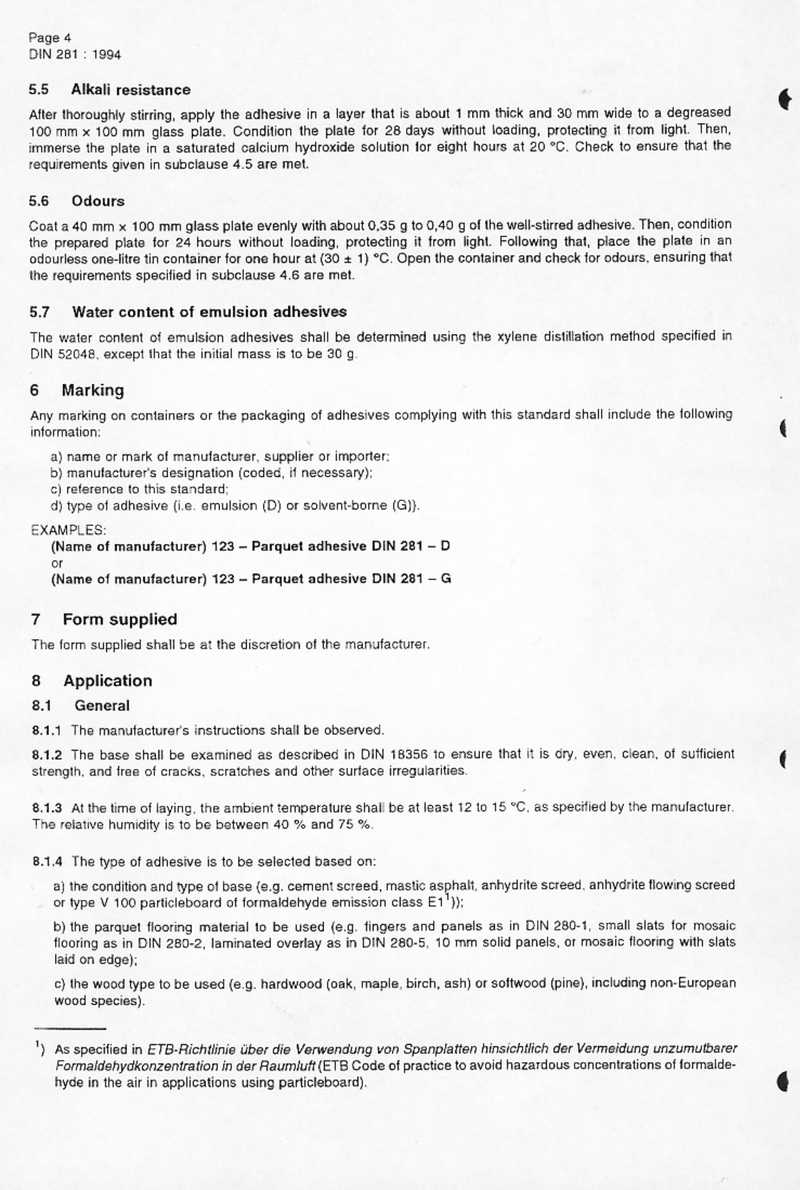
5.5 Alkali resistance
After thoroughly stirring, apply the adhesive in a layer that is about 1 mm thick and 30 mm wide to a degreased 100 mm x 100 mm glass plate. Condition the plate for 28 days without loading, protecting it from light. Then, immerse the plate in a saturated calcium hydroxide solution for eight hours at 20 °C. Check to ensure that the requirements given in subclause 4.5 are met.
5.6 Odours
Coat a 40 mm x 100 mm glass plate evenly with about 0,35 g to 0,40 g of the well-stirred adhesive. Then, condition the prepared plate for 24 hours without loading, protecting it from light. Following that, place the plate in an odourless one-litre tin container for one hour at (30 ± 1) °C. Open the container and check for odours, ensuring that the requirements specified in subclause 4.6 are met.
5.7 Water content of emulsion adhesives
The water content of emulsion adhesives shall be determined using the xylene distillation method specified in DIN 52048, except that the initial mass is to be 30 g.
6 Marking
Any marking on containers or the packaging of adhesives complying with this standard shall include the following information:
a) name or mark of manufacturer, supplier or importer;
b) manufacturer's designation (coded, if necessary);
c) reference to this standard;
d) type of adhesive (i.e. emulsion (D) or solvent-borne (G)).
EXAMPLES:
(Name of manufacturer) 123 – Parquet adhesive DIN 281 – D
or
(Name of manufacturer) 123 – Parquet adhesive DIN 281 – G
7 Form supplied
The form supplied shall be at the discretion of the manufacturer.
8 Application
8.1 General
8.1.1 The manufacturer's instructions shall be observed.
8.1.2 The base shall be examined as described in DIN 18356 to ensure that it is dry, even, clean, of sufficient strength, and free of cracks, scratches and other surface irregularities.
8.1.3 At the time of laying, the ambient temperature shall be at least 12 to 15 °C, as specified by the manufacturer. The relative humidity is to be between 40 % and 75 %.
8.1.4 The type of adhesive is to be selected based on:
a) the condition and type of base (e.g. cement screed, mastic asphalt, anhydrite screed, anhydrite flowing screed or type V 100 particleboard of formaldehyde emission class E11));
b) the parquet flooring material to be used (e.g. fingers and panels as in DIN 280-1, small slats for mosaic flooring as in DIN 280-2, laminated overlay as in DIN 280-5, 10 mm solid panels, or mosaic flooring with slats laid on edge);
c) the wood type to be used (e.g. hardwood (oak, maple, birch, ash) or softwood (pine), including non-European wood species).
1) As specified in ETB-Richtlinie über die Verwendung von Spanplatten hinsichtlich der Vermeidung unzumutbarer Formaldehydkonzentration in der Raumluft (ETB Code of practice to avoid hazardous concentrations of formaldehyde in the air in applications using particleboard).
4
8.1.5 Surface preparation
DIN 18356 lists several suitable methods of preparing the base surface, which may be necessary for some types of parquet flooring in order to ensure adequate adhesion. Preparation may involve keying (sanding or brushing followed by sweeping), levelling with a suitable material, or priming.
8.1.6 Underlays shall not be sanded until the adhesive has fully cured.
8.2 Application procedures for specific types of adhesive
8.2.1 Emulsion adhesives
Application time
About 10 to 15 minutes, depending on the adhesive used.
Spread
| Fingers and panels: | about 1 000 to 1 200 g/m2 |
| Slats: | about 800 to 1 000 g/m2 |
| Laminated overlay: | about 800 to 1 000 g/m2 |
| 10 mm solid panels: | about 800 to 1 000 g/m2 |
| Mosaic flooring with slats laid on edge: | about 1 000 g/m2 |
Spreader
The teeth of the spreader shall be spaced so that the required amount of adhesive is applied.
Primer
Extremely rough and absorbent cement screed is to be provided with a primer of diluted adhesive (one part adhesive to one part water). Priming is always required in the case of floor heating. The adhesive is not to be applied until at least 12 hours after priming. Deviations in this procedure may be required by the manufacturer.
Storage conditions
Adhesives shall be stored at room temperature wherever possible; they are to be protected from frost and kept dry.
NOTE: Emulsion adhesives are not flammable.
8.2.2 Solvent-borne adhesives
Application time
About 10 to 15 minutes, depending on the adhesive used.
Spread
| Fingers and panels: | at least 1 500 g/m2 |
| Slats: | about 800 to 1 000 g/m2 |
| Laminated overlay: | about 800 to 1 200 g/m2 |
| 10 mm solid panels: | about 1 000 to 1 200 g/m2 |
| Mosaic flooring with slats laid on edge: | at least 1 500 g/m2 |
Spreader
The teeth of the spreader shall be spaced so that the required amount of adhesive is applied.
Primer
Particleboard and extremely absorbent bases are to be primed with a diluted adhesive (one part adhesive to one part diluent).
Anhydrite screed and anhydrite flowing screed are to be primed with an adhesive diluted with two parts diluent to one part adhesive.
Priming is also required where there is floor heating.
When the primer is dry enough to be walked on, wait a further 30 minutes before applying the undiluted adhesive. Deviations in this procedure may be required by the manufacturer.
5
Storage conditions
Solvent-borne adhesives should be stored at room temperature and kept dry.
NOTE: Solvent-borne adhesives (as well as any diluents used) are highly flammable.
Standards referred to
| DIN 280-1 | Fingers and panels for parquet flooring |
| DIN 280-2 | Small slats for mosaic flooring |
| DIN 280-5 | Laminated overlay |
| DIN 18356 | Construction contract procedures (VOB) – Part C: General technical specifications in construction contracts (ATV) – Laying of parquet flooring |
| DIN 50014 | Artificial climates in technical applications – Standard atmospheres |
| DIN 52048 | Testing of bituminous binders – Determination of water content of bitumen emulsions by distillation |
| DIN 68763 | Structural particleboard – Concepts, requirements, testing and inspection |
| DIN EN 205 | Test methods for wood adhesives for non-structural applications – Determination of tensile shear strength of lap joints |
ETB-Richtlinie über die Verwendung von Spanplatten hinsichtlich der Vermeidung unzumutbarer Formaldehyd-konzentration in der Raumluft²)
Previous editions
DIN 281: 08.42, 09.64, 12.73, 04.91.
Amendments
The following amendments have been made to the April 1991 edition:
a) Reference to the use of adhesive for wood block flooring as in DIN 68701 and DIN 68702 has been deleted (cf. clause 8).
b) The text has been fully revised.
Explanatory notes
This standard has been prepared by Technical Committee Parket of the Normenausschuß Holzwirtschaft und Möbel (Timber and Furniture Standards Committee)
It should be noted that the cold-curing adhesives described in this standard are the only types of adhesive now used for parquet flooring; bitumen adhesives are no longer in use.
2) Obtainable from Beuth Verlag GmbH, Burggrafenstraße 6, D-10772 Berlin.
6
预览内容由文件识别整理,表格、公式及文字请以原始文件为准。
原文图片预览
PAGE IMAGES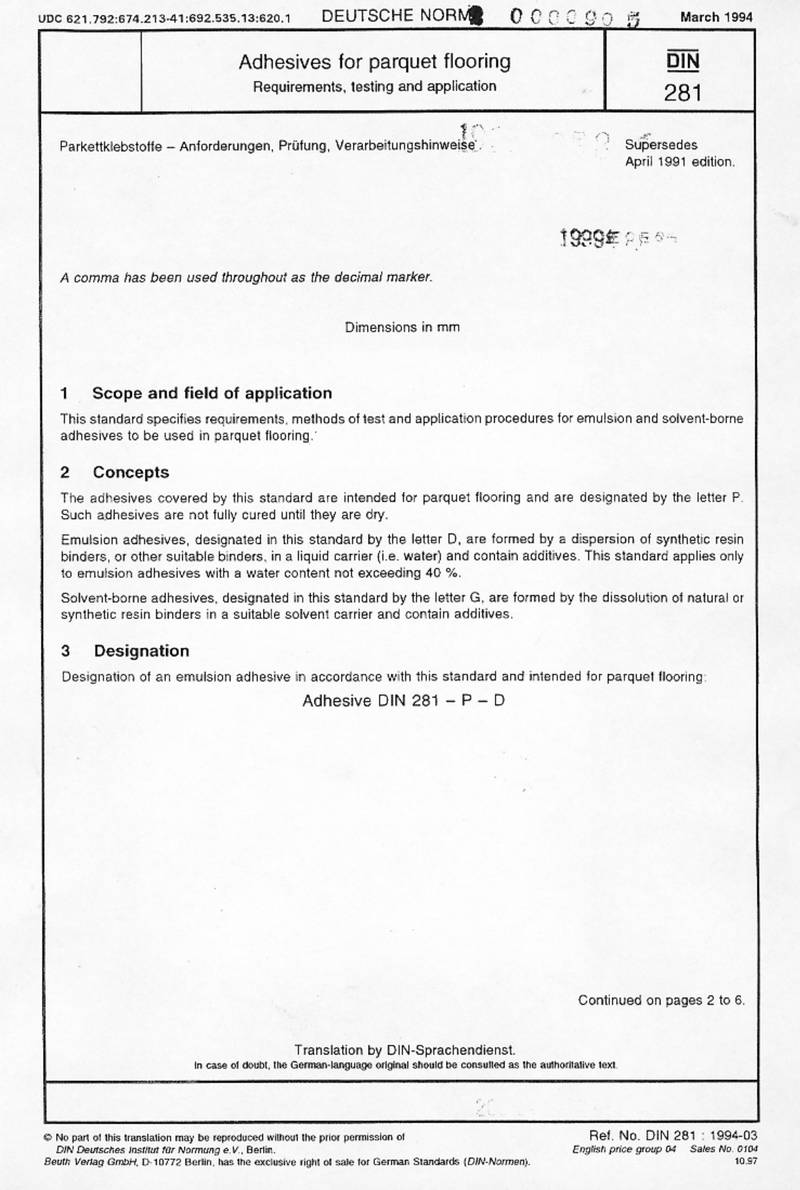
下载标准文件
DIN 281
英语 · PDF · 6 页 · 2.27 MB