
标准信息
STANDARD INFORMATION- 标准编号
- ACI 309R-96
- 所属分类
- ACI 美国混凝土学会标准
- 文件语言
- 英语
- 文件格式
- 文件页数
- 6 页
- 文件大小
- 1.2 MB
· 更新:
标准简介
OVERVIEW中文简介
标准 ACI 309R-96 的预览内容
English summary
Preview of standard ACI 309R-96
以上为根据文件整理的内容简介。
标准内容预览
DOCUMENT PREVIEWTable 5.1.5—Range of characteristics, performance, and applications of internal* vibrators
| Column | 1 | 2 | 3 | 4 | 5 | 6 | 7 | 8 | 9 |
|---|---|---|---|---|---|---|---|---|---|
| Suggested values of | Approximate values of | ||||||||
| Group | Diameter of head, in. (mm) | Recommended frequency, vibrations per min (Hz) | Eccentric amplitude, in. lb mm-kg (10-3) | Average amplitude, in. (mm) | Centrifugal force, lb (kg) | Radius of action, in. (mm) | Rate of concrete placement, yd | Application | |
| 1 | 3/4-1 1/2 (2-4) (20-40) | 9000-15,000 (150-200) | 0.03-0.10 (0.04-0.08) (3.5-12) | 0.015-0.03 (0.04-0.08) (0.4-0.8) | 100-400 (45-180) | 3-6 (8-15) | 1-5 (0.8-4) | Plastic and flowing concrete in very thin members and confined places. May be used to supplement larger vibrators, especially in prestressed work where cables and ducts cause congestion in forms. Also used for fabricating laboratory test specimens. | |
| 2 | 1 1/2-2 1/2 (3-6) (30-60) | 8500-12,500 (140-210) | 0.08-0.25 (0.09-0.29) (9-29) | 0.02-0.04 (0.05-0.10) (0.5-1.0) | 300-900 (140-400) | 5-10 (13-25) (130-250) | 3-10 (2.3-8) | Plastic concrete in thin walls, columns, beams, precast piles, thin slabs, and along construction joints. May be used to supplement larger vibrators in confined areas. | |
| 3 | 2-3 1/2 (5-9) (50-90) | 8000-12,000 (130-200) | 0.20-0.70 (0.23-0.81) (23- | ||||||
|
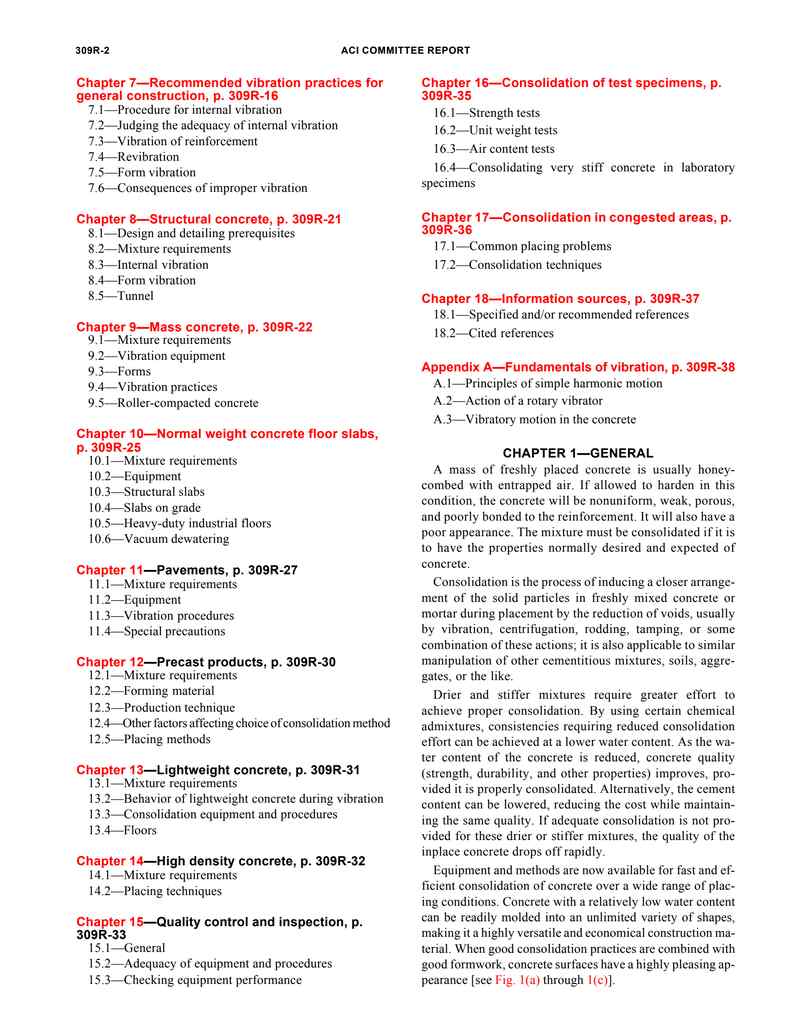
Chapter 7—Recommended vibration practices for general construction, p. 309R-16 7.1—Procedure for internal vibration 7.2—Judging the adequacy of internal vibration 7.3—Vibration of reinforcement 7.4—Revibration 7.5—Form vibration 7.6—Consequences of improper vibration Chapter 8—Structural concrete, p. 309R-21 8.1—Design and detailing prerequisites 8.2—Mixture requirements 8.3—Internal vibration 8.4—Form vibration 8.5—Tunnel Chapter 9—Mass concrete, p. 309R-22 9.1—Mixture requirements 9.2—Vibration equipment 9.3—Forms 9.4—Vibration practices 9.5—Roller-compacted concrete Chapter 10—Normal weight concrete floor slabs, p. 309R-25 10.1—Mixture requirements 10.2—Equipment 10.3—Structural slabs 10.4—Slabs on grade 10.5—Heavy-duty industrial floors 10.6—Vacuum dewatering Chapter 11—Pavements, p. 309R-27 11.1—Mixture requirements 11.2—Equipment 11.3—Vibration procedures 11.4—Special precautions Chapter 12—Precast products, p. 309R-30 12.1—Mixture requirements 12.2—Forming material 12.3—Production technique 12.4—Other factors affecting choice of consolidation method 12.5—Placing methods Chapter 13—Lightweight concrete, p. 309R-31 13.1—Mixture requirements 13.2—Behavior of lightweight concrete during vibration 13.3—Consolidation equipment and procedures 13.4—Floors Chapter 14—High density concrete, p. 309R-32 14.1—Mixture requirements 14.2—Placing techniques Chapter 15—Quality control and inspection, p. 309R-33 15.1—General 15.2—Adequacy of equipment and procedures 15.3—Checking equipment performance |
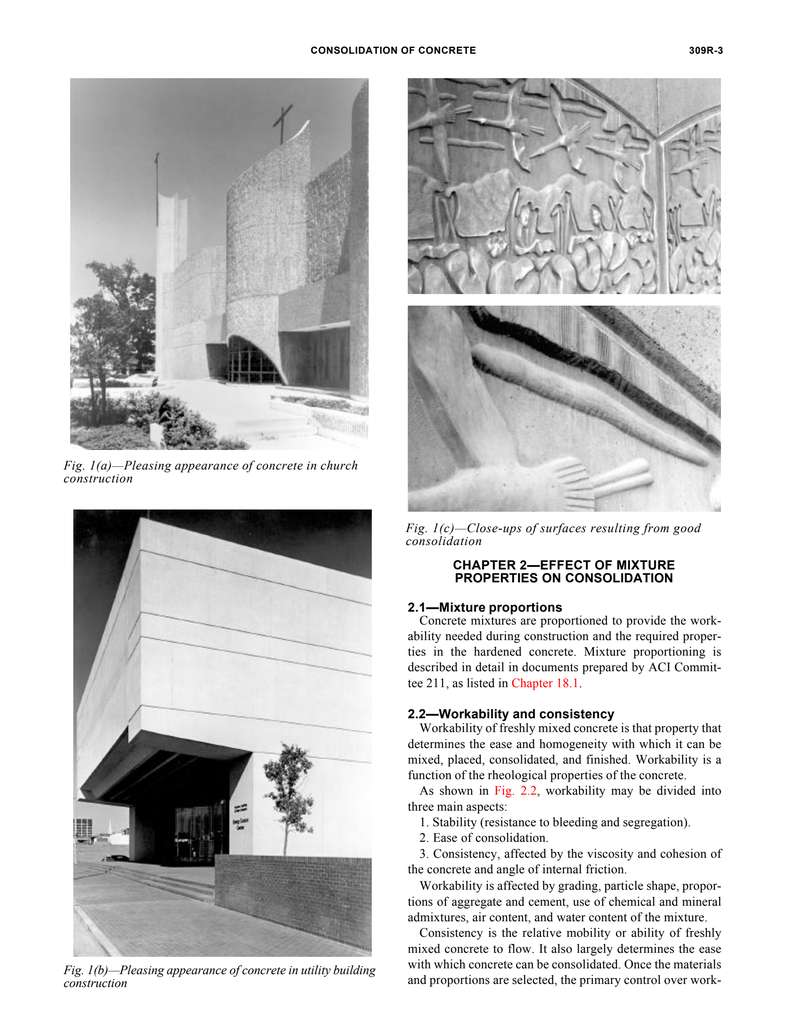
Chapter 16—Consolidation of test specimens, p. 309R-35 16.1—Strength tests 16.2—Unit weight tests 16.3—Air content tests 16.4—Consolidating very stiff concrete in laboratory specimens Chapter 17—Consolidation in congested areas, p. 309R-36 17.1—Common placing problems 17.2—Consolidation techniques Chapter 18—Information sources, p. 309R-37 18.1—Specified and/or recommended references 18.2—Cited references Appendix A—Fundamentals of vibration, p. 309R-38 A.1—Principles of simple harmonic motion A.2—Action of a rotary vibrator A.3—Vibratory motion in the concrete CHAPTER 1—GENERAL A mass of freshly placed concrete is usually honey-combed with entrapped air. If allowed to harden in this condition, the concrete will be nonuniform, weak, porous, and poorly bonded to the reinforcement. It will also have a poor appearance. The mixture must be consolidated if it is to have the properties normally desired and expected of concrete. Consolidation is the process of inducing a closer arrangement of the solid particles in freshly mixed concrete or mortar during placement by the reduction of voids, usually by vibration, centrifugation, rodding, tamping, or some combination of these actions; it is also applicable to similar manipulation of other cementitious mixtures, soils, aggregates, or the like. Drier and stiffer mixtures require greater effort to achieve proper consolidation. By using certain chemical admixtures, consistencies requiring reduced consolidation effort can be achieved at a lower water content. As the water content of the concrete is reduced, concrete quality (strength, durability, and other properties) improves, provided it is properly consolidated. Alternatively, the cement content can be lowered, reducing the cost while maintaining the same quality. If adequate consolidation is not provided for these drier or stiffer mixtures, the quality of the inplace concrete drops off rapidly. Equipment and methods are now available for fast and efficient consolidation of concrete over a wide range of placing conditions. Concrete with a relatively low water content can be readily molded into an unlimited variety of shapes, making it a highly versatile and economical construction material. When good consolidation practices are combined with good formwork, concrete surfaces have a highly pleasing appearance [see Fig. 1(a) through 1(c)]. |
2
CHAPTER 2—EFFECT OF MIXTURE PROPERTIES ON CONSOLIDATION
|
Fig. 1(a)—Pleasing appearance of concrete in church construction Fig. 1(b)—Pleasing appearance of concrete in utility building construction |
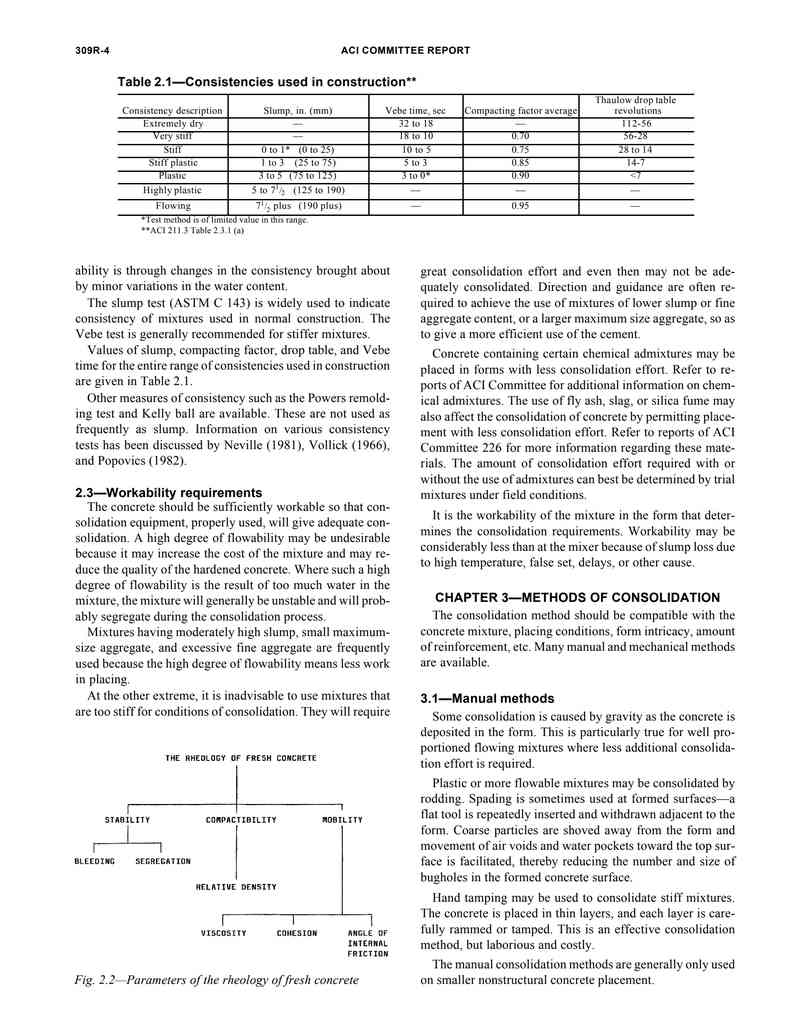
Fig. 1(c)—Close-ups of surfaces resulting from good consolidation 2.1—Mixture proportionsConcrete mixtures are proportioned to provide the workability needed during construction and the required properties in the hardened concrete. Mixture proportioning is described in detail in documents prepared by ACI Committee 211, as listed in Chapter 18.1. 2.2—Workability and consistencyWorkability of freshly mixed concrete is that property that determines the ease and homogeneity with which it can be mixed, placed, consolidated, and finished. Workability is a function of the rheological properties of the concrete. As shown in Fig. 2.2, workability may be divided into three main aspects:
Workability is affected by grading, particle shape, proportions of aggregate and cement, use of chemical and mineral admixtures, air content, and water content of the mixture. Consistency is the relative mobility or ability of freshly mixed concrete to flow. It also largely determines the ease with which concrete can be consolidated. Once the materials and proportions are selected, the primary control over work- |
3
Table 2.1—Consistencies used in construction**
| Consistency description | Slump, in. (mm) | Vebe time, sec | Compacting factor average | Thaulow drop table revolutions |
|---|---|---|---|---|
| Extremely dry | — | 32 to 18 | — | 112-56 |
| Very stiff | — | 18 to 10 | 0.70 | 56-28 |
| Stiff | 0 to 1* (0 to 25) | 10 to 5 | 0.75 | 28 to 14 |
| Stiff plastic | 1 to 3 (25 to 75) | 5 to 3 | 0.85 | 14-7 |
| Plastic | 3 to 5 (75 to 125) | 3 to 0* | 0.90 | <7 |
| Highly plastic | 5 to 7½ (125 to 190) | — | — | — |
| Flowing | 7½ plus (190 plus) | — | 0.95 | — |
*Test method is of limited value in this range.
**ACI 211.3 Table 2.3.1 (a)
|
ability is through changes in the consistency brought about by minor variations in the water content. The slump test (ASTM C 143) is widely used to indicate consistency of mixtures used in normal construction. The Vebe test is generally recommended for stiffer mixtures. Values of slump, compacting factor, drop table, and Vebe time for the entire range of consistencies used in construction are given in Table 2.1. Other measures of consistency such as the Powers remolding test and Kelly ball are available. These are not used as frequently as slump. Information on various consistency tests has been discussed by Neville (1981), Vollick (1966), and Popovics (1982). 2.3—Workability requirementsThe concrete should be sufficiently workable so that consolidation equipment, properly used, will give adequate consolidation. A high degree of flowability may be undesirable because it may increase the cost of the mixture and may reduce the quality of the hardened concrete. Where such a high degree of flowability is the result of too much water in the mixture, the mixture will generally be unstable and will probably segregate during the consolidation process. Mixtures having moderately high slump, small maximum-size aggregate, and excessive fine aggregate are frequently used because the high degree of flowability means less work in placing. At the other extreme, it is inadvisable to use mixtures that are too stiff for conditions of consolidation. They will require Fig. 2.2—Parameters of the rheology of fresh concrete |
great consolidation effort and even then may not be adequately consolidated. Direction and guidance are often required to achieve the use of mixtures of lower slump or fine aggregate content, or a larger maximum size aggregate, so as to give a more efficient use of the cement. Concrete containing certain chemical admixtures may be placed in forms with less consolidation effort. Refer to reports of ACI Committee for additional information on chemical admixtures. The use of fly ash, slag, or silica fume may also affect the consolidation of concrete by permitting placement with less consolidation effort. Refer to reports of ACI Committee 226 for more information regarding these materials. The amount of consolidation effort required with or without the use of admixtures can best be determined by trial mixtures under field conditions. It is the workability of the mixture in the form that determines the consolidation requirements. Workability may be considerably less than at the mixer because of slump loss due to high temperature, false set, delays, or other cause. CHAPTER 3—METHODS OF CONSOLIDATIONThe consolidation method should be compatible with the concrete mixture, placing conditions, form intricacy, amount of reinforcement, etc. Many manual and mechanical methods are available. 3.1—Manual methodsSome consolidation is caused by gravity as the concrete is deposited in the form. This is particularly true for well proportioned flowing mixtures where less additional consolidation effort is required. Plastic or more flowable mixtures may be consolidated by rodding. Spading is sometimes used at formed surfaces—a flat tool is repeatedly inserted and withdrawn adjacent to the form. Coarse particles are shoved away from the form and movement of air voids and water pockets toward the top surface is facilitated, thereby reducing the number and size of bugholes in the formed concrete surface. Hand tamping may be used to consolidate stiff mixtures. The concrete is placed in thin layers, and each layer is carefully rammed or tamped. This is an effective consolidation method, but laborious and costly. The manual consolidation methods are generally only used on smaller nonstructural concrete placement. |
4
3.2—Mechanical methods
The most widely used consolidation method is vibration. It will receive the most attention in this guide. Vibration may be either internal, external, or both.
Power tampers may be used to compact stiff concrete in precast units. In addition to the ramming or tamping effect, there is a low-frequency vibration that aids in the consolidation.
Mechanically operated tamping bars are suitable for consolidating stiff mixtures for some precast products, including concrete blocks.
Equipment that applies static pressures to the top surface may be used to consolidate thin concrete slabs of plastic or flowing consistency. Concrete is literally squeezed into the mold, and entrapped air and part of the mixing water is forced out.
Centrifugation (spinning) is used to consolidate concrete in concrete pipe, piles, poles, and other hollow sections.
Many types of surface vibrators are available for slab construction, including vibrating screeds, vibratory roller screeds, plate and grid vibratory tampers, and vibratory finishing tools.
Shock tables, sometimes called drop tables, are suitable for consolidating low-slump concrete. The concrete is deposited in thin lifts in sturdy molds. As the mold is filled, it is alternately raised a short distance and dropped on to a solid base. The impact causes the concrete to be rammed into a dense mass. Frequencies are 150 to 250 drops per min., and the free fall is 1/8 to 1/2 in. (3 to 13 mm).
3.3—Methods used in combination
Under some conditions, a combination of two or more consolidation methods gives the best results.
Internal and external vibration can often be combined to advantage in precast work and occasionally in cast-in-place concrete. One scheme uses form vibrators for routine consolidation and internal vibrators for spot use at critical, heavily reinforced sections prone to voids or poor bond with the re-
Fig. 4—Internal vibrator "liquifying" low-slump concrete
inforcement. Conversely, in sections where the primary consolidation is by internal vibrators, form vibration may also be applied to achieve the desired surface appearance.
Vibration may be simultaneously applied to the form and top surface. This procedure is frequently used in making precast units on vibrating tables. The mold is vibrated while a vibratory plate or screed working on the top surface exerts additional vibratory impulses and pressure.
Vibration of the form is sometimes combined with static pressure applied to the top surface. Vibration under pressure is particularly useful in concrete block production where the very stiff mixtures do not react favorably to vibration alone.
Centrifugation, vibration, and rolling may be combined in the production of concrete pipe and other hollow sections.
CHAPTER 4—CONSOLIDATION OF CONCRETE BY VIBRATION
Vibration consists of subjecting freshly placed concrete to rapid vibratory impulses which liquefy the mortar (see Fig. 4) and drastically reduce the internal friction between aggregate particles. While in this condition, concrete settles under the action of gravity (sometimes aided by other forces). When vibration is discontinued, friction is reestablished.
4.1—Vibratory motion
A concrete vibrator has a rapid oscillatory motion that is transmitted to the freshly placed concrete. Oscillating motion is basically described in terms of frequency (number of oscillations or cycles per unit of time) and amplitude (deviation from point of rest).
Rotary vibrators follow an orbital path caused by rotation of an unbalanced weight or eccentric inside a vibrator casing. The oscillation is essentially simple harmonic motion, as explained in the Appendix. Acceleration, a measure of intensity of vibration, can be computed from the frequency and amplitude when they are known. It is usually expressed by g,
Table 5.1.5—Range of characteristics, performance, and applications of internal* vibrators
| Column | 1 | 2 | 3 | 4 | 5 | 6 | 7 | 8 | 9 |
|---|---|---|---|---|---|---|---|---|---|
| Suggested values of | Approximate values of | ||||||||
| Group | Diameter of head, in. (mm) | Recommended frequency, vibrations per min (Hz) | Eccentric amplitude, in. lb mm-kg (10-3) | Average amplitude, in. (mm) | Centrifugal force, lb (kg) | Radius of action, in. (mm) | Rate of concrete placement, yd | Application | |
| 1 | 3/4-1 1/2 (2-4) (20-40) | 9000-15,000 (150-200) | 0.03-0.10 (0.04-0.08) (3.5-12) | 0.015-0.03 (0.04-0.08) (0.4-0.8) | 100-400 (45-180) | 3-6 (8-15) | 1-5 (0.8-4) | Plastic and flowing concrete in very thin members and confined places. May be used to supplement larger vibrators, especially in prestressed work where cables and ducts cause congestion in forms. Also used for fabricating laboratory test specimens. | |
| 2 | 1 1/2-2 1/2 (3-6) (30-60) | 8500-12,500 (140-210) | 0.08-0.25 (0.09-0.29) (9-29) | 0.02-0.04 (0.05-0.10) (0.5-1.0) | 300-900 (140-400) | 5-10 (13-25) (130-250) | 3-10 (2.3-8) | Plastic concrete in thin walls, columns, beams, precast piles, thin slabs, and along construction joints. May be used to supplement larger vibrators in confined areas. | |
| 3 | 2-3 1/2 (5-9) (50-90) | 8000-12,000 (130-200) | 0.20-0.70 (0.23-0.81) (23- | ||||||
预览内容由文件识别整理,表格、公式及文字请以原始文件为准。
原文图片预览
PAGE IMAGES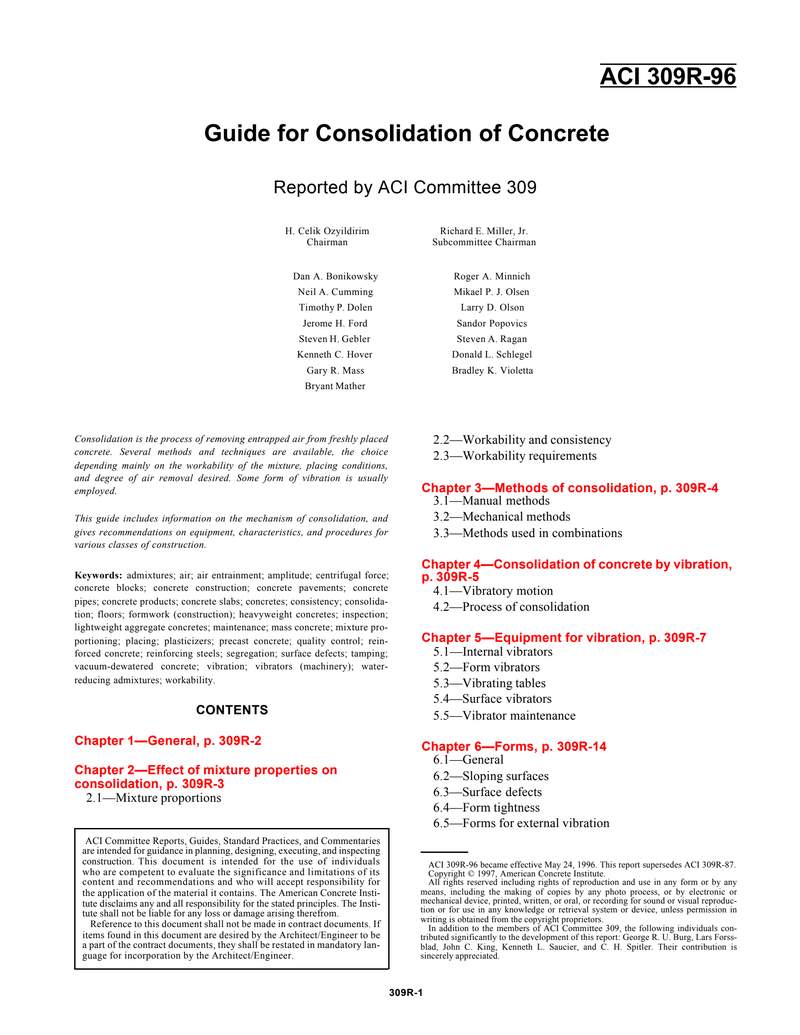
下载标准文件
ACI 309R-96
英语 · PDF · 6 页 · 1.2 MB