ACI 304.5R-91
轻集料混凝土的配料、搅拌与作业控制
ACI 304.5R-91
Batching, Mixing, and Job Control of Lightweight Concrete

标准信息
STANDARD INFORMATION- 标准编号
- ACI 304.5R-91
- 所属分类
- ACI 美国混凝土学会标准
- 发布机构
- ACI Committee 304
- 版本年份
- 1991
- 文件语言
- 英语
- 文件格式
- 文件页数
- 6 页
- 文件大小
- 324.98 KB
中文名称为参考译名,文件语言以原文为准。
· 更新:
标准简介
OVERVIEW中文简介
该报告介绍轻集料混凝土的配料、搅拌和作业控制方法,重点说明轻集料含水率、单位体积质量变化及产量调整。适用于轻集料混凝土生产中的粗、细集料计量、搅拌机装料与运行以及现场质量控制。
English summary
This report covers practical batching, mixing, and job control methods for lightweight aggregate concrete. It addresses moisture, absorbed water, unit weight variations, yield adjustments, and quality control for coarse and fine lightweight aggregates.
以上为根据文件整理的内容简介。
相关标签
标准内容预览
DOCUMENT PREVIEWtronically controlled, batching facility or it could be used in a semiautomatic plant where all of the ingredients except the lightweight aggregates are batched electronically.
If it is desired to record the total weight of coarse lightweight aggregate on the delivery ticket for any given truck, the total weights as batched are shown in the fourth column of either Table 2.3.3(a) or Table 2.3.3(b). Also, if the unit weight of the aggregate is required on the delivery ticket, the value shown in the second column provides this information.
If batches less than a full truckload might be needed, these could be batched in one cubic yard (or one cubic meter) increments using the unit weight of aggregate determined on the immediately preceding batch multiplied by the loose volume shown on the mix proportion. These batch weights are shown in the fifth column of Table 2.3.3(a) or Table 2.3.3(b).
2.4 -- Batching lightweight fine aggregate
It is not practical to batch the lightweight fine aggregate by this same method since its volume changes due to variable bulking with different amounts of surface water. For this reason, the lightweight fine aggregates are batched by weight in much the same manner as natural sand with allowances made for total moisture content.
Since the moisture in lightweight fine aggregate may be partly absorbed water as well as surface or free water, the moisture meters used in batch plant storage bins for natural sand have not been satisfactory for lightweight fine aggregate. Satisfactory batching results have been obtained by drying a small sample (about 500 g) of the lightweight fine aggregate being used in a suitable container to a constant weight at a temperature of 212 to 230 F (100 to 110 C). The total moisture (absorbed plus surface moisture) is calculated by comparing the moist weight of the sample to its dry weight. Moisture tests should be conducted at least once per day or whenever a fresh supply of lightweight fine aggregate is introduced which has a different moisture content.
To adjust for the proper amount of lightweight fine aggregate, the oven dry unit weight of the material being used is determined as indicated above. If this dry unit weight differs from that shown on the laboratory mix proportions [59.7 lb/ft3 (956 kg/m3) shown in the example] then the dry batch weight is changed by multiplying the loose volume [15.9 ft3 (0.590 m3)] by the new dry unit weight just determined. This dry batch weight is increased by the moisture content as previously determined to give the actual scale weight to be used.
CHAPTER 3 -- MIXING
The absorptive properties of lightweight aggregates should be given consideration during mixing. Care should be taken to assure that a high degree of water absorption by the lightweight aggregate has taken place prior to batching and mixing. Otherwise, a portion of diluted admixture may be absorbed into the aggregate, thus reducing its effectiveness. Some quantity of the mixing water may be absorbed during mixing, delivery, and placement creating an apparently higher mixing water demand or a rapid slump loss condition. The time rate of absorption as well as the maximum total absorption must be properly integrated into the mixing cycle to control the consistency.
3.1 -- Charging mixers
The sequence of introducing the ingredients for lightweight concrete into a mixer may vary from one plant to another. Once acceptable procedures for both wetting and batching have been established, it is important to repeat these as closely as possible at all times to assume uniformity. Weather conditions such as ambient temperature, humidity, and rain or snow on stockpiles can exert significant influences on any concrete production and should be properly considered.
3.1.1 Plant mixers
Stationary plant mixers are commonly used in precasting or prestressing operations and occasionally on building sites where concrete is not moved a great distance. They may also be used at a ready-mixed concrete production plant for complete premixing or for partial remixing (shrink mixing) with the concrete later being fully mixed and transported to the jobsite in mixer trucks.
Lightweight aggregates should be placed in the mixer first, followed by the required water, cement, and any specified admixtures. Lightweight fine aggregate should be added after the coarse aggregate when lightweight fine aggregate is being used in the concrete.
After all of the ingredients have been fed into the plant mixer, it should be operated at mixing speed to produce a complete mix that will meet the evaluation tests as described in ASTM C 94. When stationary mixers are used for the purpose of partial or shrink mixing, they are only required to blend the materials together since mixing is completed in the truck mixer.
3.1.2 Truck mixers
Charging or loading a truck mixer follows the same general practice used in stationary mixers. Larger volumes of lightweight concrete can sometimes be hauled in truck mixers without exceeding the legal weight or axle load limits. However, the volume of concrete in the drum should not exceed the rated capacity of the drum or 63 percent of the drum volume when used as a mixer nor 80 percent of this volume when used as an agitator in accordance with ASTM C 94.
3.2 -- Mixer operation
Since most concrete, both normal and lightweight, is handled in truck mixers, it is important to understand some aspects of truck operation. Delivery time and weather effects have an important role in slump control. These variables may require changes in the amount of water needed to produce the desired slump.
3.2.1 Transportation and waiting time
Construction
6
CONTENTS
Chapter 1 -- Introduction, pg. 304.5R-2
Chapter 2 -- Measuring and batching, p. 304.5R-2
2.1--Free water and absorbed water
2.2--Absolute volumes
2.3--Batching coarse aggregate
2.4--Batching lightweight fine aggregate
Chapter 3 -- Mixing, p. 304.5R-6
3.1--Charging mixers
3.2--Mixer operation
Chapter 4 -- Job controls, p. 304.5R-7
4.1--Slump
4.2--Unit weight
4.3--Air content
4.4--Yield adjustments
4.5--Test cylinders
Chapter 5 -- References, p. 304.5R-8
CHAPTER 1 -- INTRODUCTION
Measuring, mixing, transporting, and placing operations for lightweight concrete are similar to comparable procedures for normal weight concrete. However, there are certain differences, especially in proportioning and batching procedures, that should be considered to produce a finished product of the highest quality. The weight and absorptive properties of lightweight aggregates are different and should be properly considered. Every effort has been made to coordinate these batching methods with the basic principles set forth in ACI 211.2. Other batching methods currently being used in various locations may also be employed. This report also describes batching methods for the coarse lightweight aggregates to correct for changes in weight and moisture content to insure proper yield. It also covers batching of lightweight fine aggregates using a modification of the method used for coarse lightweight aggregates.
Quality control for plastic lightweight concrete requires special emphasis with regard to yield, aggregate measuring, and batching methods along with the control of water for slump and for aggregate absorption.
CHAPTER 2 -- MEASURING AND BATCHING
2.1 -- Free water and absorbed water
One of the first considerations in batching lightweight concrete mixtures is a proper understanding of the water used in the mixture. The total water used per unit volume is divided into two components. One is the water absorbed by the aggregates while the other is similar to that in normal weight aggregate concrete and is classified as free water. Free water controls the slump and, when mixed with a given quantity of cement, establishes the strength of the paste. The amount of absorbed water will vary with different lightweight materials, presoaking, and mixing times. Absorbed water does not change the volume of the aggregates or concrete because it is inside the aggregate. Most importantly, absorbed water does not affect the water-cement ratio or the slump of the concrete.
2.2 -- Absolute volumes
Lightweight concrete uses lightweight aggregate particles in place of normal weight aggregates to the extent necessary to achieve the total weight desired in the hardened concrete. The space that the aggregates occupy within the concrete is called their absolute volume. The sum of the absolute volumes of all the ingredients including air must equal the required volume of mixed concrete.
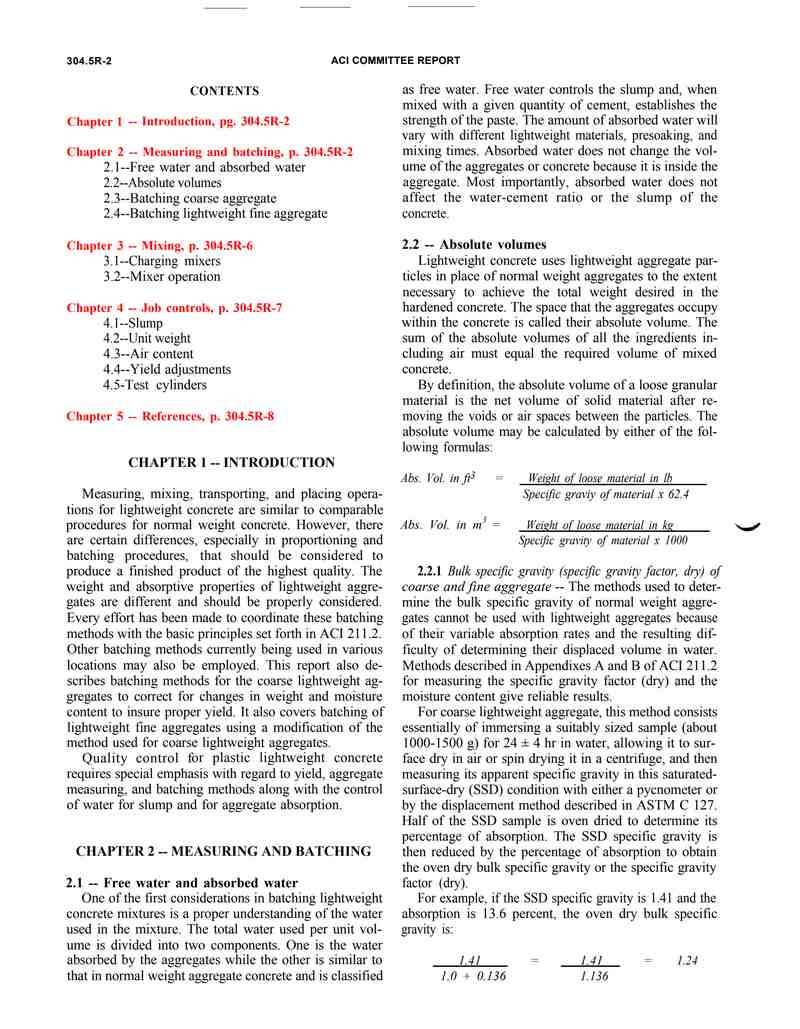
By definition, the absolute volume of a loose granular material is the net volume of solid material after removing the voids or air spaces between the particles. The absolute volume may be calculated by either of the following formulas:
Abs. Vol. in ft3 = Weight of loose material in lb / Specific gravity of material x 62.4
Abs. Vol. in m3 = Weight of loose material in kg / Specific gravity of material x 1000
2.2.1 Bulk specific gravity (specific gravity factor, dry) of coarse and fine aggregate -- The methods used to determine the bulk specific gravity of normal weight aggregates cannot be used with lightweight aggregates because of their variable absorption rates and the resulting difficulty of determining their displaced volume in water. Methods described in Appendices A and B of ACI 211.2 for measuring the specific gravity factor (dry) and the moisture content give reliable results.
For coarse lightweight aggregate, this method consists essentially of immersing a suitably sized sample (about 1000-1500 g) for 24 ± 4 hr in water, allowing it to surface dry in air or spin drying it in a centrifuge, and then measuring its apparent specific gravity in this saturated-surface-dry (SSD) condition with either a pycnometer or by the displacement method described in ASTM C 127. Half of the SSD sample is oven dried to determine its percentage of absorption. The SSD specific gravity is then reduced by the percentage of absorption to obtain the oven dry bulk specific gravity or the specific gravity factor (dry).
For example, if the SSD specific gravity is 1.41 and the absorption is 13.6 percent, the oven dry bulk specific gravity is:
1.41 / (1.0 + 0.136) = 1.41 / 1.136 = 1.24
2
BATCHING, MIXING, AND JOB CONTROL OF LIGHTWEIGHT CONCRETE
|
For lightweight fine aggregate, the oven dry bulk specific gravity is determined in much the same manner as for the coarse lightweight material. However, it is difficult to visually determine the SSD condition and the spin dry procedure or ASTM C 128 may give more satisfactory results. Another procedure for determining the bulk specific gravity using all dry materials, which employs a flow cone sand testing apparatus, is described in Reference 10. 2.2.2 Unit weight variations -- The unit weight of lightweight aggregate varies depending on the raw materials used and the size of the aggregate. Smaller particles usually have higher densities, specific gravities, and unit weights than larger particles. Unit weights also vary due to changes in absorption or moisture content. If the lightweight aggregates are batched without adjusting for these variations in unit weight, problems of over or under yield of the concrete can result. To prevent such problems, various field adjustments are suggested in the standard on proportioning lightweight concrete, ACI 211.2. Essentially these field adjustments consist of changing the batch weights of the lightweight aggregates, both coarse and fine, to insure that the resulting concrete produces the intended volume or yield. The dry loose unit weight of aggregate depends on its specific gravity, on the grading, on the shape and size of the particles. Angular shaped crushed aggregates have more voids or unfilled spaces between the aggregate particles than rounded or spherically shaped pieces. Poorly graded aggregate (i.e., all one size) generally has more voids than a uniformly graded material which has enough smaller pieces to fit into the voids between the larger particles. Numerous routine tests of both natural and lightweight aggregates show an amazingly close correlation of the void content for specific products being produced by a given plant over a long period. If changes are made in the source of raw materials, in crushing or screening equipment, or in production methods, this could result in a different void content. With no such major changes, the variation in the void content will generally result in less than 1.0 percent change in yield of the mixture. Different sized materials from the same production facility may have a different, but also a relatively constant void content. Each production facility has its own characteristic void content value for each size aggregate being produced, and this information can usually be obtained from the source. The absolute volume of the specific lightweight materials in a given container would be a volume of material remaining after the volume of voids has been subtracted from it. In other words, if the unfilled void space was 44 percent or 0.44, then the absolute volume would be 1.00 - 0.44 = 0.56 or 56 percent. Every loose unit volume of lightweight aggregate in this case will add only 56 percent of that volume as net solids or absolute volume to the total volume of the concrete. The absolute volume, or the displaced volume in the |
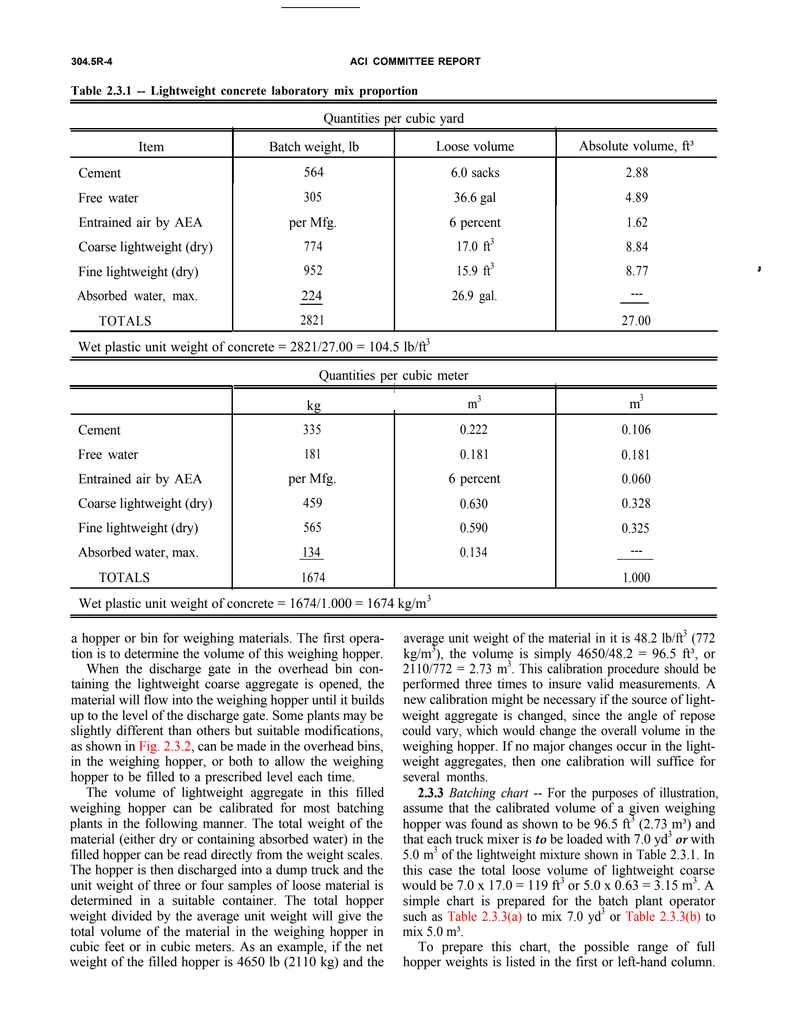
concrete, for a given lightweight material will remain the same even though its density changes or its moisture absorption changes. The proper usage of these basic principles makes it possible for any ready-mixed concrete producer to batch and deliver lightweight concrete at the proper slump and yield for any job. 2.3 -- Batching coarse aggregate2.3.1 Mix proportions -- For illustration purposes, a typical lightweight concrete mixture prepared in a laboratory is shown in Table 2.3.1. This mixture was proportioned by the weight method described in ACI 211.2. The quantities per cubic yard and per cubic meter of concrete are shown separately. The specification requirements for the lightweight concrete and the properties of the lightweight coarse and fine aggregate are given as follows: Specifications: 3000 psi (20.7 MPa) at 28 days, slump 3-4 in. (75-100 mm), air entrainment 6 ± 1 percent, air dry weight, max., 100 lb/ft³ (1602 kg/m³), wet plastic weight, max., 105 lb/ft³ (1682 kg/m³), maximum size aggregate 3/4 in. (19 mm). Aggregate properties on laboratory, samples: Lightweight coarse: Gradation meets ASTM C 330, oven-dry, loose weight = 45.5 lb/ft³ (730 kg/m³), specific gravity factor (dry) 1.40, absorption 12.6 percent. Lightweight fines: Gradation meets ASTM C 330, |
Table 2.3.1 – Lightweight concrete laboratory mix proportion
| Quantities per cubic yard | |||
|---|---|---|---|
| Item | Batch weight, lb | Loose volume | Absolute volume, ft³ |
| Cement | 564 | 6.0 sacks | 2.88 |
| Free water | 305 | 36.6 gal | 4.89 |
| Entrained air by AEA | per Mfg. | 6 percent | 1.62 |
| Coarse lightweight (dry) | 774 | 17.0 ft³ | 8.84 |
| Fine lightweight (dry) | 952 | 15.9 ft³ | 8.77 |
| Absorbed water, max. | 224 | 26.9 gal. | --- |
| TOTALS | 2821 | 27.00 | |
| Wet plastic unit weight of concrete = 2821/27.00 = 104.5 lb/ft³ | |||
| Quantities per cubic meter | |||
| kg | m³ | m³ | |
| Cement | 335 | 0.222 | 0.106 |
| Free water | 181 | 0.181 | 0.181 |
| Entrained air by AEA | per Mfg. | 6 percent | 0.060 |
| Coarse lightweight (dry) | 459 | 0.630 | 0.328 |
| Fine lightweight (dry) | 565 | 0.590 | 0.325 |
| Absorbed water, max. | 134 | 0.134 | --- |
| TOTALS | 1674 | 1.000 | |
| Wet plastic unit weight of concrete = 1674/1.000 = 1674 kg/m³ | |||
|
a hopper or bin for weighing materials. The first operation is to determine the volume of this weighing hopper. When the discharge gate in the overhead bin containing the lightweight coarse aggregate is opened, the material will flow into the weighing hopper until it builds up to the level of the discharge gate. Some plants may be slightly different than others but suitable modifications, as shown in Fig. 2.3.2, can be made in the overhead bins, in the weighing hopper, or both to allow the weighing hopper to be filled to a prescribed level each time. The volume of lightweight aggregate in this filled weighing hopper can be calibrated for most batching plants in the following manner. The total weight of the material (either dry or containing absorbed water) in the filled hopper can be read directly from the weight scales. The hopper is then discharged into a dump truck and the unit weight of three or four samples of loose material is determined in a suitable container. The total hopper weight divided by the average unit weight will give the total volume of the material in the weighing hopper in cubic feet or in cubic meters. As an example, if the net weight of the filled hopper is 4650 lb (2110 kg) and the |
average unit weight of the material in it is 48.2 lb/ft³ (772 kg/m³), the volume is simply 4650/48.2 = 96.5 ft³, or 2110/772 = 2.73 m³. This calibration procedure should be performed three times to insure valid measurements. A new calibration might be necessary if the source of lightweight aggregate is changed, since the angle of repose could vary, which would change the overall volume in the weighing hopper. If no major changes occur in the lightweight aggregates, then one calibration will suffice for several months. 2.3.3 Batching chart -- For the purposes of illustration, assume that the calibrated volume of a given weighing hopper was found as shown to be 96.5 ft³ (2.73 m³) and that each truck mixer is to be loaded with 7.0 yd³ or with 5.0 m³ of the lightweight mixture shown in Table 2.3.1. In this case the total loose volume of lightweight coarse would be 7.0 x 17.0 = 119 ft³ or 5.0 x 0.63 = 3.15 m³. A simple chart is prepared for the batch plant operator such as Table 2.3.3(a) to mix 7.0 yd³ or Table 2.3.3(b) to mix 5.0 m³. To prepare this chart, the possible range of full hopper weights is listed in the first or left-hand column. |
4
BATCHING, MIXING, AND JOB CONTROL OF LIGHTWEIGHT CONCRETE
|
Fig. 2.3.2--Overhead bin and weighing hopper arrangements Full weighing hopper volume = 96.5 ft3
|
tronically controlled, batching facility or it could be used in a semiautomatic plant where all of the ingredients except the lightweight aggregates are batched electronically.
If it is desired to record the total weight of coarse lightweight aggregate on the delivery ticket for any given truck, the total weights as batched are shown in the fourth column of either Table 2.3.3(a) or Table 2.3.3(b). Also, if the unit weight of the aggregate is required on the delivery ticket, the value shown in the second column provides this information.
If batches less than a full truckload might be needed, these could be batched in one cubic yard (or one cubic meter) increments using the unit weight of aggregate determined on the immediately preceding batch multiplied by the loose volume shown on the mix proportion. These batch weights are shown in the fifth column of Table 2.3.3(a) or Table 2.3.3(b).
2.4 -- Batching lightweight fine aggregate
It is not practical to batch the lightweight fine aggregate by this same method since its volume changes due to variable bulking with different amounts of surface water. For this reason, the lightweight fine aggregates are batched by weight in much the same manner as natural sand with allowances made for total moisture content.
Since the moisture in lightweight fine aggregate may be partly absorbed water as well as surface or free water, the moisture meters used in batch plant storage bins for natural sand have not been satisfactory for lightweight fine aggregate. Satisfactory batching results have been obtained by drying a small sample (about 500 g) of the lightweight fine aggregate being used in a suitable container to a constant weight at a temperature of 212 to 230 F (100 to 110 C). The total moisture (absorbed plus surface moisture) is calculated by comparing the moist weight of the sample to its dry weight. Moisture tests should be conducted at least once per day or whenever a fresh supply of lightweight fine aggregate is introduced which has a different moisture content.
To adjust for the proper amount of lightweight fine aggregate, the oven dry unit weight of the material being used is determined as indicated above. If this dry unit weight differs from that shown on the laboratory mix proportions [59.7 lb/ft3 (956 kg/m3) shown in the example] then the dry batch weight is changed by multiplying the loose volume [15.9 ft3 (0.590 m3)] by the new dry unit weight just determined. This dry batch weight is increased by the moisture content as previously determined to give the actual scale weight to be used.
CHAPTER 3 -- MIXING
The absorptive properties of lightweight aggregates should be given consideration during mixing. Care should be taken to assure that a high degree of water absorption by the lightweight aggregate has taken place prior to batching and mixing. Otherwise, a portion of diluted admixture may be absorbed into the aggregate, thus reducing its effectiveness. Some quantity of the mixing water may be absorbed during mixing, delivery, and placement creating an apparently higher mixing water demand or a rapid slump loss condition. The time rate of absorption as well as the maximum total absorption must be properly integrated into the mixing cycle to control the consistency.
3.1 -- Charging mixers
The sequence of introducing the ingredients for lightweight concrete into a mixer may vary from one plant to another. Once acceptable procedures for both wetting and batching have been established, it is important to repeat these as closely as possible at all times to assume uniformity. Weather conditions such as ambient temperature, humidity, and rain or snow on stockpiles can exert significant influences on any concrete production and should be properly considered.
3.1.1 Plant mixers
Stationary plant mixers are commonly used in precasting or prestressing operations and occasionally on building sites where concrete is not moved a great distance. They may also be used at a ready-mixed concrete production plant for complete premixing or for partial remixing (shrink mixing) with the concrete later being fully mixed and transported to the jobsite in mixer trucks.
Lightweight aggregates should be placed in the mixer first, followed by the required water, cement, and any specified admixtures. Lightweight fine aggregate should be added after the coarse aggregate when lightweight fine aggregate is being used in the concrete.
After all of the ingredients have been fed into the plant mixer, it should be operated at mixing speed to produce a complete mix that will meet the evaluation tests as described in ASTM C 94. When stationary mixers are used for the purpose of partial or shrink mixing, they are only required to blend the materials together since mixing is completed in the truck mixer.
3.1.2 Truck mixers
Charging or loading a truck mixer follows the same general practice used in stationary mixers. Larger volumes of lightweight concrete can sometimes be hauled in truck mixers without exceeding the legal weight or axle load limits. However, the volume of concrete in the drum should not exceed the rated capacity of the drum or 63 percent of the drum volume when used as a mixer nor 80 percent of this volume when used as an agitator in accordance with ASTM C 94.
3.2 -- Mixer operation
Since most concrete, both normal and lightweight, is handled in truck mixers, it is important to understand some aspects of truck operation. Delivery time and weather effects have an important role in slump control. These variables may require changes in the amount of water needed to produce the desired slump.
3.2.1 Transportation and waiting time
Construction
6
预览内容由文件识别整理,表格、公式及文字请以原始文件为准。
原文图片预览
PAGE IMAGES

下载标准文件
ACI 304.5R-91
英语 · PDF · 6 页 · 324.98 KB