ACI 207.4R-93
大体积混凝土的冷却与保温系统
ACI 207.4R-93
Cooling and Insulating Systems for Mass Concrete
标准信息
STANDARD INFORMATION- 标准编号
- ACI 207.4R-93
- 所属分类
- ACI 美国混凝土学会标准
- 发布机构
- American Concrete Institute (ACI)
- 版本年份
- 1993
- 文件语言
- 英语
- 文件格式
- 文件页数
- 6 页
- 文件大小
- 559.79 KB
中文名称为参考译名,文件语言以原文为准。
· 更新:
标准简介
OVERVIEW中文简介
该报告综述了大体积混凝土施工中用于控制温度变化引起体积变化的冷却与保温系统。内容涵盖温度控制需求、预冷、后冷、保温系统、发展趋势以及新拌混凝土温度的简化计算方法。
English summary
This report reviews cooling and insulating systems used to control temperature-induced volume change in mass concrete construction. It covers temperature control needs, precooling, post-cooling, insulation systems, expected trends, and a simplified method for computing fresh concrete temperature.
以上为根据文件整理的内容简介。
相关标签
标准内容预览
DOCUMENT PREVIEW我们需要回答用户:作为OCR引擎,把工程标准PDF页面精确转成HTML片段,只返回HTML,不要解释。需要遵守严格标签和class限制。现在分析页面内容。
页面是两栏布局。左栏顶部有列表:
5.5-Edges and comers
5.6-Heat absorption from light energy penetration
5.7-Geographical requirements
Chapter 6-Expected trends, pg. 207.4R-20
6.1-Effects of aggregate quality
6.2-Lightweight aggregates
6.3-Blended cements
6.4-Admixtures
6.5-Temperature control practices
6.6-Permanent insulation and precast stay-in-place forms
6.7-Roller-compacted concrete
Chapter 7-References, pg. 207.4R-21
7.1-Recommended references
7.2-Cited references
CHAPTER I-INTRODUCTION
1.1-Scope and objective
This report presents a discussion of special construction procedures which can be used to control the temperature changes which occur in concrete structures. The principal construction practices covered are precooling of materials, post-cooling of in-place concrete by embedded pipes, and surface insulation. Other design and construction practices, including the selection of cementing materials, aggregates, chemical admixtures, cement content, and strength requirements are not within the scope of this report.
The objective of this report is to summarize experiences with cooling and insulating systems, and to offer guidance on the selection and application of these procedures in design and construction for controlling thermal cracking in all types of concrete structures.
1.2 - Historical background
The first major use of artificial cooling (post-cooling) of mass concrete was in the construction of the Bureau of Reclamation's Hoover Dam in the early 1930's. In this case the primary objective of the post-cooling was to accelerate thermal contraction of the columns of concrete composing the dam so that the contraction joints could be filled with grout to insure monolithic action of the dam. The cooling was achieved by circulating cold water through pipes embedded in the concrete. Circulation of water through the pipes was usually started several weeks or more after the concrete had been placed. Since Hoover Dam, post-cooling has been used in construction of many large dams. Generally the practices followed were essentially identical to those followed at Hoover Dam, except that circulation of cooling water was initiated simultaneously with the placement of concrete.
In the early 1940's the Tennessee Valley Authority utilized post-cooling in the construction of Fontana Dam for two purposes: (a) to control the temperature rise par-
右栏继续:
ticularly in the vulnerable base of the dam where cracking of the concrete could be induced by the restraining effect of the foundation, and (b) to accelerate thermal contraction of the columns so that the contraction joints between columns could be filled with grout to ensure monolithic action. Post-cooling was started coincidently with the placing of each new lift of concrete on the previously placed lift and on foundation rock. The pipe spacing and lift thickness were varied to limit the maximum temperature to a pre-designed level in all seasons. In summer with naturally high (unregulated) placing temperatures, the pipe spacing and lift thickness for the critical foundation zone was 2.5 ft (0.76 m); in winter when placing temperatures were naturally low the pipe spacing and lift thickness for this zone was 5.0 ft (1.5 m). Above the critical zone, the lift thickness was increased to 5.0 ft (1.5 m) and the pipe spacing was increased to 6.25 ft (1.9 m). Cooling was also started in this latter zone coincidently with the placing of concrete in each new lift.
In the 1960's the Corps of Engineers began the practice of starting, stopping, and restarting the cooling process based on the results of embedded resistance thermometers. At Dworshak Dam and the Ice Harbor Additional Power House Units, the cooling water was stopped when the temperature of the concrete near the pipes began to drop rapidly after reaching a peak. Within 1 to 3 days, when the temperature would rise again to the previous peak temperature, cooling would be started again to produce controlled safe cooling.
First use of precooling of concrete materials to reduce the maximum temperature of mass concrete was by the Corps of Engineers during the construction of Norfolk Dam (1941-1945). A part of the batch water was introduced into the mixture as crushed ice. The placing temperature of the concrete was reduced about 10 F (6 C). Precooling has become very common for mass concrete placements. It also is used for placements of relatively small dimensions such as for bridge piers and foundations where there is sufficient concern for minimizing thermal stresses. For precooling applications various combinations of crushed ice, cold batch water, liquid nitrogen, and cooled aggregate were used to achieve a placing temperature of 50 F (10 C) and in some dams to as low as 40 F (4.5 C).
Roller-compacted concrete (RCC) projects have effectively used "natural" precooling of aggregate. Large quantities of aggregate (sometimes all of the aggregate for a dam) are produced during cold winter months and placed into stockpiles. In the warm summer months the exterior of the piles warms but the interior stays cold. At Middle Fork, Monksville, and Stagecoach Dams it was not unusual to find frost in the aggregate stockpiles during production of RCC in the summer at ambient temperatures about 75-95 F (24-35 C).
Precooling and post-cooling have been used in combination in the construction of some massive structures such as Glen Canyon Dam, completed in 1963, Dworshak
页眉:207.4R-2 ACI COMMITTEE REPORT 忽略。页码?没有底部页码?忽略。
需要输出以 h2 开头。页面内标题:CHAPTER I-INTRODUCTION 是主标题,用 h2。但左栏顶部列表是前面章节目录?它属于正文内容,不是页眉。需要保留。由于最高优先级要求每页输出必须以
开头(页面内标题)。页面内标题是 CHAPTER I-INTRODUCTION,但它在左栏中部。若以 h2 开头,可能先输出 CHAPTER I-INTRODUCTION,然后左栏列表?但内容规则忠实还原,编号体系保留。两栏布局可用 table class layout-columns。若用两栏,第一栏包含列表和 CHAPTER I-INTRODUCTION? 但要求每页输出必须以 h2 开头。可以输出 CHAPTER I-INTRODUCTION
然后两栏表格?但这样会打乱视觉顺序:左栏列表在标题之前。是否允许?最高优先级必须 h2 开头。也许把 CHAPTER I-INTRODUCTION 作为 h2 开头,然后两栏包含左栏列表和右栏正文?但左栏列表在标题之前,若先标题再列表,不忠实顺序。另一种:把左栏列表作为 h2? 不行,列表不是标题。也许页面内标题指页眉? 不,页内标题。必须 h2 开头。可以输出 CHAPTER I-INTRODUCTION
然后
| 左栏 | 右栏 |
但两栏中左栏包含列表和标题,右栏包含正文。若 h2 先输出 CHAPTER I-INTRODUCTION,然后 table 左栏放列表,右栏放正文。这样标题在列表前,但视觉标题在列表后。是否可接受?也许更好:把左栏列表作为 h2? 不。
也许页面内标题是 "CHAPTER I-INTRODUCTION",但左栏列表是前一页延续的目录,属于正文。由于必须 h2 开头,我们只能先 h2。然后两栏:左栏放列表和 1.1/1.2 段落,右栏放续接段落。这样标题在列表前,但可能违反忠实顺序。是否可以用 h2 开头为 "5.5-Edges and comers"? 不,不是标题。
考虑是否不需要两栏,按阅读顺序输出:先左栏列表,再 CHAPTER I-INTRODUCTION h2,再左栏段落,再右栏段落。但最高优先级每页输出必须以 h2 开头。若先列表则违反。也许可以把列表放在 h2 之后,因为 h2 是页面内标题,列表是目录延续,顺序可调整?用户强调忠实还原,但最高优先级违反会被拒。必须 h2 开头。
也许可以用
CHAPTER I-INTRODUCTION
然后| ... | ... |
Need ensure first tag h2. Could do:
CHAPTER I-INTRODUCTION
... Chapter 6-Expected trends, pg. 207.4R-20
Chapter 7-References, pg. 207.4R-21
1.1-Scope and objective... ... 1.2 - Historical background... ... par- |
ticularly ... ... |
2
But h2 outside before table means title before list. Could instead put h2 inside first td? Then first tag table, violates. Could put h2 inside first td but first tag h2? no.
Could use h2 as first tag with text "5.5-Edges and comers"? no.
Maybe output h2 "CHAPTER I-INTRODUCTION" then table. Good.
Need consider "CHAPTER I-INTRODUCTION" maybe Roman numeral I not 1. Use exact.
Need preserve hyphen spaces: "1.2 - Historical background" has spaces around hyphen. Use single spaces. "1.1-Scope and objective" no space after hyphen. "Chapter 6-Expected trends, pg. 207.4R-20". "Chapter 7-References, pg. 207.4R-21".
Need preserve "comers" likely "corners" but OCR says comers? Image text: "5.5-Edges and comers" maybe corners? It shows comers? Need not guess. Use comers.
Need preserve "post-cooling" etc.
Need preserve quotes: "natural" use straight quotes? Original curly? Use straight? Fine.
Need preserve degrees? It shows 10 F (6 C), 50 F (10 C), 40 F (4.5 C), 75-95 F (24-35 C). No degree symbol. Use as is.
Need preserve apostrophes: Hoover Dam's, 1930's, 1940's, 1960's. Use straight apostrophe.
Need preserve "coincidently" (sic) maybe. Use as image.
Need preserve "Additional Power House Units".
Need preserve "Norfolk Dam (1941-1945)".
Need preserve "Dworshak" at end incomplete. Right column ends "Dworshak". Keep.
Need maybe page has top rule? ignore.
Need no style. No nbsp. No tabs. No multiple spaces. Ensure no double spaces in text. Check paragraphs.
Potential issue: using
- inside table td. Allowed. But list items are not bullet? Original no bullets, just lines. Could use
for each line to avoid list semantics? But list allowed. Numbering preserved. If use ul, browser adds bullets, but class not allowed to remove. Maybe better use
lines to preserve no bullets? But list is okay? The original has no bullet markers, just hanging list. Using ul may add bullets, altering visual. But allowed. Could use
for each line. But content rule says lists? It says title, paragraphs, lists, tables. The left lines are list-like. But no bullets. To avoid unwanted bullets, use
for each line. However numbering system preserved. Which is better? The allowed tags include ul/li but no class to remove list-style. Since no style, ul will show bullets, not faithful. Use
for each line. But then no list. That's okay. For references maybe not. Use p.
Need maybe indent? The list lines are indented relative to Chapter headings. Could use class indent for subitems? Allowed. But not necessary? Could use
6.1-...
. But original indentation. Use indent for subitems under Chapter? It may help. But class indent allowed. However if every subitem indent, okay. Chapter headings not indent. Top 5.5 etc maybe indent? They are indented. Use5.5-...
. But no style, class may be defined externally. Fine.Need maybe "CHAPTER I-INTRODUCTION" centered? It appears centered. Use
? Allowed class align-center on h2? It says only these class, not tag-specific. Example uses p class align-center. Could use h2 class align-center? It says 居中 →
...
. For headings maybe not. But allowed class. To be safe, useCHAPTER I-INTRODUCTION
without align-center? But visual centered. Could useCHAPTER I-INTRODUCTION
but must h2? Page内标题 must h2. Could useCHAPTER I-INTRODUCTION
. Is class allowed? yes. But排版替代方案 says 居中 → p class align-center. It doesn't forbid h2 with class. But maybe only p? It says only these class. I'd useCHAPTER I-INTRODUCTION
to preserve center. But if strict, class on h2 okay.Need maybe "Chapter 6" red bold. Use .
Need maybe "1.1-Scope and objective" bold. Use Need maybe "1.2 - Historical background" bold. Use h3. Need table layout: If h2 outside, then table. But h2 centered. Good. Need ensure no blank lines? Output can have newlines. Fine. Potential issue: The first h2 outside table then table left column includes 1.1 and 1.2. But the h2 is before list. Could we instead make first h2 be "CHAPTER I-INTRODUCTION" and then table left column includes list and paragraphs. Good. Alternative: Use h2 inside table but first tag h2 by putting h2 before table and then table. Fine. Need maybe include page header? ignore. Need maybe include top horizontal line? ignore. Need maybe include "207.4R-2" and "ACI COMMITTEE REPORT" as page header? ignore. Need maybe page number bottom? none. But output placeholder 2. Need check all text exact. Let's transcribe carefully. Left: 5.5-Edges and comers 5.6-Heat absorption from light energy penetration 5.7-Geographical requirements Chapter 6-Expected trends, pg. 207.4R-20 6.1-Effects of aggregate quality 6.2-Lightweight aggregates 6.3-Blended cements 6.4-Admixtures 6.5-Temperature control practices 6.6-Permanent insulation and precast stay-in-place forms 6.7-Roller-compacted concrete Chapter 7-References, pg. 207.4R-21 7.1-Recommended references 7.2-Cited references CHAPTER I-INTRODUCTION 1.1-Scope and objective This report presents a discussion of special construction procedures which can be used to control the temperature changes which occur in concrete structures. The principal construction practices covered are precooling of materials, post-cooling of in-place concrete by embedded pipes, and surface insulation. Other design and construction practices, including the selection of cementing materials, aggregates, chemical admixtures, cement content, and strength requirements are not within the scope of this report. The objective of this report is to summarize experiences with cooling and insulating systems, and to offer guidance on the selection and application of these procedures in design and construction for controlling thermal cracking in all types of concrete structures. 1.2 - Historical background The first major use of artificial cooling (post-cooling) of mass concrete was in the construction of the Bureau of Reclamation's Hoover Dam in the early 1930's. In this case the primary objective of the post-cooling was to accelerate thermal contraction of the columns of concrete composing the dam so that the contraction joints could be filled with grout to insure monolithic action of the dam. The cooling was achieved by circulating cold water through pipes embedded in the concrete. Circulation of water through the pipes was usually started several weeks or more after the concrete had been placed. Since Hoover Dam, post-cooling has been used in construction of many large dams. Generally the practices followed were essentially identical to those followed at Hoover Dam, except that circulation of cooling water was initiated simultaneously with the placement of concrete. In the early 1940's the Tennessee Valley Authority utilized post-cooling in the construction of Fontana Dam for two purposes: (a) to control the temperature rise par- Right: ticularly in the vulnerable base of the dam where cracking of the concrete could be induced by the restraining effect of the foundation, and (b) to accelerate thermal contraction of the columns so that the contraction joints between columns could be filled with grout to ensure monolithic action. Post-cooling was started coincidently with the placing of each new lift of concrete on the previously placed lift and on foundation rock. The pipe spacing and lift thickness were varied to limit the maximum temperature to a pre-designed level in all seasons. In summer with naturally high (unregulated) placing temperatures, the pipe spacing and lift thickness for the critical foundation zone was 2.5 ft (0.76 m); in winter when placing temperatures were naturally low the pipe spacing and lift thickness for this zone was 5.0 ft (1.5 m). Above the critical zone, the lift thickness was increased to 5.0 ft (1.5 m) and the pipe spacing was increased to 6.25 ft (1.9 m). Cooling was also started in this latter zone coincidently with the placing of concrete in each new lift. In the 1960's the Corps of Engineers began the practice of starting, stopping, and restarting the cooling process based on the results of embedded resistance thermometers. At Dworshak Dam and the Ice Harbor Additional Power House Units, the cooling water was stopped when the temperature of the concrete near the pipes began to drop rapidly after reaching a peak. Within 1 to 3 days, when the temperature would rise again to the previous peak temperature, cooling would be started again to produce controlled safe cooling. First use of precooling of concrete materials to reduce the maximum temperature of mass concrete was by the Corps of Engineers during the construction of Norfolk Dam (1941-1945). A part of the batch water was introduced into the mixture as crushed ice. The placing temperature of the concrete was reduced about 10 F (6 C). Precooling has become very common for mass concrete placements. It also is used for placements of relatively small dimensions such as for bridge piers and foundations where there is sufficient concern for minimizing thermal stresses. For precooling applications various combinations of crushed ice, cold batch water, liquid nitrogen, and cooled aggregate were used to achieve a placing temperature of 50 F (10 C) and in some dams to as low as 40 F (4.5 C). Roller-compacted concrete (RCC) projects have effectively used "natural" precooling of aggregate. Large quantities of aggregate (sometimes all of the aggregate for a dam) are produced during cold winter months and placed into stockpiles. In the warm summer months the exterior of the piles warms but the interior stays cold. At Middle Fork, Monksville, and Stagecoach Dams it was not unusual to find frost in the aggregate stockpiles during production of RCC in the summer at ambient temperatures about 75-95 F (24-35 C). Precooling and post-cooling have been used in combination in the construction of some massive structures such as Glen Canyon Dam, completed in 1963, Dworshak Need maybe "Dworshak" incomplete. Keep. Need decide if combine paragraph across columns: Could put left p ending "par-" and right p starting "ticularly". But if table, right column first p is continuation. That's okay. But maybe better to combine into one p in left column? Then right column would not have that paragraph. But right column visually starts with continuation. If combine, right column first paragraph would be "In the 1960's..." and left column contains full paragraph. That changes layout but content more coherent. Which is preferred? OCR of two-column PDF: Usually read left column then right column. The paragraph spans columns, but if output two-column table, we can keep split. The user wants precise HTML fragment, likely preserve layout. Use split. Need maybe use for subitems. But if inside table, indentation not necessary. Could use indent for 6.x and 7.x. Top 5.x also indent. Use class indent for all subitems. Chapter headings not indent. Need maybe use for paragraphs? Original paragraphs not indented. No. Need maybe use for CHAPTER. But h2 class align-center. Need ensure no double spaces after periods? Single. Need check forbidden: no style, no nbsp, no tabs, no continuous two+ spaces. In HTML source, indentation with newlines and spaces? The rule likely about content spaces, but source indentation may include multiple spaces? It says 禁止制表符、连续两个以上空格. To be safe, avoid indentation with multiple spaces in output? We can output compact with newlines but no leading multiple spaces? Newlines okay. But if we indent HTML with two spaces, that's multiple spaces in source? It might count? Better avoid leading spaces. Use no indentation or single spaces. But readability not required. We can output each tag on new line without leading spaces. Newlines are not spaces. Good. Need no Markdown fences. Potential issue: table class layout-columns with td containing h3. Allowed. But table without caption. Fine. Need maybe use or ? It's heading. Use h3.
. The class is single value. Good.... ...
Need maybe first h2 outside table then table. But if h2 outside, the two-column layout doesn't include title. Could be okay.
Could we put h2 inside first td and still first tag h2 by using
CHAPTER I-INTRODUCTION
yes.Need maybe include "CHAPTER I-INTRODUCTION" in left column after list? If h2 outside, not. Could duplicate? No.
Maybe better: first h2 is "CHAPTER I-INTRODUCTION", then table left column starts with list. This changes order but satisfies. Could we instead first h2 be "5.5-Edges and comers"? no.
Could use
CHAPTER I-INTRODUCTION
then table left column includes list and then 1.1. The title visually before list? Actually title after list in original. But maybe acceptable due to constraint.Need maybe page内标题: If page has no h2? It has CHAPTER. Good.
Need maybe use h2 for Chapter 6/7? They are headings in list. But if use h2 inside table, then multiple h2. Allowed? Page内标题: first page h2, subsequent h2/h3. But Chapter 6/7 are section headings? Could use h3? But they are part of list. If use h3, okay. But then first h2 outside. However using h3 for Chapter 6/7 may be okay. But they are bold red headings. Could use
Chapter 6-Expected trends, pg. 207.4R-20
. But then subitems p. This adds heading semantics. But original list maybe table of contents. Use strong p to avoid heading hierarchy. But headings allowed. Which is better? The content rule says 编号体系保留. It doesn't require headings for TOC. Use strong p.Need maybe "1.1-Scope and objective" and "1.2 - Historical background" are headings, use h3.
Need maybe "CHAPTER I-INTRODUCTION" is h2. Good.
Need maybe "Chapter 6" and "Chapter 7" are headings but part of TOC; use strong.
Potential issue: class "indent" on p inside table may be okay. But if no CSS, no effect. Fine.
Need maybe use
for 6.x lines. But if no CSS, not indented. Could use
only. The class is allowed but not necessary. The original indentation is visual; class can represent. Use indent for subitems to preserve. But if class not defined, no visual. But allowed.
Need maybe use
for 5.5 etc. Good.
Need maybe use
for 7.1 etc.
Need maybe use
for 6.6 line wraps? It's one line.
Need maybe preserve line breaks? Paragraphs can wrap. No br.
Need maybe no empty p.
Let's craft final HTML compact.
Check forbidden tags: no div. table, tr, td, p, h2, h3, strong, ul? If use p no ul. Good.
Need maybe use
|
5.5-Edges and comers 5.6-Heat absorption from light energy penetration 5.7-Geographical requirements Chapter 6-Expected trends, pg. 207.4R-20 6.1-Effects of aggregate quality ... Chapter 7-References, pg. 207.4R-21 7.1-Recommended references 7.2-Cited references 1.1-Scope and objectiveThis report ... The objective ... 1.2 - Historical backgroundThe first ... In the early 1940's ... par- |
ticularly ... In the 1960's ... First use ... Roller-compacted ... Precooling ... Dworshak |
2
Need check no double spaces. In source, newlines no spaces. Text single spaces.
Potential issue: "1.2 - Historical background" has spaces around hyphen. That's single spaces. Good.
Potential issue: "CHAPTER I-INTRODUCTION" maybe should be "CHAPTER I-INTRODUCTION" no space. Good.
Potential issue: "Chapter 6-Expected trends" no space after hyphen. Good.
Potential issue: "Chapter 7-References" no space.
Potential issue: "pg." maybe with space after period? "pg. 207.4R-20" single.
Potential issue: "5.6-Heat absorption from light energy penetration" maybe "light energy penetration" yes.
Potential issue: "comers" maybe "corners". The image says "comers"? It might be "corners" but OCR? Let's inspect: "5.5-Edges and comers" likely "corners" but missing n? The text in image: "5.5-Edges and comers" maybe due to OCR? It says comers. We should not guess. Use comers.
Potential issue: "insure" vs "ensure". Left uses insure, right uses ensure. Preserve.
Potential issue: "coincidently" appears twice. Preserve.
Potential issue: "Additional Power House Units" maybe "Power House" two words. Preserve.
Potential issue: "batch water" etc.
Potential issue: "10 F (6 C)" maybe degree symbol omitted. Preserve.
Potential issue: "75-95 F" maybe en dash? Use hyphen.
Potential issue: "24-35 C".
Potential issue: "Dworshak" incomplete. Keep.
Need maybe include footnote? none.
Need maybe references? none.
Now, consider if using table class layout-columns with h2 outside violates two-column layout? The title is centered across page, not in columns. In original, CHAPTER I-INTRODUCTION is in left column? Actually it appears centered within left column? It is centered in left column, not across page. But h2 outside table will be full width centered. Could be okay. If we want preserve, could put h2 inside left td, but first tag issue. Could use h2 outside and then table. Fine.
Could we make first tag h2 with text "CHAPTER I-INTRODUCTION" and then table left column includes list before? No.
Maybe we can use
CHAPTER I-INTRODUCTION
then table left column includes list and then 1.1. Good.Need maybe if h2 outside, the left column list appears after title, but original list before title. Could be considered not faithful. But highest priority. Could we instead output
5.5-Edges and comers
? No, not title. Could outputCHAPTER I-INTRODUCTION
and then table left column with list. Accept.Need maybe use
2
at end. Good.Double-check allowed class: layout-columns on table. align-center on h2 and p. indent on p. Good.
No style. No nbsp. No tabs. No multiple spaces in text. In HTML source, there are newlines and maybe no leading spaces. Good.
Need final only HTML. No explanation.
Let's ensure no accidental double spaces after punctuation. I'll write carefully.
Potential issue: In table, td content includes h3. Is h3 allowed inside td? Yes.
Potential issue: The table class layout-columns uses tr/td but no th. Fine.
Potential issue: The output begins with h2 class align-center. Good.
Potential issue: The page number placeholder should be 2, not actual page? Requirement says 页码用
2
结尾. Use 2.Potential issue: If page has no page number, still output 2.
Potential issue: Should we include "207.4R-2" header? Filter
预览内容由文件识别整理,表格、公式及文字请以原始文件为准。
原文图片预览
PAGE IMAGES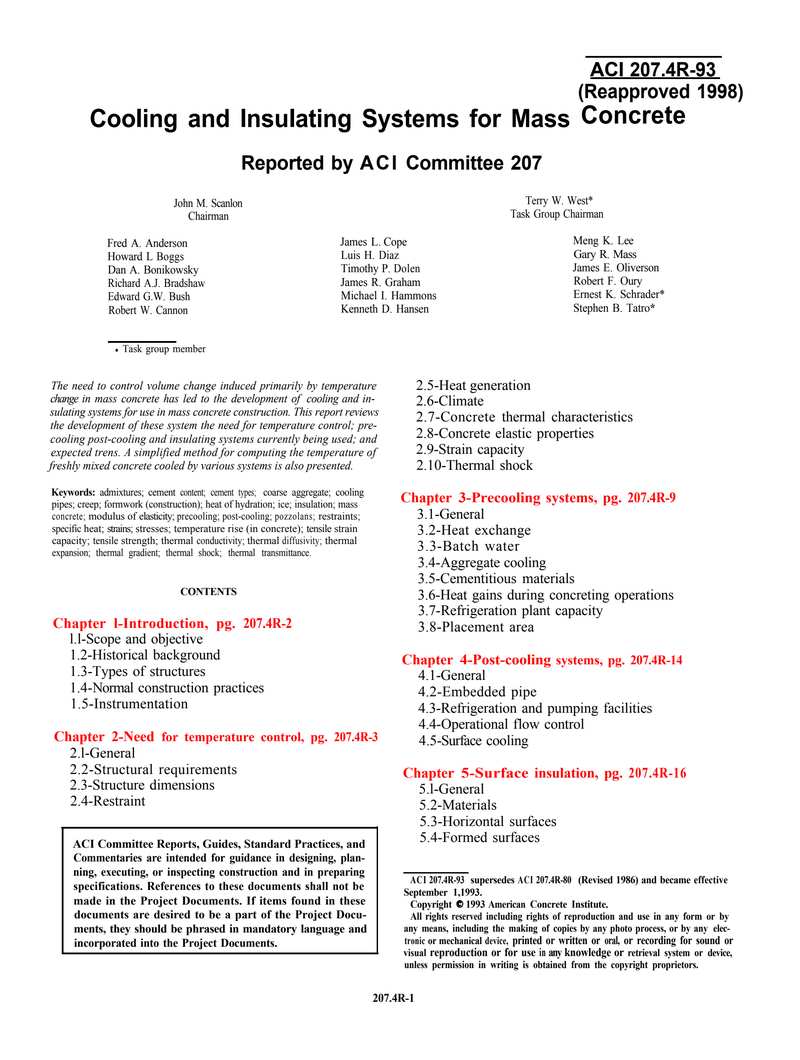
下载标准文件
ACI 207.4R-93
英语 · PDF · 6 页 · 559.79 KB