标准信息
STANDARD INFORMATION- 标准编号
- ACI 124.2R-94
- 所属分类
- ACI 美国混凝土学会标准
- 文件语言
- 英语
- 文件格式
- 文件页数
- 6 页
- 文件大小
- 12.61 KB
· 更新:
标准简介
OVERVIEW中文简介
标准 ACI 124.2R-94 的预览内容
English summary
Preview of standard ACI 124.2R-94
以上为根据文件整理的内容简介。
标准内容预览
DOCUMENT PREVIEWmaintain procedures for unique identification of individual product or batches. This identification should be recorded. 5.8—Process controlThe supplier should identify and plan the production and installation processes, which directly affect quality. They should ensure that these processes are carried out under controlled conditions. Controlled conditions include the following:
5.9—Inspection and testingThe supplier should establish and maintain procedures for inspection and testing activities in order to verify that the specified requirements of the product are met. The required inspection and testing, and the records to be established, should be detailed in the quality plan or procedures. Materials testing should be performed by a laboratory accredited according to the requirements of ASTM C 1077.4 Minimum requirements for inspection of all construction operations should be defined and inspection should follow the guidance of ACI 311.4R, and ACI SP-2.5 Inspectors should have appropriate certification per ACI. Minimum requirements may include inspection of the formwork system, the proper installation of reinforcing steel, the concrete quality as evidenced by required tests, verification of operations and facilities of production, concrete placements, and curing. Other considerations that could be included are reshore and form removal requirements, repair work, core drilling, sampling and testing, weather conditions, bonding and jointing, leveling and alignment operations, finishing operations, grouting operations, and protective coating operations. Periodic photographs documenting construction sequence, job progress, and construction details are desirable. 5.10—Control of measuring and test equipmentThe supplier and subcontractor should establish and maintain procedures to control, calibrate, and maintain inspection, measuring, and test equipment (including test software) used by the supplier to demonstrate the conformance of the product to the specified requirements. Inspection, measuring, and test equipment should be used in a manner that | ensures that the measurement uncertainty is known and is consistent with the required measurement capability. 5.11—Inspection and test statusThe inspection and test status of the product should be identified by suitable means that indicate the conformance or nonconformance of the product with regard to inspection and tests performed. The identification of inspection and test status should be maintained, as defined in the quality plan or procedures, or both, throughout production and installation of the product to ensure that only products that have passed the required inspections and tests (or released under an authorized concession) are dispatched, used, or installed. ACI 311.4R and 311.5R contain detailed recommendations for the inspection of concrete construction. 5.12—Control of nonconforming productThe supplier should establish and maintain procedures to ensure that products that do not conform to specified requirements are prevented from unintended use or installation. This control should provide for identification, documentation, evaluation, segregation (when practical), disposition of nonconforming products, and for notification, as required in the project quality plan. Categories of dispositions are as follows:
Repaired or reworked items should be reinspected. Because repaired items may not comply with the original requirements, criteria for the acceptability of the repair should be furnished to the individual or team performing the inspection. Reworked items should be inspected in accordance with the original requirements. 5.13—Corrective and preventive actionCorrective action request: Significant nonconformance of a recurring nature, that indicates a system problem should be addressed in a corrective action request. Determining the root cause of such conditions, as well as the appropriate corrective actions, should preclude future similar nonconforming conditions. The supplier should establish and maintain procedures for implementing corrective and preventive action. Any corrective or preventive action taken to eliminate the causes of actual or potential nonconformities shall be to a degree appropriate to the magnitude of problems and commensurate |
5.3—Design control
5.4—Document and data control
5.5—Purchasing
5.6—Control of owner supplied product
5.7—Product identification and traceability
5.8—Process control
5.9—Inspection and testing
5.10—Control of measuring and test equipment
5.11—Inspection and test status
5.12—Control of nonconforming product
5.13—Corrective and preventative action
5.14—Handling and storage
5.15—Control of quality records
5.16—Internal quality audits
5.17—Training
5.18—Statistical techniques
Chapter 6—Cited and recommended references
Appendix A—ISO Concepts
CHAPTER 1—INTRODUCTION
1.1—Scope and purpose
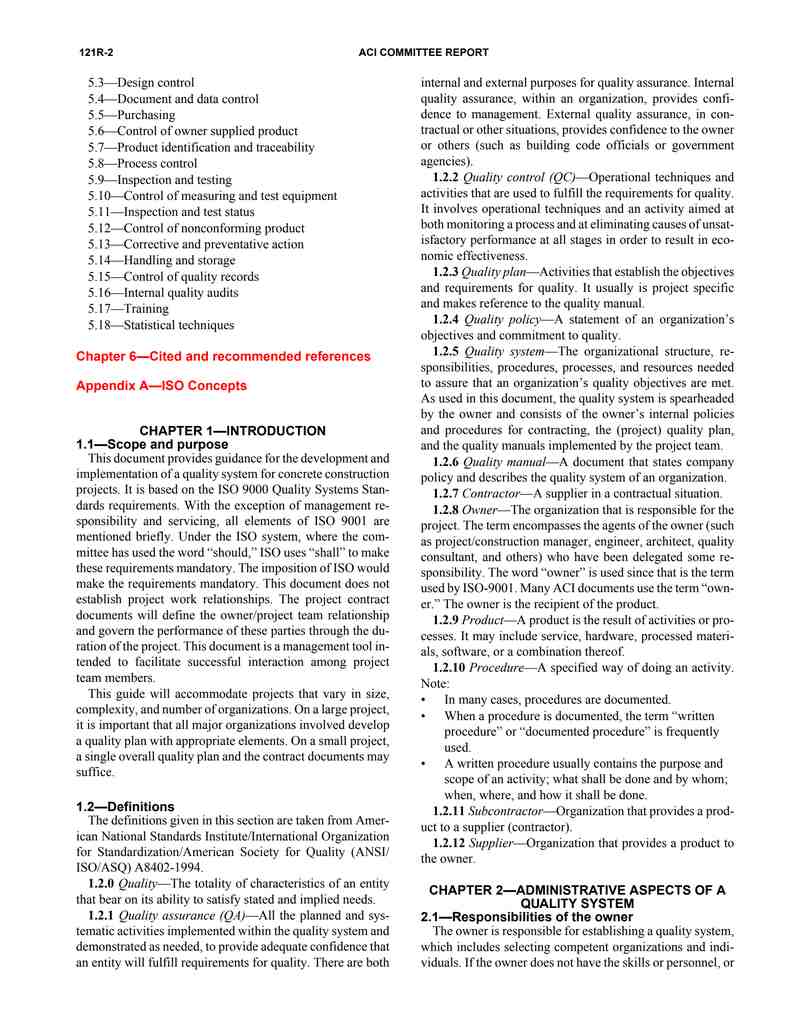
This document provides guidance for the development and implementation of a quality system for concrete construction projects. It is based on the ISO 9000 Quality Systems Standards requirements. With the exception of management responsibility and servicing, all elements of ISO 9001 are mentioned briefly. Under the ISO system, where the committee has used the word “should,” ISO uses “shall” to make these requirements mandatory. The imposition of ISO would make the requirements mandatory. This document does not establish project work relationships. The project contract documents will define the owner/project team relationship and govern the performance of these parties through the duration of the project. This document is a management tool intended to facilitate successful interaction among project team members.
This guide will accommodate projects that vary in size, complexity, and number of organizations. On a large project, it is important that all major organizations involved develop a quality plan with appropriate elements. On a small project, a single overall quality plan and the contract documents may suffice.
1.2—Definitions
The definitions given in this section are taken from American National Standards Institute/International Organization for Standardization/American Society for Quality (ANSI/ISO/ASQ) A8402-1994.
1.2.0 Quality—The totality of characteristics of an entity that bear on its ability to satisfy stated and implied needs.
1.2.1 Quality assurance (QA)—All the planned and systematic activities implemented within the quality system and demonstrated as needed, to provide adequate confidence that an entity will fulfill requirements for quality. There are both internal and external purposes for quality assurance. Internal quality assurance, within an organization, provides confidence to management. External quality assurance, in contractual or other situations, provides confidence to the owner or others (such as building code officials or government agencies).
1.2.2 Quality control (QC)—Operational techniques and activities that are used to fulfill the requirements for quality. It involves operational techniques and an activity aimed at both monitoring a process and at eliminating causes of unsatisfactory performance at all stages in order to result in economic effectiveness.
1.2.3 Quality plan—Activities that establish the objectives and requirements for quality. It usually is project specific and makes reference to the quality manual.
1.2.4 Quality policy—A statement of an organization’s objectives and commitment to quality.
1.2.5 Quality system—The organizational structure, responsibilities, procedures, processes, and resources needed to assure that an organization’s quality objectives are met. As used in this document, the quality system is spearheaded by the owner and consists of the owner’s internal policies and procedures for contracting, the (project) quality plan, and the quality manuals implemented by the project team.
1.2.6 Quality manual—A document that states company policy and describes the quality system of an organization.
1.2.7 Contractor—A supplier in a contractual situation.
1.2.8 Owner—The organization that is responsible for the project. The term encompasses the agents of the owner (such as project/construction manager, engineer, architect, quality consultant, and others) who have been delegated some responsibility. The word “owner” is used since that is the term used by ISO-9001. Many ACI documents use the term “owner.” The owner is the recipient of the product.
1.2.9 Product—A product is the result of activities or processes. It may include service, hardware, processed materials, software, or a combination thereof.
1.2.10 Procedure—A specified way of doing an activity.
Note:
- In many cases, procedures are documented.
- When a procedure is documented, the term “written procedure” or “documented procedure” is frequently used.
- A written procedure usually contains the purpose and scope of an activity; what shall be done and by whom; when, where, and how it shall be done.
1.2.11 Subcontractor—Organization that provides a product to a supplier (contractor).
1.2.12 Supplier—Organization that provides a product to the owner.
CHAPTER 2—ADMINISTRATIVE ASPECTS OF A QUALITY SYSTEM
2.1—Responsibilities of the owner
The owner is responsible for establishing a quality system, which includes selecting competent organizations and individuals. If the owner does not have the skills or personnel, or
2
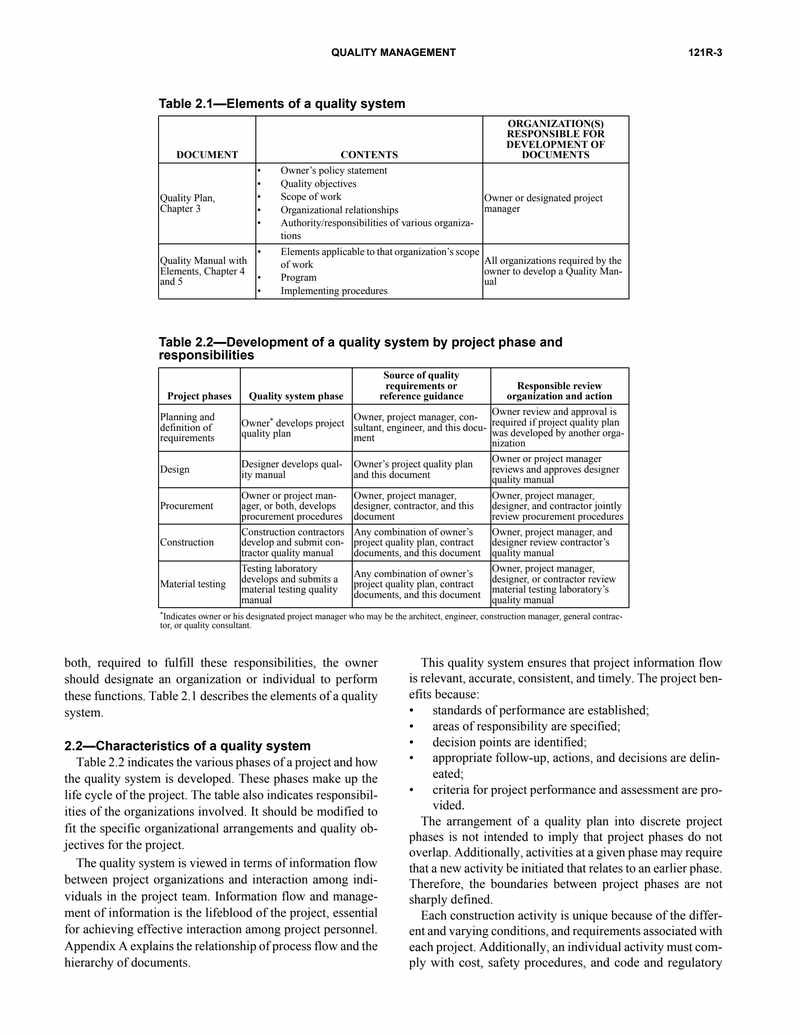
Table 2.1—Elements of a quality system
| DOCUMENT | CONTENTS | ORGANIZATION(S) RESPONSIBLE FOR DEVELOPMENT OF DOCUMENTS |
|---|---|---|
| Quality Plan, Chapter 3 |
| Owner or designated project manager |
| Quality Manual with Elements, Chapter 4 and 5 |
| All organizations required by the owner to develop a Quality Manual |
Table 2.2—Development of a quality system by project phase and responsibilities
| Project phases | Quality system phase | Source of quality requirements or reference guidance | Responsible review organization and action |
|---|---|---|---|
| Planning and definition of requirements | Owner* develops project quality plan | Owner, project manager, consultant, engineer, and this document | Owner review and approval is required if project quality plan was developed by another organization |
| Design | Designer develops quality manual | Owner’s project quality plan and this document | Owner or project manager reviews and approves designer quality manual |
| Procurement | Owner or project manager, or both, develops procurement procedures | Owner, project manager, designer, contractor, and this document | Owner, project manager, designer, and contractor jointly review procurement procedures |
| Construction | Construction contractors develop and submit contractor quality manual | Any combination of owner’s project quality plan, contract documents, and this document | Owner, project manager, and designer review contractor’s quality manual |
| Material testing | Testing laboratory develops and submits a material testing quality manual | Any combination of owner’s project quality plan, contract documents, and this document | Owner, project manager, designer, or contractor review material testing laboratory’s quality manual |
*Indicates owner or his designated project manager who may be the architect, engineer, construction manager, general contractor, or quality consultant.
|
both, required to fulfill these responsibilities, the owner should designate an organization or individual to perform these functions. Table 2.1 describes the elements of a quality system. 2.2—Characteristics of a quality systemTable 2.2 indicates the various phases of a project and how the quality system is developed. These phases make up the life cycle of the project. The table also indicates responsibilities of the organizations involved. It should be modified to fit the specific organizational arrangements and quality objectives for the project. The quality system is viewed in terms of information flow between project organizations and interaction among individuals in the project team. Information flow and management of information is the lifeblood of the project, essential for achieving effective interaction among project personnel. Appendix A explains the relationship of process flow and the hierarchy of documents. |
This quality system ensures that project information flow is relevant, accurate, consistent, and timely. The project benefits because:
The arrangement of a quality plan into discrete project phases is not intended to imply that project phases do not overlap. Additionally, activities at a given phase may require that a new activity be initiated that relates to an earlier phase. Therefore, the boundaries between project phases are not sharply defined. Each construction activity is unique because of the different and varying conditions, and requirements associated with each project. Additionally, an individual activity must comply with cost, safety procedures, and code and regulatory |
3
2.3—Initial project and preconstruction meetings
|
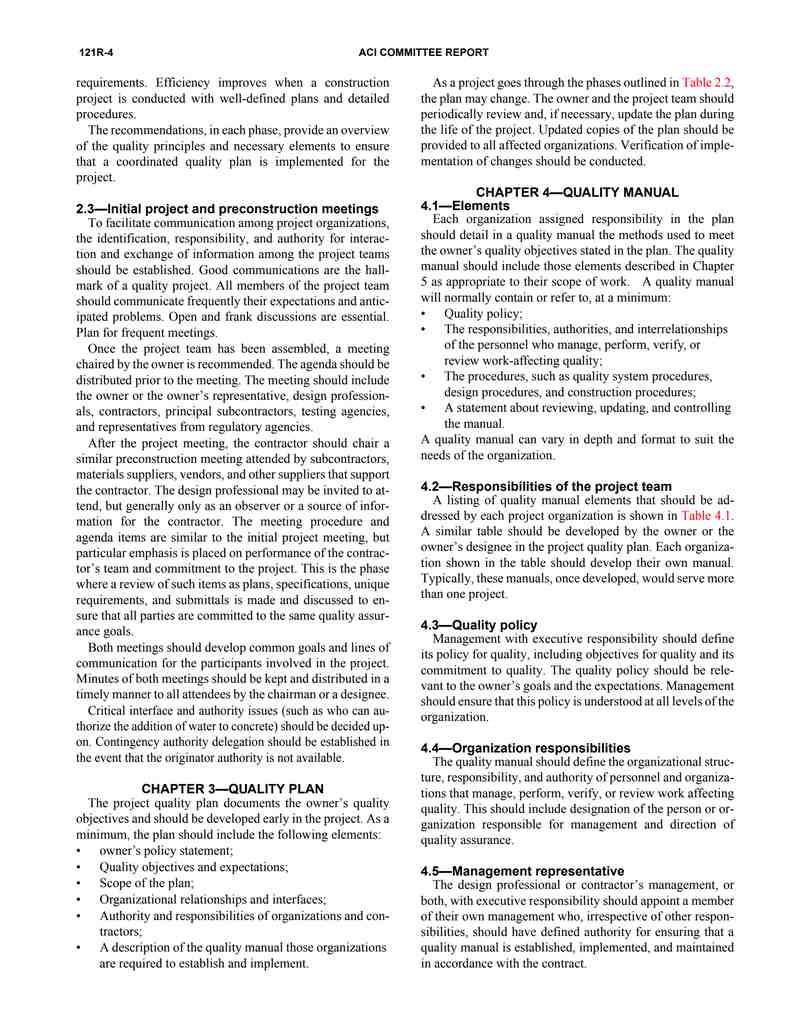
requirements. Efficiency improves when a construction project is conducted with well-defined plans and detailed procedures. The recommendations, in each phase, provide an overview of the quality principles and necessary elements to ensure that a coordinated quality plan is implemented for the project. To facilitate communication among project organizations, the identification, responsibility, and authority for interaction and exchange of information among the project teams should be established. Good communications are the hallmark of a quality project. All members of the project team should communicate frequently their expectations and anticipated problems. Open and frank discussions are essential. Plan for frequent meetings. Once the project team has been assembled, a meeting chaired by the owner is recommended. The agenda should be distributed prior to the meeting. The meeting should include the owner or the owner’s representative, design professionals, contractors, principal subcontractors, testing agencies, and representatives from regulatory agencies. After the project meeting, the contractor should chair a similar preconstruction meeting attended by subcontractors, materials suppliers, vendors, and other suppliers that support the contractor. The design professional may be invited to attend, but generally only as an observer or a source of information for the contractor. The meeting procedure and agenda items are similar to the initial project meeting, but particular emphasis is placed on performance of the contractor’s team and commitment to the project. This is the phase where a review of such items as plans, specifications, unique requirements, and submittals is made and discussed to ensure that all parties are committed to the same quality assurance goals. Both meetings should develop common goals and lines of communication for the participants involved in the project. Minutes of both meetings should be kept and distributed in a timely manner to all attendees by the chairman or a designee. Critical interface and authority issues (such as who can authorize the addition of water to concrete) should be decided upon. Contingency authority delegation should be established in the event that the originator authority is not available. CHAPTER 3—QUALITY PLANThe project quality plan documents the owner’s quality objectives and should be developed early in the project. As a minimum, the plan should include the following elements:
|
As a project goes through the phases outlined in Table 2.2, the plan may change. The owner and the project team should periodically review and, if necessary, update the plan during the life of the project. Updated copies of the plan should be provided to all affected organizations. Verification of implementation of changes should be conducted. CHAPTER 4—QUALITY MANUAL4.1—ElementsEach organization assigned responsibility in the plan should detail in a quality manual the methods used to meet the owner’s quality objectives stated in the plan. The quality manual should include those elements described in Chapter 5 as appropriate to their scope of work. A quality manual will normally contain or refer to, at a minimum:
A quality manual can vary in depth and format to suit the needs of the organization. 4.2—Responsibilities of the project teamA listing of quality manual elements that should be addressed by each project organization is shown in Table 4.1. A similar table should be developed by the owner or the owner’s designee in the project quality plan. Each organization shown in the table should develop their own manual. Typically, these manuals, once developed, would serve more than one project. 4.3—Quality policyManagement with executive responsibility should define its policy for quality, including objectives for quality and its commitment to quality. The quality policy should be relevant to the owner’s goals and the expectations. Management should ensure that this policy is understood at all levels of the organization. 4 |
| Element | Supplier, Architect, Engineer | Supplier, Contractor | Subcontractor | Subcontractor, Material Supplier | Material Testing Laboratory |
|---|---|---|---|---|---|
| Quality policy | X* | X | X | X | X |
| Organization responsibilities | X | X | X |
maintain procedures for unique identification of individual product or batches. This identification should be recorded. 5.8—Process controlThe supplier should identify and plan the production and installation processes, which directly affect quality. They should ensure that these processes are carried out under controlled conditions. Controlled conditions include the following:
5.9—Inspection and testingThe supplier should establish and maintain procedures for inspection and testing activities in order to verify that the specified requirements of the product are met. The required inspection and testing, and the records to be established, should be detailed in the quality plan or procedures. Materials testing should be performed by a laboratory accredited according to the requirements of ASTM C 1077.4 Minimum requirements for inspection of all construction operations should be defined and inspection should follow the guidance of ACI 311.4R, and ACI SP-2.5 Inspectors should have appropriate certification per ACI. Minimum requirements may include inspection of the formwork system, the proper installation of reinforcing steel, the concrete quality as evidenced by required tests, verification of operations and facilities of production, concrete placements, and curing. Other considerations that could be included are reshore and form removal requirements, repair work, core drilling, sampling and testing, weather conditions, bonding and jointing, leveling and alignment operations, finishing operations, grouting operations, and protective coating operations. Periodic photographs documenting construction sequence, job progress, and construction details are desirable. 5.10—Control of measuring and test equipmentThe supplier and subcontractor should establish and maintain procedures to control, calibrate, and maintain inspection, measuring, and test equipment (including test software) used by the supplier to demonstrate the conformance of the product to the specified requirements. Inspection, measuring, and test equipment should be used in a manner that | ensures that the measurement uncertainty is known and is consistent with the required measurement capability. 5.11—Inspection and test statusThe inspection and test status of the product should be identified by suitable means that indicate the conformance or nonconformance of the product with regard to inspection and tests performed. The identification of inspection and test status should be maintained, as defined in the quality plan or procedures, or both, throughout production and installation of the product to ensure that only products that have passed the required inspections and tests (or released under an authorized concession) are dispatched, used, or installed. ACI 311.4R and 311.5R contain detailed recommendations for the inspection of concrete construction. 5.12—Control of nonconforming productThe supplier should establish and maintain procedures to ensure that products that do not conform to specified requirements are prevented from unintended use or installation. This control should provide for identification, documentation, evaluation, segregation (when practical), disposition of nonconforming products, and for notification, as required in the project quality plan. Categories of dispositions are as follows:
Repaired or reworked items should be reinspected. Because repaired items may not comply with the original requirements, criteria for the acceptability of the repair should be furnished to the individual or team performing the inspection. Reworked items should be inspected in accordance with the original requirements. 5.13—Corrective and preventive actionCorrective action request: Significant nonconformance of a recurring nature, that indicates a system problem should be addressed in a corrective action request. Determining the root cause of such conditions, as well as the appropriate corrective actions, should preclude future similar nonconforming conditions. The supplier should establish and maintain procedures for implementing corrective and preventive action. Any corrective or preventive action taken to eliminate the causes of actual or potential nonconformities shall be to a degree appropriate to the magnitude of problems and commensurate |
预览内容由文件识别整理,表格、公式及文字请以原始文件为准。
原文图片预览
PAGE IMAGES
下载标准文件
ACI 124.2R-94
英语 · PDF · 6 页 · 12.61 KB