
标准信息
STANDARD INFORMATION- 标准编号
- AS4041 2006 Pressure Piping
- 所属分类
- AS 澳大利亚标准
- 发布机构
- Standards Australia
- 版本年份
- 2006
- 文件语言
- 英语
- 文件格式
- 文件页数
- 6 页
- 文件大小
- 6.07 MB
中文名称为参考译名,文件语言以原文为准。
· 更新:
标准简介
OVERVIEW中文简介
该标准规定了压力管道的设计、制造、安装、测试和调试的最低工程要求。它适用于金属和非金属压力管道,旨在为所有者、设计者、制造商、检验机构和用户指导,确保公众和操作人员的保护。
English summary
This standard specifies the minimum engineering requirements for the safe design, fabrication, installation, testing, and commissioning of pressure piping. It applies to both metallic and non-metallic pressure piping and provides guidance for owners, designers, manufacturers, inspection bodies, and users to ensure the protection of the general public and personnel.
以上为根据文件整理的内容简介。
相关标签
标准内容预览
DOCUMENT PREVIEWAustralian Standard®
Pressure piping
1
Committee ME-001, Pressure Equipment
This Australian Standard® was prepared by Committee ME-001, Pressure Equipment. It was approved on behalf of the Council of Standards Australia on 16 June 2006.
This Standard was published on 20 September 2006.
The following are represented on Committee ME-001:
- A.C.T. WorkCover
- Australasian Institute of Engineer Surveyors
- Australian Aluminium Council
- Australian Building Codes Board
- Australian Chamber of Commerce and Industry
- Australian Industry Group
- Australian Institute for the Certification of Inspection Personnel
- Australian Institute of Energy
- Australian Institute of Petroleum
- Bureau of Steel Manufacturers of Australia
- Department of Administrative and Information Services, SA
- Department of Consumer & Employment Protection, Worksafe Division, WA
- Department of Infrastructure, Energy and Resources, Tas.
- Energy Networks Association
- Engineers Australia
- Insurance Council of Australia
- LPG Australia
- Materials Australia
- National Association of Testing Authorities
- Pressure Equipment Association
- Victorian WorkCover Authority
- Welding Technology Institute of Australia
- WorkCover, NSW
This Standard was issued in draft form for comment as DR 05158.
Standards Australia wishes to acknowledge the participation of the expert individuals that contributed to the development of this Standard through their representation on the Committee and through public comment period.
Keeping Standards up-to-date
Australian Standards® are living documents that reflect progress in science, technology and systems. To maintain their currency, all Standards are periodically reviewed, and new editions are published. Between editions, amendments may be issued.
Standards may also be withdrawn. It is important that readers assure themselves they are using a current Standard, which should include any amendments that may have been published since the Standard was published.
Detailed information about Australian Standards, drafts, amendments and new projects can be found by visiting www.standards.org.au
Standards Australia welcomes suggestions for improvements, and encourages readers to notify us immediately of any apparent inaccuracies or ambiguities. Contact us via email at mail@standards.org.au, or write to Standards Australia, GPO Box 476, Sydney, NSW 2001.
2
Australian Standard®
Pressure piping
Originated in part as part of AS CB15—1959.
Previous edition AS 4041—1998.
Third edition 2006.
COPYRIGHT
© Standards Australia
All rights are reserved. No part of this work may be reproduced or copied in any form or by any means, electronic or mechanical, including photocopying, without the written permission of the publisher.
Published by Standards Australia, GPO Box 476, Sydney, NSW 2001, Australia
ISBN 0 7337 7707 4
3
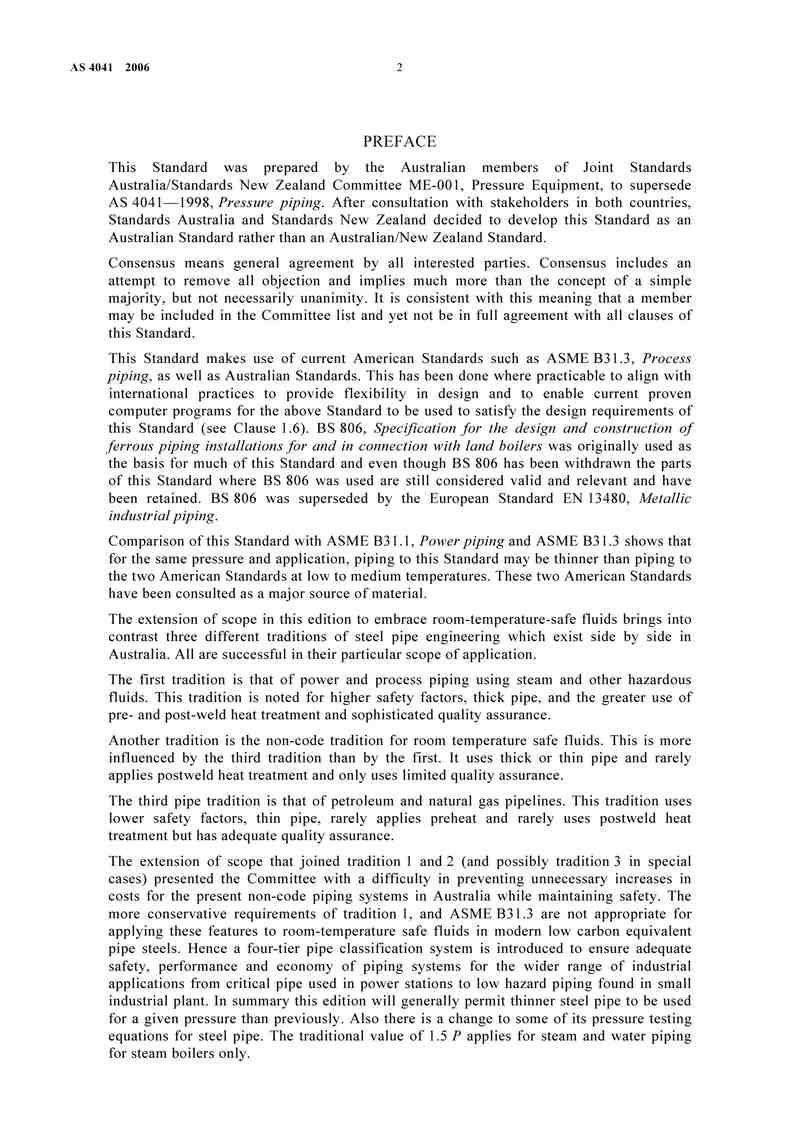
PREFACE
This Standard was prepared by the Australian members of Joint Standards Australia/Standards New Zealand Committee ME-001, Pressure Equipment, to supersede AS 4041—1998, Pressure piping. After consultation with stakeholders in both countries, Standards Australia and Standards New Zealand decided to develop this Standard as an Australian Standard rather than an Australian/New Zealand Standard.
Consensus means general agreement by all interested parties. Consensus includes an attempt to remove all objection and implies much more than the concept of a simple majority, but not necessarily unanimity. It is consistent with this meaning that a member may be included in the Committee list and yet not be in full agreement with all clauses of this Standard.
This Standard makes use of current American Standards such as ASME B31.3, Process piping, as well as Australian Standards. This has been done where practicable to align with international practices to provide flexibility in design and to enable current proven computer programs for the above Standard to be used to satisfy the design requirements of this Standard (see Clause 1.6). BS 806, Specification for the design and construction of ferrous piping installations for and in connection with land boilers was originally used as the basis for much of this Standard and even though BS 806 has been withdrawn the parts of this Standard where BS 806 was used are still considered valid and relevant and have been retained. BS 806 was superseded by the European Standard EN 13480, Metallic industrial piping.
Comparison of this Standard with ASME B31.1, Power piping and ASME B31.3 shows that for the same pressure and application, piping to this Standard may be thinner than piping to the two American Standards at low to medium temperatures. These two American Standards have been consulted as a major source of material.
The extension of scope in this edition to embrace room-temperature-safe fluids brings into contrast three different traditions of steel pipe engineering which exist side by side in Australia. All are successful in their particular scope of application.
The first tradition is that of power and process piping using steam and other hazardous fluids. This tradition is noted for higher safety factors, thick pipe, and the greater use of pre- and post-weld heat treatment and sophisticated quality assurance.
Another tradition is the non-code tradition for room temperature safe fluids. This is more influenced by the third tradition than by the first. It uses thick or thin pipe and rarely applies postweld heat treatment and only uses limited quality assurance.
The third pipe tradition is that of petroleum and natural gas pipelines. This tradition uses lower safety factors, thin pipe, rarely applies preheat and rarely uses postweld heat treatment but has adequate quality assurance.
The extension of scope that joined tradition 1 and 2 (and possibly tradition 3 in special cases) presented the Committee with a difficulty in preventing unnecessary increases in costs for the present non-code piping systems in Australia while maintaining safety. The more conservative requirements of tradition 1, and ASME B31.3 are not appropriate for applying these features to room-temperature safe fluids in modern low carbon equivalent pipe steels. Hence a four-tier pipe classification system is introduced to ensure adequate safety, performance and economy of piping systems for the wider range of industrial applications from critical pipe used in power stations to low hazard piping found in small industrial plant. In summary this edition will generally permit thinner steel pipe to be used for a given pressure than previously. Also there is a change to some of its pressure testing equations for steel pipe. The traditional value of 1.5 P applies for steam and water piping for steam boilers only.
4
3
This Standard is arranged similarly to AS 1210, Pressure vessels, including Supplement 1, Unfired Pressure Vessels—Advance design and construction (Supplement to AS 1210—1997), and its class system parallels that of these Standards. Without inferring equality of the safety factor, the alignment of classes is approximately as follows:
| AS 4041 Class | AS 1210 Class |
|---|---|
| 1 | 1H |
| 2A | 2H |
| 2P | — |
| 3 | 3 |
Australian, American, and European material and component Standards which are used to a considerable extent in Australia have been listed. This Standard now provides for a wider range of materials than previously covered. A basis for specifying non-metallic pressure piping is given by reference to ASME B31.3 but with provision for substitution of equivalent Australian Standards.
The Standard follows in principle other Standards forming part of AS/NZS 1200, Pressure equipment, in providing guidance for owners, designers, manufacturers, inspection bodies and users in the form of minimum engineering requirements for the safe design, fabrication, installation, testing, and commissioning of pressure piping based on world-wide advances and experience. It also provides basic requirements and references for welding qualification, non-destructive testing, operation, maintenance and in-service inspection.
The principle objective of this Standard is to provide clear uniform national requirements which will result in reasonably certain protection of the general public, persons installing and operating the piping, and of adjacent property and environment, which give economic piping, and which show where a margin for deterioration may be necessary to give adequate and safe service life. Additional requirements may be necessary to prevent damage from unusual conditions, third parties and abnormal forces.
The Standard provides an authoritative source of important principles, data, and practical guidelines to be used by responsible and competent persons. It is not practicable nor indeed desirable for the Standard to specify every aspect of piping design and fabrication. It is neither an instruction manual nor a complete design or construction specification. The Standard does not replace the need for appropriate experience, competent engineering judgement, and the application of fundamental engineering principles.
Acknowledgment is gratefully made to the American Society of Mechanical Engineers and the British Standards Institution for the considerable assistance provided by the above referenced national Standards.
Statements expressed in mandatory terms in notes and footnotes to tables and figures are deemed to be requirements of this Standard.
The terms ‘normative’ and ‘informative’ have been used in this Standard to define the application of the Appendix to which they apply. A ‘normative’ appendix is an integral part of a Standard, whereas an ‘informative’ appendix is only for information and guidance.
5
CONTENTS
Page
SECTION 1 SCOPE AND GENERAL
| 1.1 | SCOPE | 7 |
| 1.2 | RESPONSIBILITIES | 8 |
| 1.3 | NOT ALLOCATED | 8 |
| 1.4 | APPLICATION OF PIPING CLASSES FOR SERVICE CONDITIONS | 10 |
| 1.5 | SELECTION OF PIPING CLASS | 11 |
| 1.6 | ALTERNATIVE STANDARDS | 15 |
| 1.7 | DEFINITIONS | 15 |
| 1.8 | NOTATION | 21 |
| 1.9 | NON-SI UNITS | 21 |
| 1.10 | REFERENCED DOCUMENTS | 21 |
| 1.11 | REPORTS AND CERTIFICATES | 21 |
| 1.12 | NOT ALLOCATED | 22 |
| 1.13 | NOT ALLOCATED | 22 |
| 1.14 | NON-METALLIC PIPING | 22 |
| 1.15 | INTERPRETATION OF STANDARDS | 22 |
| 1.16 | NEW DESIGNS, MATERIALS AND FABRICATION METHODS | 22 |
| 1.17 | DIMENSIONAL AND MASS TOLERANCES | 22 |
| 1.18 | ALTERNATIVE DESIGN OF ACCESSORIES | 22 |
SECTION 2 MATERIALS AND COMPONENTS
| 2.1 | GENERAL | 23 |
| 2.2 | QUALIFICATION OF MATERIALS AND COMPONENTS | 23 |
| 2.3 | NOT ALLOCATED | 27 |
| 2.4 | PROPERTIES OF MATERIALS | 28 |
| 2.5 | IDENTIFICATION OF MATERIALS AND COMPONENTS | 28 |
| 2.6 | LIMITATIONS ON APPLICATION | 28 |
| 2.7 | MATERIALS AND COMPONENTS FOR CORROSIVE SERVICE | 33 |
| 2.8 | DISSIMILAR MATERIALS | 33 |
| 2.9 | BACKING RINGS AND FUSIBLE INSERTS | 33 |
| 2.10 | BRAZING MATERIALS | 34 |
| 2.11 | MATERIALS FOR LOW TEMPERATURE SERVICE | 34 |
SECTION 3 DESIGN
| 3.1 | GENERAL | 55 |
| 3.2 | DESIGN PRESSURE | 55 |
| 3.3 | DESIGN TEMPERATURE | 55 |
| 3.4 | DESIGN LIFE | 56 |
| 3.5 | STATIC AND DYNAMIC LOADS AND FORCES | 56 |
| 3.6 | RISK ANALYSIS | 57 |
| 3.7 | THERMAL EFFECTS | 57 |
| 3.8 | EFFECTS OF MOVEMENT AT SUPPORTS, ANCHORS AND TERMINALS | 58 |
| 3.9 | DESIGN PRESSURE AND TEMPERATURE FOR PIPING ASSOCIATED WITH STEAM BOILERS | 58 |
| 3.10 | DESIGN CRITERIA | 60 |
| 3.11 | DESIGN STRENGTH | 63 |
| 3.12 | DESIGN FACTORS | 66 |
| 3.13 | ALLOWANCES | 69 |
| 3.14 | WALL THICKNESS OF STRAIGHT PIPE | 70 |
6
预览内容由文件识别整理,表格、公式及文字请以原始文件为准。
原文图片预览
PAGE IMAGES

下载标准文件
AS4041 2006 Pressure Piping
英语 · PDF · 6 页 · 6.07 MB