ASNZS1170.0 2002 Structural Design Actions - Gener
ASNZS1170.0 2002 Structural Design Actions - General Principles Supplement (incl Amdt 1)
ASNZS1170.0 2002 Structural Design Actions - General Principles Supplement (incl Amdt 1)
标准信息
STANDARD INFORMATION- 标准编号
- ASNZS1170.0 2002 Structural Design Actions - Gener
- 所属分类
- AS 澳大利亚标准
- 文件语言
- 英语
- 文件格式
- 文件页数
- 6 页
- 文件大小
- 293.84 KB
· 更新:
标准简介
OVERVIEW中文简介
标准 ASNZS1170.0 2002 Structural Design Actions - General Principles Supplement (incl Amdt 1) 的预览内容
English summary
Preview of standard ASNZS1170.0 2002 Structural Design Actions - General Principles Supplement (incl Amdt 1)
以上为根据文件整理的内容简介。
标准内容预览
DOCUMENT PREVIEWSTANDARDS AUSTRALIA/STANDARDS NEW ZEALAND
Australian/New Zealand Standard
Structural design actions—General principles—Commentary
(Supplement to AS/NZS 1170.0:2002)
SECTION C1 SCOPE AND GENERAL
C1.1 SCOPE
This Commentary is intended to be read in conjunction with AS/NZS 1170.0:2002. It explains the provisions of and, in some cases, suggests approaches that may satisfy the intent of the Standard. Commentary Clauses are not mandatory. Lists of references are also given for further reading.
The Standard (AS/NZS 1170.0) has been revised as a joint Australian/New Zealand Standard. It specifies the basic procedure for the structural design of structures including buildings. Other documents may be relevant for the details of building design (e.g., design of fire escapes) that are not needed for the design of the structure.
The Standard incorporates the fundamentals of the limit states method and enables the designer to confirm the design of a structure. The intention is that confirmation establishes the ability of the proposed structure to resist known or foreseeable types of action appropriate to the intended use and design working life of the structure.
The determination of structural resistance is covered by the Standards for design of materials.
Much of the philosophy and some of the text (for example, most of the definitions and notation) are drawn from ISO Standards, including ISO 2394, ISO 3898, ISO 4356 and ISO 8930.
The general principles given in the Standard are relevant to the design of any structure. However, the information may not be sufficient for some structure types because their design is more complex (due to the inherent behaviour of the structure) or involves loadings that are not covered (type of action or load case), or other Standards give design criteria.
Structures and structural elements should be designed so that they are suited for their intended use during the design working life.
ISO 2394 states the following:
‘In particular, they shall fulfil, with appropriate degrees of reliability, the following objectives:
(a) They shall perform adequately under all expected actions.
(b) They shall withstand both extreme actions and frequently repeated actions occurring during their construction and anticipated use.
(c) They shall have structural robustness.’
These three objectives enunciate the serviceability, ultimate and fatigue, and progressive collapse (structural robustness) aspects of design.
6
AS/NZS 1170.0 Supp 1:2002
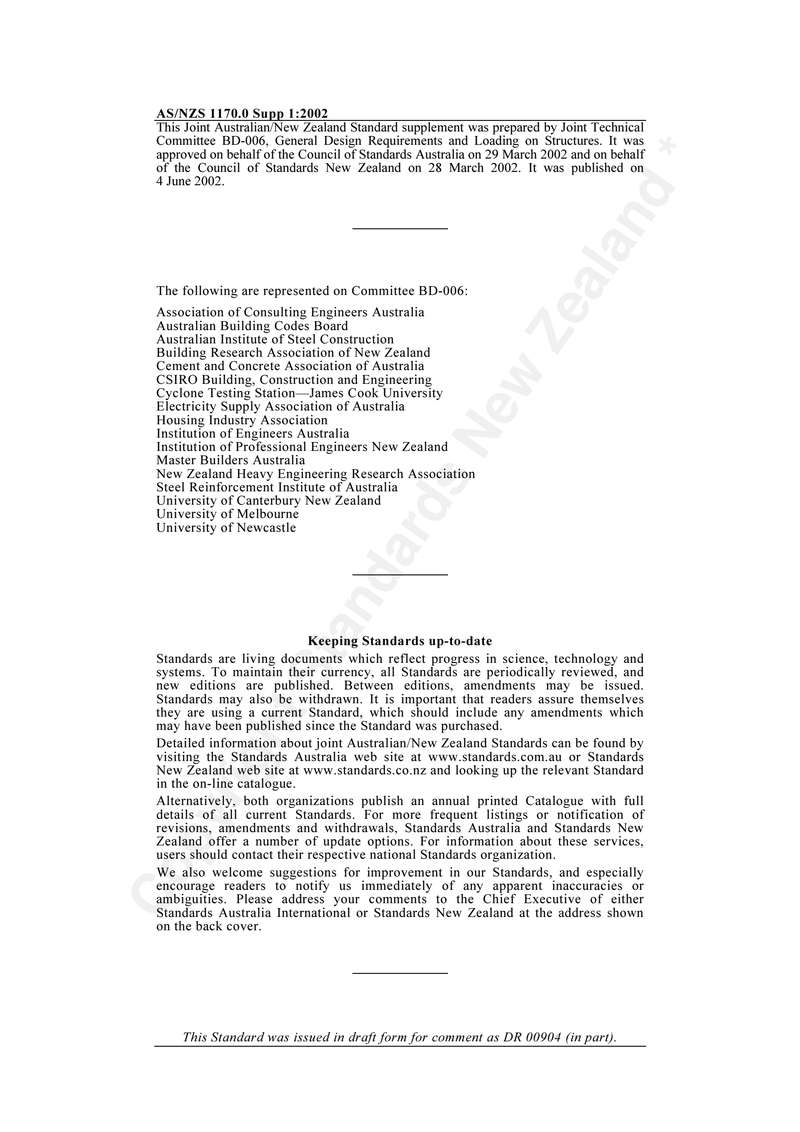
This Joint Australian/New Zealand Standard supplement was prepared by Joint Technical Committee BD-006, General Design Requirements and Loading on Structures. It was approved on behalf of the Council of Standards Australia on 29 March 2002 and on behalf of the Council of Standards New Zealand on 28 March 2002. It was published on 4 June 2002.
The following are represented on Committee BD-006:
- Association of Consulting Engineers Australia
- Australian Building Codes Board
- Australian Institute of Steel Construction
- Building Research Association of New Zealand
- Cement and Concrete Association of Australia
- CSIRO Building, Construction and Engineering
- Cyclone Testing Station—James Cook University
- Electricity Supply Association of Australia
- Housing Industry Association
- Institution of Engineers Australia
- Institution of Professional Engineers New Zealand
- Master Builders Australia
- New Zealand Heavy Engineering Research Association
- Steel Reinforcement Institute of Australia
- University of Canterbury New Zealand
- University of Melbourne
- University of Newcastle
Keeping Standards up-to-date
Standards are living documents which reflect progress in science, technology and systems. To maintain their currency, all Standards are periodically reviewed, and new editions are published. Between editions, amendments may be issued. Standards may also be withdrawn. It is important that readers assure themselves they are using a current Standard, which should include any amendments which may have been published since the Standard was purchased.
Detailed information about joint Australian/New Zealand Standards can be found by visiting the Standards Australia web site at www.standards.com.au or Standards New Zealand web site at www.standards.co.nz and looking up the relevant Standard in the on-line catalogue.
Alternatively, both organizations publish an annual printed Catalogue with full details of all current Standards. For more frequent listings or notification of revisions, amendments and withdrawals, Standards Australia and Standards New Zealand offer a number of update options. For information about these services, users should contact their respective national Standards organization.
We also welcome suggestions for improvement in our Standards, and especially encourage readers to notify us immediately of any apparent inaccuracies or ambiguities. Please address your comments to the Chief Executive of either Standards Australia International or Standards New Zealand at the address shown on the back cover.
This Standard was issued in draft form for comment as DR 00904 (in part).
2
AS/NZS 1170.0 Supplement 1:2002
Structural design actions—General principles—Commentary (Supplement to AS/NZS 1170.0:2002)
Originated in Australia as part of AS 1170.1—1989.
Originated in New Zealand as part of NZS 4203:1976.
Previous New Zealand edition NZS 4203:1992.
AS 1170.1—1989 and NZS 4203:1992 jointly revised, amalgamated and redesignated in part as AS/NZS 1170.0 Supplement 1:2002.
Reissued incorporating Amendment No. 1 (November 2003).
COPYRIGHT
© Standards Australia/Standards New Zealand
All rights are reserved. No part of this work may be reproduced or copied in any form or by any means, electronic or mechanical, including photocopying, without the written permission of the publisher.
Jointly published by Standards Australia International Ltd, GPO Box 5420, Sydney, NSW 2001 and Standards New Zealand, Private Bag 2439, Wellington 6020
ISBN 0 7337 4470 2
3
PREFACE
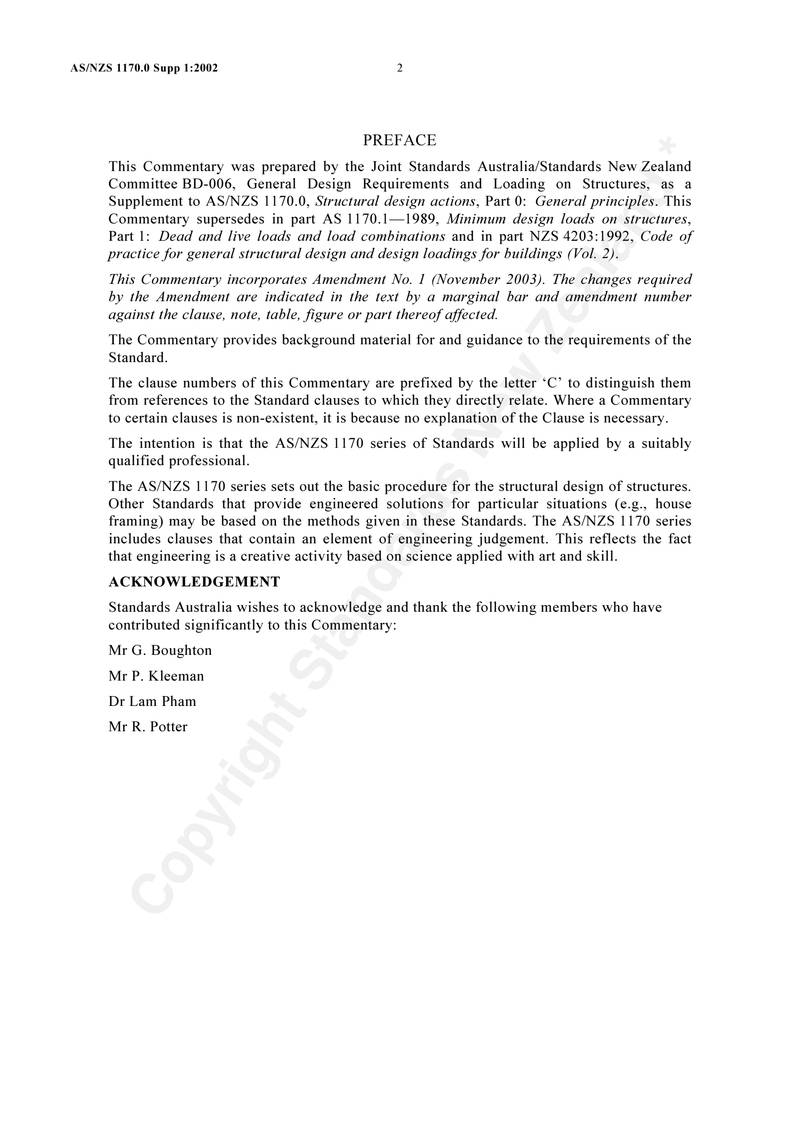
This Commentary was prepared by the Joint Standards Australia/Standards New Zealand Committee BD-006, General Design Requirements and Loading on Structures, as a Supplement to AS/NZS 1170.0, Structural design actions, Part 0: General principles. This Commentary supersedes in part AS 1170.1—1989, Minimum design loads on structures, Part 1: Dead and live loads and load combinations and in part NZS 4203:1992, Code of practice for general structural design and design loadings for buildings (Vol. 2).
This Commentary incorporates Amendment No. 1 (November 2003). The changes required by the Amendment are indicated in the text by a marginal bar and amendment number against the clause, note, table, figure or part thereof affected.
The Commentary provides background material for and guidance to the requirements of the Standard.
The clause numbers of this Commentary are prefixed by the letter ‘C’ to distinguish them from references to the Standard clauses to which they directly relate. Where a Commentary to certain clauses is non-existent, it is because no explanation of the Clause is necessary.
The intention is that the AS/NZS 1170 series of Standards will be applied by a suitably qualified professional.
The AS/NZS 1170 series sets out the basic procedure for the structural design of structures. Other Standards that provide engineered solutions for particular situations (e.g., house framing) may be based on the methods given in these Standards. The AS/NZS 1170 series includes clauses that contain an element of engineering judgement. This reflects the fact that engineering is a creative activity based on science applied with art and skill.
ACKNOWLEDGEMENT
Standards Australia wishes to acknowledge and thank the following members who have contributed significantly to this Commentary:
Mr G. Broughton
Mr P. Kleeman
Dr Lam Pham
Mr R. Potter
4
CONTENTS
| Page | |
|---|---|
| SECTION C1 SCOPE AND GENERAL | |
| C1.1 SCOPE | 4 |
| C1.2 APPLICATION | 5 |
| C1.3 REFERENCED DOCUMENTS | 5 |
| C1.4 DEFINITIONS | 6 |
| C1.5 NOTATION | 6 |
| SECTION C2 STRUCTURAL DESIGN PROCEDURE | |
| C2.1 GENERAL | 7 |
| C2.2 ULTIMATE LIMIT STATES | 7 |
| C2.3 SERVICEABILITY LIMIT STATES | 8 |
| SECTION C3 ANNUAL PROBABILITY OF EXCEEDANCE | |
| (FOR NEW ZEALAND USE ONLY) | |
| C3.1 GENERAL | 9 |
| C3.2 IMPORTANCE LEVELS | 9 |
| C3.3 DESIGN WORKING LIFE | 9 |
| C3.4 ANNUAL PROBABILITY OF EXCEEDANCE | 9 |
| SECTION C4 COMBINATIONS OF ACTIONS | |
| C4.1 GENERAL | 10 |
| C4.2 COMBINATIONS OF ACTIONS FOR ULTIMATE LIMIT STATES | 10 |
| C4.3 COMBINATIONS OF ACTIONS FOR SERVICEABILITY LIMIT STATES | 13 |
| C4.4 CYCLIC ACTIONS | 13 |
| SECTION C5 METHODS OF ANALYSIS | |
| C5.1 GENERAL | 14 |
| C5.2 STRUCTURAL MODELS | 14 |
| SECTION C6 STRUCTURAL ROBUSTNESS | |
| C6.1 GENERAL | 16 |
| C6.2 LOAD PATHS | 16 |
| SECTION C7 CONFIRMATION METHODS | |
| C7.1 GENERAL | 17 |
| C7.2 ULTIMATE LIMIT STATES | 17 |
| C7.3 SERVICEABILITY LIMIT STATES | 17 |
| APPENDICES | |
| CA SPECIAL STUDIES | 19 |
| CB USE OF TEST DATA FOR DESIGN | 21 |
| CC GUIDELINES FOR SERVICEABILITY LIMITS | 23 |
| CD FACTORS FOR USE WITH AS 1170.4—1993 | 24 |
| CE FACTORS FOR USE WITH AS 1170.3—1990 | 25 |
| CF ANNUAL PROBABILITY OF EXCEEDANCE | |
| (FOR AUSTRALIAN USE ONLY—STRUCTURES FOR WHICH DESIGN | |
| EVENTS ARE NOT GIVEN) | 26 |
| CZ ADDITIONAL LOAD INFORMATION | 29 |
5
STANDARDS AUSTRALIA/STANDARDS NEW ZEALAND
Australian/New Zealand Standard
Structural design actions—General principles—Commentary
(Supplement to AS/NZS 1170.0:2002)
SECTION C1 SCOPE AND GENERAL
C1.1 SCOPE
This Commentary is intended to be read in conjunction with AS/NZS 1170.0:2002. It explains the provisions of and, in some cases, suggests approaches that may satisfy the intent of the Standard. Commentary Clauses are not mandatory. Lists of references are also given for further reading.
The Standard (AS/NZS 1170.0) has been revised as a joint Australian/New Zealand Standard. It specifies the basic procedure for the structural design of structures including buildings. Other documents may be relevant for the details of building design (e.g., design of fire escapes) that are not needed for the design of the structure.
The Standard incorporates the fundamentals of the limit states method and enables the designer to confirm the design of a structure. The intention is that confirmation establishes the ability of the proposed structure to resist known or foreseeable types of action appropriate to the intended use and design working life of the structure.
The determination of structural resistance is covered by the Standards for design of materials.
Much of the philosophy and some of the text (for example, most of the definitions and notation) are drawn from ISO Standards, including ISO 2394, ISO 3898, ISO 4356 and ISO 8930.
The general principles given in the Standard are relevant to the design of any structure. However, the information may not be sufficient for some structure types because their design is more complex (due to the inherent behaviour of the structure) or involves loadings that are not covered (type of action or load case), or other Standards give design criteria.
Structures and structural elements should be designed so that they are suited for their intended use during the design working life.
ISO 2394 states the following:
‘In particular, they shall fulfil, with appropriate degrees of reliability, the following objectives:
(a) They shall perform adequately under all expected actions.
(b) They shall withstand both extreme actions and frequently repeated actions occurring during their construction and anticipated use.
(c) They shall have structural robustness.’
These three objectives enunciate the serviceability, ultimate and fatigue, and progressive collapse (structural robustness) aspects of design.
6
预览内容由文件识别整理,表格、公式及文字请以原始文件为准。
原文图片预览
PAGE IMAGES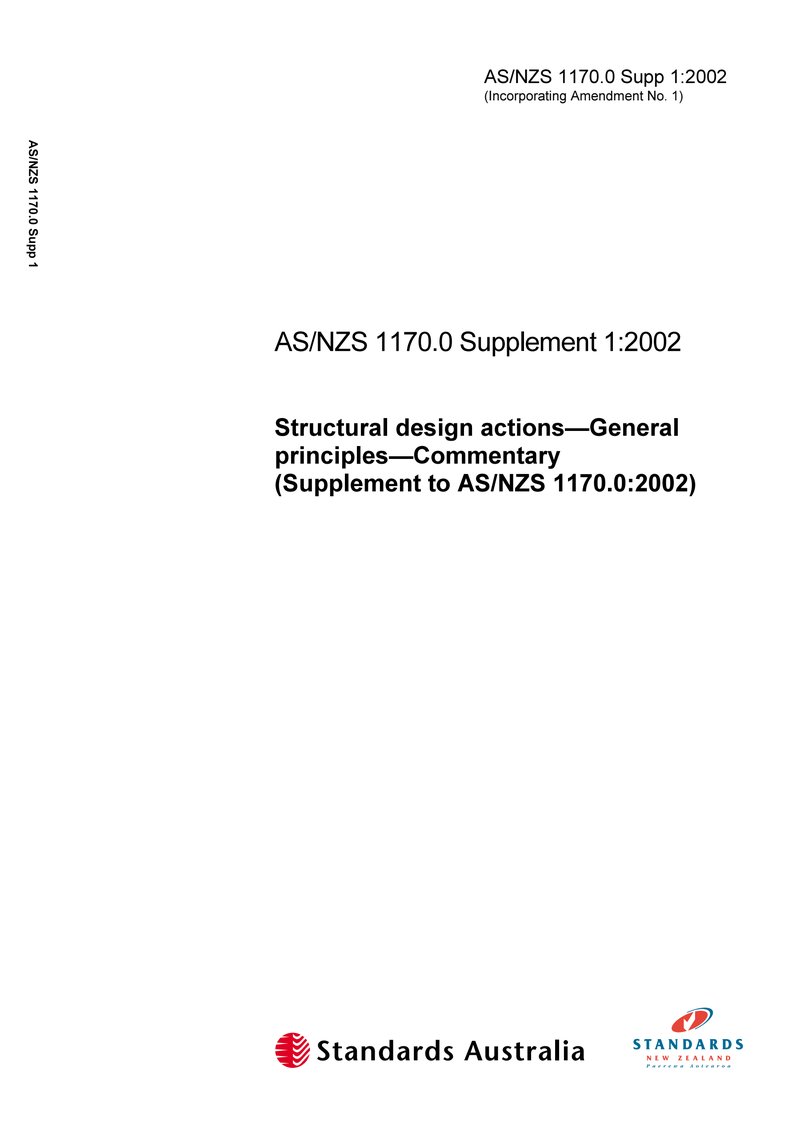

下载标准文件
ASNZS1170.0 2002 Structural Design Actions - Gener
英语 · PDF · 6 页 · 293.84 KB