AS NZS 3008.1.1.1998 Electrical installations Sele
AS NZS 3008.1.1.1998 Electrical installations Selection of cables Part 1.1 Cables for alternating
AS NZS 3008.1.1.1998 Electrical installations Selection of cables Part 1.1 Cables for alternating
标准信息
STANDARD INFORMATION- 标准编号
- AS NZS 3008.1.1.1998 Electrical installations Sele
- 所属分类
- AS 澳大利亚标准
- 文件语言
- 英语
- 文件格式
- 文件页数
- 6 页
- 文件大小
- 807.77 KB
· 更新:
标准简介
OVERVIEW中文简介
标准 AS NZS 3008.1.1.1998 Electrical installations Selection of cables Part 1.1 Cables for alternating 的预览内容
English summary
Preview of standard AS NZS 3008.1.1.1998 Electrical installations Selection of cables Part 1.1 Cables for alternating
以上为根据文件整理的内容简介。
标准内容预览
DOCUMENT PREVIEWCONTENTS
| Page | |
|---|---|
| FOREWORD | 8 |
| SECTION 1 SCOPE AND GENERAL | |
| 1.1 SCOPE AND APPLICATION | 9 |
| 1.2 ALTERNATIVE SPECIFICATIONS | 9 |
| 1.3 REFERENCED AND RELATED DOCUMENTS | 10 |
| 1.4 DEFINITIONS | 11 |
| SECTION 2 CABLE SELECTION PROCEDURE | |
| 2.1 GENERAL | 12 |
| 2.2 SELECTION PROCESS | 12 |
| 2.3 DETERMINATION OF MINIMUM CABLE SIZE BASED ON CURRENT-CARRYING CAPACITY CONSIDERATIONS | 12 |
| 2.4 DETERMINATION OF MINIMUM CABLE SIZE BASED ON VOLTAGE DROP CONSIDERATIONS | 13 |
| 2.5 DETERMINATION OF MINIMUM CABLE SIZE BASED ON THE SHORT-CIRCUIT TEMPERATURE CONSIDERATIONS | 14 |
| SECTION 3 CURRENT-CARRYING CAPACITY | |
| 3.1 RATINGS | 15 |
| 3.2 TYPES OF CONDUCTORS | 15 |
| 3.3 TYPES OF CABLE | 16 |
| 3.4 INSTALLATION CONDITIONS | 18 |
| 3.5 EXTERNAL INFLUENCES ON CABLES | 21 |
| SECTION 4 VOLTAGE DROP | |
| 4.1 GENERAL | 65 |
| 4.2 DETERMINATION OF VOLTAGE DROP FROM MILLIVOLTS PER AMPERE METRE | 65 |
| 4.3 DETERMINATION OF VOLTAGE DROP FROM CIRCUIT IMPEDANCE | 66 |
| 4.4 DETERMINATION OF VOLTAGE DROP FROM CABLE OPERATING TEMPERATURE | 67 |
| 4.5 DETERMINATION OF VOLTAGE DROP FROM LOAD POWER FACTOR | 68 |
| 4.6 DETERMINATION OF VOLTAGE DROP IN UNBALANCED MULTIPHASE CIRCUITS | 70 |
| SECTION 5 SHORT-CIRCUIT PERFORMANCE | |
| 5.1 GENERAL | 90 |
| 5.2 FACTORS GOVERNING THE APPLICATION OF THE TEMPERATURE LIMITS | 90 |
| 5.3 CALCULATION OF PERMISSIBLE SHORT-CIRCUIT CURRENTS | 91 |
| 5.4 INFLUENCE OF METHOD OF INSTALLATION | 91 |
| 5.5 MAXIMUM PERMISSIBLE SHORT-CIRCUIT TEMPERATURES | 92 |
6
AS IS
内部资料
仅供参考
张忠辉惠存
禁止一切非法目的和活动行为,否则后果自负。
NOT FOR PUBLIC RELEASE
2
AS/NZS 3008.1.1:1998
This Joint Australian/New Zealand Standard was prepared by Joint Technical Committee EL/1, Wiring Rules. It was approved on behalf of the Council of Standards Australia on 17 November 1997 and on behalf of the Council of Standards New Zealand on 14 November 1997. It was published on 5 February 1998.
The following interests are represented on Committee EL/1:
- The Association of Consulting Engineers, Australia
- Australian Building Codes Board
- Australian Electrical and Electronic Manufacturers Association
- Canterbury Manufacturers Association New Zealand
- Communications Electrical Plumbing Union, Australia
- DAS Interiors Australia
- Electrical Contractors Association, Qld
- Electrical Contractors Association of New Zealand
- Electricity Supply Association of Australia
- Institute of Electrical Inspectors, Australia
- Institution of Engineers, Australia
- Insurance Council of Australia
- Ministry of Commerce, New Zealand
- National Electrical Contractors Association of Australia
- Regulatory authorities (electrical), Australia
- Telstra Corporation, Australia
Review of Standards. To keep abreast of progress in industry, Joint Australian/New Zealand Standards are subject to periodic review and are kept up to date by the issue of amendments or new editions as necessary. It is important therefore that Standards users ensure that they are in possession of the latest edition, and any amendments thereto.
Full details of all Joint Standards and related publications will be found in the Standards Australia and Standards New Zealand Catalogue of Publications; this information is supplemented each month by the magazines ‘The Australian Standard’ and ‘Standards New Zealand’, which subscribing members receive, and which give details of new publications, new editions and amendments, and of withdrawn Standards.
Suggestions for improvements to Joint Standards, addressed to the head office of either Standards Australia or Standards New Zealand, are welcomed. Notification of any inaccuracy or ambiguity found in a Joint Australian/New Zealand Standard should be made without delay in order that the matter may be investigated and appropriate action taken.
This Standard was issued in draft form for comment as DR 96408.
3
Australian/New Zealand Standard®
AS/NZS 3008.1.1:1998
Electrical installations—Selection of cables
Part 1.1: Cables for alternating voltages up to and including 0.6/1 kV—Typical Australian installation conditions
Originated in Australia as AS 3008.1.1—1984.
Final Australian edition AS 3008.1—1989.
Jointly revised and redesignated AS/NZS 3008.1.1:1998.
PUBLISHED JOINTLY BY:
STANDARDS AUSTRALIA
1 The Crescent,
Homebush NSW 2140 Australia
STANDARDS NEW ZEALAND
Level 10, Radio New Zealand House,
155 The Terrace,
Wellington 6001 New Zealand
ISBN 0 7337 1709 8
4
PREFACE
This Standard was prepared by the Joint Standards Australia/Standards New Zealand Committee EL/1, Wiring Rules, to supersede AS 3008.1—1989, Electrical installations—Selection of cables, Part 1: Cables for alternating voltages up to and including 0.6/1 kV. This Standard (Part 1.1) is applicable to Australian installation conditions where the nominal ambient air and soil temperatures are 40°C and 25°C, respectively. Part 1.2 is applicable to New Zealand installation conditions where the nominal air and soil temperatures are 30°C and 15°C respectively. Each Part is a complete Standard and requires no reference to the other.
Part 2 will deal with cables for use with alternating voltages over 1 kV.
The objective of the Standard is to specify current-carrying capacity, voltage drop and short-circuit temperature rise of cables, to provide a method of selection for those types of electric cables and methods of installation which are in common use at working voltages up to and including 0.6/1 kV at 50 Hz a.c.
This Standard differs from the 1989 edition as follows:
(a) Cables with a conductor operating temperature of 110°C have been added.
(b) Aluminium sheathed MIMS cables have been deleted, tables for copper sheathed MIMS cables have been revised and their sheath operating temperature has been changed to 100°C.
(c) Paper insulated cables have been deleted.
(d) Voltage drop tables for tinned copper conductors have been deleted.
(e) References have been added for aerial bundled cables.
(f) The tables apply to Australian installation conditions.
(g) Tables have been recalculated to IEC 287, Electric cables—Calculation of the current rating (all Parts), based on conductor, insulation and sheath dimensions in the relevant Australian/New Zealand Standards and Australian ambient temperatures, except as detailed in Clause 3.1.2. The current ratings for insulated aerial cables are generally based on IEC 287 and on methods proposed by Dr V.T. Morgan of the CSIRO. The work carried out by Dr V.T. Morgan was sponsored by ESAA and AEEMA.
In the preparation of this Standard, reference was made to IEC 287 and acknowledgment is made of the assistance received from that source.
Statements expressed in mandatory terms in notes to tables and figures are deemed to be requirements of this Standard.
The term 'informative' has been used in this Standard to define the application of the appendix to which it applies. An 'informative' appendix is only for information and guidance.
5
CONTENTS
| Page | |
|---|---|
| FOREWORD | 8 |
| SECTION 1 SCOPE AND GENERAL | |
| 1.1 SCOPE AND APPLICATION | 9 |
| 1.2 ALTERNATIVE SPECIFICATIONS | 9 |
| 1.3 REFERENCED AND RELATED DOCUMENTS | 10 |
| 1.4 DEFINITIONS | 11 |
| SECTION 2 CABLE SELECTION PROCEDURE | |
| 2.1 GENERAL | 12 |
| 2.2 SELECTION PROCESS | 12 |
| 2.3 DETERMINATION OF MINIMUM CABLE SIZE BASED ON CURRENT-CARRYING CAPACITY CONSIDERATIONS | 12 |
| 2.4 DETERMINATION OF MINIMUM CABLE SIZE BASED ON VOLTAGE DROP CONSIDERATIONS | 13 |
| 2.5 DETERMINATION OF MINIMUM CABLE SIZE BASED ON THE SHORT-CIRCUIT TEMPERATURE CONSIDERATIONS | 14 |
| SECTION 3 CURRENT-CARRYING CAPACITY | |
| 3.1 RATINGS | 15 |
| 3.2 TYPES OF CONDUCTORS | 15 |
| 3.3 TYPES OF CABLE | 16 |
| 3.4 INSTALLATION CONDITIONS | 18 |
| 3.5 EXTERNAL INFLUENCES ON CABLES | 21 |
| SECTION 4 VOLTAGE DROP | |
| 4.1 GENERAL | 65 |
| 4.2 DETERMINATION OF VOLTAGE DROP FROM MILLIVOLTS PER AMPERE METRE | 65 |
| 4.3 DETERMINATION OF VOLTAGE DROP FROM CIRCUIT IMPEDANCE | 66 |
| 4.4 DETERMINATION OF VOLTAGE DROP FROM CABLE OPERATING TEMPERATURE | 67 |
| 4.5 DETERMINATION OF VOLTAGE DROP FROM LOAD POWER FACTOR | 68 |
| 4.6 DETERMINATION OF VOLTAGE DROP IN UNBALANCED MULTIPHASE CIRCUITS | 70 |
| SECTION 5 SHORT-CIRCUIT PERFORMANCE | |
| 5.1 GENERAL | 90 |
| 5.2 FACTORS GOVERNING THE APPLICATION OF THE TEMPERATURE LIMITS | 90 |
| 5.3 CALCULATION OF PERMISSIBLE SHORT-CIRCUIT CURRENTS | 91 |
| 5.4 INFLUENCE OF METHOD OF INSTALLATION | 91 |
| 5.5 MAXIMUM PERMISSIBLE SHORT-CIRCUIT TEMPERATURES | 92 |
6
预览内容由文件识别整理,表格、公式及文字请以原始文件为准。
原文图片预览
PAGE IMAGES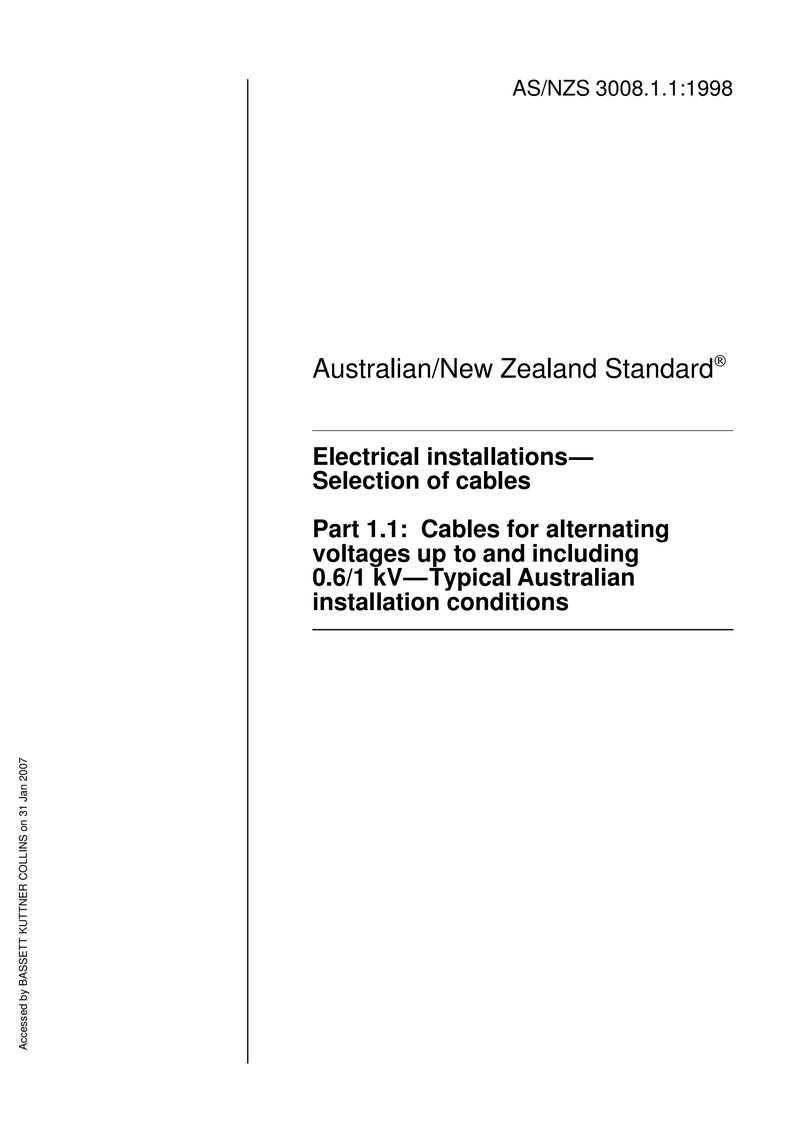


下载标准文件
AS NZS 3008.1.1.1998 Electrical installations Sele
英语 · PDF · 6 页 · 807.77 KB