AS NZS 2312 2002 Guide to the Protection of Struct
结构钢通过保护涂层防止大气腐蚀的指南
AS NZS 2312 2002 Guide to the Protection of Structural Steel by the Use of Protective Coatings
Guide to the protection of structural steel against atmospheric corrosion by the use of protective coatings
标准信息
STANDARD INFORMATION- 标准编号
- AS NZS 2312 2002 Guide to the Protection of Struct
- 所属分类
- AS 澳大利亚标准
- 发布机构
- Standards Australia/Standards New Zealand
- 版本年份
- 2002
- 文件语言
- 英语
- 文件格式
- 文件页数
- 6 页
- 文件大小
- 1.82 MB
中文名称为参考译名,文件语言以原文为准。
· 更新:
标准简介
OVERVIEW中文简介
该标准为建筑师、工程师、施工方和表面涂层行业提供结构钢防腐蚀保护指南。它基于预期使用寿命和不同环境条件推荐涂层体系,适用于外部大气环境及非大气环境的钢结构防护。
English summary
This standard provides guidance for architects, engineers, builders and the surface coating industry on protective coating systems for steelwork. It recommends coating systems based on expected service life and environmental conditions, covering exterior atmospheric and non-atmospheric environments.
以上为根据文件整理的内容简介。
相关标签
标准内容预览
DOCUMENT PREVIEWPREFACE
This Standard was prepared by the Joint Standards Australia/Standards New Zealand Committee MT-014, Corrosion of Metals, to supersede AS/NZS 2312:1994, Guide to the protection of iron and steel against exterior atmospheric corrosion.
This Standard incorporates Amendment 1 (August 2004). The changes required by the Amendment are indicated in the text by a marginal bar and amendment number against the clause, note, table, figure, or part thereof affected.
The objective of this Standard is to provide guidance for architects, engineers, builders, the surface coating industry and users of protective services in general, on coating systems for the protection of steel work against corrosion. The designer can choose from a selection of systems based on expected service life to first maintenance for various environments. The systems recommended herein are based on good industrial practice and usage; however, local knowledge of any corrosion problem should influence the decisions taken.
Many of the system options will provide equal performance in the field. The system chosen will depend on many factors including location, material supply, available equipment, labour and cost.
It is necessary to refer to each Section of this Standard when a specification for an appropriate system is being prepared.
This edition of the Standard has been expanded to cover non-atmospheric environments in addition to exterior atmospheric environments.
In providing recommendations on up-to-date protection systems, the Committee is aware of the large number of systems used commercially, but, to avoid confusion, has included only a limited range of systems for each type of environment.
The Committee acknowledges the developments which are taking place in the protection of structural steel work and will continue to monitor these in order to make changes to future editions of this Standard as may become necessary.
In preparing this revision, cognizance was taken of the International Standard ISO 9223:1992, Corrosion of metals and alloys—Corrosivity of atmospheres—Classification. Cognizance was also taken of a number of the draft International Standards being prepared to become part of the ISO 12944 series of Standards, Paints and varnishes—Corrosion protection of steel structures by protective paint systems. These Standards were not adopted as most of the paint systems they specify are not used in Australia and New Zealand.
The term 'informative' has been used in this Standard to define the application of the appendix to which it applies. An 'informative' appendix is only for information and guidance.
6
AS/NZS 2312:2002
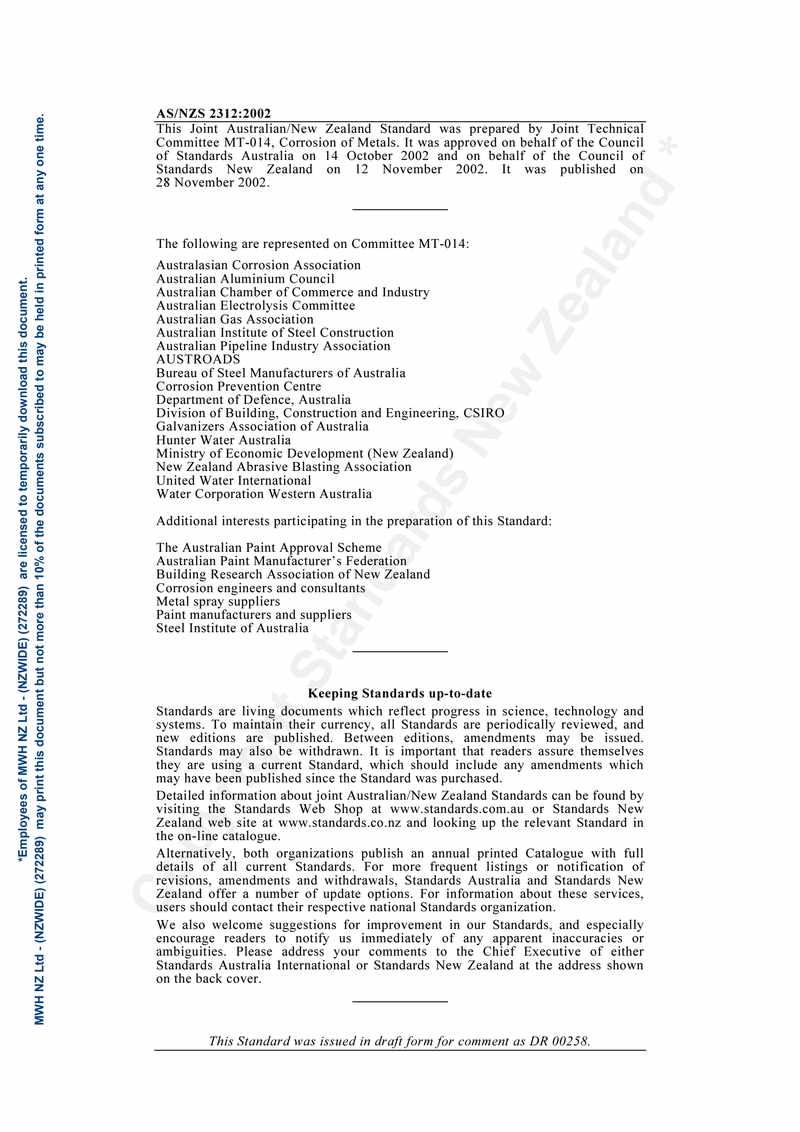
This Joint Australian/New Zealand Standard was prepared by Joint Technical Committee MT-014, Corrosion of Metals. It was approved on behalf of the Council of Standards Australia on 14 October 2002 and on behalf of the Council of Standards New Zealand on 12 November 2002. It was published on 28 November 2002.
The following are represented on Committee MT-014:
- Australasian Corrosion Association
- Australian Aluminium Council
- Australian Chamber of Commerce and Industry
- Australian Electrolysis Committee
- Australian Gas Association
- Australian Institute of Steel Construction
- Australian Pipeline Industry Association
- AUSTROADS
- Bureau of Steel Manufacturers of Australia
- Corrosion Prevention Centre
- Department of Defence, Australia
- Division of Building, Construction and Engineering, CSIRO
- Galvanizers Association of Australia
- Hunter Water Australia
- Ministry of Economic Development (New Zealand)
- New Zealand Abrasive Blasting Association
- United Water International
- Water Corporation Western Australia
Additional interests participating in the preparation of this Standard:
- The Australian Paint Approval Scheme
- Australian Paint Manufacturer's Federation
- Building Research Association of New Zealand
- Corrosion engineers and consultants
- Metal spray suppliers
- Paint manufacturers and suppliers
- Steel Institute of Australia
Keeping Standards up-to-date
Standards are living documents which reflect progress in science, technology and systems. To maintain their currency, all Standards are periodically reviewed, and new editions are published. Between editions, amendments may be issued. Standards may also be withdrawn. It is important that readers assure themselves they are using a current Standard, which should include any amendments which may have been published since the Standard was purchased.
Detailed information about joint Australian/New Zealand Standards can be found by visiting the Standards Web Shop at www.standards.com.au or Standards New Zealand web site at www.standards.co.nz and looking up the relevant Standard in the on-line catalogue.
Alternatively, both organizations publish an annual printed Catalogue with full details of all current Standards. For more frequent listings or notification of revisions, amendments and withdrawals, Standards Australia and Standards New Zealand offer a number of update options. For information about these services, users should contact their respective national Standards organization.
We also welcome suggestions for improvement in our Standards, and especially encourage readers to notify us immediately of any apparent inaccuracies or ambiguities. Please address your comments to the Chief Executive of either Standards Australia International or Standards New Zealand at the address shown on the back cover.
This Standard was issued in draft form for comment as DR 00258.
2
Online Subscription Service PDF Terms & Conditions
- An Authorised User may download a single copy of a document and retain that copy on their personal computer for a maximum of five working days for their internal purposes. At the expiry of five working days, the Document must be deleted from the Authorised User's computer.
- Each Authorised User may print one hard copy of any Document for their internal purposes. These copies may not be used to build up a hard copy reference collection. A reference collection is defined as a collection comprising more than 10% of the number of the Documents within the Authorised User's subscription portfolio. All hard copies of Documents must be destroyed on expiry of the subscription period.
- Copyright subsists in each of the Documents and the full title to that copyright is at all times retained by Standards New Zealand.
- Except as otherwise may be expressly permitted under the Copyright Act 1994 Authorised Users will undertake not to copy, modify, merge with other software or documents, or circulate electronically without securing the prior written permission of SNZ. .
- Under no circumstance may a Document, whether in electronic or hard copy form, be sold, or transferred to a third party.
- Under no circumstances may any Document be placed on a network of any sort without express permission of SNZ.
- Authorised Users may not modify, adapt, translate, reverse engineer, decompile, disassemble or create derivative works based on the Documents.
- Right of access to the Subscription Service is personal to Authorised Users and can not be transferred, sold, leased, rented or loaned via a timesharing, service bureau or other arrangement.
- All Authorised User identification information, including logins and passwords, are to be kept secret and secure.
- No Authorised User may attempt to damage, interfere or harm the SNZ website, or any network, or system underlying or connected to the Subscription Service.
3
NOTES
4
AS/NZS 2312:2002
(Incorporating Amendment No. 1)
Australian/New Zealand Standard™
Guide to the protection of structural steel against atmospheric corrosion by the use of protective coatings
Originated as part of MA 1.5—1967.
Previous edition AS/NZS 2312:1994.
Fourth edition 2002.
Reissued incorporating Amendment No. 1 (August 2004)
COPYRIGHT
© Standards Australia/Standards New Zealand
All rights are reserved. No part of this work may be reproduced or copied in any form or by any means, electronic or mechanical, including photocopying, without the written permission of the publisher.
Jointly published by Standards Australia International Ltd, GPO Box 5420, Sydney, NSW 2001 and Standards New Zealand, Private Bag 2439, Wellington 6020
ISBN 0 7337 4887 2
5
PREFACE
This Standard was prepared by the Joint Standards Australia/Standards New Zealand Committee MT-014, Corrosion of Metals, to supersede AS/NZS 2312:1994, Guide to the protection of iron and steel against exterior atmospheric corrosion.
This Standard incorporates Amendment 1 (August 2004). The changes required by the Amendment are indicated in the text by a marginal bar and amendment number against the clause, note, table, figure, or part thereof affected.
The objective of this Standard is to provide guidance for architects, engineers, builders, the surface coating industry and users of protective services in general, on coating systems for the protection of steel work against corrosion. The designer can choose from a selection of systems based on expected service life to first maintenance for various environments. The systems recommended herein are based on good industrial practice and usage; however, local knowledge of any corrosion problem should influence the decisions taken.
Many of the system options will provide equal performance in the field. The system chosen will depend on many factors including location, material supply, available equipment, labour and cost.
It is necessary to refer to each Section of this Standard when a specification for an appropriate system is being prepared.
This edition of the Standard has been expanded to cover non-atmospheric environments in addition to exterior atmospheric environments.
In providing recommendations on up-to-date protection systems, the Committee is aware of the large number of systems used commercially, but, to avoid confusion, has included only a limited range of systems for each type of environment.
The Committee acknowledges the developments which are taking place in the protection of structural steel work and will continue to monitor these in order to make changes to future editions of this Standard as may become necessary.
In preparing this revision, cognizance was taken of the International Standard ISO 9223:1992, Corrosion of metals and alloys—Corrosivity of atmospheres—Classification. Cognizance was also taken of a number of the draft International Standards being prepared to become part of the ISO 12944 series of Standards, Paints and varnishes—Corrosion protection of steel structures by protective paint systems. These Standards were not adopted as most of the paint systems they specify are not used in Australia and New Zealand.
The term 'informative' has been used in this Standard to define the application of the appendix to which it applies. An 'informative' appendix is only for information and guidance.
6
预览内容由文件识别整理,表格、公式及文字请以原始文件为准。
原文图片预览
PAGE IMAGES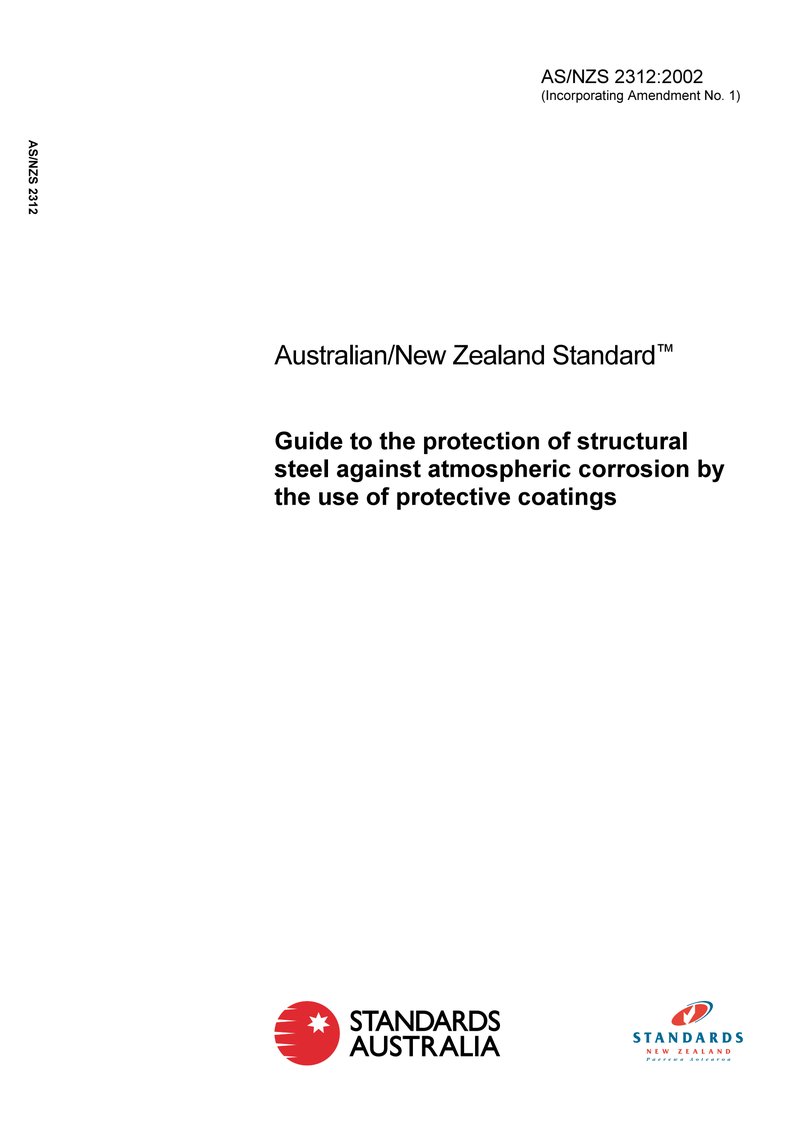
下载标准文件
AS NZS 2312 2002 Guide to the Protection of Struct
英语 · PDF · 6 页 · 1.82 MB