AS 1288 2006 Glass in buildings Selection and in
建筑用玻璃——选择与安装
AS 1288 2006 Glass in buildings Selection and installation
Glass in buildings—Selection and installation
标准信息
STANDARD INFORMATION- 标准编号
- AS 1288 2006 Glass in buildings Selection and in
- 所属分类
- AS 澳大利亚标准
- 发布机构
- Standards Australia
- 版本年份
- 2006
- 文件语言
- 英语
- 文件格式
- 文件页数
- 6 页
- 文件大小
- 3.41 MB
中文名称为参考译名,文件语言以原文为准。
· 更新:
标准简介
OVERVIEW中文简介
该标准规定了建筑中玻璃的选择和安装要求,旨在为澳大利亚全境玻璃的使用和安装提供统一指导。它取代了AS 1288—1994,并被2006年澳大利亚建筑法规引用,以澄清技术定义并支持立法使用。
English summary
This standard specifies requirements for the selection and installation of glass in buildings, providing uniform direction for its use throughout Australia. It supersedes AS 1288—1994 and is referenced in the Building Code of Australia 2006 to clarify technical definitions and support legislative use.
以上为根据文件整理的内容简介。
标准内容预览
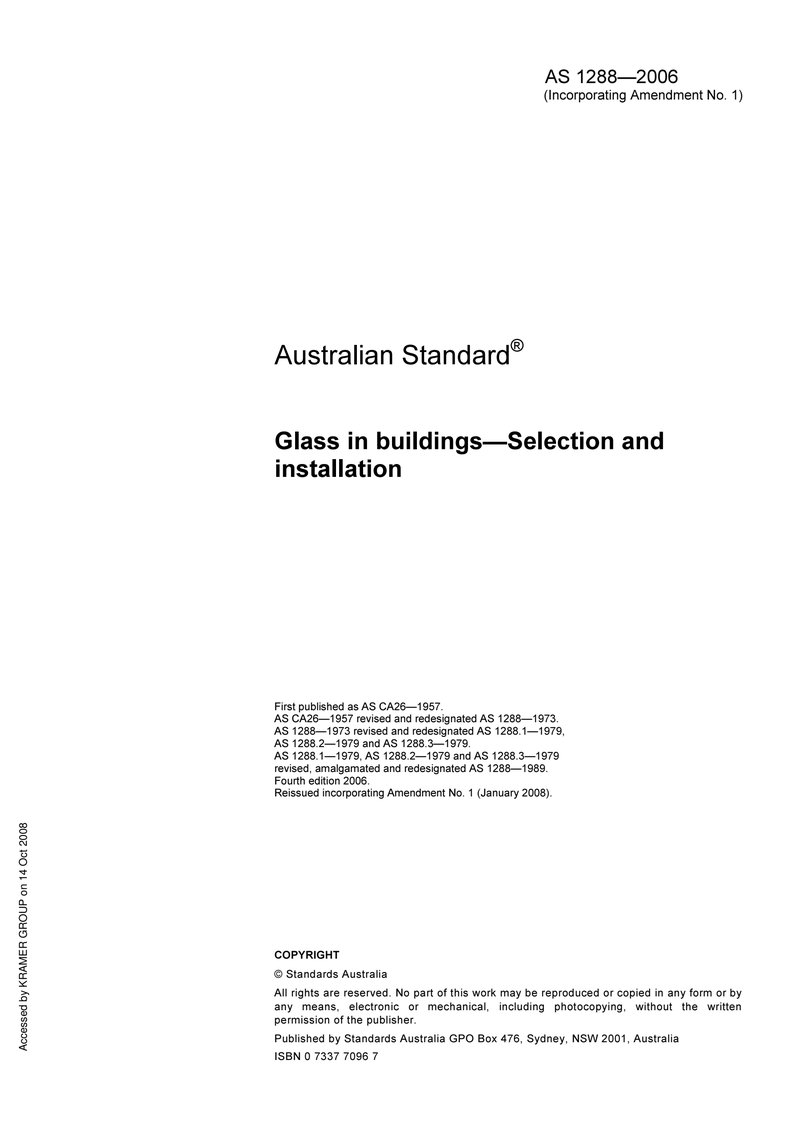
DOCUMENT PREVIEWAS 1288—2006
(Incorporating Amendment No. 1)
Australian Standard®
Glass in buildings—Selection and installation
1
AS IS
内部资料
仅供参考
张忠辉惠存
禁止一切非法目的和活动行为,否则后果自负。
NOT FOR PUBLIC RELEASE
2
Foreword
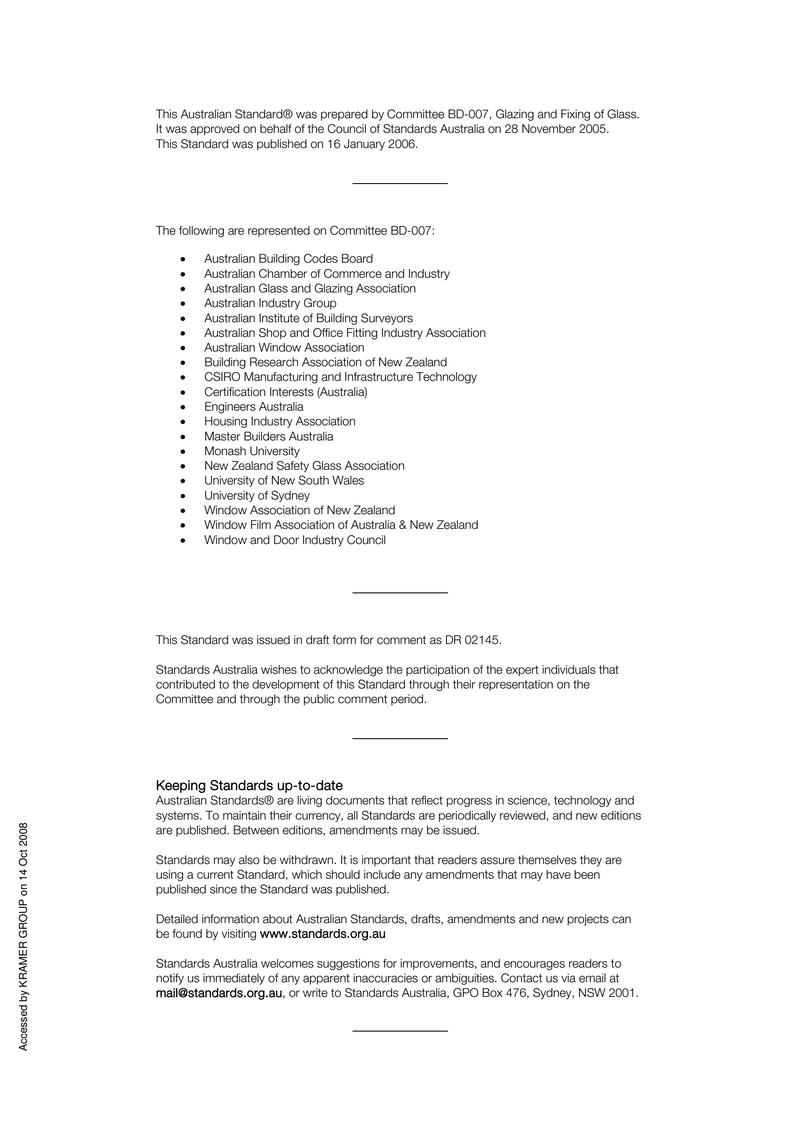
This Australian Standard® was prepared by Committee BD-007, Glazing and Fixing of Glass. It was approved on behalf of the Council of Standards Australia on 28 November 2005. This Standard was published on 16 January 2006.
The following are represented on Committee BD-007:
- Australian Building Codes Board
- Australian Chamber of Commerce and Industry
- Australian Glass and Glazing Association
- Australian Industry Group
- Australian Institute of Building Surveyors
- Australian Shop and Office Fitting Industry Association
- Australian Window Association
- Building Research Association of New Zealand
- CSIRO Manufacturing and Infrastructure Technology
- Certification Interests (Australia)
- Engineers Australia
- Housing Industry Association
- Master Builders Australia
- Monash University
- New Zealand Safety Glass Association
- University of New South Wales
- University of Sydney
- Window Association of New Zealand
- Window Film Association of Australia & New Zealand
- Window and Door Industry Council
This Standard was issued in draft form for comment as DR 02145.
Standards Australia wishes to acknowledge the participation of the expert individuals that contributed to the development of this Standard through their representation on the Committee and through the public comment period.
Keeping Standards up-to-date
Australian Standards® are living documents that reflect progress in science, technology and systems. To maintain their currency, all Standards are periodically reviewed, and new editions are published. Between editions, amendments may be issued.
Standards may also be withdrawn. It is important that readers assure themselves they are using a current Standard, which should include any amendments that may have been published since the Standard was published.
Detailed information about Australian Standards, drafts, amendments and new projects can be found by visiting www.standards.org.au
Standards Australia welcomes suggestions for improvements, and encourages readers to notify us immediately of any apparent inaccuracies or ambiguities. Contact us via email at mail@standards.org.au, or write to Standards Australia, GPO Box 476, Sydney, NSW 2001.
3
Australian Standard®
Glass in buildings—Selection and installation
First published as AS CA26—1957.
AS CA26—1957 revised and redesignated AS 1288—1973.
AS 1288—1973 revised and redesignated AS 1288.1—1979, AS 1288.2—1979 and AS 1288.3—1979.
AS 1288.1—1979, AS 1288.2—1979 and AS 1288.3—1979 revised, amalgamated and redesignated AS 1288—1989.
Fourth edition 2006.
Reissued incorporating Amendment No. 1 (January 2008).
COPYRIGHT
© Standards Australia
All rights are reserved. No part of this work may be reproduced or copied in any form or by any means, electronic or mechanical, including photocopying, without the written permission of the publisher.
Published by Standards Australia GPO Box 476, Sydney, NSW 2001, Australia
ISBN 0 7337 7096 7
4
PREFACE
This Standard was prepared by the Joint Standards Australia/Standards New Zealand Committee BD-007, Glazing and Fixing of Glass, to supersede AS 1288—1994.
This Standard incorporates Amendment No. 1 (January 2008). The changes required by the Amendment are indicated in the text by a marginal bar and amendment number against the clause, note, table, figure or part thereof affected.
The objective of this Standard is to provide uniform direction for the use and installation of glazing throughout Australia to allow its use in legislation, and to clarify technical definitions.
This Standard will be referenced in the Building Code of Australia 2006; thereby superseding AS 1288—1994, which will be withdrawn in 12 months from the date of publication of this Standard.
When revising this Standard, consideration was given to the existing human impact safety requirements of AS 1288—1994 and NZS 4223.3:1999 Code of practice for glazing in buildings Part 3: Human impact safety requirements, as well as BS 6262-4, Glazing for buildings, Part 4: Safety related to human impact.
There was also a need to recognize that accidents involving glass continued at a high rate and at a considerable cost to the community. With these factors in mind, changes were made that have resulted in the introduction of increased areas of safety glass and the reduction of areas of ordinary glass in locations where accidents are known to occur at greater frequency. The Standard has also been closely aligned with international practice by the adoption of selected criteria from international Standards.
The change to ultimate limit state design in the new wind code has necessitated the corresponding upgrading of the wind loading charts. The new charts are based on the increased ultimate limit state wind loads. The committee has taken this opportunity to improve the design charts to include basic criteria such as the influence of aspect ratio and slenderness factor. The charts are unique as they incorporate all relevant aspects that influence the performance of glass in the one chart for each glass type and thickness.
The most significant changes of this revision include the following:
(a) Change from permissible design stresses for wind loading to Ultimate Limit State design.
(b) New design charts for wind loading based on ULS and taking into consideration panel aspect ratio.
(c) Introduction of new and increased areas of safety glass in locations subject to high risk of human impact.
(d) New section on installation requirements for glass.
(e) New sections and detailed specifications for overhead glazing, balustrades, faceted glazing and fin-supported glazing.
The Committee considers that this Standard represents the best compromise that can be presented at this time. Further research and testing for safety will possibly result in changes which will be incorporated in future editions. It makes recommendations for design and installation practice based on proven techniques but does not restrict the adoption of materials or methods of design that can be shown to the satisfaction of the responsible authority to provide no lesser standard of materials, designs or constructions than obtained by using the procedures specified herein.
5
3
Notes to the text contain information and guidance. They are not an integral part of the Standard.
The terms ‘normative’ and ‘informative’ have been used in this Standard to define the application of the appendix to which they apply. A ‘normative’ appendix is an integral part of a Standard, whereas an ‘informative’ appendix is only for information and guidance.
6
预览内容由文件识别整理,表格、公式及文字请以原始文件为准。
原文图片预览
PAGE IMAGES
下载标准文件
AS 1288 2006 Glass in buildings Selection and in
英语 · PDF · 6 页 · 3.41 MB