AS 2848.1 1998 Aluminium and aluminium alloys Comp
铝和铝合金——成分与牌号 第1部分:变形产品
AS 2848.1 1998 Aluminium and aluminium alloys Compositions and designations Part 1 Wrought produc
Aluminium and aluminium alloys—Compositions and designations Part 1: Wrought products
标准信息
STANDARD INFORMATION- 标准编号
- AS 2848.1 1998 Aluminium and aluminium alloys Comp
- 所属分类
- AS 澳大利亚标准
- 发布机构
- Standards Australia
- 版本年份
- 1998
- 文件语言
- 英语
- 文件格式
- 文件页数
- 6 页
- 文件大小
- 144.84 KB
中文名称为参考译名,文件语言以原文为准。
· 更新:
标准简介
OVERVIEW中文简介
该标准列出了澳大利亚目前可用的变形铝及铝合金,并定义了用于应变硬化或热处理铝及铝合金的硬度状态牌号系统。标准规定了所有指定牌号的化学成分限值,其牌号基于澳大利亚铝业委员会1994年发布的文件,硬度状态牌号与ISO 2107:1983保持一致。
English summary
This standard provides a listing of wrought aluminium and aluminium alloys currently available in Australia and defines the temper designation system for alloys that have been strain hardened or thermally treated. It specifies chemical composition limits for all designated grades, with designations based on the 1994 Australian Aluminium Council document and temper designations aligned with ISO 2107:1983.
以上为根据文件整理的内容简介。
相关标签
标准内容预览
DOCUMENT PREVIEWAustralian Standard™
Aluminium and aluminium alloys—Compositions and designations
Part 1: Wrought products
1
AS IS
内部资料
仅供参考
张忠辉惠存
禁止一切非法目的和活动行为,否则后果自负。
NOT FOR PUBLIC RELEASE
This Australian Standard was prepared by Committee MT/3, Aluminium and Aluminium Alloys. It was approved on behalf of the Council of Standards Australia on 7 August 1998 and published on 5 October 1998.
The following interests are represented on Committee MT/3:
Australasian Railway Association
Australian Aluminium Council
Australian Automobile Association
Australian Chamber of Commerce and Industry
New Zealand Manufacturers Federation
Residential Window Association
Society of Automotive Engineers—Australasia
Review of Australian Standards. To keep abreast of progress in industry, Australian Standards are subject to periodic review and are kept up to date by the issue of amendments or new editions as necessary. It is important therefore that Standards users ensure that they are in possession of the latest edition, and any amendments thereto.
Full details of all Australian Standards and related publications will be found in the Standards Australia Catalogue of Publications; this information is supplemented each month by the magazine 'The Australian Standard', which subscribing members receive, and which gives details of new publications, new editions and amendments, and of withdrawn Standards.
Suggestions for improvements to Australian Standards, addressed to the head office of Standards Australia, are welcomed. Notification of any inaccuracy or ambiguity found in an Australian Standard should be made without delay in order that the matter may be investigated and appropriate action taken.
This Standard was issued in draft form for comment as DR 97568.
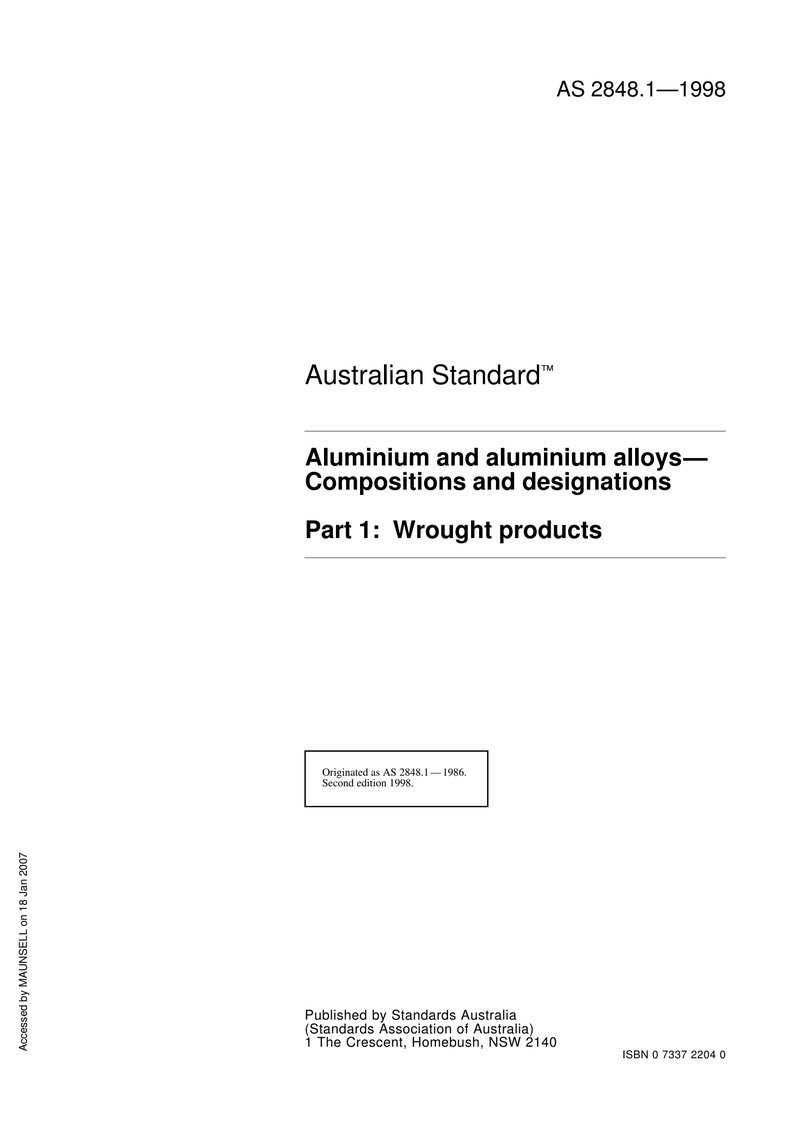
AS 2848.1—1998
Australian StandardTM
Aluminium and aluminium alloys—Compositions and designations
Part 1: Wrought products
Originated as AS 2848.1—1986. Second edition 1998.
Published by Standards Australia (Standards Association of Australia) 1 The Crescent, Homebush, NSW 2140
ISBN 0 7337 2204 0
4
PREFACE
This Standard was prepared by the Joint Standards Australia/Standards New Zealand Committee MT/3, Aluminium and Aluminium Alloys, at the request of the Australian Aluminium Council, to supersede AS 2848.1—1986.
This Standard is the result of a consensus among Australian and New Zealand representatives on the Joint Committee to produce it as an Australian Standard.
The objective of this revision is to upgrade the listings of designations and chemical compositions of wrought aluminium and aluminium alloys currently available in Australia and to upgrade the temper designations for strain hardening and heat treatment.
The designations are based on those in the 1994 edition of the Australian Aluminium Council document, Aluminium Standards, Data and Design—Wrought Products. The aluminium and alloy designations for grade comprise a four-digit numbering system. The designations for temper generally align with the ‘alternative designations’ listed in ISO 2107:1983, Aluminium, magnesium and their alloys—Temper designations.
CONTENTS
Page
SECTION 1 SCOPE AND GENERAL
1.1 SCOPE 3
1.2 DEFINITIONS 3
SECTION 2 ALLOY DESIGNATION
2.1 SCOPE 4
2.2 DESIGNATION SYSTEM 4
2.3 CHEMICAL COMPOSITION 5
SECTION 3 TEMPER DESIGNATION
3.1 SCOPE 10
3.2 DESIGNATION SYSTEM 10
3.3 BASIC TEMPER DESIGNATIONS 10
3.4 STRAIN-HARDENED TEMPERS (H) 10
3.5 THERMALLY TREATED TEMPERS (T) 12
© Copyright — STANDARDS AUSTRALIA
Users of Standards are reminded that copyright subsists in all Standards Australia publications and software. Except where the Copyright Act allows and except where provided for below no publications or software produced by Standards Australia may be reproduced, stored in a retrieval system in any form or transmitted by any means without prior permission in writing from Standards Australia. Permission may be conditional on an appropriate royalty payment. Requests for permission and information on commercial software royalties should be directed to the head office of Standards Australia.
Standards Australia will permit up to 10 percent of the technical content pages of a Standard to be copied for use exclusively in-house by purchasers of the Standard without payment of a royalty or advice to Standards Australia.
Standards Australia will also permit the inclusion of its copyright material in computer software programs for no royalty payment provided such programs are used exclusively in-house by the creators of the programs.
Care should be taken to ensure that material used is from the current edition of the Standard and that it is updated whenever the Standard is amended or revised. The number and date of the Standard should therefore be clearly identified.
The use of material in print form or in computer software programs to be used commercially, with or without payment, or in commercial contracts is subject to the payment of a royalty. This policy may be varied by Standards Australia at any time.
5
SECTION 1 SCOPE AND GENERAL
1.1 SCOPE This Standard provides a listing of wrought aluminium and aluminium alloys currently available in Australia and defines the temper designation system for aluminium and aluminium alloys that have been strain hardened, with or without supplementary thermal treatments, or thermally treated, with or without supplementary strain-hardening. This Standard specifies chemical composition limits for all designated grades. Requirements for other properties are specified in Standards that cover product types.
1.2 DEFINITIONS For the purpose of this Standard, the definitions below apply.
1.2.1 Annealing—a thermal treatment to soften metal by the removal of strain hardening resulting from cold working, by recrystallization and/or by coalescing precipitates from the solid solution.
1.2.2 Artificial ageing—a thermal treatment of an alloy carried out above room temperature to produce strengthening by precipitation of soluble constituents from a super-saturated solid solution. Also known as ‘precipitation heat treatment’.
1.2.3 Cold working—plastic deformation of a metal or alloy to enable strain hardening to occur. Cold working is usually conducted at room temperature.
1.2.4 Natural ageing—the strengthening of an alloy that occurs by the spontaneous precipitation of soluble constituents from a super-saturated solid solution at room temperature.
1.2.5 Partial annealing—a thermal treatment of a cold-worked metal or alloy to reduce its strength properties to a controlled level.
1.2.6 Quenching—a process of cooling a metal or alloy from an elevated temperature at a sufficiently rapid rate to retain some or all of the soluble constituents in solid solution, by contact with a solid, a liquid or a gas.
1.2.7 Solution heat treatment—a process in which an alloy is heated to and held at a suitable temperature long enough to allow soluble constituents to enter into solid solution, and quenched to retain them in a super-saturated state.
1.2.8 Stabilizing—a thermal treatment used to promote stability of dimensions, mechanical properties, structure or internal stress.
1.2.9 Strain hardening—modification of a metal structure by cold working, resulting in an increase in strength and hardness, and some loss of ductility.
1.2.10 Temper—a state of a metal or alloy resulting from processing, by mechanical and/or thermal treatments, to produce characteristic physical and mechanical properties.
6
预览内容由文件识别整理,表格、公式及文字请以原始文件为准。
原文图片预览
PAGE IMAGES
下载标准文件
AS 2848.1 1998 Aluminium and aluminium alloys Comp
英语 · PDF · 6 页 · 144.84 KB