标准信息
STANDARD INFORMATION- 标准编号
- AS 1210 1997 Pressure Vessels
- 所属分类
- AS 澳大利亚标准
- 发布机构
- Standards Australia
- 版本年份
- 1997
- 文件语言
- 英语
- 文件格式
- 文件页数
- 6 页
- 文件大小
- 3.98 MB
中文名称为参考译名,文件语言以原文为准。
· 更新:
标准简介
OVERVIEW中文简介
该标准规定了压力容器的设计、制造、检验和测试的最小工程要求,旨在确保人员安全和财产安全。它取代了AS 1210—1989,并作为AS/NZS 1200的主要适用标准之一,适用于非火灾压力容器及相关压力设备。
English summary
This standard specifies the minimum engineering requirements for the safe design, manufacture, and testing of pressure vessels to protect life and property. It supersedes AS 1210—1989 and serves as a primary applicable standard referenced in AS/NZS 1200 for unfired pressure vessels and related pressure equipment.
以上为根据文件整理的内容简介。
标准内容预览
DOCUMENT PREVIEWAS 1210—1997
(Incorporating Amendment Nos. 1, 2 and 3)
Australian StandardTM
Pressure vessels
Standards Australia
1
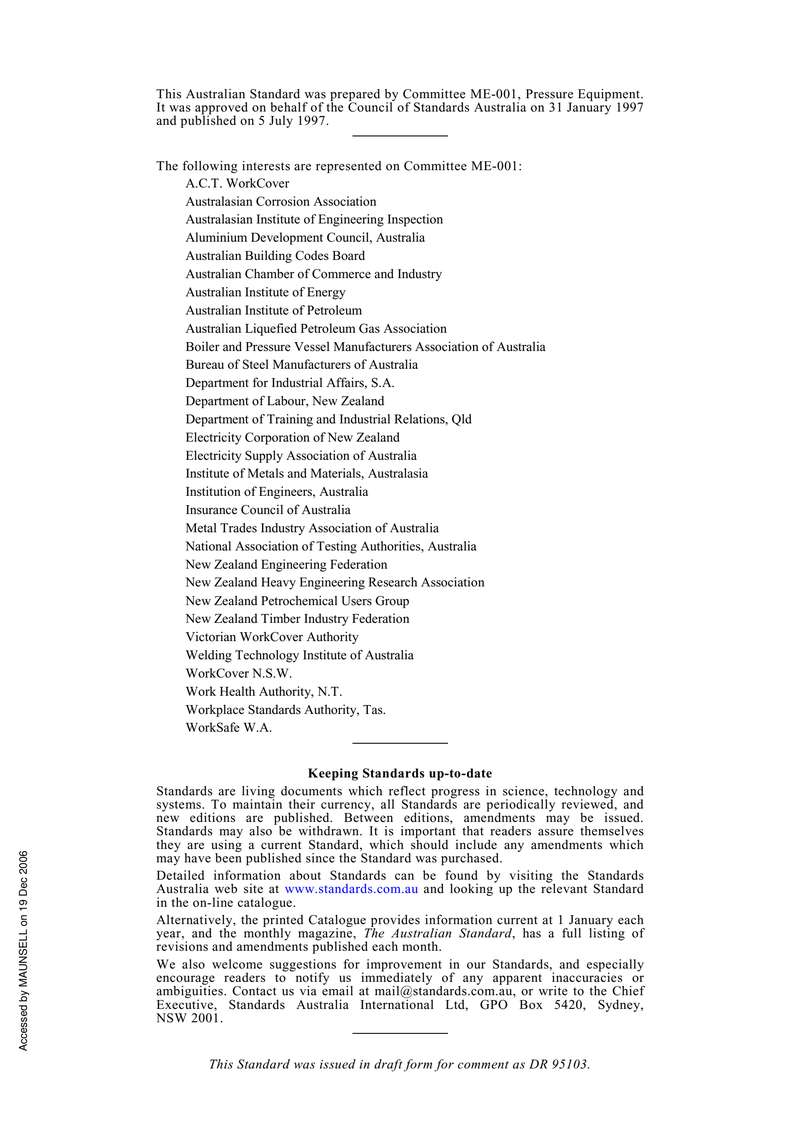
This Australian Standard was prepared by Committee ME-001, Pressure Equipment. It was approved on behalf of the Council of Standards Australia on 31 January 1997 and published on 5 July 1997.
The following interests are represented on Committee ME-001:
- A.C.T. WorkCover
- Australasian Corrosion Association
- Australasian Institute of Engineering Inspection
- Aluminium Development Council, Australia
- Australian Building Codes Board
- Australian Chamber of Commerce and Industry
- Australian Institute of Energy
- Australian Institute of Petroleum
- Australian Liquefied Petroleum Gas Association
- Boiler and Pressure Vessel Manufacturers Association of Australia
- Bureau of Steel Manufacturers of Australia
- Department for Industrial Affairs, S.A.
- Department of Labour, New Zealand
- Department of Training and Industrial Relations, Qld
- Electricity Corporation of New Zealand
- Electricity Supply Association of Australia
- Institute of Metals and Materials, Australasia
- Institution of Engineers, Australia
- Insurance Council of Australia
- Metal Trades Industry Association of Australia
- National Association of Testing Authorities, Australia
- New Zealand Engineering Federation
- New Zealand Heavy Engineering Research Association
- New Zealand Petrochemical Users Group
- New Zealand Timber Industry Federation
- Victorian WorkCover Authority
- Welding Technology Institute of Australia
- WorkCover N.S.W.
- Work Health Authority, N.T.
- Workplace Standards Authority, Tas.
- WorkSafe W.A.
Keeping Standards up-to-date
Standards are living documents which reflect progress in science, technology and systems. To maintain their currency, all Standards are periodically reviewed, and new editions are published. Between editions, amendments may be issued. Standards may also be withdrawn. It is important that readers assure themselves they are using a current Standard, which should include any amendments which may have been published since the Standard was purchased.
Detailed information about Standards can be found by visiting the Standards Australia web site at www.standards.com.au and looking up the relevant Standard in the on-line catalogue.
Alternatively, the printed Catalogue provides information current at 1 January each year, and the monthly magazine, The Australian Standard, has a full listing of revisions and amendments published each month.
We also welcome suggestions for improvement in our Standards, and especially encourage readers to notify us immediately of any apparent inaccuracies or ambiguities. Contact us via email at mail@standards.com.au, or write to the Chief Executive, Standards Australia International Ltd, GPO Box 5420, Sydney, NSW 2001.
This Standard was issued in draft form for comment as DR 95103.
2
Pressure vessels
Australian StandardTM
Originated in part as AS B31—1931 and AS CB1—1931.
Previous edition 1989.
Fifth edition 1997.
Reissued incorporating Amendment Nos. 1 (February 1998), 2 (September 1998) and 3 (April 2002).
COPYRIGHT
© Standards Australia International
All rights are reserved. No part of this work may be reproduced or copied in any form or by any means, electronic or mechanical, including photocopying, without the written permission of the publisher.
Published by Standards Australia International Ltd
GPO Box 5420, Sydney, NSW 2001, Australia
ISBN 0 7337 1012 3
3
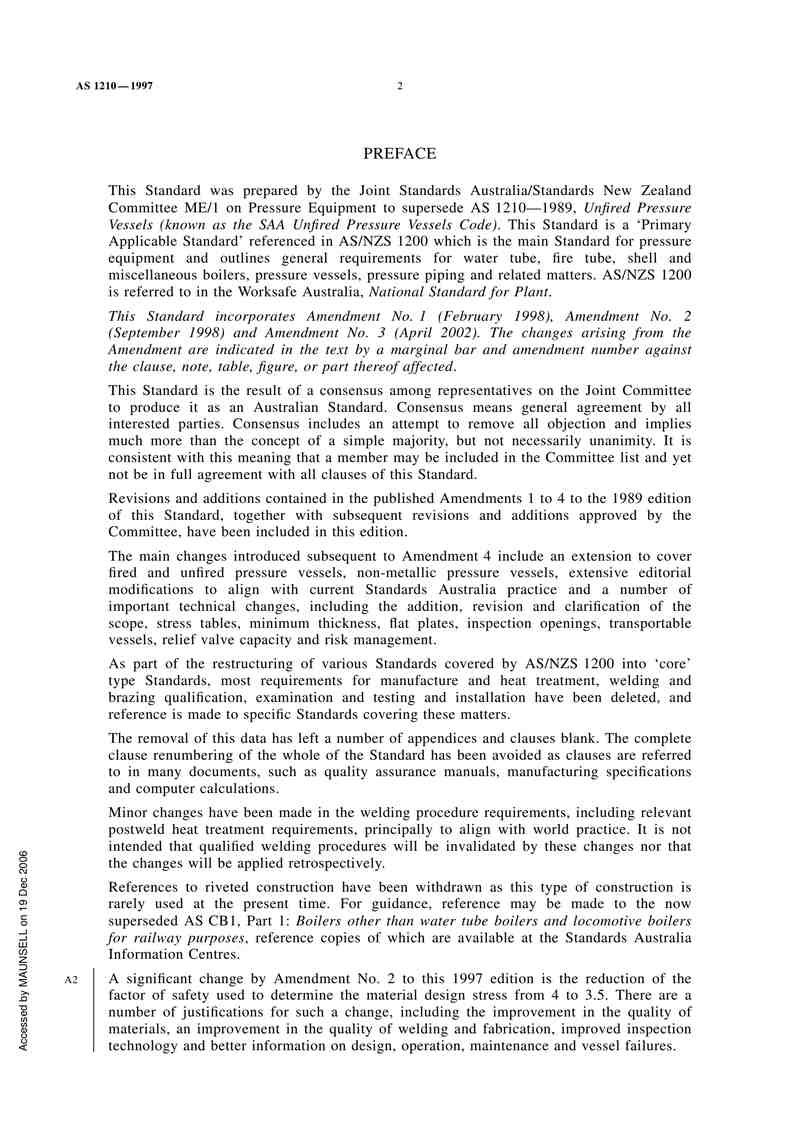
PREFACE
This Standard was prepared by the Joint Standards Australia/Standards New Zealand Committee ME/1 on Pressure Equipment to supersede AS 1210—1989, Unfired Pressure Vessels (known as the SAA Unfired Pressure Vessels Code). This Standard is a ‘Primary Applicable Standard’ referenced in AS/NZS 1200 which is the main Standard for pressure equipment and outlines general requirements for water tube, fire tube, shell and miscellaneous boilers, pressure vessels, pressure piping and related matters. AS/NZS 1200 is referred to in the Worksafe Australia, National Standard for Plant.
This Standard incorporates Amendment No. 1 (February 1998), Amendment No. 2 (September 1998) and Amendment No. 3 (April 2002). The changes arising from the Amendment are indicated in the text by a marginal bar and amendment number against the clause, note, table, figure, or part thereof affected.
This Standard is the result of a consensus among representatives on the Joint Committee to produce it as an Australian Standard. Consensus means general agreement by all interested parties. Consensus includes an attempt to remove all objection and implies much more than the concept of a simple majority, but not necessarily unanimity. It is consistent with this meaning that a member may be included in the Committee list and yet not be in full agreement with all clauses of this Standard.
Revisions and additions contained in the published Amendments 1 to 4 to the 1989 edition of this Standard, together with subsequent revisions and additions approved by the Committee, have been included in this edition.
The main changes introduced subsequent to Amendment 4 include an extension to cover fired and unfired pressure vessels, non-metallic pressure vessels, extensive editorial modifications to align with current Standards Australia practice and a number of important technical changes, including the addition, revision and clarification of the scope, stress tables, minimum thickness, flat plates, inspection openings, transportable vessels, relief valve capacity and risk management.
As part of the restructuring of various Standards covered by AS/NZS 1200 into ‘core’ type Standards, most requirements for manufacture and heat treatment, welding and brazing qualification, examination and testing and installation have been deleted, and reference is made to specific Standards covering these matters.
The removal of this data has left a number of appendices and clauses blank. The complete clause renumbering of the whole of the Standard has been avoided as clauses are referred to in many documents, such as quality assurance manuals, manufacturing specifications and computer calculations.
Minor changes have been made in the welding procedure requirements, including relevant postweld heat treatment requirements, principally to align with world practice. It is not intended that qualified welding procedures will be invalidated by these changes nor that the changes will be applied retrospectively.
References to riveted construction have been withdrawn as this type of construction is rarely used at the present time. For guidance, reference may be made to the now superseded AS CB1, Part 1: Boilers other than water tube boilers and locomotive boilers for railway purposes, reference copies of which are available at the Standards Australia Information Centres.
A significant change by Amendment No. 2 to this 1997 edition is the reduction of the factor of safety used to determine the material design stress from 4 to 3.5. There are a number of justifications for such a change, including the improvement in the quality of materials, an improvement in the quality of welding and fabrication, improved inspection technology and better information on design, operation, maintenance and vessel failures.
4
AS IS
内部资料
仅供参考
张忠辉惠存
禁止一切非法目的和活动行为,否则后果自负。
NOT FOR PUBLIC RELEASE
5
This Standard follows in principle other codes forming part of AS/NZS 1200 in giving guidance to designers, manufacturers, inspection bodies, purchasers and users in the form of minimum engineering requirements which are necessary for the safe design, manufacture and testing of pressure vessels. In special instances additional requirements may be necessary for adequate performance or safety.
The requirements in this Standard have been formulated to afford reasonably certain protection of life and property and to indicate where a margin for deterioration in service may be needed so as to give a reasonably long, safe period of usefulness. The Standard takes into consideration advancements in design and materials, and the evidence of experience.
The Standard contains basic data necessary for design, including material specification, design parameters, requirements for fabrication, testing and inspection. These requirements are specified in terms of principles to the fullest practicable extent, supplemented where necessary by further detail to obtain uniform interpretation of principle and guidance on best methods. In other areas the Standard indicates where caution is necessary but a direct prohibition would be unwise at the present level of knowledge.
The Standard incorporates the class system of vessels based on different classes of construction, and gives basic principles to indicate where such classes should or are to be used. Three main classes are adopted using the present level of stress (safety factor of 4 approximately). Additional classes of vessel, i.e. Class 1 H and 2 H, may be produced in accordance with AS 1210 Supplement 1, which permits the use of design stresses higher than those contained herein.
The specific design requirements of the Standard are based on a simplified engineering approach and are intended to be the standard methods of design. However, in special instances, particularly where guidance is not provided in this Standard, other methods may be used provided that the validity of the design is satisfactorily established and agreed.
No rules for manufacture can be written in sufficient detail to ensure good workmanship in manufacture. Each vessel manufacturer is responsible for taking every necessary step to make sure that the quality of manufacture is such as will ensure compliance with good engineering practice and design.
The user will also need to consider many factors beyond those covered by this Standard in the final specification of a vessel and is cautioned that the Standard is not a complete design handbook and that there is a need for competent engineering judgement.
The Standard continues to be written largely for Australian conditions and to cater for recent moves in various States and Territories to objective or performance regulations rather than the earlier prescriptive ones. These moves also have lead to privatization of inspection functions such as design verification, manufacture and in-service inspection, and agreement by designers, manufacturers, purchasers and others involved.
Thus the Standard uses competent inspection bodies as in European Union practice in place of the previous regulatory authority; and is written as far as practical for clear interpretation and use in contracts to assist all parties and facilitate safety and trade.
It provides flexibility to use alternative methods, materials, Standards and the like where equivalent safety and performance is achieved and any departures from the Standard are clearly identified in all documentation and are agreed.
Acknowledgment is gratefully made to the American Society of Mechanical Engineers for permission to reproduce certain extracts from the ASME Boiler and Pressure Vessel Code. In addition, acknowledgment is made of the considerable assistance provided by British and other national Standards.
This Standard makes use of the draft ISO Standard for pressure vessels and the current American and British Standards for pressure vessels as well as other selected leading Standards including the developing European Standards and the experience and
6
预览内容由文件识别整理,表格、公式及文字请以原始文件为准。
原文图片预览
PAGE IMAGES
下载标准文件
AS 1210 1997 Pressure Vessels
英语 · PDF · 6 页 · 3.98 MB