NF P15-311-中文
建筑石灰 - 定义、规格和合格标准
NF P15-311-中文
Building limes - Definitions, specifications and criteria of conformity
标准信息
STANDARD INFORMATION- 标准编号
- NF P15-311-中文
- 所属分类
- NF 法国标准
- 发布机构
- AFNOR
- 版本年份
- 1996
- 文件语言
- 英语
- 文件格式
- 文件页数
- 6 页
- 文件大小
- 312.54 KB
中文名称为参考译名,文件语言以原文为准。
· 更新:
标准简介
OVERVIEW中文简介
该标准规定了建筑石灰的定义、分类、规格及合格标准,适用于浆砌砂浆和内外抹面工程中作为主要粘结料的各类石灰。文件涵盖了气硬石灰和水硬石灰的化学、机械及物理特性要求,并规定了制造商的自控程序以确保产品合格性。
English summary
This standard specifies the definitions, classifications, specifications, and criteria of conformity for building limes. It applies to limes used as primary binders in masonry mortars and internal/external plastering, covering chemical, mechanical, and physical requirements for air-lime and hydraulic limes, as well as manufacturer self-control procedures.
以上为根据文件整理的内容简介。
相关标签
标准内容预览
DOCUMENT PREVIEW/html
3.7 熟石灰
气硬石灰,主要由氢氧化钙及可能的氢氧化镁构成,是生石灰熟化的结果。此石灰与水接触时不会产生发热反应。以干粉末或灰浆形式生产。
3.8 钙质熟石灰
熟石灰,主要由氢氧化钙构成。
3.9 白云石熟石灰
熟石灰,主要由氢氧化钙、氢氧化镁和氧化镁构成。
3.10 白云石半熟石灰
白云石熟石灰,主要由氢氧化钙和氧化镁构成。
3.11 全熟白云石石灰
白云石熟石灰,主要由氢氧化钙和氢氧化镁构成。
3.12 贝类石灰
通过贝壳煅烧和熟化生产的熟石灰。
3.13 碳石灰
碳化钙和乙炔反应后的衍生物。
3.14 浆状石灰
熟石灰,与水混合直至达到所要的粘稠度,主要由氢氧化钙构成,含或不含氢氧化镁。
3.15 水硬石灰和天然水硬石灰
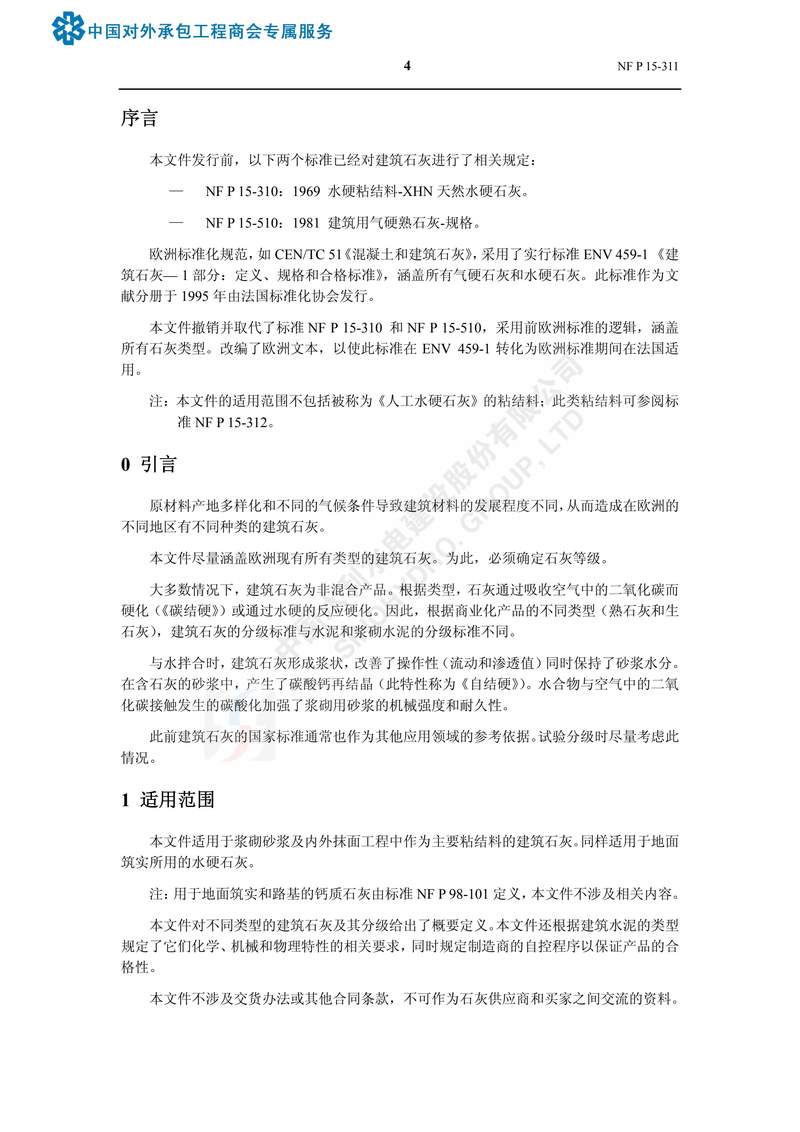
主要由经煅烧、熟化和碾碎黏土质石灰岩或经恰当材料混合氢氧化钙生产的硅酸钙、氯化钙和氢氧化钙所构成的石灰。
此石灰具备与水接触凝结和硬化的特性。空气中的二氧化碳同样能让其发生硬化。非粘稠石灰的含量至少占总量的 20%(见表 1 和标准 NF EN 459-2 第 4.7 条)。
经煅烧黏土质或硅质石灰岩生产、熟化成粉状、经或不经碾碎的石灰称为《天然水硬石灰》(NHL)。以适当方式添加至 20% 的火山灰或水硬材料的天然水硬石灰称为 NHL-Z。
所有 HL 和 NHL 型的水硬石灰均可添加有机添加物(见 4.4)。
4 建筑石灰类型
4.1 分级
不同类型的建筑石灰根据其氧化钙和氧化镁含量,水硬石灰根据其抗压强度分级如下:
1)钙质石灰 90 CL 90
6
Révision de la présente publication
Le contenu technique des publications de la CEI est constamment revu par la Commission afin d'assurer qu'il reflète bien l'état actuel de la technique.
Les renseignements relatifs à ce travail de révision, à l'établissement des éditions révisées et aux mises à jour peuvent être obtenus auprès des Comités nationaux de la CEI et en consultant les documents ci-dessous :
- Bulletin de la CEI
- Annuaire de la CEI
- Catalogue des publications de la CEI
Publié annuellement
Terminologie
En ce qui concerne la terminologie générale, le lecteur se reportera à la Publication 50 de la CEI : Vocabulaire Electrotechnique International (VEI), qui est établie sous forme de chapitres séparés traitant chacun d'un sujet défini, l'Index général étant publié séparément. Des détails complets sur le VEI peuvent être obtenus sur demande.
Les termes et définitions figurant dans la présente publication ont été soit repris du VEI, soit spécifiquement approuvés aux fins de cette publication.
Symboles graphiques et littéraux
Pour les symboles graphiques, symboles littéraux et signes d'usage général approuvés par la CEI, le lecteur consultera :
- la Publication 27 de la CEI : Symboles littéraux à utiliser en électrotechnique ;
- la Publication 617 de la CEI : Symboles graphiques pour schémas.
Les symboles et signes contenus dans la présente publication ont été soit repris des Publications 27 ou 617 de la CEI, soit spécifiquement approuvés aux fins de cette publication.
Publications de la CEI établies par le même Comité d'Etudes
L'attention du lecteur est attirée sur la page 3 de la couverture, qui énumère les publications de la CEI préparées par le Comité d'Etudes qui a établi la présente publication.
Revision of this publication
The technical content of IEC publications is kept under constant review by the IEC, thus ensuring that the content reflects current technology.
Information on the work of revision, the issue of revised editions and amendment sheets may be obtained from IEC National Committees and from the following IEC sources :
- IEC Bulletin
- IEC Yearbook
- Catalogue of IEC Publications
Published yearly
Terminology
For general terminology, readers are referred to IEC Publication 50 : International Electrotechnical Vocabulary (IEV), which is issued in the form of separate chapters each dealing with a specific field, the General Index being published as a separate booklet. Full details of the IEV will be supplied on request.
The terms and definitions contained in the present publication have either been taken from the IEV or have been specifically approved for the purpose of this publication.
Graphical and letter symbols
For graphical symbols, and letter symbols and signs approved by the IEC for general use, readers are referred to :
- IEC Publication 27 : Letter symbols to be used in electrical technology ;
- IEC Publication 617 : Graphical symbols for diagrams.
The symbols and signs contained in the present publication have either been taken from IEC Publications 27 or 617, or have been specifically approved for the purpose of this publication.
IEC publications prepared by the same Technical Committee
The attention of readers is drawn to the inside of the back cover, which lists IEC publications issued by the Technical Committee which has prepared the present publication.
2
SOMMAIRE
| pages | |
|---|---|
| Extrait de l'arrêté du 12 février 2004 relatif à la composition du cahier des clauses techniques générales applicables aux marchés publics de travaux et approuvant ou modifiant divers fascicules | III |
| Circulaire n° 2004-16 du 4 mars 2004 relative à la modification du fascicule 56 du Cahier des clauses techniques générales applicables aux marchés publics de travaux | V |
| Rapport de présentation | IX |
| Fascicule 56 | |
| Table des matières | 1 |
| Fascicule 56 | 7 |
| Annexes | 77 |
| Liste des membres du groupe de travail | 129 |
TABLE DES MATIÈRES
| Pages | |
| Extraits du décret n° 83-253 du 8 avril 1987 relatif à la composition du cahier des clauses techniques générales applicables aux marchés publics de travaux et approuvant ou modifiant divers fascicules | V |
| Fascicule n° 76 — Textes et commentaires | 2 |
| Annexes | 41 |
| Rapport de présentation | 71 |
:current
Foreword
This document (EN 10216-3:2002) has been prepared by Technical Committee EC/TC 29, "Steel tubes and fittings for steel tubes", the secretariat of which is held by UNI.
This European Standard shall be given the status of a national standard, either by publication of an identical text or by endorsement, at the latest by November 2002, and conflicting national standards shall be withdrawn at the latest by November 2002.
This document has been prepared under a mandate given to CEN by the European Commission and the European Free Trade Association, and supports essential requirements of EU Directive(s).
For relationship with EU Directive(s), see informative annex ZA, which is an integral part of this document.
Other Parts of EN 10216 are:
| Part 1: | Non-alloy steel tubes with specified room temperature properties |
| Part 2: | Non-alloy and alloy steel tubes with specified elevated temperature properties |
| Part 4: | Non-alloy and alloy steel tubes with specified low temperature properties |
| Part 5: | Stainless steel tubes |
Another European Standard series covering tubes for pressure purposes is:
| EN 10217: | Welded steel tubes for pressure purposes |
According to the CEN/CENELEC Internal Regulations, the national standards organizations of the following countries are bound to implement this European Standard: Austria, Belgium, Czech Republic, Denmark, Finland, France, Germany, Greece, Iceland, Ireland, Italy, Luxembourg, Malta, Netherlands, Norway, Portugal, Spain, Sweden, Switzerland and the United Kingdom.
5
ISO 657-1 : 1988 (E)
Table 1 — Dimensions and sectional properties of hot-rolled equal-leg angles (concluded)
| Designation | Mass kg/m | Sectional area cm² | Dimensions | Distances of centre of gravity | Sectional properties about axes | |||||||||||
|---|---|---|---|---|---|---|---|---|---|---|---|---|---|---|---|---|
| X-X = Y-Y | U-U | V-V | ||||||||||||||
| A mm | l mm | rroot mm | cx = cy cm | cu cm | cv cm | Ix = Iy cm⁴ | rx = ry cm | Zx = Zy cm³ | Iu cm⁴ | ru cm | Iv cm⁴ | rv cm | Zv cm³ | |||
| (1) | (2) | (3) | (4) | (5) | (6) | (7) | (8) | (9) | (10) | (11) | (12) | (13) | (14) | (15) | (16) | (17) |
| 200 × 200 × 16 | 48,5 | 61,8 | 200 | 16 | 18 | 5,52 | 14,1 | 7,81 | 2 340 | 6,16 | 162 | 3 720 | 7,76 | 960 | 3,94 | 123 |
| 200 × 200 × 20 | 59,9 | 76,3 | 200 | 20 | 18 | 5,68 | 14,1 | 8,04 | 2 850 | 6,11 | 199 | 4 530 | 7,70 | 1 170 | 3,92 | 146 |
| 200 × 200 × 24 | 71,1 | 90,6 | 200 | 24 | 18 | 5,84 | 14,1 | 8,26 | 3 330 | 6,06 | 235 | 5 280 | 7,64 | 1 380 | 3,90 | 167 |
| 250 × 250 × 28 | 104 | 133 | 250 | 28 | 18 | 7,24 | 17,7 | 10,2 | 7 700 | 7,62 | 433 | 12 200 | 9,61 | 3 170 | 4,89 | 309 |
| 250 × 250 × 35 | 128 | 163 | 250 | 35 | 18 | 7,50 | 17,7 | 10,6 | 9 260 | 7,54 | 529 | 14 700 | 9,48 | 3 860 | 4,87 | 364 |
NOTES
- Member countries may choose, to be included in their national standards, the sizes which are required to meet their demand.
- For the angles so chosen, only thicknesses which can be rolled in their mills to meet the demand of the users may be selected from the list of thicknesses corresponding to equal angles in table 1.
- The sectional area has been calculated using the formula
S = [l/2 A - l) + 0,214 6 (rroot² - 2rtoe²)] × 1/100
where
S is the sectional area, in square centimetres;
l is the thickness, in millimetres;
rroot is the root radius, in millimetres;
rtoe is the toe radius, in millimetres;
A is the leg length, in millimetres.
- Mass is calculated on the basis of density of steel of 7,85 kg/dm³.
4
预览内容由文件识别整理,表格、公式及文字请以原始文件为准。
原文图片预览
PAGE IMAGES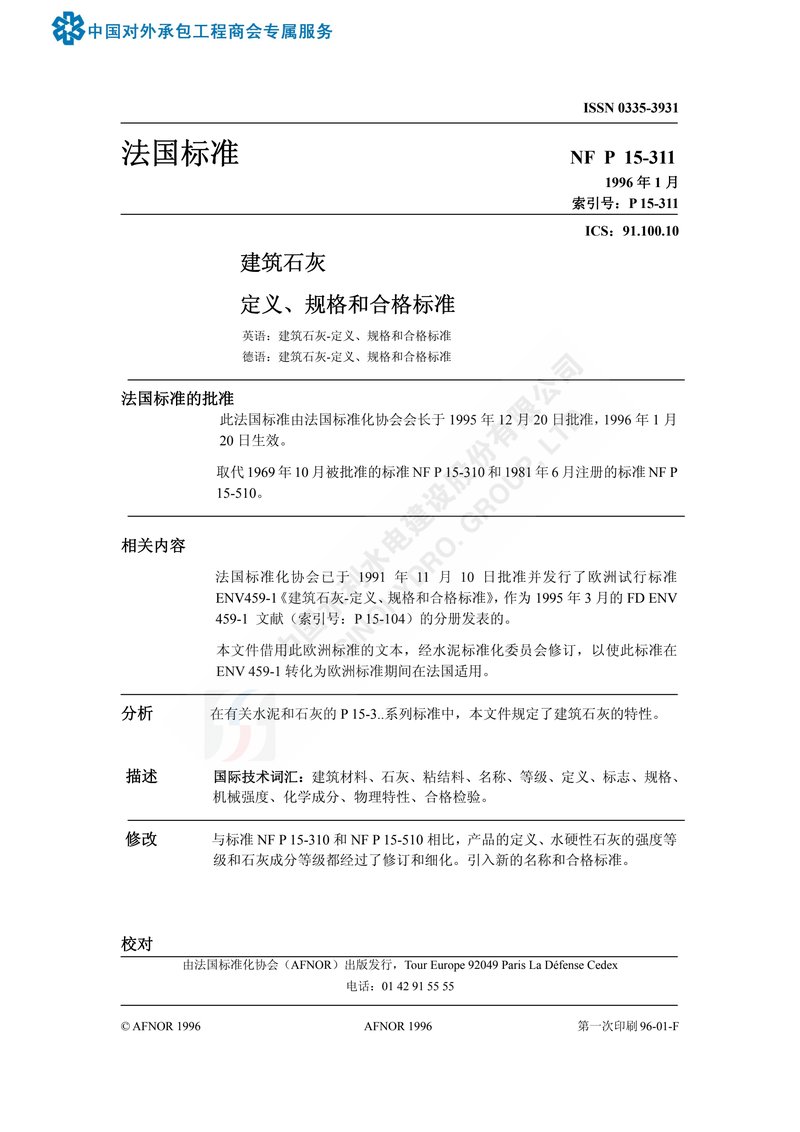

下载标准文件
NF P15-311-中文
英语 · PDF · 6 页 · 312.54 KB