ISO 1940 - 1
机械振动 - 刚性转子平衡质量要求 - 第1部分:许用剩余不平衡量的确定
ISO 1940 - 1
Mechanical vibration — Balance quality requirements of rigid rotors — Part 1: Determination of permissible residual unbalance
标准信息
STANDARD INFORMATION- 标准编号
- ISO 1940 - 1
- 所属分类
- ISO 国际标准
- 发布机构
- ISO
- 版本年份
- 1986
- 文件语言
- 英语
- 文件格式
- 文件页数
- 6 页
- 文件大小
- 415.38 KB
中文名称为参考译名,文件语言以原文为准。
· 更新:
标准简介
OVERVIEW中文简介
该标准规定了刚性转子平衡质量的要求,特别是如何确定许用剩余不平衡量。它定义了平衡质量等级,并提供了基于转子工作转速和几何尺寸来确定许用剩余比不平衡值的方法。
English summary
This standard specifies balance quality requirements for rigid rotors, focusing on the determination of permissible residual unbalance. It defines balance quality grades and provides methods to determine permissible residual specific unbalance values based on rotor service speed and geometry.
以上为根据文件整理的内容简介。
相关标签
标准内容预览
DOCUMENT PREVIEWISO 1940/1-1986 (E)
|
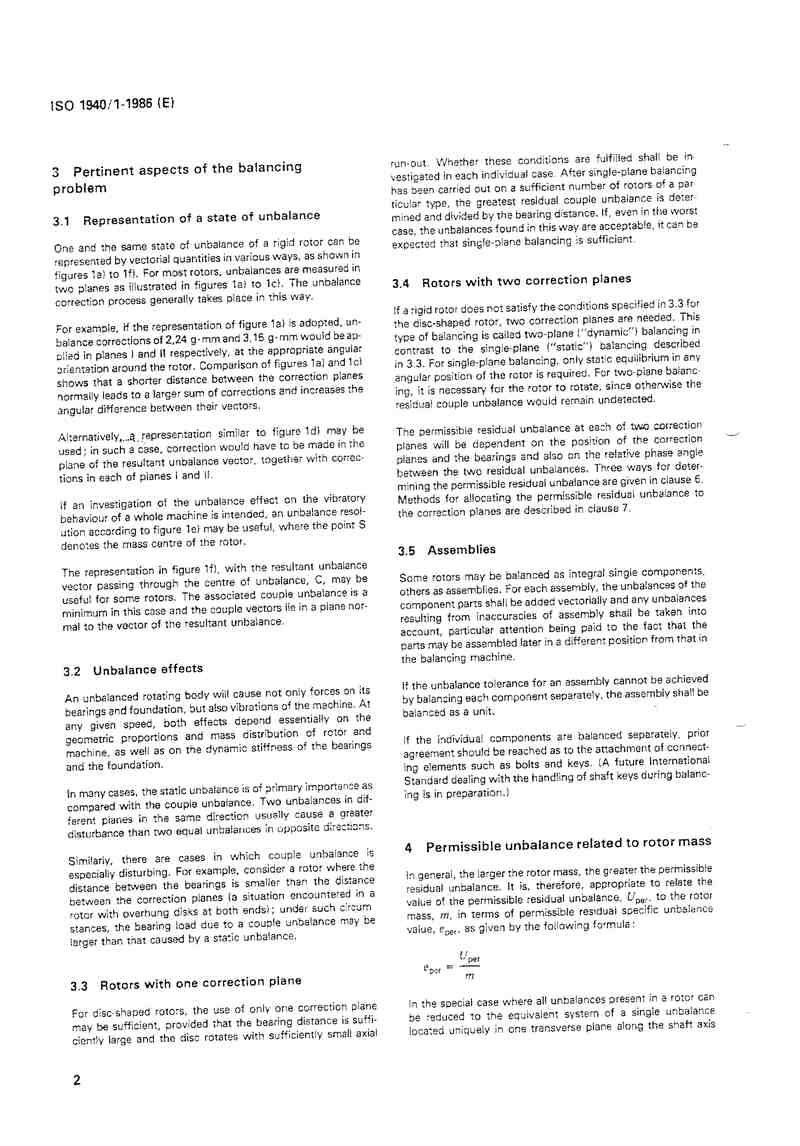
such that the couple unbalance is zero, the permissible residual specific unbalance value, eper, can be considered as equivalent to a permissible displacement of the mass centre of the rotor from the shaft axis. In all other cases, one of which is shown in figure 1, the equivalent residual displacement, e, of the mass centre, after two-plane balancing to the permissible values, is smaller than the specific permissible residual unbalance value, eper. 5 Quality grades relating service speed and permissible residual specific unbalanceExperience shows that, in general, for rotors of the same type, the permissible residual specific unbalance value, eper, varies inversely as the speed of the rotor in the speed range shown in figure 2 for a given balance quality grade; this relationship is given by the following formula: eper × ω = constant where ω is the angular velocity of the rotor at maximum service speed. This relationship follows also from the fact that, for geometrically similar rotors running at equal peripheral velocities, the stresses in rotors and bearings are the same. The balance quality grades (given in table 1 and illustrated in figure 2) are based on this relationship. 6 Determination of balance quality requirements6.1 GeneralThe balance quality requirements can be determined by three methods as described in 6.2 to 6.4. The first method is based on empirical quality grades derived from long-term practical experience with a large number of different rotors (see 6.2). The second method is an experimental one and is often used in mass production balancing (see 6.3). The third method is used if permissible bearing forces due to unbalance are specified (see 6.4). Choice of method should be agreed between the manufacturer and user. 6.2 Balance quality requirements based on established gradesOn the basis of clauses 4 and 5, balance quality grades have been established which permit a classification of the quality requirements. Each balance quality grade in table 1 comprises a range of permissible residual specific unbalance from an upper limit to zero, the upper limit being given by a certain magnitude of the product of the relationship (eper × ω), expressed in millimetres per second; balance quality grades are designated according to the product of the relationship, i.e. if the product of eper × ω is equal to 630 mm/s, the balance quality grade is designated G630. |
Balance quality grades are separated from each other by a factor of 2,5. A finer grading may be necessary in some cases, especially when high precision balancing is required. The upper limits of eper are plotted against the maximum service speed in figure 2. The permissible residual unbalance given by Uper = eper × m, where m is the rotor mass. NOTE — For balance quality grades G1 and G0,4, the final balance quality requirements selected is a compromise between technical requirements and what is practically possible. The selected limit is usually associated with the minimal state of unbalance which can reasonably be repeated. The recommended values in these balance quality grades can only be achieved in practice if the accuracy of shaft journals (roundness, etc.) in the rotor bearings and/or the bearing accuracy are sufficient. In order to achieve a balance quality grade G1, it is usually necessary to balance the rotor in its own service bearings, using belt, air or self-drives. In order to achieve balance quality grade G0,4, balancing usually needs to be carried out with the rotor mounted in its own housing and bearing and under service conditions and temperature; self-drive is generally required. 6.3 Balance quality requirements based on experimental determinationExperimental determination of the balance quality requirements is often carried out for mass production applications. Tests are commonly run in situ, although occasionally they may be carried out in balancing machines, provided that the characteristics of the balancing machine are essentially those of the service condition of the machine in which the rotor will be used. The value of permissible residual unbalance in each correction plane is determined experimentally by introducing various test unbalances successively in each plane; the criterion to be chosen is given by the one most representative (e.g. vibrations, forces or noise caused by unbalance). In two-plane balancing, the differing effects of unbalances with the same phase angle and of unbalance couples have to be taken into account. In addition, changes in the local environment, and/or in the rotor, which may occur in service, have to be taken into consideration. 6.4 Balance quality requirements based on specified permissible bearing forcesWhere the effect of unbalance forces transmitted at the bearings into the supporting structure is of major concern and limits to these forces are specified, this has to be taken into consideration in the determination of permissible residual unbalance. The value of permissible unbalance in each bearing plane can then be derived directly from the maximum permissible forces due to unbalance at each bearing. If the rotor is balanced in a balancing machine which measures the residual unbalance in the bearing planes, these values may be applied directly. However, if the residual unbalance is measured at other planes, the permissible residual unbalance at these planes can be |
6
Révision de la présente publication
Le contenu technique des publications de la CEI est constamment revu par la Commission afin d'assurer qu'il reflète bien l'état actuel de la technique.
Les renseignements relatifs à ce travail de révision, à l'établissement des éditions révisées et aux mises à jour peuvent être obtenus auprès des Comités nationaux de la CEI et en consultant les documents ci-dessous :
- Bulletin de la CEI
- Annuaire de la CEI
- Catalogue des publications de la CEI
Publié annuellement
Terminologie
En ce qui concerne la terminologie générale, le lecteur se reportera à la Publication 50 de la CEI : Vocabulaire Electrotechnique International (VEI), qui est établie sous forme de chapitres séparés traitant chacun d'un sujet défini, l'Index général étant publié séparément. Des détails complets sur le VEI peuvent être obtenus sur demande.
Les termes et définitions figurant dans la présente publication ont été soit repris du VEI, soit spécifiquement approuvés aux fins de cette publication.
Symboles graphiques et littéraux
Pour les symboles graphiques, symboles littéraux et signes d'usage général approuvés par la CEI, le lecteur consultera :
- la Publication 27 de la CEI : Symboles littéraux à utiliser en électrotechnique ;
- la Publication 617 de la CEI : Symboles graphiques pour schémas.
Les symboles et signes contenus dans la présente publication ont été soit repris des Publications 27 ou 617 de la CEI, soit spécifiquement approuvés aux fins de cette publication.
Publications de la CEI établies par le même Comité d'Etudes
L'attention du lecteur est attirée sur la page 3 de la couverture, qui énumère les publications de la CEI préparées par le Comité d'Etudes qui a établi la présente publication.
Revision of this publication
The technical content of IEC publications is kept under constant review by the IEC, thus ensuring that the content reflects current technology.
Information on the work of revision, the issue of revised editions and amendment sheets may be obtained from IEC National Committees and from the following IEC sources :
- IEC Bulletin
- IEC Yearbook
- Catalogue of IEC Publications
Published yearly
Terminology
For general terminology, readers are referred to IEC Publication 50 : International Electrotechnical Vocabulary (IEV), which is issued in the form of separate chapters each dealing with a specific field, the General Index being published as a separate booklet. Full details of the IEV will be supplied on request.
The terms and definitions contained in the present publication have either been taken from the IEV or have been specifically approved for the purpose of this publication.
Graphical and letter symbols
For graphical symbols, and letter symbols and signs approved by the IEC for general use, readers are referred to :
- IEC Publication 27 : Letter symbols to be used in electrical technology ;
- IEC Publication 617 : Graphical symbols for diagrams.
The symbols and signs contained in the present publication have either been taken from IEC Publications 27 or 617, or have been specifically approved for the purpose of this publication.
IEC publications prepared by the same Technical Committee
The attention of readers is drawn to the inside of the back cover, which lists IEC publications issued by the Technical Committee which has prepared the present publication.
2
NORME INTERNATIONALE INTERNATIONAL STANDARD МЕЖДУНАРОДНЫЙ СТАНДАРТ
|
NORME INTERNATIONALE INTERNATIONAL STANDARD МЕЖДУНАРОДНЫЙ СТАНДАРТ |
CEI IEC 50(426) Première édition First edition 1990-10 Vocabulaire Electrotechnique InternationalChapitre 426 : Matériel électrique pour atmosphères explosives International Electrotechnical VocabularyChapter 426 : Electrical apparatus for explosive atmospheres Международный Электротехнический СловарьГлава 426 : Электрооборудование для взрывоопасных сред © CEI 1990 Droits de reproduction réservés - Copyright - all rights reserved - Право издания охраняется законом Aucune partie de cette publication ne peut être reproduite ni utilisée sous quelque forme que ce soit et par aucun procédé, électronique ou mécanique, y compris la photocopie et les microfilms, sans l'accord écrit de l'éditeur. No part of this publication may be reproduced or utilized in any form or by any means, electronic or mechanical, including photocopying and microfilm, without permission in writing from the publisher. Запрещается Без письменного разрешения издателя воспроизведение или копирование этой публикации или ее части в любой форме или любыми средствами — электронными или механическими, включая фотоконю и микрофильм. Bureau central de la Commission Electrotechnique Internationale 3, rue de Varembé Genève Suisse
|
50(715) © IEC:1996
CONTENTS
| FOREWORD | VII | |
| PREFACE | VII | |
| Sections | ||
| 715-01 | Basic terms | 1 |
| 715-02 | Resources | 10 |
| 715-03 | Calls | 17 |
| 715-04 | Times and delays | 22 |
| 715-05 | Traffic | 24 |
| 715-06 | Circuit groups | 32 |
| 715-07 | Traffic engineering | 34 |
| 715-08 | Networks | 41 |
| 715-09 | Circuit switched networks | 46 |
| 715-10 | Message switched networks | 51 |
| 715-11 | Packet switched networks | 52 |
| Index | 53 |
:current
Foreword
This document (EN 10216-3:2002) has been prepared by Technical Committee EC/TC 29, "Steel tubes and fittings for steel tubes", the secretariat of which is held by UNI.
This European Standard shall be given the status of a national standard, either by publication of an identical text or by endorsement, at the latest by November 2002, and conflicting national standards shall be withdrawn at the latest by November 2002.
This document has been prepared under a mandate given to CEN by the European Commission and the European Free Trade Association, and supports essential requirements of EU Directive(s).
For relationship with EU Directive(s), see informative annex ZA, which is an integral part of this document.
Other Parts of EN 10216 are:
| Part 1: | Non-alloy steel tubes with specified room temperature properties |
| Part 2: | Non-alloy and alloy steel tubes with specified elevated temperature properties |
| Part 4: | Non-alloy and alloy steel tubes with specified low temperature properties |
| Part 5: | Stainless steel tubes |
Another European Standard series covering tubes for pressure purposes is:
| EN 10217: | Welded steel tubes for pressure purposes |
According to the CEN/CENELEC Internal Regulations, the national standards organizations of the following countries are bound to implement this European Standard: Austria, Belgium, Czech Republic, Denmark, Finland, France, Germany, Greece, Iceland, Ireland, Italy, Luxembourg, Malta, Netherlands, Norway, Portugal, Spain, Sweden, Switzerland and the United Kingdom.
5
1 Scope
This Part of EN 10216 specifies the technical delivery conditions in two test categories for seamless tubes of circular cross section, made of weldable alloyed fine grained steel.
2 Normative references
This European Standard incorporates by date or undated reference, provisions from other publications. These normative references are cited at the appropriate places in the text and the publications are listed hereafter. For date references, subsequent amendments to or revisions of, any of these publications apply to this European Standard only when incorporated in it by amendment or revision. For undated references the latest edition of the publication referred to applies (including amendments).
The requirements of this European Standard rule when they differ from those in the standards and documents referred to below:
EN 10002-1, Metallic materials - Tensile testing - Part 1: Method of test (at ambient temperature).
EN 10002-5, Metallic materials - Tensile testing - Part 5: Method of testing (at elevated temperature).
EN 10020, Definitions and classification of grades of steel.
EN 10021, General technical delivery requirements for steel and iron products.
EN 10045-1, Metallic materials - Charpy impact test - Part 1: Test method.
EN 10052, Vocabulary of heat treatment terms for ferrous products.
EN 10204, Metallic products - Types of inspection documents.
EN 10027-1, Designation systems for steels - Part 1: Steel names, principle symbols.
EN 10027-2, Designation systems for steels Part 2: Numerical systems.
ENV 10220, Seamless and welded steel tubes - Dimensions and masses per unit length
EN 10233, Metallic materials - Tubes - Flattening test.
EN 10234, Metallic materials - Tubes - Drift expanding test.
EN 10236, Metallic materials - Tubes - Ring expanding test.
EN 10237, Metallic materials - Tubes - Ring tensile test.
EN 10246-1, Non-Destructive Testing of steel tubes Part 1: Automatic electromagnetic testing of seamless and welded (except submerged arc welded) ferromagnetic steel tubes for verification of hydraulic leak-tightness.
EN 10246-5, Non-Destructive Testing of steel tubes - Part 5: Automatic full peripheral magnetic transducer/flux leakage testing of seamless and welded (except submerged arc-welded) ferromagnetic steel tubes for the detection of longitudinal imperfections.
EN 10246-6, Non-Destructive Testing of steel tubes - Part 6: Automatic full peripheral ultrasonic testing of seamless steel tubes for the detection of transverse imperfections.
EN 10246-7, Non-Destructive Testing of steel tubes - Part 7: Automatic full peripheral ultrasonic testing of seamless and welded (except submerged arc welded) steel tubes for the detection of longitudinal imperfections.
6
预览内容由文件识别整理,表格、公式及文字请以原始文件为准。
原文图片预览
PAGE IMAGES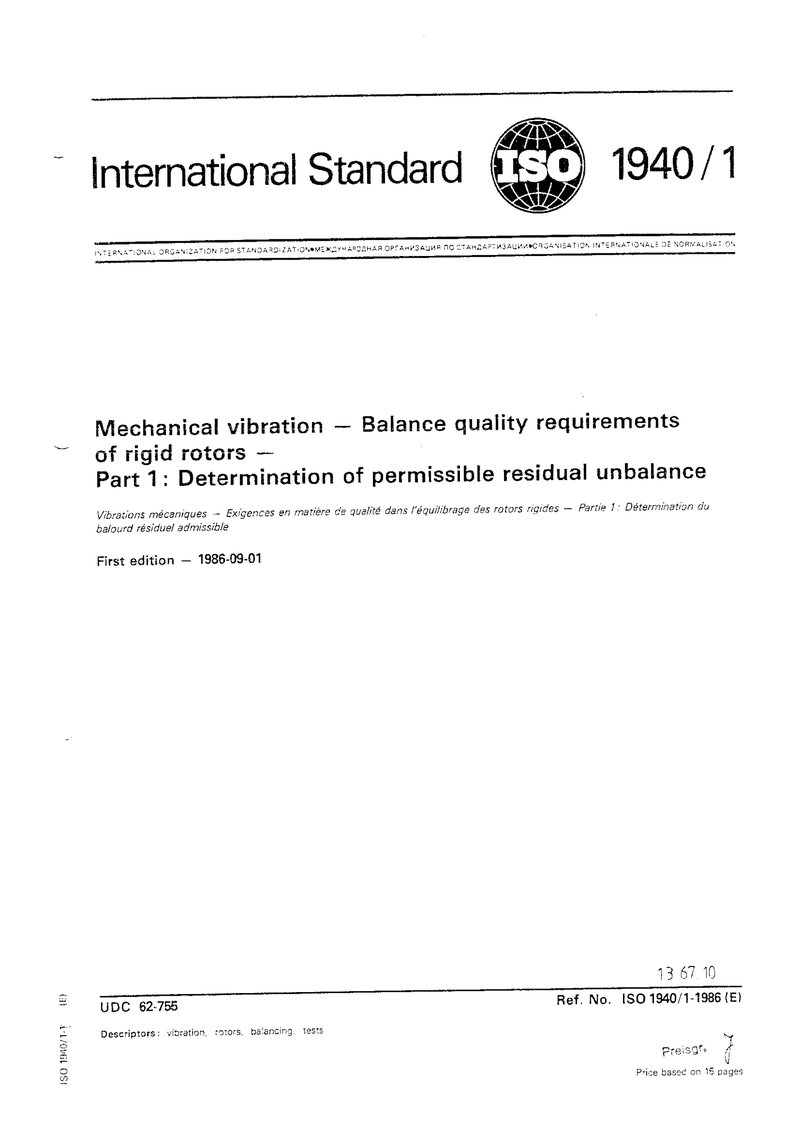
下载标准文件
ISO 1940 - 1
英语 · PDF · 6 页 · 415.38 KB