IEC 60479-3 effects of current passing through the
电流对人和家畜的影响 – 第3部分:通过家畜身体的电流效应
IEC 60479-3 effects of current passing through the body of live stock
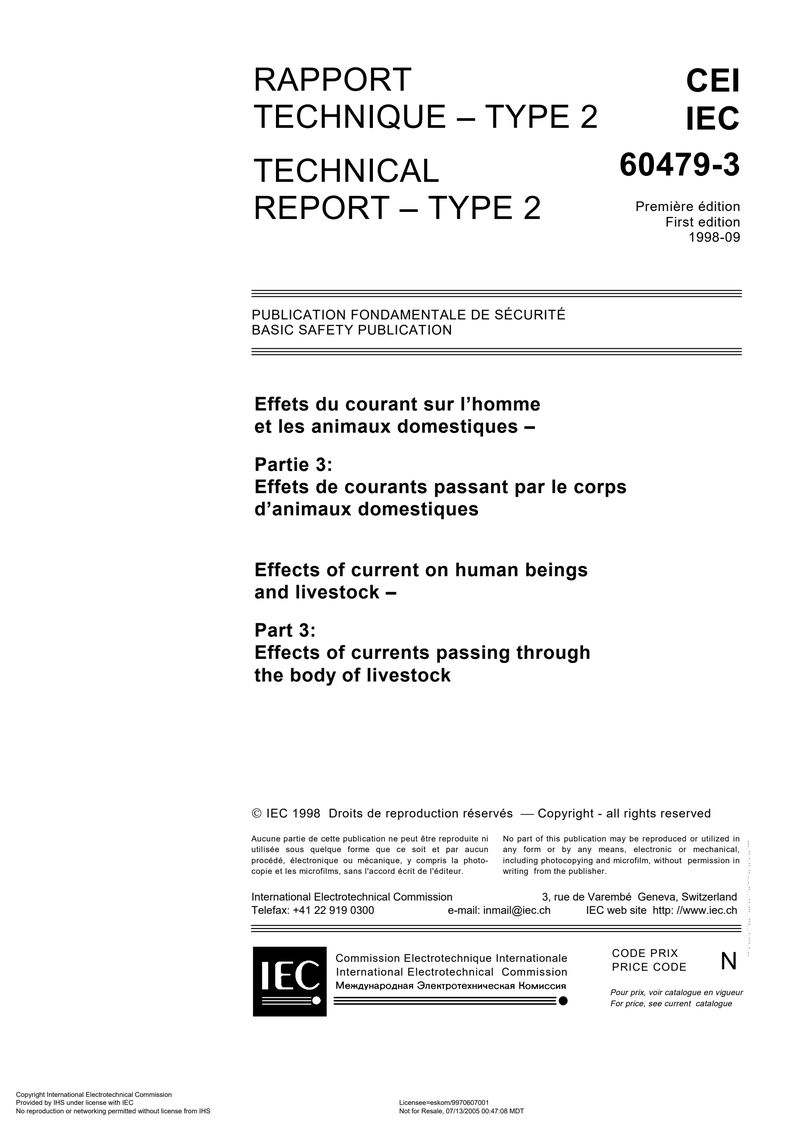
Effects of current on human beings and livestock – Part 3: Effects of currents passing through the body of livestock
标准信息
STANDARD INFORMATION- 标准编号
- IEC 60479-3 effects of current passing through the
- 所属分类
- IEC 国际电工标准
- 发布机构
- IEC
- 版本年份
- 1998
- 文件语言
- 英语
- 文件格式
- 文件页数
- 6 页
- 文件大小
- 170.3 KB
中文名称为参考译名,文件语言以原文为准。
· 更新:
标准简介
OVERVIEW中文简介
该标准规定了通过家畜身体的电流效应,包括家畜身体阻抗特性(如内部阻抗、皮肤阻抗、蹄部阻抗等)的数值。它详细描述了15 Hz至100 Hz范围内的正弦交流电对家畜的反应阈值、固定阈值和心室颤动阈值。
English summary
This standard specifies the effects of currents passing through the body of livestock, including values for body impedance characteristics such as internal impedance, hide/skin impedance, and hoof impedance. It details the thresholds for reaction, immobilization, and ventricular fibrillation caused by sinusoidal alternating currents in the range of 15 Hz to 100 Hz.
以上为根据文件整理的内容简介。
相关标签
标准内容预览
DOCUMENT PREVIEWCOMMISSION ÉLECTROTECHNIQUE INTERNATIONALE
EFFETS DU COURANT SUR L'HOMME ET LES ANIMAUX DOMESTIQUES –
Partie 3: Effets de courants passant par le corps d'animaux domestiques
AVANT-PROPOS
- La CEI (Commission Electrotechnique Internationale) est une organisation mondiale de normalisation composée de l'ensemble des comités électrotechniques nationaux (Comités nationaux de la CEI). La CEI a pour objet de favoriser la coopération internationale pour toutes les questions de normalisation dans les domaines de l'électricité et de l'électronique. A cet effet, la CEI, entre autres activités, publie des Normes internationales. Leur élaboration est confiée à des comités d'études, aux travaux desquels tout Comité national intéressé par le sujet traité peut participer. Les organisations internationales, gouvernementales et non gouvernementales, en liaison avec la CEI, participent également aux travaux. La CEI collabore étroitement avec l'Organisation Internationale de Normalisation (ISO), selon les conditions fixées par accord entre les deux organisations.
- Les décisions ou accords officiels de la CEI concernant les questions techniques représentent, dans la mesure du possible un accord international sur les sujets étudiés, étant donné que les Comités nationaux intéressés sont représentés dans chaque comité d'études.
- Les documents produits se présentent sous la forme de recommandations internationales. Ils sont publiés comme normes, rapports techniques ou guides et agréés comme tels par les Comités nationaux.
- Dans le but d'encourager l'unification internationale, les Comités nationaux de la CEI s'engagent à appliquer de façon transparente, dans toute la mesure possible, les Normes internationales de la CEI dans leurs normes nationales et régionales. Toute divergence entre la norme de la CEI et la norme nationale ou régionale correspondante doit être indiquée en termes clairs dans cette dernière.
- La CEI n'a fixé aucune procédure concernant le marquage comme indication d'approbation et sa responsabilité n'est pas engagée quand un matériel est déclaré conforme à l'une de ses normes.
- L'attention est attirée sur le fait que certains des éléments de la présente Norme internationale peuvent faire l'objet de droits de propriété intellectuelle ou de droits analogues. La CEI ne saurait être tenue pour responsable de ne pas avoir identifié de tels droits de propriété et de ne pas avoir signalé leur existence.
La tâche principale des comités d'études de la CEI est l'élaborer des Normes internationales. Exceptionnellement, un comité d'études peut proposer la publication d'un rapport technique de l'un des types suivants:
- type 1, lorsque, en dépit de maints efforts, l'accord requis ne peut être réalisé en faveur de la publication d'une Norme internationale;
- type 2, lorsque le sujet en question est encore en cours de développement technique ou lorsque, pour une raison quelconque, la possibilité d'un accord pour la publication d'une Norme internationale peut être envisagée pour l'avenir mais pas dans l'immédiat;
- type 3, lorsqu'un comité d'études a réuni des données de nature différente de celles qui sont normalement publiées comme Normes internationales, cela pouvant comprendre, par exemple, des informations sur l'état de la technique.
Les rapports techniques des types 1 et 2 font l'objet d'un nouvel examen trois ans au plus tard après leur publication afin de décider éventuellement de leur transformation en Normes internationales. Les rapports techniques du type 3 ne doivent pas nécessairement être révisés avant que les données qu'ils contiennent ne soient plus jugées valables ou utiles.
6
2 Scope
2
NORME INTERNATIONALE INTERNATIONAL STANDARD МЕЖДУНАРОДНЫЙ СТАНДАРТ
|
NORME INTERNATIONALE INTERNATIONAL STANDARD МЕЖДУНАРОДНЫЙ СТАНДАРТ |
CEI IEC 50(426) Première édition First edition 1990-10 Vocabulaire Electrotechnique InternationalChapitre 426 : Matériel électrique pour atmosphères explosives International Electrotechnical VocabularyChapter 426 : Electrical apparatus for explosive atmospheres Международный Электротехнический СловарьГлава 426 : Электрооборудование для взрывоопасных сред © CEI 1990 Droits de reproduction réservés - Copyright - all rights reserved - Право издания охраняется законом Aucune partie de cette publication ne peut être reproduite ni utilisée sous quelque forme que ce soit et par aucun procédé, électronique ou mécanique, y compris la photocopie et les microfilms, sans l'accord écrit de l'éditeur. No part of this publication may be reproduced or utilized in any form or by any means, electronic or mechanical, including photocopying and microfilm, without permission in writing from the publisher. Запрещается Без письменного разрешения издателя воспроизведение или копирование этой публикации или ее части в любой форме или любыми средствами — электронными или механическими, включая фотоконю и микрофильм. Bureau central de la Commission Electrotechnique Internationale 3, rue de Varembé Genève Suisse
|
50(715) © IEC:1996
CONTENTS
| FOREWORD | VII | |
| PREFACE | VII | |
| Sections | ||
| 715-01 | Basic terms | 1 |
| 715-02 | Resources | 10 |
| 715-03 | Calls | 17 |
| 715-04 | Times and delays | 22 |
| 715-05 | Traffic | 24 |
| 715-06 | Circuit groups | 32 |
| 715-07 | Traffic engineering | 34 |
| 715-08 | Networks | 41 |
| 715-09 | Circuit switched networks | 46 |
| 715-10 | Message switched networks | 51 |
| 715-11 | Packet switched networks | 52 |
| Index | 53 |
:current
Foreword
This document (EN 10216-3:2002) has been prepared by Technical Committee EC/TC 29, "Steel tubes and fittings for steel tubes", the secretariat of which is held by UNI.
This European Standard shall be given the status of a national standard, either by publication of an identical text or by endorsement, at the latest by November 2002, and conflicting national standards shall be withdrawn at the latest by November 2002.
This document has been prepared under a mandate given to CEN by the European Commission and the European Free Trade Association, and supports essential requirements of EU Directive(s).
For relationship with EU Directive(s), see informative annex ZA, which is an integral part of this document.
Other Parts of EN 10216 are:
| Part 1: | Non-alloy steel tubes with specified room temperature properties |
| Part 2: | Non-alloy and alloy steel tubes with specified elevated temperature properties |
| Part 4: | Non-alloy and alloy steel tubes with specified low temperature properties |
| Part 5: | Stainless steel tubes |
Another European Standard series covering tubes for pressure purposes is:
| EN 10217: | Welded steel tubes for pressure purposes |
According to the CEN/CENELEC Internal Regulations, the national standards organizations of the following countries are bound to implement this European Standard: Austria, Belgium, Czech Republic, Denmark, Finland, France, Germany, Greece, Iceland, Ireland, Italy, Luxembourg, Malta, Netherlands, Norway, Portugal, Spain, Sweden, Switzerland and the United Kingdom.
5
1 Scope
This Part of EN 10216 specifies the technical delivery conditions in two test categories for seamless tubes of circular cross section, made of weldable alloyed fine grained steel.
2 Normative references
This European Standard incorporates by date or undated reference, provisions from other publications. These normative references are cited at the appropriate places in the text and the publications are listed hereafter. For date references, subsequent amendments to or revisions of, any of these publications apply to this European Standard only when incorporated in it by amendment or revision. For undated references the latest edition of the publication referred to applies (including amendments).
The requirements of this European Standard rule when they differ from those in the standards and documents referred to below:
EN 10002-1, Metallic materials - Tensile testing - Part 1: Method of test (at ambient temperature).
EN 10002-5, Metallic materials - Tensile testing - Part 5: Method of testing (at elevated temperature).
EN 10020, Definitions and classification of grades of steel.
EN 10021, General technical delivery requirements for steel and iron products.
EN 10045-1, Metallic materials - Charpy impact test - Part 1: Test method.
EN 10052, Vocabulary of heat treatment terms for ferrous products.
EN 10204, Metallic products - Types of inspection documents.
EN 10027-1, Designation systems for steels - Part 1: Steel names, principle symbols.
EN 10027-2, Designation systems for steels Part 2: Numerical systems.
ENV 10220, Seamless and welded steel tubes - Dimensions and masses per unit length
EN 10233, Metallic materials - Tubes - Flattening test.
EN 10234, Metallic materials - Tubes - Drift expanding test.
EN 10236, Metallic materials - Tubes - Ring expanding test.
EN 10237, Metallic materials - Tubes - Ring tensile test.
EN 10246-1, Non-Destructive Testing of steel tubes Part 1: Automatic electromagnetic testing of seamless and welded (except submerged arc welded) ferromagnetic steel tubes for verification of hydraulic leak-tightness.
EN 10246-5, Non-Destructive Testing of steel tubes - Part 5: Automatic full peripheral magnetic transducer/flux leakage testing of seamless and welded (except submerged arc-welded) ferromagnetic steel tubes for the detection of longitudinal imperfections.
EN 10246-6, Non-Destructive Testing of steel tubes - Part 6: Automatic full peripheral ultrasonic testing of seamless steel tubes for the detection of transverse imperfections.
EN 10246-7, Non-Destructive Testing of steel tubes - Part 7: Automatic full peripheral ultrasonic testing of seamless and welded (except submerged arc welded) steel tubes for the detection of longitudinal imperfections.
6
预览内容由文件识别整理,表格、公式及文字请以原始文件为准。
原文图片预览
PAGE IMAGES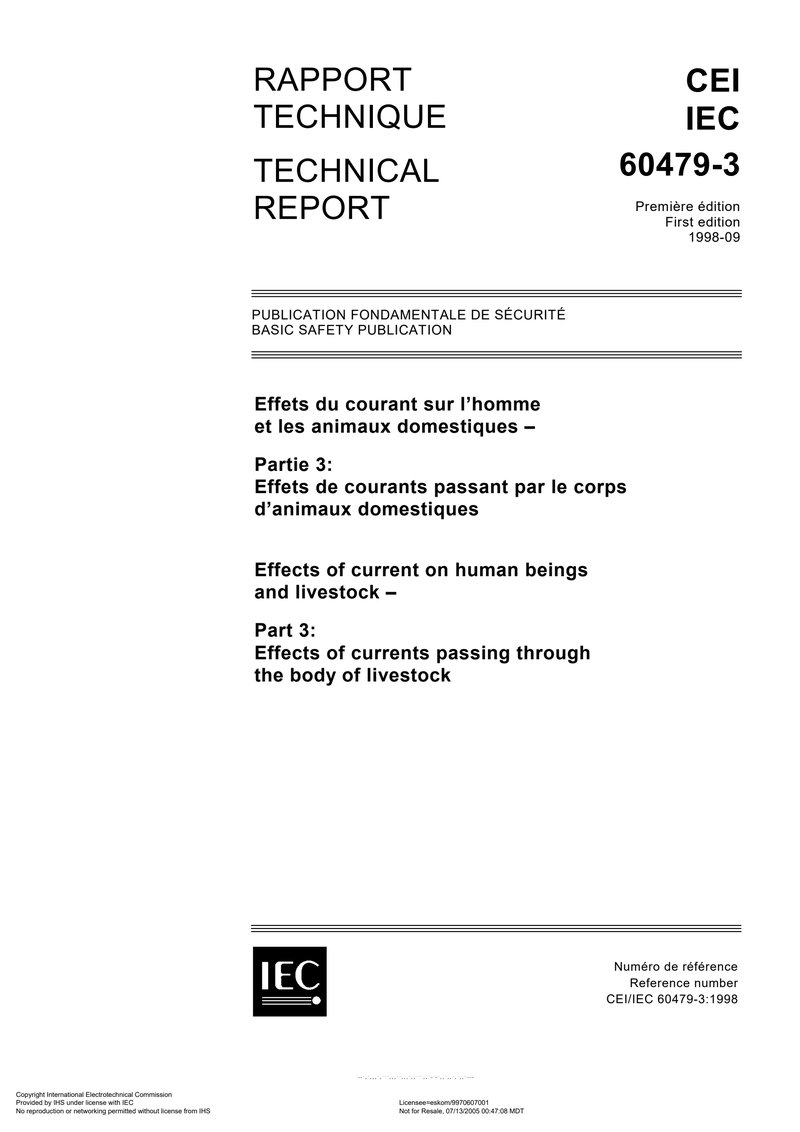
下载标准文件
IEC 60479-3 effects of current passing through the
英语 · PDF · 6 页 · 170.3 KB