ACI 307-98
钢筋混凝土烟囱的设计与施工
ACI 307-98
Design and Construction of Reinforced Concrete Chimneys
标准信息
STANDARD INFORMATION- 标准编号
- ACI 307-98
- 所属分类
- ACI 美国混凝土学会标准
- 发布机构
- American Concrete Institute (ACI)
- 版本年份
- 1998
- 文件语言
- 英语
- 文件格式
- 文件页数
- 6 页
- 文件大小
- 392.4 KB
中文名称为参考译名,文件语言以原文为准。
· 更新:
标准简介
OVERVIEW中文简介
该标准规定了现浇和预制钢筋混凝土烟囱的材料、施工和设计要求。它给出了设计最小荷载、混凝土与钢筋确定方法,并主要适用于圆形烟囱壳体,同时包含非圆形形状的一般分析方法。
English summary
This standard specifies material, construction, and design requirements for cast-in-place and precast reinforced concrete chimneys. It provides minimum design loadings and methods for determining concrete and reinforcement, primarily for circular chimney shells, with a general procedure for noncircular shapes.
以上为根据文件整理的内容简介。
相关标签
标准内容预览
DOCUMENT PREVIEWThe user wants me to convert an OCR of an engineering standard PDF page into HTML. Let me analyze the page carefully.
This is page 307-2 of an ACI STANDARD. It has two columns. The left column contains Chapter 1 (General) and the start of reference standards. The right column contains the continuation of reference standards, Chapter 2 (Materials), and Chapter 3 (Construction Requirements).
Let me transcribe carefully.
Left column:
CHAPTER 1—GENERAL
1.1—Scope
This standard covers the design and construction of circular cast-in-place or precast reinforced concrete chimney shells. If other shapes are used, their design shall be substantiated in accordance with the principles used here. The standard does not include the design of linings, but includes the effects of linings on the concrete shell.
A precast chimney shell is defined as a shell constructed wholly from precast reinforced concrete sections, assembled one atop another, to form a freestanding, self-supporting cantilever. Vertical reinforcement and grout are placed in cores as the precast sections are erected to provide structural continuity and stability. The use of precast panels as stay-in-place forms is considered cast-in-place construction.
1.2—Drawings
Drawings of the chimney shall be prepared showing all features of the work, including the design strength of the concrete, the thickness of the concrete chimney shell, the size and position of reinforcing steel, details and dimensions of the chimney lining, and information on chimney accessories.
1.3—Regulations
1.3.1 The design and construction of the chimney shall meet the requirements of all ordinances and regulations of authorities having jurisdiction, except that where such requirements are less conservative than the comparable requirements of this standard, this standard shall govern.
1.3.2 Consideration shall be given to the recommendations of the Federal Aviation Administration with respect to chimney heights and aviation obstruction lighting and marking, and the standards of the Underwriters Laboratories regarding lightning protection and grounding.
1.4—Reference standards
Standards of the American Concrete Institute, the American Society of Civil Engineers, and the American Society for Testing and Materials referred to in this standard are listed in the following with their serial designations, including the year of adoption or revision, and are declared to be a part of this standard as if fully set forth here.
ACI 104-71 (Reapproved 1987) Preparation of Notation for Concrete
ACI 318-95 Building Code Requirements for Reinforced Concrete
ASCE 7-95 Minimum Design Loads for Buildings and Other Structures
ASTM A 615-95c Standard Specification for Deformed and Plain Billet Steel Bars for Concrete Reinforcement
ASTM A 617-96 Standard Specification for Axle-Steel Deformed and Plain Bars for Concrete Reinforcement
Right column (continuation of reference standards):
ASTM A 706-96 Standard Specification for Low-Alloy Steel Deformed Bars for Concrete Reinforcement
ASTM C 33-93 Standard Specification for Concrete Aggregates
ASTM C 150-95 Standard Specification for Portland Cement
ASTM C 309-95 Standard Specification for Liquid Membrane-Forming Compounds for Curing Concrete
ASTM C 595-95 Standard Specification for Blended Hydraulic Cement
CHAPTER 2—MATERIALS
2.1—General
All materials and material tests shall conform to ACI 318, except as otherwise specified here.
2.2—Cement
The same brand and type of cement shall be used throughout the construction of the chimney. The cement used shall conform to the requirements for Type I, Type II, Type III, or Type V of ASTM C 150, or Type IS or Type IP of ASTM C 595.
2.3—Aggregates
2.3.1 Concrete aggregates shall conform to ASTM C 33.
2.3.2 The maximum size of coarse aggregate shall be not larger than 1/8 of the narrowest dimension between forms nor larger than 1/2 the minimum clear distance between reinforcing bars.
2.4—Reinforcement
Reinforcement shall conform to ASTM A 615, A 617, or A 706. Deformed reinforcement with a specified yield stress fy exceeding 60,000 psi (414.0 MPa) shall be permitted provided the ultimate tensile strain shall equal or exceed 0.07.
CHAPTER 3—CONSTRUCTION REQUIREMENTS
3.1—General
Concrete quality, methods of determining strength of concrete, field tests, concrete proportions and consistency, mixing and placing, and formwork and details of reinforcement shall be in accordance with ACI 318, except as stated otherwise here.
3.2—Concrete quality
The specified concrete compressive strength shall not be less than 3000 psi (20.7 MPa) at 28 days.
3.3—Strength tests
The 28-day compressive strength of the concrete shall be determined from a minimum of two sets of cylinders (consisting of three specimens each) per 8-hr shift (slipform) or per lift (jump form). For precast sections, a minimum of two sets shall be taken from each class of concrete cast each day and from each 100 yd3 (76.5 m3) of concrete placed each day.
Now, the page has a two-column layout. The instructions say to use a two-column layout with table class="layout-columns". But the content flows across columns in a complex way (the reference standards list spans both columns). Hmm.
Actually, looking at the layout, the left column has Chapter 1 and the start of the reference list, and the right column has the continuation of the reference list plus Chapters 2 and 3. This is a continuous flow across two columns.
The instruction says: "两栏布局 →
| 左栏 | 右栏 |
But the reference standards list is split across columns. The left column ends with ASTM A 617-96, and the right column starts with ASTM A 706-96. So I'll just put the left column content in the left td and the right column content in the right td, preserving the visual layout.
Let me think about the structure. The page starts with CHAPTER 1—GENERAL which is a page-internal title, so it should be h2. But there are two columns. The first h2 should be at the start.
Actually, the rule says "每页输出必须以
开头(页面内标题)". So the first element must be h2. The first title is CHAPTER 1—GENERAL.
For the two-column layout, I'll use a table with class layout-columns. Inside each td, I'll put the content.
Let me structure:
CHAPTER 1—GENERAL
— but this is in the left column. Hmm, but the h2 must be at the start of the page output. The CHAPTER 1 title is at the top of the left column. The right column top has the reference standards continuation.Actually, looking at the visual layout, the top of the right column starts with "ASTM A 706-96" which is a continuation of the reference list from the left column. So the two columns are not independent sections; they're a continuous flow.
Given the constraints, I think the cleanest approach is to use the layout-columns table to represent the visual two-column layout. The h2 at the start would be CHAPTER 1—GENERAL which is in the left column.
Let me put the h2 inside the left td? But the rule says "每页输出必须以
开头". So the very first tag must be h2. If I wrap everything in a table, the first tag would be table. That violates rule 9.
Hmm. Let me reconsider. Maybe I should not use the two-column table and instead just flow the content linearly: Chapter 1, then the full reference list (combining both columns), then Chapter 2, then Chapter 3. That would be a linear reading order which is actually the logical reading order of a two-column page.
But the instruction explicitly provides a two-column layout alternative. However, the rule 9 says output must start with h2. If I use the table, the table would be first. Unless I put the h2 before the table.
Let me think. The page has CHAPTER 1—GENERAL at top-left. The right column top is a continuation. So if I do linear flow: h2 CHAPTER 1, then its content, then 1.4 reference standards with the full list (left part then right part), then h2 CHAPTER 2, then content, then h2 CHAPTER 3, then content. That's the logical reading order and starts with h2. This seems most faithful to content and satisfies rule 9.
But the visual two-column layout would be lost. The instruction's "排版替代方案" says two-column layout → table. But it's a suggestion for when there's a genuine two-column layout. Here the columns are a continuous flow, so linear is fine and arguably more correct for content fidelity.
Hmm, but the OCR engine task is to "精确转成HTML片段" - precisely convert. The visual layout is two columns. But the content flows continuously. I think linear flow is acceptable and avoids the h2-first conflict.
Actually wait, let me re-examine. The reference standards list: left column has ACI 104-71, ACI 318-95, ASCE 7-95, ASTM A 615-95c, ASTM A 617-96. Right column has ASTM A 706-96, ASTM C 33-93, ASTM C 150-95, ASTM C 309-95, ASTM C 595-95. These form one continuous list. So linear flow combining them is correct.
I'll go with linear flow. This satisfies rule 9 (starts with h2) and is the logical reading order.
Now for the reference standards list, each entry is like "ACI 104-71 (Reapproved 1987) Preparation of Notation for Concrete". This is a two-part entry: designation and title. I could use a table or just paragraphs. The original uses a tab-like alignment. I'll represent each as a paragraph with the designation and title. But the alignment... The instruction says don't use nbsp or multiple spaces for alignment. I could use a table for the reference list? But the instruction's table rules are for data tables with caption/thead. A reference list isn't really a data table. Hmm.
Actually, I think representing each reference as a paragraph is fine:
ACI 104-71 (Reapproved 1987) Preparation of Notation for Concrete
. But the original has them on separate visual lines with the title indented. Let me look: "ACI 104-71" on one line, "(Reapproved 1987)" below it, then "(Reapproved 1987)" then "Preparation of Notation for Concrete" to the right. Actually the layout is:ACI 104-71 Preparation of Notation for Concrete
(Reapproved 1987)
So the designation column and title column. This is like a definition list or a two-column mini-table.
Given the constraints (no style, no nbsp), I think the cleanest is to use a table without caption/thead for the reference list? But the instruction says tables should have caption/thead/tbody. Hmm, but it says "表格:标题用 caption,表头用 thead/tr/th,数据行用 tbody/tr/td". That's a guideline for tables that have headers. A reference list table has no header. I could still use table with tbody only. But is that allowed? The allowed tags include table, tbody, tr, td. Yes.
But maybe simpler: just paragraphs. The visual alignment isn't critical for content fidelity. The instruction says "不要猜测模糊文字" and "不要改写原文". The content is the designation + title. I'll put them as paragraphs, perhaps with the designation and title separated by a space or as separate lines via the natural paragraph.
Hmm, but the original clearly has a two-column alignment for the reference list. To preserve that, a table is the right tool. Let me use a table with two columns (designation, title) and no thead (or with thead? there's no header). I'll use tbody only. Actually the rule 8 says only td/th can have rowspan/colspan. That's fine.
Wait, but using a table for the reference list might be over-engineering. Let me look at how AS standards are typically represented. The reference list in ACI standards is usually a list. I think paragraphs are acceptable. But the alignment of title to the right of designation is a visual feature. The instruction's "排版替代方案" doesn't have a "definition list" option. The closest is the two-column layout table or just paragraphs.
I'll use a table for the reference list to preserve the two-column alignment, with class... no class needed (it's not layout-columns, it's a real data table of references). Actually it's a data table: column 1 = designation, column 2 = title. No header row. I'll use table > tbody > tr > td. That's valid.
Hmm, but the instruction example shows tables with caption and thead. It doesn't forbid tables without them. I think it's fine.
Actually, let me reconsider whether to use the layout-columns table for the whole page. The conflict with rule 9 (must start with h2) is the issue. If I put h2 before the table, then the table contains the rest. But CHAPTER 1 title is in left column and the right column top is reference continuation. If I do:
CHAPTER 1—GENERAL
| [left column content: 1.1, 1.2, 1.3, 1.4 intro, reference list part 1] | [right column content: reference list part 2, CHAPTER 2, CHAPTER 3] |
But then CHAPTER 2 and CHAPTER 3 titles would be h2 inside the right td. That's allowed (h2 inside td). And the page starts with h2. This preserves the visual two-column layout! And the reference list is split across columns matching the visual.
But is splitting the reference list across two tds faithful? Visually yes. Logically the list is continuous but visually split. The OCR task is to reproduce the page. I think the layout-columns table is the intended approach for a two-column page.
Hmm, but the h2 CHAPTER 1 is in the left column visually, not above both columns. If I put h2 before the table, it would appear above both columns, which is wrong visually. But rule 9 forces h2 first. There's tension.
Let me look at the visual again. CHAPTER 1—GENERAL is centered at the top of the left column only. The right column top is "ASTM A 706-96". So CHAPTER 1 title is NOT spanning both columns. So putting h2 before the table misrepresents layout.
Given the conflict, I think the linear flow approach is actually the most sensible: it gives correct reading order and starts with h2. The two-column visual is a layout artifact; the content is linear. Many OCR-to-HTML conversions of two-column pages use linear flow. The instruction's two-column alternative is for when columns are independent (e.g., side-by-side text blocks). Here they're a continuous flow, so linear is correct.
I'll go with linear flow. This is the safest for rule 9 and content fidelity.
Now, the reference list alignment. I'll use a table for it to keep designation and title aligned. Let me decide: I'll use a table with two columns, no thead, tbody rows. Each row: td designation, td title. For ACI 104-71, the designation spans two lines "ACI 104-71" and "(Reapproved 1987)". I can put them in one td with a
? The instruction says don't use br to create paragraph spacing, but br within a cell for line breaks is okay? Rule: "不要用
制造段落间距(段落之间直接换行即可)". That's about paragraph spacing, not line breaks within a cell. Using br inside a td for a multi-line designation is acceptable. Or I could just write "ACI 104-71 (Reapproved 1987)" on one line. The original has them on two lines. To be faithful, use br. Hmm, but is that "制造段落间距"? No, it's a line break within the same logical entry. I think it's fine. Actually, to be safe and avoid br misuse, I'll put the designation and the reapproval note as separate lines using br inside the td. That's a legitimate line break.
Wait, but maybe simpler to keep each reference as a single paragraph combining designation and title with the title following. The visual two-column alignment of the reference list is a minor formatting detail. The instruction emphasizes content fidelity and not inventing alignment with nbsp. A table is the proper way to do alignment. I'll use a table.
Let me reconsider the whole reference list as one table spanning both columns' worth of entries (since linear flow). Good.
Now superscripts/subscripts: "1/8" and "1/2" appear as fractions with the 1 above 8 and 1 above 2 (like ⅛ and ½ but rendered as stacked). In the image, "1/8" is shown as a fraction with 1 over 8 (small). And "1/2" as 1 over 2. These are inline fractions. I could represent as sup/sub? The image shows them as stacked fractions (numerator over denominator). The OCR shows "1/8" with 1 superscript-ish and 8 subscript-ish? Looking at the text: "not larger than 1/8 of the narrowest" where 1 is raised and 8 is lowered (fraction style). Similarly "1/2". And "yd3" with 3 superscript, "m3" with 3 superscript. And "fy" with y subscript.
So:
- 1/8 → I'll represent as 1/8? Hmm but that's not standard fraction. The image shows a proper fraction (1 over 8). Using sup and sub with a slash is a common OCR representation. Actually the image shows the 1 above the 8 with a horizontal line (fraction bar). Hard to represent. The OCR text in the image shows "1" raised and "8" lowered with a slash? Let me look: "1/8" appears as 1 superscript, slash, 8 subscript? In the image it's "1" small top, "8" small bottom, like a fraction. I'll use 1/8. Hmm but that introduces a slash not in original. The original fraction has a bar, not slash. But representing a stacked fraction in HTML without style is hard. The allowed tags include sup and sub. A common approach: 1/8. I think that's acceptable as inline formula representation. Alternatively use for inline formula per the rule "行内公式 → ...". The fractions 1/8 and 1/2 could be considered inline formulas. And yd³, m³, f_y are inline math.
The rule: "行内公式 → ...". So I should wrap inline math in em. So "1/8" → 1/8? But the visual is a fraction. Hmm. The OCR text shows them as fractions. I think representing as 1/8 loses the fraction structure but the rule says inline formula = em. But the fraction's stacked nature... I could do 1/8. That uses sup/sub inside em. Allowed tags include sup, sub, em. Good. That preserves the stacked look somewhat. Actually, looking very carefully at the image text: "1/8" is rendered with 1 as superscript and 8 as subscript with a slash between? The image shows "1" then a small slash then "8" lower? It looks like a fraction with horizontal bar actually. Hard to say. I'll go with 1/8 inside em? Or just 1/8. Hmm. Let me look at "yd3" - the 3 is clearly superscript (cubic yards). "m3" - 3 superscript. "fy" - y subscript. These are clear sup/sub. For the fractions, the image shows them as stacked fractions (1 over 8, 1 over 2) which in OCR often becomes sup/sub. I'll represent as 1/8 and 1/2. But should I wrap in em as inline formula? The rule says inline formula → em. A fraction is a formula. But sup/sub already convey it. I think wrapping the whole fraction in em is reasonable: 1/8. Hmm, but em is italic which might look odd. The original fraction isn't italic. But the rule forces em for inline formulas. The fractions are arguably not "formulas" but numbers. The "fy" is a symbol (formula-like). yd³ is a unit. This is getting too detailed. Let me make pragmatic choices: - For "fy": fy — f is italic variable, y subscript. Good. - For "yd3": yd3 - For "m3": m3 - For fractions 1/8 and 1/2: I'll use 1/8 and 1/2. I won't wrap in em because they're just numbers, not formulas. Actually the rule example for inline formula is em. But these are simple fractions. I'll keep sup/sub. Hmm, but the visual in the image is a stacked fraction without slash. Using sup/sub with slash adds a slash. Without slash, 18 would render as "18" stacked weirdly. The slash is needed for readability. I'll include the slash. It's a reasonable OCR representation. Actually, you know, maybe the image literally shows "1/8" with 1 as superscript and 8 as subscript and a slash. Let me trust that. I'll write 1/8. Hmm wait, but the rule 4 forbids consecutive spaces and nbsp, but slash is fine. OK let me also handle the "1/8" in 2.3.2 and "1/2" in 2.3.2. Now the headings: CHAPTER 1—GENERAL, CHAPTER 2—MATERIALS, CHAPTER 3—CONSTRUCTION REQUIREMENTS. These are page-internal titles. Rule 3: 第1页用 h2,后续页用 h2 或 h3. This is one page (page 307-2). All chapter titles on this page. The first is h2. Subsequent chapter titles—should they be h2 or h3? They're all the same level (chapter titles). I'll make all chapter titles h2. That's consistent. Rule 3 says page-internal titles: first page h2, subsequent pages h2 or h3 by visual hierarchy. Within a page, multiple h2 for chapters is fine. The sub-headings like 1.1—Scope, 1.2—Drawings, etc. are section headings. They should be h3. And 2.1—General etc. h3. And 3.1—General h3. The numbered sub-items like 1.3.1, 1.3.2, 2.3.1, 2.3.2 are paragraphs (not headings), they're inline numbered paragraphs. I'll keep them as paragraphs starting with the number. Now the reference standards list. Let me build the table. Entries: ACI 104-71 (Reapproved 1987) | Preparation of Notation for Concrete ACI 318-95 | Building Code Requirements for Reinforced Concrete ASCE 7-95 | Minimum Design Loads for Buildings and Other Structures ASTM A 615-95c | Standard Specification for Deformed and Plain Billet Steel Bars for Concrete Reinforcement ASTM A 617-96 | Standard Specification for Axle-Steel Deformed and Plain Bars for Concrete Reinforcement ASTM A 706-96 | Standard Specification for Low-Alloy Steel Deformed Bars for Concrete Reinforcement ASTM C 33-93 | Standard Specification for Concrete Aggregates ASTM C 150-95 | Standard Specification for Portland Cement ASTM C 309-95 | Standard Specification for Liquid Membrane-Forming Compounds for Curing Concrete ASTM C 595-95 | Standard Specification for Blended Hydraulic Cement For ACI 104-71, the designation cell has two lines: "ACI 104-71" and "(Reapproved 1987)". I'll use br inside td. Now, should the reference list be a table or paragraphs? I'll use a table with two columns. No thead (no header). tbody with rows. That's valid HTML and allowed tags. Hmm, but the instruction's table rule says "表头用 thead/tr/th". It's a guideline, not absolute prohibition of headerless tables. I think it's fine. Alternatively, I could make the reference list a series of paragraphs where each paragraph is "ACI 104-71 (Reapproved 1987) Preparation of Notation for Concrete". That loses alignment but is simpler and avoids table-without-header concerns. The instruction says don't use nbsp/spaces for alignment; a table is the proper alignment tool. I'll use the table. Actually, let me reconsider: maybe the reference list should be presented as a definition-style with the designation and title. The original visual is two columns. A table is the faithful representation. I'll go with table. Now let's also consider the page header "307-2" and "ACI STANDARD" — these are page headers, ignore per filter rule 1. Page number at bottom: there's no visible page number at the bottom in this image (the bottom just ends with text). The footer rule says page number ignored, and we add 2 2 2
Now let's write the HTML.
Structure:
CHAPTER 1—GENERAL
1.1—Scope
This standard covers...
A precast chimney shell is defined...
1.2—Drawings
Drawings of the chimney...
1.3—Regulations
1.3.1 The design and construction...
1.3.2 Consideration shall be given...
1.4—Reference standards
Standards of the American Concrete Institute...
| ACI 104-71 (Reapproved 1987) | Preparation of Notation for Concrete |
CHAPTER 2—MATERIALS
2.1—General
All materials and material tests shall conform to ACI 318, except as otherwise specified here.
2.2—Cement
The same brand and type of cement...
2.3—Aggregates
2.3.1 Concrete aggregates shall conform to ASTM C 33.
2.3.2 The maximum size of coarse aggregate shall be not larger than 1/8 of the narrowest dimension between forms nor larger than 1/2 the minimum clear distance between reinforcing bars.
2.4—Reinforcement
Reinforcement shall conform to ASTM A 615, A 617, or A 706. Deformed reinforcement with a specified yield stress fy exceeding 60,000 psi (414.0 MPa) shall be permitted provided the ultimate tensile strain shall equal or exceed 0.07.
CHAPTER 3—CONSTRUCTION REQUIREMENTS
3.1—General
Concrete quality, methods of determining strength of concrete, field tests, concrete proportions and consistency, mixing and placing, and formwork and details of reinforcement shall be in accordance with ACI 318, except as stated otherwise here.
3.2—Concrete quality
The specified concrete compressive strength shall not be less than 3000 psi (20.7 MPa) at 28 days.
3.3—Strength tests
The 28-day compressive strength of the concrete shall be determined from a minimum of two sets of cylinders (consisting of three specimens each) per 8-hr shift (slipform) or per lift (jump form). For precast sections, a minimum of two sets shall be taken from each class of concrete cast each day and from each 100 yd3 (76.5 m3) of concrete placed each day.
2
Now check the em for fy: I used fy. Good. The "f" in original is italic. Good.
Check the fractions: I used 1/8. The slash is added. Acceptable.
Now, the reference table: should I add a caption? The original has no table caption for the reference list. The instruction says "表格:标题用 caption". But there's no title for this list. I'll omit caption. That's fine.
Hmm, but maybe the reference list isn't a "table" semantically; it's a list. The instruction's filter/structure rules treat tables as data tables. Using a table for a reference list might be seen as inventing structure. But the visual is two-column aligned. The alternative (paragraphs) loses alignment. The instruction's "排版替代方案" includes two-column layout via table class layout-columns. But that's for page-level two columns, not for a list.
Let me think about what's most faithful and least likely to be rejected. The reference list in the original is essentially a two-column list (designation | description). A table with two columns and no header is a faithful representation. I'll keep it but maybe I should not overthink. Actually, I worry that a table without thead might be flagged. The rule 8 only restricts rowspan/colspan to td/th. It doesn't require thead. The example shows thead but it's an example. I'll keep tbody only.
Alternatively, represent each reference as a paragraph with the designation and title separated by a single space, and rely on the natural flow. But then "ACI 104-71 (Reapproved 1987) Preparation of Notation for Concrete" reads as one line which is okay content-wise. The visual two-column alignment is lost but content preserved. The instruction says don't use spaces for alignment; it doesn't say I must preserve alignment. Hmm.
I think a table is the better choice for fidelity to the two-column reference list. I'll go with table.
Wait, but the reference list spans the visual two columns of the page (left column has 5 entries, right column has 5 entries). In linear flow I combine them into one table of 10 rows. That's fine and logical.
Let me double check the ACI 104-71 entry: original shows "ACI 104-71" then below "(Reapproved 1987)" then to the right "Preparation of Notation for Concrete". So designation cell = "ACI 104-71
(Reapproved 1987)". Good.
Now check for any other formatting: "1.3.1" and "1.3.2" are bold? In the image, "1.3.1" and "1.3.2" appear bold (the numbers are bold). Looking: "1.3.1 The design..." the "1.3.1" looks bold. Similarly "2.3.1", "2.3.2" bold. And section headings "1.1—Scope" bold. The chapter titles bold. The reference designations (ACI 104-71 etc.) are not bold. The "1.3.1" inline numbers are bold in the image. Let me look: In the image, "1.3.1" appears bold, "1.3.2" bold, "2.3.1" bold, "2.3.2" bold. Yes they look bold. I'll wrap them in . Similarly the section headings are bold (h3 already bold by default, but I can leave as h3). The inline numbers 1.3.1 etc. I'll bold with strong.
Actually, are they bold? Looking carefully at the image: "1.3.1 The design and construction" — the "1.3.1" is in bold. Yes. "1.3.2 Consideration" bold. "2.3.1 Concrete aggregates" bold. "2.3.2 The maximum size" bold. Yes. So I'll write 1.3.1 The design... etc. Now the section headings like "1.1—Scope" are bold and are headings → h3. Good. Now, the em-dash in "CHAPTER 1—GENERAL": use — (em dash). The original uses a long dash. I'll use —. Now check the "1/8" representation again. In the image it's a fraction with 1 over 8 (stacked, with a horizontal bar). My 1/8 gives "1/8" with 1 raised and 8 lowered. Reasonable. Hmm, but maybe better to follow the inline-formula rule and wrap in em: 1/8. The rule says inline formula → em. A fraction is a formula. But em makes it italic. The original fraction digits aren't italic. But the rule is a hard mapping. However, the rule's intent is for actual math expressions. A simple fraction like 1/8 might be considered a number, not a formula. I'll not wrap in em to avoid italicizing digits. I'll keep sup/sub only. This is a judgment call. I think it's fine. Actually, let me reconsider: the rule "行内公式 → ..." is a layout alternative, not a strict requirement that every math token be em. The fy is clearly a variable (italic f). I'll em the f. The fractions I'll leave as sup/sub. Good. Now let's ensure no forbidden tags, no style, no nbsp, no double spaces. Check double spaces: I must avoid two consecutive spaces. In "ASTM A 615, A 617, or A 706" single spaces. Good. In table cells single spaces. Good. Check the reference table: I'll write each td content with single spaces. Now, the table for references: should I include thead? I'll skip. But maybe to be safe with the "表头用 thead" guideline, I could add a thead with empty? No, that's weird. I'll skip thead. It's acceptable. Hmm, actually I realize the reference list might be better as a simple list of paragraphs to avoid any table-structure nitpicking,
预览内容由文件识别整理,表格、公式及文字请以原始文件为准。
原文图片预览
PAGE IMAGES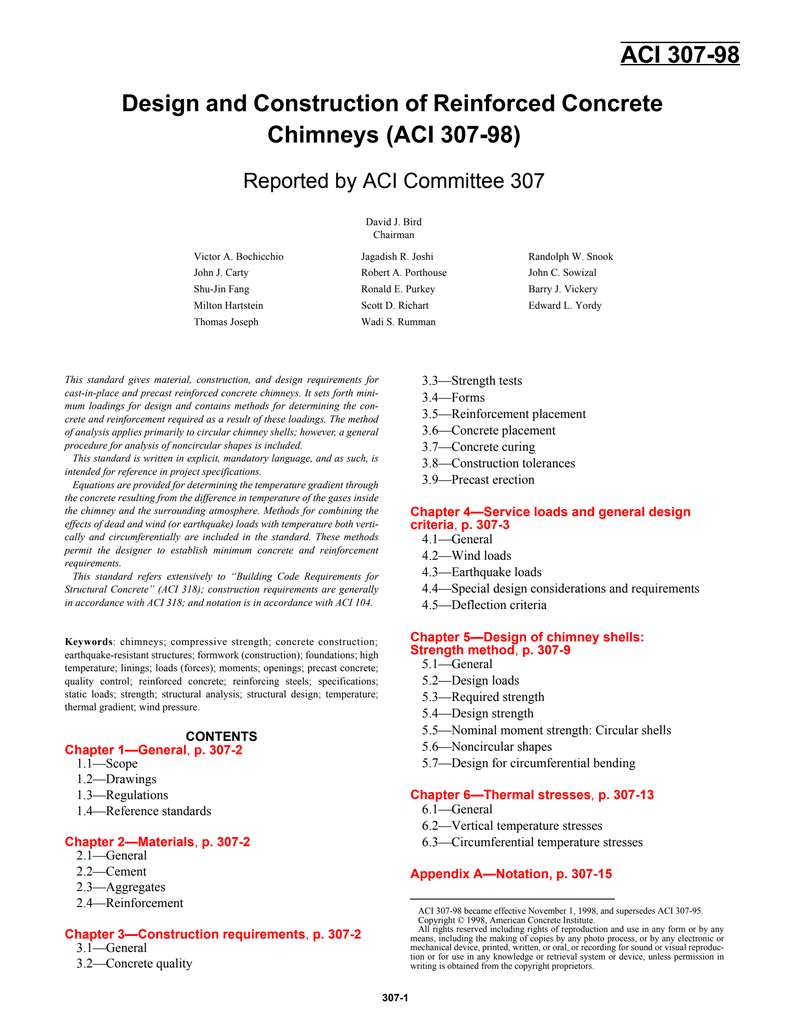

下载标准文件
ACI 307-98
英语 · PDF · 6 页 · 392.4 KB